Contract signed with EUSPA to develop the next version of EGNOS
Thales Alenia Space, the joint venture between Thales (67%) and Leonardo (33%), has signed a new contract with the EU Agency for the Space Programme (EUSPA) to develop, qualify and deploy the new European Geostationary Navigation Overlay Service (EGNOS) version.
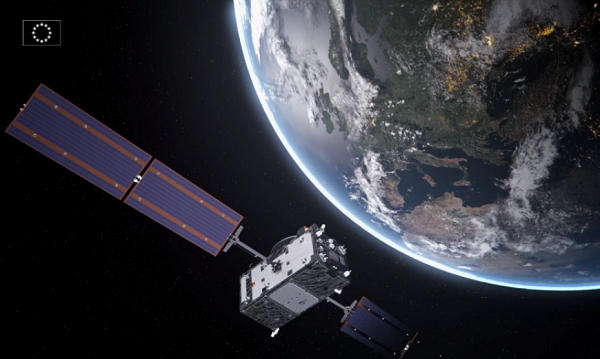
Thales Alenia Space has also just reached a new milestone in the Galileo program with the integration of a new satellite into Galileo’s Ground Mission Segment (GMS) which will improve positioning service for 3.3 billion users.
EGNOS Upgrade
Thales Alenia Space will provide EUSPA and the EU navigation community with a new version of EGNOS (V243). Its operations will be secured by a new state-of-the art Navigation Land Earth Station technology developed by Thales Alenia Space – NLES-G3.
The NLES transmits the EGNOS message containing all accuracy and integrity corrections to the geostationary satellites for broadcast to users such as aviation operators. Thales Alenia Space NLES-G3 will be integrated with a new geostationary satellite, GEO3, which will enhance the EGNOS system and its end-to-end performance.
Certification and commissioning of this latest version is slated for 2024.
Galileo Milestone
Thales Alenia Space also is the prime contractor for Galileo First Generation’s Ground Mission Segment. Galileo has achieved a milestone with the Galileo constellation approaching final steps before its completion with the GSAT0223 satellite. GSAT0223 will increase the operational constellation to 23 satellites for positioning and 25 for search and rescue.
The new satellite has successfully been positioned in orbit and its payload signals inserted in the Ground Mission Segment (GMS) operational chain of Galileo. The GMS is generating the world’s most accurate satellite ephemerids, enabling decimetric ranging accuracy.
With the entry in service of this satellite, the GMS now serves more than 3,3 billion Galileo users who will benefit from an enhanced positioning and timing service.