Telecom, technology and aviation industry leaders join forces to create the HAPS Alliance to connect more people, places and things by using the stratosphere
A group of global industry leaders is forming the HAPS Alliance, an association of world-leading telecommunications, technology, aviation and aerospace companies united in promoting the use of high-altitude vehicles in the Earth’s stratosphere to eliminate the digital divide and bring connectivity to more people, places and things worldwide.
Members who have committed to join the HAPS Alliance include
SoftBank Corp.’s HAPSMobile Inc.
Alphabet’s Loon LLC
AeroVironment Inc.
Airbus Defence and Space
Bharti Airtel Limited
China Telecom Corporation Limited
Deutsche Telekom AG
Intelsat US LLC
Nokia Corporation
SoftBank Corp.
Telefónica S.A.
Telefonaktiebolaget LM Ericsson
The HAPS Alliance is being created so member companies can
collectively advocate for High Altitude Platform Station (HAPS) business development with the relevant authorities in various countries
build a cooperative HAPS ecosystem
develop common product specifications and promote the standardization of HAPS network interoperability
All of these activities will be key to the Alliance’s aim of addressing diverse social issues and creating new value by providing telecommunications network connectivity worldwide through the utilization of high altitude vehicles.
Polar stratospheric clouds. (Photo: Paul Newman, GSFC/NASA)
The Alliance, originally an initiative from HAPSMobile and Loon, will have members from participating leading companies across the aerospace, technology and telecom industries to carry out the Alliance’s activities.
The launch of the HAPS Alliance follows an April 2019 announcement between HAPSMobile and Loon where the companies formed a strategic alliance to advance the use of high-altitude vehicles.
High-altitude network connectivity platforms operate in the stratosphere — above ground infrastructure but below satellites — allowing for near ubiquitous coverage that avoids ground clutter and significant latency issues.
These advantages make such vehicles a promising solution for expanding mobile coverage to areas where connectivity is lacking — mountainous terrain, remote islands, marine regions and developing countries — as well as for IoT and 5G use-cases. The HAPS Alliance seeks to create an ecosystem to support next-generation global connectivity needed to revolutionize the world’s mobile networks.
Some ups and downs for unmanned aircraft this month — good news that there is further progress on the pseudo-satellite front, but we also have MIL-SPEC drones lost to shoot-downs and recent crash landings. Amazon continues to advance toward deliveries really soon after orders, and another police department takes up drone use for aerial observation.
High-Altitude Pseudo-Satellite UAS
HAPSMobile (Softbank 95% and AeroVironment 5% JV) is funding further development and testing of the Hawk30 family of high-altitude pseudo-satellite (HAPS) solar-powered unmanned aircraft, with the expectation of long-duration flights above 65,000 feet — “a super cell-tower up in the stratosphere…providing connectivity for everybody that needs it,” according to AeroVironment President and CEO Wahid Nawabi.
HAPSMobile is collaborating with the Pan-Pacific UAS Test Range Complex (PPUTRC), which is managed by the University of Alaska (UA) Fairbanks, and with the University of Hawaii (UH) to conduct stratospheric test flights using the HAWK30 prototype HAPS vehicle. On behalf of this group, UA was recently granted a Certificate of Authorization by the U.S. Federal Aviation Administration (FAA) to fly HAWK30 as a stratospheric telecommunications platform system over the Hawaiian island of Lanai.
The HAPSMobile team will prep test flights at Lanai during 2019, conducting safety verifications and working with island authorities to comply with local regulations. During the program, HAPSMobile will also explore contributions to environmental conservation and to agriculture. Hawaii — not a bad place to run test flights, you might say…
Predator UAV downed
Following the shooting down of a U.S. Global Hawk (really expensive) and one or two Iranian drones (not very expensive) in the Gulf of Hormuz, U.S. forces on Aug. 13 just crash-landed an MQ-1C Grey Eagle (Predator UAV family) southwest of Baghdad on farmland in the town of Radwaniyah. The following pictures were released by a local news group:
The aircraft doesn’t appear to be too badly damaged, and seems to have been deliberately brought to rest in soft undergrowth on the edge of a field. So crash-landing might be an overstatement — rather an unplanned landing, perhaps? Then again, the landing gear appears to be significantly bent out of shape, so the U.S. Army 52178 drone’s contact with the ground might have been heavier than normal.
The news source indicated that the drone might have been brought down by “electronic interference or have been intercepted by a cyber-attack.” perhaps references to potential jamming of some kind? Nevertheless, the aircraft landed safely and was then recovered by Iraqi Security Forces. There were no injuries or damage to property.
The U.S. Army MQ-1C Gray Eagle provides both combat and intelligence forces with a long-endurance, armed, unmanned aircraft system (UAS) with significant range, altitude and payload flexibility.
And another report hit the internet today that back in June, a £6 million U.K. Watchkeeper WK050 drone on a training flight met a somewhat messy end after overshooting its landing and coming to rest in a tree. But the report also mentions that there was some indication of possible operator error.
Amazon Drone Deliveries?
Fresh on the heels of Fed Ex deciding to dump Amazon as a customer because they would appear to be developing a competing delivery infrastructure, Amazon is proposing a semi-autonomous drone that could automate short-distance deliveries.
In a recent letter to the FAA, Amazon is proposing trials in “sparsely populated” regions of the U.S. using its latest 88lb MK-27 Prime Air delivery drone. The UAV apparently has well-developed sense-and-avoid for the flight phase and uses optical capability for the delivery phase.
If obstacles were to be detected in flight (other UAVs, low-flying manned aircraft, helicopters or birds) the MK-27 would avoid and fly round each obstacle. If an obstacle were detected during delivery (maybe the customer waving frantically to stay out of the cabbage patch) the delivery may be aborted and the drone would return to base. But would it automatically dispense one of those “We-called-while-you-were-out” postcards, fluttering down into the backyard so you could go pick up your package later?
Seriously, though… The initial trials would be managed by an operator who can command a return to base if the drone gets into any trouble, but Amazon claims that the fail-safe autonomy built into the MK-27 will make this unlikely. The hardware and software have gone through extensive simulated testing, and the drone has already completed more than 10,000 simulated delivery flights into representative backyards.
Amazon’s objective seems to be to eventually deliver packages within 30 minutes after the customer places an order — to Prime customers within ~8.5 miles from an Amazon fulfillment center.
Growing Police Use of Drones
The Oneida County, New York, Sheriff’s Office just announced that it is are now drone-trained and drone-equipped — with five certificated operators and a fleet of eight DJI Mavic drones for indoor and outdoor use.
The DJI drones will not be modified and will be used as is. The Mavic 2 drones will provide all manner of aerial surveillance including flood and disaster monitoring. In addition, active shooter investigations and the like could involve initial indoor surveillance using Mavic Air drone(s) to provide armed police with situational awareness before any take-down efforts. Accident investigations, location of missing persons, house fires, and rescue efforts are other applications for the drones.
The Sherriff’s department has been preparing for drone use for two years — five officers have already completed FAA-certified drone training, and others are expected to undertake training over time.
Summary
We have potential stratospheric “cell towers” being tested over Hawaii, landing accidents, preparations for potential rapid deliveries by Amazon drones, and another police department launching a drone unit. These are some of the expanding uses for drones, and the unfortunate reality that drones can sometimes get into operational difficulties.
If a passenger-carrying drone could cost about the same as a regular passenger car, like those used by taxi and Uber drivers, then the economics might work. So it’s interesting that an outfit in the United Kingdom — Autonomous Flight — is talking about building passenger-carrying drones for around $25,000.
Autonomous Flight says has a prototype up and running, testing the concept in Southern England; testing with passengers is expected to get underway this year. The YS6 is battery-powered with multiple redundant systems for safety and is designed to fly at 70 mph, with a range of 80 miles at 1,500 ft.
This happens to meet a design goal of covering a distance from Heathrow Airport to Charing Cross train station in 12 minutes, a journey that would normally take around an hour by car in London traffic. There are similar “hops” that could save a massive amount of time in almost every city in the world.
But don’t hold your breath. It could take more than five years to get regulatory approval for the vehicle and for the initial routes over cities — never mind the time needed to get this particular concept into large-scale production to achieve the target price. But it’s nevertheless a good sign with good prospects for the future.
Drone Recovery System
While the U.S. Federal Aviation Administration (FAA) considers the regulations for drone flights over people, in the meantime several applications have been developed for people-overflight with drones equipped with parachutes.
Presumably, a drone would be safer if lowered by parachute in the event of equipment failure, but apparently such applications that rely on parachutes for risk mitigation have all been turned down by FAA. University of Alabama and Virginia Tech research has indicated a 70 percent chance of significant injury or death when a drone the size of an 8.85-pound DJI Inspire 2 fails and falls onto people.
Indemnis in Anchorage, Alaska, has been working with the FAA and other interested stakeholders to draft the regulatory standard for flight over people and has now gone on to develop its Nexus ballistic drone recovery system, which it plans to have on the market by next summer.
With a retail price of between $1,700 and $2,500, the system is expected to satisfy these coming FAA regulations for UAS flight over people and in urban areas for Part 107 commercial operations, but would seem to be quite expensive for smaller recreational drones.
The system is scalable for drones from eight pounds to “several thousand” pounds. The Nexus system is designed to automatically deploy within 30 milliseconds of detecting a failure on the drone or of entering unrecoverable flight, and the system is capable of determining normal flight or a failure to within six feet of vertical movement.
According to Indemnis, more than 10,000 requests for flight over people have been received by the FAA in the last 14 months, but all those that rely on parachutes for risk mitigation have been refused. This is apparently because conventional parachute systems have a tendency to become tangled with the aircraft or manual deployment is required. It is also said that current quadcopter drone safety systems — which cut power to an engine to prevent tumbling and which slow descent by adding power to the remaining engines — are inadequate for flying over people.
The Nexus system automatically detects failure, cuts engine power, and deploys an aircraft parachute within 30 milliseconds, slowing vertical speed to around 7 mph. This should be slow enough to allow the operator to catch up with the vehicle before it hits the ground. However, reducing vertical speed is only half the solution, as a vehicle under parachute will still travel horizontally due to wind velocity. So Indemnis is testing their parachute system with an airbag on a 33.29-pound DJI M600 drone. The airbag turns the drone “into a giant pillow” once the chute deploys.
The expected FAA standard is anticipated to require 45 tests in two failure modes — critical motor failure and full motor failure — at full flight speed, hover, and in automatic and manual deployment scenarios. Tests with a DJI Inspire 2 cutting one motor, two motors or four motors have pitched the drone violently just before it enters a slow roll — at 60 mph, it will roll quickly and violently.
This drone safety and recovery system is expected to be on the market within the next few years, following release of the projected FAA standards.
GoPro Karma hits the dust
In what would seem to be an unusual turn of events in a rapidly expanding market, GoPro has decided to exit the UAS vehicle business. GoPro cameras are still a favorite on a wide range of UAVs, but the company has chosen to get out of the business of making end-item unmanned vehicles, despite reaching second place in market share in 2017 for its price range.
At the Consumer Electronics Show (CES) Jan. 9-12 in Las Vegas, GoPro explained that its decision was based on inadequate returns versus the investment required to support their single-product UAS business.
However, Karma’s demise was apparently brought on not only by an expensive initial product recall, but also by the apparent additional financial pressure of poor Hero5 camera sales.
Nevertheless, GoPro still feels that the “action-camera” market has the legs to sustain growth, so it’s likely UAV manufacturers will not have to go looking for another reliable video camera source any time soon.
Joint venture for solar HALE UAS
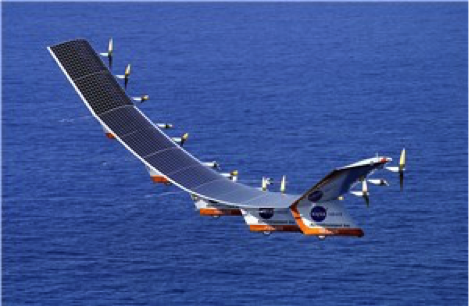
The solar-powered Helios in flight.
In late 1990s/early 2000s, NASA contracted with AeroVironment to develop a high-altitude solar-powered UAS for NASA’s Environmental Research Aircraft and Sensor Technology, or ERAST, program.
In August 2001, the Helios prototype reached a world-record altitude of 96,863 ft., and in 2002 the Pathfinder Plus prototype provided from 65,000 feet high-definition television (HDTV) signals; third-generation (3G) mobile voice, video and data; and high-speed internet.
AeroVironment has now formed a joint venture with Japanese SoftBank Corporation to develop a solar-powered high-altitude long-endurance (HALE) UAS for commercial operations that may include applications such as high-altitude pseudo-satellites.
The joint venture — known as HAPSMobile — is a Japanese corporation in which AeroVironment holds minority ownership but is still able to directly exploit commercial and military opportunities outside Japan.
Summary
It’s encouraging to see another airborne taxi initiative joining the folks who were demonstrating prototypes in Dubai back last September. If the market is there, more entrants should help make this option a reality.
It’s also good news that a company already has a drone recovery system in the works that could reduce the potential for injury in the event one falls out of the sky. This might start to reverse adverse public opinion about drones and help the FAA move forward with regulations allowing wider usage.
Meanwhile, it’s sad but true that new industries inevitably see some entrants pull back and even leave in the early stages. It’s fortunate that popular drone camera supplier GoPro still has the ability to retrench and fall back on its existing business.
Finally, the promise of high-altitude solar-powered drones would seem to be still alive. If it could be possible to hang TV and other comms systems on these high-altitude loitering vehicles, there might be a much less expensive way of getting transmitters into very high altitude orbits without the cost of a space launch. Then many areas around the world could benefit from low-cost signal distribution that might not otherwise work commercially.
AeroVironment Inc., a maker of unmanned aircraft systems (UAS) for defense and commercial applications, has formed a joint venture to develop solar-powered high-altitude long-endurance (HALE) UAS for commercial operations.
This category of unmanned aerial systems (UAS) is also referred to as high-altitude pseudo-satellites, or HAPS.
The joint venture will fund the development program up to a net maximum value of $65,011,481.
The joint venture, HAPSMobile Inc., is a Japanese corporation that is 95 percent funded and owned by Japan-based telecommunications operator SoftBank Corp. and 5 percent funded and owned by AeroVironment.
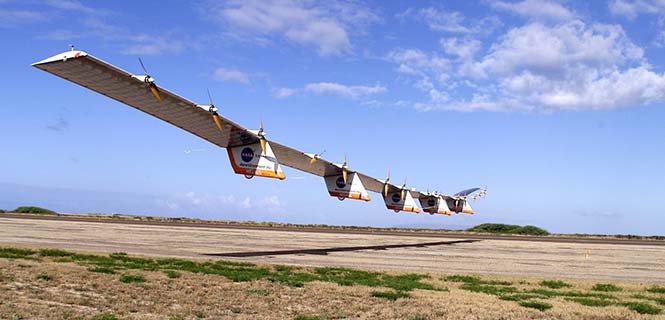
The solar-powered Helios in flight.(Photo: NASA)
AeroVironment is committed to contribute $5 million in capital for its 5 percent ownership of the joint venture, and has an option to increase its ownership stake in HAPSMobile up to 19 percent at the same cost basis as its initial 5 percent purchase.
“This is a historic moment for AeroVironment. For many years, we have fully understood the incredible value high-altitude, long-endurance unmanned aircraft platforms could deliver to countless organizations and millions of people around the world through remote sensing and last mile, next generation IoT connectivity,” said Wahid Nawabi, AeroVironment chief executive officer.“We were searching for the right strategic partner to pursue this very large global opportunity with us.Now we believe we are extremely well-positioned to build on the decades of successful development we have performed to translate our solar UAS innovations into long-term value through HAPSMobile Inc. Our entire team is excited, and we look forward to transforming this strategic growth opportunity into reality.”
AeroVironment pioneered the concept of high-altitude solar-powered UAS in the 1980s, and developed and demonstrated multiple systems for NASA’s Environmental Research Aircraft and Sensor Technology, or ERAST program, in the late 1990s and early 2000s.
In August 2001, the AeroVironment Helios prototype reached an altitude of 96,863 feet, setting the world-record for sustained horizontal flight by a winged aircraft.
In 2002, the AeroVironment Pathfinder Plus prototype performed the world’s first UAS telecommunications demonstrations at 65,000 feet by providing high-definition television (HDTV) signals, third-generation (3G) mobile voice, video and data and high-speed internet connectivity.
Multiple U.S. government agencies funded the development of the hybrid-electric Global Observer unmanned aircraft system from 2007 through 2011. Global Observer represents a solution for extended operation over high northern and southern latitudes during local winters, when the sun’s energy is insufficient to maintain continuous solar aircraft operation at high altitude.
SoftBank Corp. and AeroVironment, Inc. have agreed to license certain background intellectual properties to HAPSMobile, which will own the newly developed UAS intellectual property and possess exclusive rights for commercial applications globally, and non-commercial applications in Japan.AeroVironment will possess exclusive rights to the resulting intellectual property for certain non-commercial applications, except in Japan.AeroVironment will also possess exclusive rights to design and manufacture all such aircraft in the future for HAPSMobile, subject to the terms of the Joint Venture Agreement.
For additional information, please see AeroVironment’s Form 8-K, filed with the Securities and Exchange Commission on Jan. 3.