Tag: hazards

  • Wingcopter drones conduct aerial surveys in Japan

    Wingcopter drones conduct aerial surveys in Japan

    Wingcopter’s authorized partner in Japan, ITOCHU Corporation, has signed a Memorandum of Understanding (MOU) to collaborate on the practical use of Wingcopter’s long-range drones in aerial surveying together with PASCO Corporation and YellowScan Japan.

    The companies initially plan to use the Wingcopter 198 in disaster management where drone-based surveying is playing an increasingly important role,

    • to create hazard maps and monitor ground deformation as part of effective pre-disaster prevention,
    • to gather information and assess damage in the event of a disaster, and
    • to measure terrain changes and develop recovery plans during post-disaster restoration.

    According to Wingcopter, carrying out these tasks is easier and less risky with fixed-wing drones such as the Wingcopter 198 than with traditional human or aircraft-based methods.

    About 70 percent of Japan’s land consists of mountainous and hilly terrain, with steep slopes and short, fast-flowing rivers. Conventional multicopter droneswould not be suitable for such tasks as they are limited in range and coverage compared to the Wingcopter 198.

    Image: Wingcopter
    Image: Wingcopter

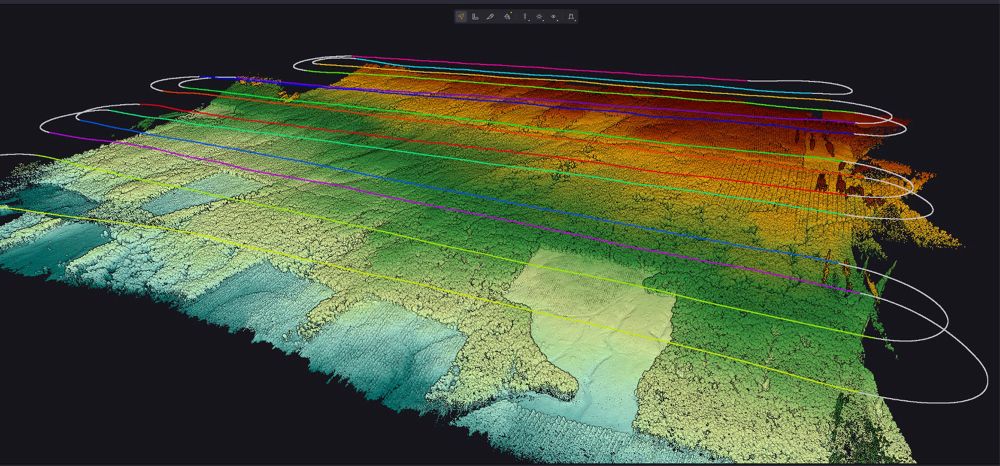
    Under the MOU, YellowScan Japan’s advanced lidaer scanner Voyager will be used on the Wingcopter 198. By integrating this technology with PASCO’s extensive expertise in operational quality and safety in aerial surveying, it is possible to carry out long-distance and large-area surveys that were previously difficult to achieve without manned aircraft. 

    In a single 45-minute flight, the Wingcopter 198 can scan 1,000+ hectares, simultaneously capturing lidar and RGB data, allowing the system to generate an exceptionally high point density and precision. This makes it suitable even for demanding applications.

    The collaboration also promotes automation and labor savings in surveying tasks, contributing to sustainable development in the surveying industry and reducing disaster risks.

  • OGC hosts disaster preparedness workshop

    The Open Geospatial Consortium (OGC) is hosting the second Disasters Concept Development Study Workshop July 24-25 at the NOAA Auditorium in Silver Spring, Maryland.

    Organized by OGC, the workshop is sponsored by the Department of Homeland Security, the Federal Geographic Data Committee, the U.S. Geological Survey (USGS) and other government agencies.

    The workshop is part of the OGC’s Disaster Concept Development Study, and will shape future activities to be led by OGC regarding disaster preparedness and response, and to inform development of potential disaster spatial data infrastructures (SDI).

    According to NOAA, in 2017 in the United States there were 16 major natural disasters with costs that exceeded 306 billion dollars, shattering previous annual records.

    The workshop asks whether more lives can be saved and damages reduced by providing better discovery and access to data that will improve mitigation, preparedness, response and recovery from disasters.

    The ability to effectively share, use and reuse geospatial information and applications across and between governments and non-government organizations in support of disaster response and resilience depends on having a spatial data infrastructure in place when disaster strikes.

    The OGC is bringing together key stakeholders in the natural hazards disaster communities to advance the emerging Disaster SDI by conducting a study and developing a set of pilots over the coming years. OGC’s Disasters Interoperability Concept Development Study (CDS) will assess the current state of data and product exchange technologies as used in disaster planning, response, and recovery. The information gained in the CDS will aid in developing a series of future pilots that will in turn advance the state of SDIs that support disaster risk reduction across the globe.

    For more information on the Disasters Concept Development Study, visit the website or email [email protected].

    For more information on the Disasters CDS Workshop, including the agenda and how to register, visit the event page on the OGC website. Registration for the workshop is free but mandatory.

  • CoreLogic Natural Hazard Risk Summary Covers 2014 Disasters

    CoreLogic, a global property information, analytics and data-enabled services provider, has released its annual Natural Hazard Risk Summary and Analysis detailing the most significant natural disasters of 2014 and providing projections for 2015. The report provides a look at the year’s hurricanes, floods, hailstorms, tornados, wildfires, sinkholes, earthquakes, tropical cyclones and typhoon events in the U.S. as well as an international snapshot of the hazard events that imposed significant damage across the globe.

    Among key findings in the U.S., the CoreLogic 2014 Natural Hazard Risk Summary and Analysis notes:

    • Just as 2013 experienced a decline in the damage caused by major hazards in the U.S. when compared with 2012, this year experienced a continuation of similarly low overall damage totals. Not since 2012 when Superstorm Sandy devastated parts of the northeast coast has the U.S. experienced a single natural hazard event that has totaled in the tens of billions of dollars in damage.
    • The 2014 hurricane season marked the second consecutive year of low tropical storm and hurricane activity in the Atlantic Ocean. With only eight named North Atlantic storms, six formed into hurricanes and just two of the six developed into a major hurricane (defined as developing into a Category 3 or larger).
    • Reasons for the below-normal hurricane impact in 2013 and 2014 can be attributed to the continuing high levels of wind shear in the Atlantic that impede the development of tropical cyclones, along with more stable atmospheric conditions in the Atlantic which subdue the formation of clouds and thunderstorms necessary for the development of tropical cyclones.
    • The amount of flood-related losses that occurred in the first half of the year was dominated by flash flood events that caused a disproportionally large share of property loss in the flood category. Flash flooding was not limited to one region of the U.S, and many happened in large metropolitan areas such as Detroit, Long Island, N.Y., and Phoenix.
    • The amount of damage attributed to flooding in 2014 is approximately $4.2 billion in losses for the year, which is below the long-term historical average of $5.3 billion annually.
    • It is possible that the U.S. may still have two to three years of near-average flood-related damage before the next catastrophic loss occurs, based on projections from historic data. Analysis indicates that 2015 flood losses could total between $5-6 billion, with flash flooding events continuing to account for a large percentage of overall annual damage.
    • This year is on track to have the fewest number of tornadoes recorded in the past decade with just 720 tornados verified through August and an additional 128 storm reports filed through November.
    • Overall hail fall across the U.S. this year covered the greatest geographical area of any year since at least 2006. According to CoreLogic hail verification technology, 934,948 square miles, or 18.6 percent of the continental United States, were impacted by hail of 0.75 inches or greater
    • Looking ahead to 2015, if the number or geographical extent of storms producing larger, damaging hail returns to near or above recent norms, we will likely see a more severe hail season in 2015 and possibly higher insurance claims volume in comparison to 2013 and 2014.
    • This year has had the lowest amount of acreage lost to wildfire in the past 10 years. The number of fires in 2014 is slightly above the 2013 year-to-date total, but the amount of acreage lost to wildfire this year is only 85 percent of last year’s total.
    • Early drought forecasts for 2015 indicate the likelihood of a continuation of drought conditions in the west. The accumulation of higher levels of dry fuel mean that the elevated risk for wildfires seen over the past few years will continue.
    • Across the globe, the year 2014 is trending towards becoming the warmest year on record, with temperatures through the first 10 months of 2014 recorded as the warmest yet.

    For a copy of the 2014 CoreLogic Natural Hazard Risk Summary and Analysis, which includes maps, charts and images, visit this link.


  • CoreLogic Identifies U.S. States at Risk of Property Loss from Natural Hazards

    Corelogic-hazard-9-9-2014

    CoreLogic, a global property information, analytics and data-enabled services provider, has released an analysis ranking Florida as the U.S. state with the highest level of comprehensive risk exposure to multiple natural hazards, with Michigan identified as the state with the lowest risk.

    The analysis was derived from the new CoreLogic Hazard Risk Score (HRS), an analytics tool launched today that gathers data on multiple natural hazard risks and combines them into a single easy-to-use score ranging from 0 to 100. The overall score indicates risk exposure at the individual property and location level.

    For every geocoded location across the U.S, the CoreLogic HRS is compiled using data representing nine natural hazards: flood, wildfire, tornado, storm surge, earthquake, straight-line wind, hurricane wind, hail and sinkhole. Locations with higher risk levels are exposed to multiple hazard risks and will, therefore, receive higher scores when the risk analysis is aggregated. Subsequently, locations with minimal risk levels have lower exposure and receive lower scores. Geocoded locations are generated at the property-address level using latitude and longitude coordinates and include both residential and commercial properties.

    “Florida’s high level of risk is driven by the potential for hurricane winds and storm surge damage along its extensive Atlantic and Gulf coastline, as well as the added potential for sinkholes, flooding and wildfires. Michigan alternatively ranks low for most natural hazard risks, other than flooding,” said Dr. Howard Botts, vice president and chief scientist for CoreLogic Spatial Solutions.

    The proprietary CoreLogic HRS is able to calculate risk based on a 10 x 10 meter grid, the lowest level of granularity available for the underlying hazard data. In calculating the overall score, both the probability of an event and the frequency of past events are significant contributing factors used to determine risk levels associated with individual hazards, as well as each distinct hazard’s risk contribution to total loss. The data is combined into an aggregated, consistent and normalized value that allows statistically valid combinations to be derived.

    “In the past, natural hazards have been difficult to compare and combine in a meaningful way,” said Dr. Botts. “Hazard Risk Score is a single solution that measures risk concentration consistently and pinpoints the riskiest places in the U.S. with timely and granular accuracy. This insight is critical in conducting comparative risk management nationwide and fully understanding exposure to potential natural hazard damage.”

    Insurers, risk managers and mortgage servicers can use CoreLogic Hazard Risk Score to improve decision-making and enhance a variety of business operations, including:

    • Business continuity and disaster recovery planning
    • Analyzing risk associated with a residential property or portfolios of properties
    • Measuring mitigation savings vs. total hazard potential damage
    • Evaluating and determining natural hazard risk levels of distribution and supplier networks
    • Recognizing which underinsured or uninsured properties may become at risk of default
    • Adverse selection avoidance and identification of “good risk” properties

    U.S. Natural Hazard Risk by State* (Ranked by CoreLogic Hazard Risk Score)

    Rank State HRS

    1FL94.51

    2RI79.67

    3LA79.23

    4CA75.56

    5MA72.12

    6KS69.51

    7CT69.04

    8OK66.82

    9SC66.38

    10DE65.38

    11OR64.89

    12NJ61.54

    13IA61.02

    14TX60.89

    15NC59.72

    16MO57.81

    17DC57.33

    18MS57.05

    19AR56.7

    20NH55.3

    21ID52.75

    22MD52.28

    23CO51.88

    24NE51.86

    25IL51.8

    26IN50.74

    27GA50.58

    28NV50.12

    29AL49.42

    30KY47.34

    31TN46.48

    32UT45.22

    33NM43.76

    34AZ42.81

    35VA42.35

    36WA42.3

    37WI38.52

    38SD38.24

    39MT37.91

    40MN36.42

    41OH34.61

    42ME31.64

    43WY30.24

    44PA28.79

    45VT28.31

    46ND27.5

    47NY24.97

    48WV20.67

    49MI20.22

    Source: CoreLogic 2014.

    * AK and HI were excluded in the ranking due to limited natural hazard risk data.