Tag: helicopters

  • Contrasting the use of drones on Mars and in Afghanistan

    Contrasting the use of drones on Mars and in Afghanistan

    NASA and the European Space Agency (ESA) have been cooking up a way to get some of Mars back to Earth, so that samples can be analyzed in detail — just like the rocks the astronauts brought back during the Apollo missions, which gave us a deeper understanding of our Moon.

    The Perseverance rover already on Mars has been seeking promising areas to investigate that might provide evidence of ancient past life, with the help of the Ingenuity helicopter drone. Recently, the two worked together to drive the rover to an old river delta, expected to be a prime location where such samples could be found.

    The rover has been drilling and saving rock and dirt samples in onboard storage tubes. The difficulty is that getting them back to Earth requires another major undertaking.

    Returning the Samples

    Termed the “Sample Return Mission,” the two space agencies have been discussing for months how best to bring the samples back, and have now refined an approach. Given that Perseverance has been so good at the job it was given, the NASA/ESA team has decided that the rover should be used for the return mission in 2030 when things would be in operation on Mars. (We’re not sure if the warranty sticker on Perseverance will still be valid in 2030, but if past performance is an indication, all the rovers have significantly outlived their initial design lives.)

    Its partner Ingenuity has graduated from proving it can fly in the thin Martian air to actually scouting routes for the large rover. Because Ingenuity has proven reliable and capable of traveling significant distances, NASA and ESA have decided that two new helicopter drones will become part of the return mission. They will be based on the successful Ingenuity design, but will be fitted with wheels, one on each of the four landing legs, to enable movement on the ground.

    They will also be fitted with a device which is capable of picking up and carrying a sample tube. Since the prototype drone helicopter was designed to be as light as possible, this infers  a substantial increase in lift capacity will be required. The original mission included a sample-collection rover, but this task will now be assigned to Perseverance, with the two sample-carrying helicopters acting as backup, if needed.

    An earlier concept had the rover dropping sample canisters behind it as it progressed around the surface for subsequent pick up. This concept appears to have been shelved for the moment. Keeping the canisters onboard the rover throughout perhaps simplifies transfer to the return lander.

    NASA Return Sample concept illustration includes wheeled helicopters. (Image: NASA)
    This NASA return sample concept illustration includes wheeled helicopters. (Image: NASA/JPL-Caltech)

    The Mars Ascent Vehicle would then carry the samples into orbit, to a waiting Earth Return Obiter, where the samples would be transferred to a return system for onward transit and atmospheric re-entry to Earth. Some of these details are a little sketchy, but there sure are a lot of moving (autonomous, robotic?) parts. This, of course, means a lot of opportunities for something to go wrong. No doubt continuing refinement of the mission will reduce the risks. The Jet Propulsion Lab (JPL) and AeroVironment designed and built Ingenuity — they may face some challenges developing the successor helicopter drones.

    Meanwhile, Here on Earth…

    Drones led the news Aug. 1, when President Biden announced the killing of Ayman al-Zawahiri in Kabul, Afghanistan. Al-Zawahiri topped the U.S. 9/11 wanted list, and his removal was all about the offensive use of drones. Presumably fired from a General Atomics Reaper variant drone at quite some altitude, two Hellfire AGM-114R9X “knife bomb”missiles took out al-Zawahiri as he stood alone on the balcony of a home in Kabul.

    This means that video/infrared from high altitude was sufficiently clear to determine that the man was alone on the balcony, presumably confirming information on the ground that his family was elsewhere. So long-distance, high-level authorization was then granted to fire on him in a foreign country now run by the Taliban.

    Suspected damaged al-Zawahiri house in Kabul (Photo: Secunder Kermani/BBC News)
    Suspected damage at the al-Zawahiri house in Kabul. (Photo: Secunder Kermani/BBC News)

    To minimize inadvertent casualties, the Hellfire R9X missile was used, which lacks explosive armaments. The weapon is a nasty piece of work, weighing ~100 lb with an inert payload, and fitted with six long knives that deploy before impact. This missile has previously been used in perhaps 11 other instances to take out terrorist individuals and minimize collateral damage.
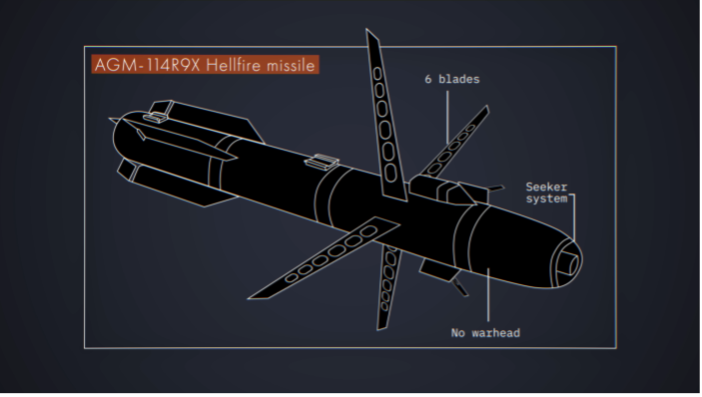
    Bladed R9X missle lacks warhead (Image: Newsy/Bellingcat)
    Bladed R9X missile lacks a warhead (Image: Newsy/Bellingcat)

    This is another instance of how the U.S. use of military drones has become less devastating, but is still very deadly to the specific target.

    To Sum Up

    We’ve taken a quick glimpse at how NASA and ESA are planning more drones for the surface of Mars, and a much more aggressive use of drones here on Earth.

  • Garmin unveils aviation portable navigator, the aera 660

    Garmin International Inc. has launched the aera 660, a new cost-effective, feature-rich, purpose-built aviation portable. The compact 5-inch capacitive touchscreen has a bright, sunlight readable display complete with rich, interactive maps and a built-in GPS/GLONASS receiver that can be viewed in portrait or landscape modes for optimum customization.

    The aera 660 encompasses features of the aera and GPSMAP aviation portable series, adding new Connext wireless capabilities, WireAware wire-strike avoidance technology and more. New cost-effective database options along with built-in Wi-Fi database updating capabilities allow customers to more easily access the most up-to-date data, including daily U.S. fuel prices.

    Bluetooth supports the display of ADS-B in traffic and weather from a variety of sources, including the GDL 39/GDL 39 3D, Flight Stream and the GTX 345 ADS-B transponder. Availability of the aera 660 is expected later this month at an anticipated street price of $899.

    “Pilots have been asking for a new, purpose-built, easy to use aviation portable from Garmin and we have answered with the most powerful, robust and capable handheld device of this size ever designed, the aera 660,” said Carl Wolf, Garmin’s vice president of aviation sales and marketing. “For 25 years we have been the market leader in bringing innovative portable navigation devices to the cockpit that improve aviation safety and we have done that yet again with this terrific aera 660 — a premium portable product that conveniently fits on the yoke or in the palm of your hand.”


  • McMurdo Gets FAA, EASA Nods for Commercial Aircraft Locator

    McMurdo Group, maker of end-to-end search and rescue solutions, has received formal certification from the U.S. Federal Aviation Administration (FAA) and European Aviation Safety Agency (EASA) for its Kannad Integra ARINC 429 Navigation Interface.

    Based on the ARINC 429 GPS communications standard for most commercial aircraft, the interface, when used with the Kannad Integra Emergency Locator Transmitter (ELT), provides dual GPS redundancy that can result in aircraft being found much faster compared to standard ELTs in event of an emergency. The solution has already been selected by aircraft manufacturers including Pilatus, Embraer and Airbus Helicopters.

    Traditional ELTs rely on an aircraft’s external antenna and GPS equipment, which is subject to failure in the event of an emergency. The Kannad Integra ELT, however, can operate independently of the aircraft to provide key positioning data through its built-in internal antenna and embedded GPS receiver. The Integra ARINC 429 navigation interface stores the latest known position of the aircraft based on the aircraft navigation system data. This data is then used by the built-in Integra GPS for better location accuracy and a higher chance of rescue.

    In March, McMurdo introduced an Integra Smart Pack bundle, which provides similar redundancy for general aviation aircraft using the standard NMEA interface.

    The Kannad Integra ELT and Integra ARINC 429 Navigation Interface are suitable for commercial aircraft, helicopters, business jets and airlines. Once activated, the Integra ELT transmits a distress signal to alert international rescue services to the emergency location via the global Cospas-Sarsat Search and Rescue satellite system, which has helped to save more than 37,000 lives since 1982.

    “McMurdo’s Kannad products have been chosen by the world’s leading aircraft manufacturers and airlines for their quality, reliability and innovation,” said Christian Belleux, head of McMurdo’s Kannad Aviation Business Unit. “This new ARINC 429 interface is yet another example of how we are helping to shape the present and the future of aviation safety.”

  • Kalashnikov Goes Airborne with UAV Acquisition

    Russian automatic weapons maker Kalashnikov Concern is acquiring UAV company, according to Defense News.

    Kalashnikov produces a well-known assault rifle. The acquisition of the UAV companyZALA Aero is part of the company’s development strategy through 2020, according to a statement released to Defense News.

    “Based off Kalashnikov Concern and ZALA Aero company, we plan to develop and manufacture drones, mobile and earth-based management stations,” said Aleksey Krivoruchko, Kalashnikov Concern CEO.

    “Our main product here will be intelligence-gathering pilotless airplanes, helicopters and aerostats. The decision to purchase control stake of ZALA Aero to widen our product line has been made as a part of the strategy of Kalashnikov corporate development through the year 2020 and as a part of the process of developing new sectors of our market.”

    The UAVs will operate to secure state borders, intelligence gathering and rescue operations, as well as special operations, the report states.

  • Thales to Provide GPS SAASM Receivers for French Navy Lynx Helicopters

    Thales has been awarded a contract by the Service Industriel de l’Aéronautique (SIAé), France’s military aircraft maintenance, repair and overhaul service, to supply stand-alone GPS receivers for the French Navy’s Lynx helicopters, which are currently being upgraded by the French defence procurement agency (DGA).

    Thales’s GNSS 1000-S receiver relies on SAASM (Selective Availability Anti-Spoofing Module) technology to access military GPS encrypted signals. This technology also uses state-of-the-art signal processing offering extended satellite tracking capabilities in terms of precision, integrity, availability and jamming resistance in severe operational conditions.

    This contract consolidates Thales’s European leadership in the field of military GPS receivers, which already equip FREMM multi-mission frigates, cruise missiles, Tiger helicopters, C-135 refuelling aircraft, Atlantique-2 marine patrol aircraft and Mirage 2000D fighters in service with the French armed forces, and the tanker aircraft being delivered for the UK’s FSTA (Future Strategic Tanker Aircraft) programme.

    The GNSS 1000-S is part of Thales’s suite of GNSS products which will be presented at the European Navigation Conference in Gdansk, Poland, April 25-27 on the Galileo Services booth.