Tag: Helix Technologies

  • Helix Technologies wins ESA contract to develop Galileo antenna

    Helix Technologies Ltd. has been awarded a significant contract by the European Space Agency (ESA) to develop its next-generation GNSS antenna — a multi-frequency antenna optimized for the advanced Galileo E1 Alt-BOC and wide-band E5 Alt-BOC waveforms for use in driverless cars.

    The antenna, to be developed under the ESA’s Navigation Innovation and Support Programme (NAVISP), will provide enhanced performance due to its dielectric, multi-filar construction. It will also be optimized to take maximum advantage of the Galileo E5 Alt-BOC waveform, which enables significantly improved measurement accuracy, precision and multipath suppression over conventional GNSS signals.


    Learn more about the Helix Technologies antenna in our February issue article here.


    “In order to achieve the 10-centimeter accuracy that is required for autonomous vehicle lane-level positioning within challenging urban multi-path propagation conditions, there is a need both for a significant improvement in current GNSS antenna performance and to fully exploit the advanced Alt-BOC waveforms transmitted by Galileo,” said John Yates, managing director of Helix Technologies.

    The GNSS antenna, which will also be capable of optimized operation with the GPS L1 and L5 M BOC signals, is aimed at the automotive and consumer markets, and the company is targeting the third quarter of this year for the manufacture of prototypes.

    Independent testing and evaluation of the vehicle-mounted antenna performance will be conducted in the challenging multipath environments of the high-rise financial districts of the cities of London and Shanghai.

  • Multifilar antennas target improved autonomous performance

    By Oliver Leisten
    Technical Director, Helix Technologies Ltd.

    To attain the 10-centimeter accuracy required for autonomous vehicle positioning within urban multipath propagation conditions, there is a need for a significant upgrade in GNSS antenna performance. The autonomous vehicle application demands excellent antenna performance together with exploitation of the full set of GNSS multi-frequency and multi-constellation system advances to deliver this performance paradigm in the most severe of real-world use scenarios.

    Given that an antenna necessarily operates in open fields, it follows that field resonance must be managed to provide predicable performance in diverse use-scenarios. A new antenna developed by Helix Technologies (Figure 1) deploys balanced fields across a cylindrical ceramic dielectric core to constrain the outreach of resonance fields and thereby minimize the interaction with nearby objects. The antenna feed is designed to provide enforcement of balanced operation, which ensures that the antenna resonates predictably and independently of the platform (i.e., the vehicle in the case of autonomous driving). Thus, the operation is not significantly influenced by the mechanical or material properties of the platform or housing. This architecture provides isolation from common-mode signals and protects the GNSS signals from conducted interference.

    Figure 1. Features of the hexafilar-turnstile solution for multi-frequency GNSS.

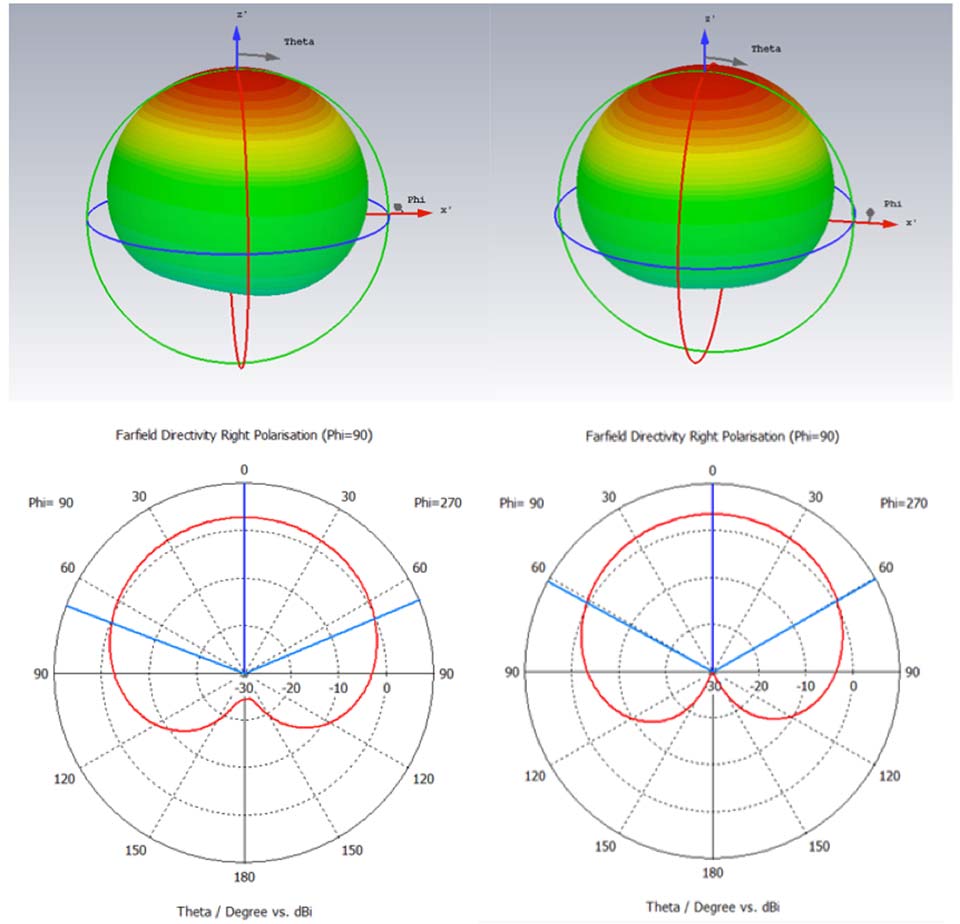
    It is challenging to configure a GNSS antenna operating at many frequencies in which the performance at any one frequency is not impaired by mode interactions. Such impairments can have serious consequences for the position accuracy in an urban environment because they adversely affect the cross-polar discrimination: a parameter which is most important for eliminating multipath positioning errors. The architecture of the hexafilar-turnstile antenna has overcome this problem and delivers the circular polarization pattern characteristics illustrated (simulated data) in Figure 2.

    Figure 2. Simulated RH circular polarized patterns at GPS L1 (left) and GPS L2 (right).

    The figure demonstrates that the antenna is forming cardioid patterns at two frequencies. The 3D graphic is intended to show the omni-directionality and the 2D elevation cuts exhibit the signature cardioid shape which characterize a “spinning-dipole” circular polarization antenna.

    It is often suggested that patterns of wide beam-width such as these would not be particularly suitable for positioning in urban canyons where the sky can only be seen in a relatively small solid angle. In fact, the ratio of front-to-back gain is strongly associated with the cross-polar discrimination that is important for position accuracy in urban environments. Patterns of this quality can deliver as much as 30-dB of signal-to-interference advantage in favor of the direct-path satellite signals against signals whose polarization has reversed due to multipath reflection.

    Helix Technologies is developing antennas which have two-pole frequency responses that provide two frequencies of optimum cross-polar discrimination that are aligned to the two frequencies of maximum spectral density of an M-BOC or Alt-BOC coded signal, as transmitted by the modern GPS and Galileo satellites respectively. These antennas should be available for test and evaluation in Q2 of 2018.

  • Helix Technologies to develop GNSS antennas for driverless cars

    Helix Technologies Ltd., a U.K.-based developer of high-performance, ceramic-based helix antennas, has secured funding that will enable continued development of antennas for a wide range of applications including autonomous vehicles, drones, internet of things and machine-to-machine communications.

    Photo: HelixAntenia
    Photo: HelixAntenia

    The company closed its Phase B funding round with GBP 650,000 of financing provided by private investors.

    The company said that the driverless car segment, both GNSS and vehicle-to-everything (V2X) dedicated short-range communications (DSRC) applications, represents the most immediate and compelling need and business opportunity for its helix antenna technology.

    Helix Technologies said its dielectric-loaded helix antennas will provide significant performance advantages over incumbent antenna technologies for next-generation GNSS and V2X applications.

    The use of a dielectric ceramic core gives its antennas unique properties including unsurpassed gain/efficiency per unit of volume and more effective and predictable behaviour in a wide range of challenging user scenarios.

    “We are grateful for the support of our investors which allows us to develop innovative solutions for this exciting growth market,” said John Yates, managing director of Helix Technologies. “The first self-driving cars are widely forecast to be on the market between 2019 and 2021. Any navigation and communications equipment used onboard will have to fulfil the highest-possible standards on safety, integrity and accuracy.”

    The company expects to have prototypes of its V2X DSRC antenna available by the second quarter of  2018 and its NEXTGEN GNSS antenna by the third quarter of 2018.

    According to the company, the use of the ceramic core enables the fabrication of antennas that are physically smaller than conventional antennas, behave much more effectively and predictably in a wide range of challenging user scenarios and have many compelling technical advantages which include:

    • Maintaining radiation efficiency near absorbing objects (such as the human body)
    • Improving the accuracy of GNSS systems in multipath environments (such as in cities)
    • Operation in sub-optimal orientations towards the sky
    • Are able to be placed into very tightly integrated systems
    • Operation in slim devices without a ground plane
    • Unsurpassed gain/efficiency per unit of volume
    • Simple and robust design and construction for durability and reliability
    • Excellent beamwidth (omni-directionality)
    • Multi-frequency, tailored frequency response