Hemisphere GNSS has released Athena, its next-generation GNSS engine. Offering significantly enhanced performance, Athena provides Hemisphere with a new, future-oriented foundation providing strong performance, flexibility and reliability, according to the company.
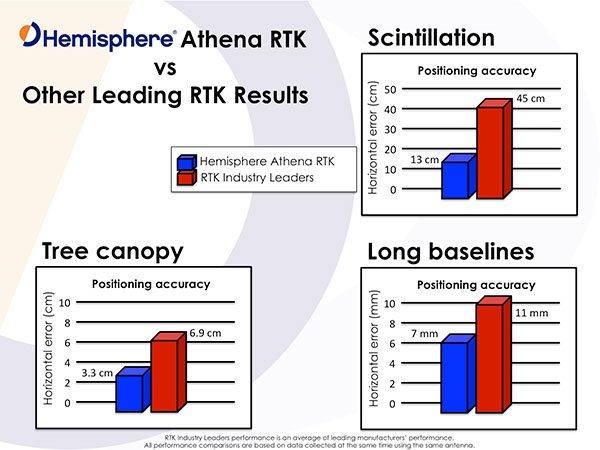
Athena has yielded outstanding performed in virtually every environment where high-accuracy GNSS receivers can be used, the company stated. Hemisphere customers have tested Athena’s performance in long baseline, in open-sky environments, under heavy canopy, and in geographic locations experiencing significant scintillation.
Hemisphere has designed its new core engine to maximize the company’s ability to excel at the rigorous GNSS requirements in multiple market segments, supplying its customers in machine control, survey and GIS, with a design for now and in the future, Hemisphere said in a statement.
The release of Athena is a significant milestone for Hemisphere, which promises another new product entry into the market in the coming months.
Features of Athena include these capabilities:
- Initialization time — A reliably consistent initialization performance, less than 15 seconds at better than 99.9 percent reliability.
- Robustness in difficult operating environments — Extremely high productivity under the most aggressive of geographic and landscape oriented environments for GNSS, while delivering up to 50 percent better performance in user tests matched against competitive systems.
- Performance on long baselines — Position stability for long baseline applications, with position quality often times exceeding the performance of other leading RTK systems on the market.
- Performance under scintillation — Sustained accuracy under ionospheric scintillation activities, providing one of the most reliable means to work with GNSS in scintillation-affected areas.
Rodrigo Leandro, Hemisphere’s director of engineering, GNSS Positioning Systems, gave this description of the design process for Athena.
“Development of Athena started shortly after I came to Hemisphere in August of 2013. The company has been a leader in RTK solutions for many years. During those years, we focused in certain specific market segments such as agriculture, and under new leadership we determined there was a need to address a wider spectrum of market segments, with very high accuracy and feature rich capabilities built on the strong legacy platform we had already established. So, working with Mike Whitehead, the company CTO and our main RTK technologist, we identified the goal of reengineering our RTK engine to match the needs of RTK for the next 10 years, and to provide a foundation for future product development.”
Leandro continued, “As part of this, we made a decision to build an expanded, world-class software development team, pulling great talent from around the industry to create a group of 11 totally focused on what we should do to move GNSS technologies forward — looking at all types of positioning techniques, not just RTK. Athena is just the first result of that work to become publicly available — you will see plenty more coming from the team over time.
“Looking at Athena specifically, we did a complete review, touching every part of the engine — from how we deal with the atmosphere, quality-control of the data, modeling the clock of the receiver, and so on, through to how to do external corrections, whether single-based or network-based. We even looked at and modified the receiver system, improving the multitasking architecture to more actively use the CPU for our computational work,” Leandro said.
“I’m proud to say that the results of all that work match up to what we envisioned. RTK is a pretty mature technology at this point, so improving on what is available in the industry is a tough ask. However, our extensive competitive testing shows that the engine performs really well in terms of initialization, accuracy, and stability across a range of different environments, for instance in long baselines and under tree canopy, and our tests of scintillation are showing great results as well. Overall, we have seen excellent accuracy coming out of this engine compared to legacy as well as others in the marketplace. It’s hard to win every single time in a toe-to-toe comparison, as systems and conditions differ in every test, but our broad testing shows us not only matching, but beating competitive systems pretty consistently.”
“In our user base, both Hemisphere branded products and our OEM boards, we get exposed to a wide variety of applications and environments, from agriculture and marine, through machine control applications and survey systems,” Leandro said. “Our goal from the start was to build a system that performed across that user base, and we are proud to say that we have delivered with Athena.”
“In terms of availability, we want to get the Athena engine on as many current and legacy systems as possible, so our users have the best possible experience. However, we have also been improving the legacy engine as well, delivering gradual steps of improvement to our customers, so whatever version they are using, their experience should be much improved,” Leandro concluded.
Test Reports
Hemisphere GNSS provided the following statements by an independent tester and from customers, widely distributed around the industry.
“I’ve had an opportunity to thoroughly test Athena in both moderate and extreme environments,” said Andy Carbognin, an independent GNSS test specialist at Vecto Geomatics of Ottowa, Canada. “I’m very impressed with the performance, and we’ve tested alongside the current industry leaders’ top-of-the-line products. In every situation, Athena is proving to be a tremendous improvement over Hemisphere’s most widespread legacy firmware versions, at a minimum, matching the industry’s best while in many cases exceeding their performance.”
“Carlson Software has extensively tested Hemisphere’s new Athena RTK engine on the Carlson BRx5 GNSS receiver,” said Butch Herter, director of Hardware Development, Carlson Software. “The Athena RTK engine provides precise, reliable, and repeatable positions. Athena exceeds or matches the performance of all other GNSS receivers it has been tested against. We have been particularly impressed with the performance of the Athena engine, when using a long baseline or in areas where there is a limited view of the sky. Athena is a first class RTK engine.”
“We’ve been working with Hemisphere’s technology for a number of years,” states Randy Noland, vice president of business development and director of Machine Control, Carlson Software. “I’m amazed at the team they’ve brought together and how they’re radically modernizing their technology. Collaborating with the ‘new’ Hemisphere has been an eye-opening experience, and I’m excited at how their innovative technologies will positively impact our future business.”
“In the marine construction and hydrographic survey markets, time is money. We’ve seen very high system reliability and impeccable results using the Athena RTK engine, which ensures we are achieving maximum up-time,” said Harrison Steves, operations manager at Cable Arm. “As well, not being tied to a specific make of RTK base gives us flexibility with our equipment deployment.”
“We’ve found Athena to offer exceptional performance, especially their RTK fix times and maintaining RTK lock on long baselines,” said David Vaughn, CEO, Novariant. “With the latest competitive performance testing completed, Novariant is excited about adding Hemisphere’s Athena offering to the list of the Novariant-recognized certified receivers that, when combined with our precision steering solution, can assure centimeter-level steering control in the toughest environments in the world.”
CEO Statement
“Our goal is to be nothing short of the best GNSS technology partner in the industry, and a key component of that is delivering market-leading technologies tailored to our customer’s needs,” said Chuck Joseph, Hemisphere GNSS CEO and president. “To that end, we have put together a world-class team that is totally rethinking our product family, and our new Athena engine is just the first, powerful proof of our fresh approach. Watch this space!”
Availability
Before the end of this month, Athena will be included in all Hemisphere multi-frequency, RTK-capable products, such as the A325, R330, S320 and VS330. To download and install Athena, visit Hemisphere’s Software page.
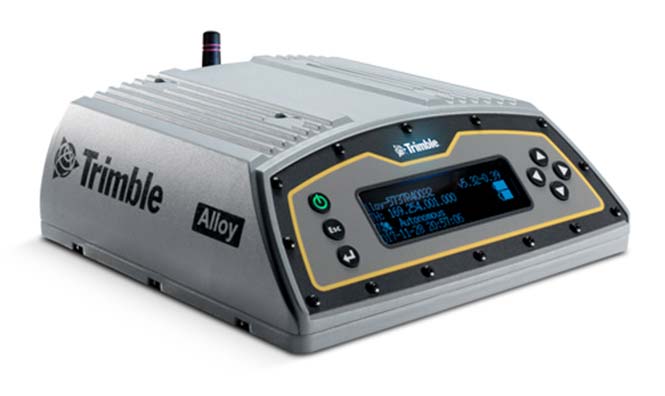 Delivering high-accuracy GNSS data to improve RTN performance and reliability, the Trimble Alloy GNSS receiver allows RTN owners and operators to: