Tag: Horizon 2020

  • Testing suspended on Galileo Batch 3 satellites

    Testing suspended on Galileo Batch 3 satellites

    In response to the ongoing coronavirus pandemic, the test campaign for the first two satellites of Galileo’s Batch 3 has been suspended.

    The suspension is based on the medical advice for social distancing — too high a concentration of people is needed on site if testing were to continue, according to the European Space Agency (ESA).

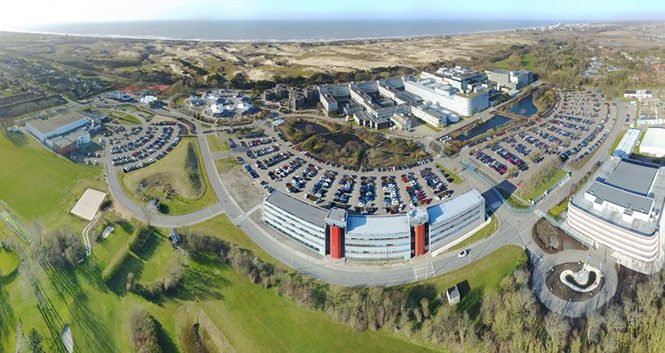
    An aerial view of ESTEC. The Erasmus building is at front right. The T building (home to ESA's Galileo team) is in the foreground. (Photo: ESTEC)
    An aerial view of ESTEC. The Erasmus building is at front right. The T building (home to ESA’s Galileo team) is in the foreground. (Photo: ESTEC)

    The satellites are based at the ESTEC Test Centre in the Netherlands for engineering tests ahead of launch. The stored satellites are being monitored by staff visiting ESTEC every few days, to verify that all is in order.

    Other Galileo-related testing continues with the aim of supporting future launches. ESTEC-based lifetime testing of the next set of rubidium atomic clocks is set to continue, involving on-site monitoring every few days.

    Working from home

    ESA’s Directorate of Navigation has shifted to teleworking while also ensuring the continuity of essential tasks, in particular the continued delivery of positioning, navigation and timing services of both Galileo and EGNOS.

    The ESA team is using video and audio conferences to continue meetings with the industries involved and minimize the impact on the deliveries of EGNOS upgrades, Galileo Batch 3 satellites, and preparatory work for Galileo Second Generation.

    The national, local and industrial decisions on travel, meetings and quarantine are impacting the ability to deliver all ongoing commitments, so measures are being taken to minimize their impact, ESA said in a press release.

    Priority has been given to ensure continued operations of both EGNOS and Galileo, so the ESA Navigation Directorate has been supporting the European GNSS Agency (GSA), the operator of Galileo and EGNOS, on behalf of the European Commission.

    The team also is maintaining constant contact with various stakeholders.

    NAVISP and Horizon 2020

    Research and development projects under the Directorate’s Navigation Innovation and Support Programme (NAVISP) are continuing at a somewhat slower pace, given the crisis. So are satellite navigation projects financed by the EU’s Horizon 2020 programme, which develop future technology for the EU satellite navigation projects.

    “Confronted with this unprecedented situation, our efforts are focussing on business continuity and supporting the GSA with services provision of Galileo and EGNOS, while taking all necessary measures to protect our personnel,” said Paul Verhoef, ESA Director of Navigation. “An impact assessment will only be possible when we see the end of the restrictions in the various European countries. For the time being, stay home, stay healthy, is the priority, whereas however we are in close contact with industry to try and keep momentum on the projects that are underway.”

  • HYBRiX multirotor UAV flies non-stop for 8 hours

    HYBRiX multirotor UAV flies non-stop for 8 hours

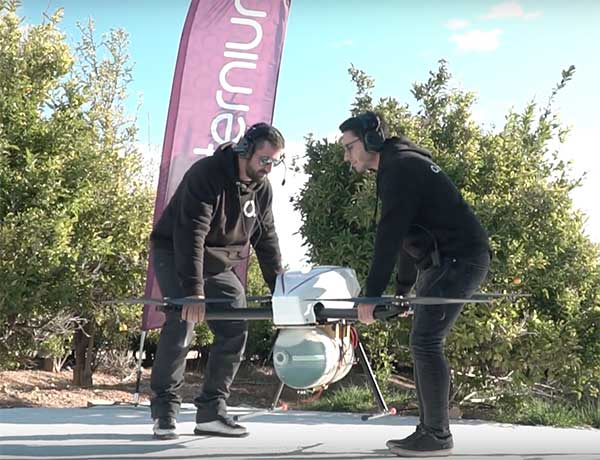
    Screenshot: Quaternium video
    Screenshot: Quaternium video

    On Feb. 3, drone company Quaternium broke its own record for long flight time with a hybrid-fuel electric drone.

    The Quaternium HYBRiX UAV took off at 08:52 a.m. in Valencia, Spain, and landed at 17:02 p.m., performing a stationary flight of 490 minutes.

    The new endurance record of 8 hours and 10 minutes of non-stop flight time was accomplished with an experimental version of the company’s HYBRiX 2.1 drone, which carries 25 kilograms of maximum take-off weight.

    Six years ago, the startup Quaternium developed its first hybrid fuel drone, inspired by hybrid cars from the automotive industry.

    In 2015 the company flew its hybrid drone, the multirotor HYBRiX, for 3 hours and 10 minutes. According to the company, Hybrid multirotors multiply flight time more than 10 times compared to electric solutions.

    The company has published a flight video with the demonstration of the record.

    Most multicopter drones provide flight times of 25 to 40 minutes, with the pilot needing to carry multiple batteries into the field.

    The HYBRiX project is supported by the European Union through its Horizon 2020 innovation program, which fosters disruptive projects in innovation, excellent science and industrial leadership. The project has received awards from institutions such as AUVSI, CDTI and the Spanish government.

    The Quaternium team was motivated to develop a long-endurance drone because it will help first responders and and firefighters to identify hot spots and search for survivors in the event of a catastrophe, the company said in a press release.

  • EU ‘GLAD-2’ develop low-cost nav for UAVs

    EU ‘GLAD-2’ develop low-cost nav for UAVs

    A European Union-funded initiative has developed a low-cost positioning and navigation system for unmanned aerial systems (UAS).

    Photo: GSA
    Photo: European GNSS Agency

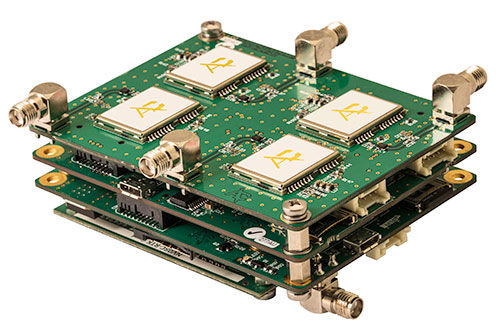
    Using multiple antennas, the device is based on off-the-shelf components and advanced data-fusion algorithms. It fuses GNSS and inertial data to enable accurate and reliable navigation.

    The EU-funded Horizon 2020 GLAD-2 project developed the system. The work involved in-depth analysis of algorithms, hardware and software redesign, exhaustive refinement and repeated in-field testing.

    Researchers used low-cost GNSS receivers, together with advanced data fusion with an inertial measurement unit, and barometer data to enhance the attitude and position of UAS in harsh GNSS environments. The system also avoided the use of magnetometers, making it immune to magnetic fields, and removing the need for system calibration when the magnetic environment is modified.

    Photo: GSA
    Photo: European GNSS Agency

    Engineers selected different GNSS antennas and measured their performance according to technical and economic criteria. A multi-antenna approach enabled UAS to take accurate headings without suffering the usual problems inherent to magnetometers.

    “The inertial sensors provide an excellent dynamic response at very high data rates, while GNSS serves as an absolute reference to prevent drift. In addition, differential GNSS carrier phase measurements can be used to obtain great accuracy in orientation by using the multi-antenna configuration,” said project coordinator Esther López of Spanish technology company ACORDE.

    GLAD-2 achieved the commercialization of the low-cost navigation system, culminating in the European Conformity (CE) certification mark following the corresponding certification process. The CE mark indicates conformity with health, safety and environmental protection standards for products sold within the European Economic area.

    The result is a highly competitive product aimed at the low-cost sector of the navigation systems market. “Due to its flexibility, the system fulfils the needs of a wide range of users, not only in UAS, but also in terrestrial and maritime environments applications,” López said.

  • GHOST project developing intelligent public transportation

    GHOST project developing intelligent public transportation

    News from the European GNSS Agency (GSA)

    All across Europe, the number of smart cities is multiplying. To tackle their growing needs and to guarantee efficient city planning and maintenance, many cities are engaged in massive investments in such key areas as street lighting, road maintenance, traffic and waste management.

    In parallel, public transportation is continuously evolving in terms of coverage, comfort and technology.

    Within this context, the exploitation of Galileo and its integration with other sensors is key to developing concrete solutions for current and future smart-city planning. Along these lines, the Horizon 2020-funded GHOST (Galileo Enhancement as Booster of the Smart Cities) project is designing, developing and validating an intelligent system for vehicles that equips existing public transport fleets with a Galileo-enabled camera and connects these vehicles to a web portal.

    The GHOST system equips existing public transport fleets with a Galileo-enabled camera and connects these vehicles to a web portal. (Photo: GSA)
    The GHOST system equips existing public transport fleets with a Galileo-enabled camera and connects these vehicles to a web portal. (Photo: GSA)

    The system automatically takes pictures of predefined points of interest (POI) based on the accurate position of the vehicle — provided by Galileo. All images are sent to a processing server capable of detecting such anomalies as potholes or a burnt-out street light. The system then uses the web portal to report these findings to the relevant authorities.

    “At this point, GHOST is designed primarily for reporting street lighting anomalies and road deteriorations, monitoring public garbage collection and detecting double parking infractions or disabled parking spots occupied by unauthorized vehicles,” said Project Coordinator Claudia Maltoni. “In addition to these basic functions, we have also identified more advanced services, such as spotting bus-lane and congestion-charging-area violations, which will be implemented at a later date.”

    A user-focused system

    The GHOST system’s key differentiator is its use of Galileo positioning, which gives it the capability to take autonomous snapshots with an error range of 1 to 10 meters (depending on the size of the POI). In densely populated urban environments, such a level of service is only possible with the combined use of Galileo, inertial sensors and Kalman filters.

    The GHOST system’s key services:

    • reporting street lighting anomalies and road deteriorations
    • monitoring public garbage collection levels
    • detecting double parking infractions or disabled parking spaces occupied by unauthorized vehicles
    • monitoring timely collection of garbage.

    GHOST-app-2Another unique feature is a free smartphone application that citizens can use to collect geo-localized snapshots. “Whenever an individual user sees an anomaly within a city’s infrastructure, all they have to do is snap a picture with their smartphone,” explained Maltoni. “This level of engagement not only enhances the overall system, but also empowers individual users to play a key role in urban upkeep.”

    Improving urban efficiency

    By taking advantage of the many vehicle movements happening in cities every day, GHOST proposes a competitive way to improve the efficiency of monitoring a city’s operations and infrastructure. Once finalized, the system will enable faster detection of double parking or road deterioration and help reduce traffic, accidents and pollution.

    “Thanks to our field tests and favourable lab results, we are already setting up the next phase of the project, with the aim of taking the system’s technology to the next level,” concluded Maltoni. “This includes providing real-time, onboard image processing so that the system can handle such dynamic scenarios as bus-lane infractions and congestion-charging enforcement.”

    The project is working to bring GHOST technology to market. Coordinators are busy making key contacts with interested public administrations, garbage collection companies and traffic police departments. It is also working to ensure that the system complies with all European regulatory standards, such as those related to circulation or privacy.

  • EU project to seek TREASURE in multi-GNSS positioning

    A European Union (EU) project exploiting GNSS to establish the blueprint for the world’s most accurate real-time positioning service will be run at the University of Nottingham in the United Kingdom.

    The service, to be developed at prototype level, will benefit safety-critical industries such as aviation and maritime navigation, as well as high-accuracy dependent applications such as offshore drilling and production operations, dredging, construction, agriculture, driverless cars and drones.

    The four-year TREASURE project will take multi-GNSS to the next level. It will focus on a service that will improve on the current use of GNSS — usually based on just one or two systems — and integrate signals from GPS, GLONASS, BeiDou and Galileo to provide accuracy of a few centimeters in real time, opening up a multitude of new possibilities.

    The TREASURE project is funded through the European Commission’s Horizon 2020 framework program.

    Atmospheric disruption

    One of the key aspects of the research is to mitigate the effects of the atmosphere, in particular related to space weather, which can often create impairing conditions that vastly reduce satellite communication and positioning accuracy.

    Controlled by the interaction of the sun with the Earth’s magnetic field, the ionosphere (the upper layer of Earth’s atmosphere) is characterized by the presence of free electrons, which interfere with a satellite’s signal passing through it.

    Mainly, but not only when solar activity is high, electron density irregularities may form in the ionosphere, which can cause signal diffraction and lead to scintillation — a scattering of the satellite signal that makes it difficult for a GNSS receiver to lock onto the satellite and calculate its position.

    This has a particularly disruptive effect on positioning technology especially at high latitude or equatorial regions, such as in Northern Europe or in Brazil, respectively.

    Similarly, the troposphere, a lower layer of the atmosphere, also interferes with the signals. The presence of water vapor in this neutral part of the atmosphere can create an additional disruptive effect on the satellite signals, also affecting GNSS accuracy.

    Correcting all intervening errors

    The project aims to develop new error models, positioning algorithms and data assimilation techniques to monitor, predict and correct not only the effects of the atmosphere but also signal degradation due to manmade sources of interference, which can also limit positioning accuracy.

    Signal processing techniques — tailored to the features of the interfering signals — will be used to improve the quality of the measurements and ultimately to generate reliable position solutions.

    Moreover, TREASURE researchers will also develop new multi-GNSS real-time precise orbit and clock products, specifically for use with the new Galileo system.

    Industry potential for multi-GNSS service

    All these problems pose significant risks to the many public and industrial sectors that now rely on GNSS or aim to use it to overcome growing humanitarian challenges such as food or energy production.

    “A highly-accurate multi-GNSS service could, for instance, assist demanding terrestrial applications like precision agriculture, giving farmers access to real-time precisely located data gathering and analysis to maximize food production, reduce costs and minimize pesticide use,” said project lead Marcio Aquino, Nottingham Geospatial Institute.

    “On the other side of the spectrum, a deep-sea drilling platform that experiences any temporary degradation of positioning accuracy could lead to phenomenal losses right at a time when, due to the current oil production climate, companies are striving to increase operational efficiency,” Aquino said. “This industry would also benefit from such an accurate multi-GNSS service.”

    The study will focus on two existing GNSS techniques known as PPP (precise point positioning) and NRTK (network real-time kinematic). Both use GPS and GLONASS, but could potentially meet future real-time high-accuracy positioning demands when Galileo is fully integrated, and if TREASURE is successful.

    Benefits and limitations of PPP and NRTK

    The NRTK technique uses fixed reference stations operating high-grade GNSS receivers at carefully surveyed reference locations to secure accurate GNSS positioning data.

    The transmission of corrections from reference locations to users is at the core of NRTK. The technique’s effectiveness relies on the spatial correlation of errors between user and reference, which must be situated less than 20-30km apart – a short enough distance to allow potential signal errors to “cancel out.”

    If atmospheric variations between reference and user are strong, a greater number of reference stations may be necessary, rendering the technique less cost-effective.

    Contrary to NRTK, PPP does not rely on errors cancelling out between the user and a known reference station. The user operates their receiver independently of the existence of nearby stations with known coordinates.

    This is achieved by incorporating external information in the solution, in the form of highly-precise satellite clocks and orbit products derived from global networks and available either for free or commercially.

    However, the accurate prediction of the state of the atmosphere, also crucial for PPP, is not normally available from these global networks — overcoming this situation is one of the main objectives of TREASURE.

    Creating a critical mass and testing market potential

    TREASURE brings together four top universities, one research institute and four leading European companies to provide the research that will result in the ultimate high-accuracy EGNSS solution.

    The project team will train and work alongside 13 Marie Skłodowska-Curie Fellows who will be earmarked as high-flying candidates for future employment in the burgeoning GNSS industry or as specialist researchers.

    The Fellows will build a prototype tool to support the different PPP and NRTK needs and test what commercial interest there is to bring the future service to market.

    TREASURE project partners are:

    • University of Nottingham
    • University of Bath
    • Politecnico di Torino
    • Technische Universiteit Delft
    • Istituto Nazionale di Geofisica e Vulcanologia
    • Fugro Intersite BV
    • Geo++GmbH
    • Noveltis SAS
    • Deimos Engenharia SA
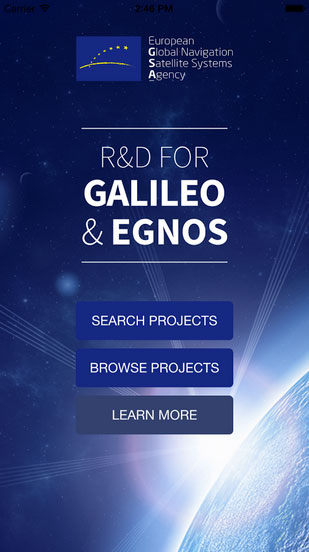
  • European GNSS R&D: There’s an App for That!

    European GNSS R&D: There’s an App for That!

    Cover: European GNSS AgencyA free app for both iOS and Android features the results of European GNSS Agency (GSA) supported research and development initiatives. The new EGNSS Research and Development (R&D) application highlights the tangible results coming out of the 7th Framework Programme (FP7) and is designed to serve as inspiration for those participating in the Horizon 2020 (H2020) period.

    The FP7 and H2020 programs, supported by the GSA, aim to support the development of EGNSS applications in key market segments. Both are geared towards accelerating the development of a European market for satellite navigation applications and creating new opportunities for European industry.

    “The app is an excellent opportunity for the GNSS community to take stock in the lessons learned during the FP7 funding period and set our sights on future R&D initiatives,” said GSA Executive Director Carlo des Dorides. “The application’s segment-specific search feature responds to the varied needs of our users, providing them with easily accessible and relevant information at their fingertips.”

    In addition to the search function, des Dorides notes that the demographics included with each project can help users identify opportunities for partnerships across segments and regions, and create virtual R&D networks.

    The FP7 programmes had a considerably positive impact on the GNSS market, GSA said (download the brochure). Within the frame of the projects, 45 products were developed, and 80 prototypes were tested and validated during the 115 demonstrations that took place.

    Today, Horizon 2020 is bringing new opportunities for GNSS applications development. Information on the 25 projects granted in the first H2020 Galileo call is already included in the application, and early next year it will be updated to include the 2nd call portfolio of projects.

    The app is available for free download from the iTunes and Google Play stores.