
Tag: Horizon

  • EUSPA’s 2nd Horizon Call seeks projects for GNSS, Earth observation

    EUSPA’s 2nd Horizon Call seeks projects for GNSS, Earth observation

    EUSPA logoEurope’s 2nd Horizon Europe call has been launched for European GNSS, Galileo and Earth observation projects, offering total funding of €48.1 million.

    The Horizon program is managed by the European Union Agency for the Space Programme (EUSPA). It funds research and innovation by small and mid-size enterprises, academia, public actors and others that will stimulate development of space applications and solutions using EUSPA data and services.

    The 2nd call aims to to strengthen downstream capabilities and modernize the EU public sector by offering cutting-edge solutions based on Galileo, Copernicus, EGNOS and GOVSATCOM.

    Funding is being offered for projects that make use of Galileo and EGNOS in smart mobility applications. Other projects fuse Copernicus data with artificial intelligence to boost the European economy and help modernize the public sector. For the first time, the call seeks to deliver satellite communication use cases based on the forthcoming GOVSATCOM system.

    Below is a breakdown of the funds’ distribution per thematic area.

    Visit the EU’s funding & tender opportunities portal for detailed information about the EUSPA call and the topics available. The deadline for applications is March 2, 2023.
  • Livox lidar sensors designed for L3/L4 autonomous driving

    Livox lidar sensors designed for L3/L4 autonomous driving

    Livox Technology Company has introduced two high-performance, mass-produced lidar sensors, the Horizon and Tele-15, which feature a new scanning method that offers improved sensing performance at a low cost.

    The lidar sensors are aimed at L3/L4 autonomous driving, smart cities, mapping, mobile robotics and more.

    “The growth potential of the lidar industry has been hindered for too long by ultra-high costs and slow manufacturing rates,” said Henri Deng, global marketing director at Livox. “Livox seeks to change this by providing access to high-quality lidar systems that are easily integrated into a wide array of different use applications. Through our technology, we hope to be the catalyst for the rapid adoption of lidar in the quickly growing industries of autonomous driving, mobile robotics, mapping, surveying and more.”

    The environment scanned by a Livox sensor increases with longer integration time as the laser explores new spaces within its field of view (FOV). A Livox Mid-40 or Mid-100 sensor generates a unique flower-like scanning pattern to create a 3D image of the surrounding environment.

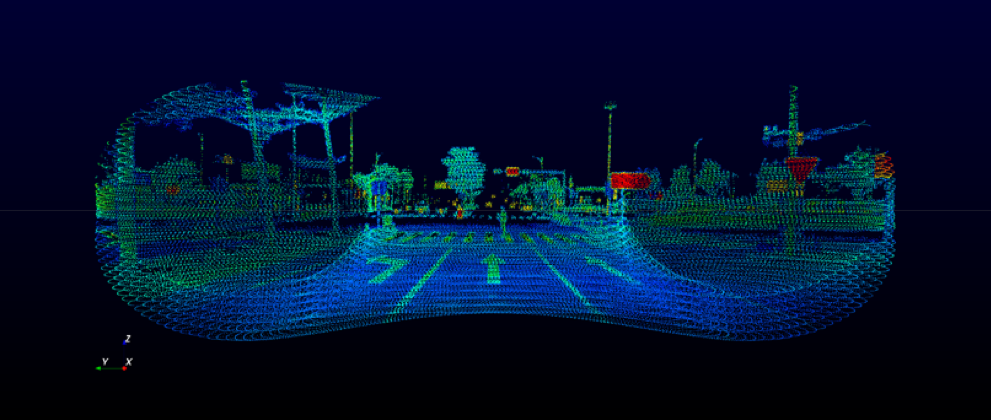
    Horizon point cloud sample of crossroads with a pedestrian crossing the street. (Image: Livox)
    Horizon point cloud sample of crossroads with a pedestrian crossing the street. (Image: Livox)

    Image fidelity increases rapidly over time. In comparison, conventional lidar sensors use horizontal linear scanning methods that run the risk of blind spots, causing some objects in their FOV to remain undetected regardless of how long the scan lasts.

    The non-repetitive scanning method of the Livox lidar sensors enables nearly 100% FOV coverage with longer integration time.

    The Horizon and Tele-15 are high-performance lidar sensors designed for L3/L4 autonomous driving applications. The Horizon has a detection range of up to 260 meters with a horizontal FOV (HFOV) of 81.7° which can cover four road lanes at a distance of 10 meters. Its FOV coverage ratio is comparable with a 64-line mechanical lidar at the integration time of 0.1 sec. Using five Horizon units enable full 360° coverage.

    Made for advanced long-distance detection, the Livox Tele-15 offers the compact size, high-precision and durability while vastly extending the real-time mapping range. The Tele-15 can scan 99.8% area within its 15° circular FOV at 0.1s.

    The Tele-15 can successfully detect an object up to 500 meters away. As a result, Tele-15’s performance allows autonomous driving systems to detect remote objects well in advance, providing more reaction time even at high speeds.

  • SBG Systems discusses Horizon IMU at Intergeo 2019

    SBG Systems‘ Raphaël Siryani discusses the company’s product line at Intergeo 2019, which took place Sept. 17-19 in Stuttgart, Germany. Siryani also explains the features of SBG Systems’ Horizon, a FOG-based high performance inertial measurement unit (IMU) designed for large hydrographic vessels surveying harsh environments.

  • Orolia launches Horizon search-and-rescue system

    Orolia launches Horizon search-and-rescue system

    Orolia has introduced the McMurdo Horizon system, an S- and L- band compatible phased array system featuring antennas developed by Ball Aerospace with horizon-to-horizon coverage to capture search-and-rescue signals relayed from orbiting satellites immediately after line-of-sight is established.

    The McMurdo Horizon system is now available to enhance regional search and rescue services worldwide with technology to complement existing and emerging ground-based systems at Medium-altitude Earth Orbit Search and Rescue (MEOSAR)ground stations.

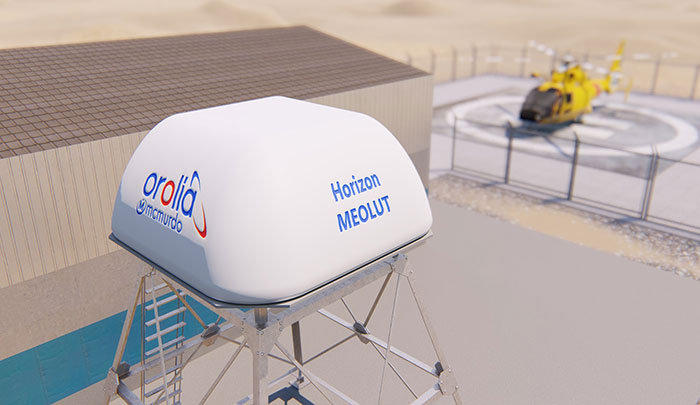
    Orolia’s McMurdo Horizon Medium Earth Orbit Local User Terminal (MEOLUT) can deliver enhanced search and rescue coverage and second-generation signal processing capabilities, in a compact form factor with no moving parts. The key technology innovation, based on a modified off-the-shelf phased array antenna developed by Ball Aerospace, is a custom-designed Orolia solution.

    By pointing to satellites near the horizon, the McMurdo Horizon MEOLUT can detect and locate emergency beacons much farther away. This enhanced detection ability, combined with the McMurdo Selective Schedule Algorithm, enables the system to monitor more diverse regions, including the translation of oblong and irregular data points that are invisible to traditional systems.