The PTSS is designed to give nations, institutions, critical infrastructure operators and scientific labs control over the time source for their critical infrastructure systems. It provides a high-quality back-up or alternative to GNSS as a source of time, which can be distributed through eLoran, IEEE 1588 over fiber, two-way time transfer, and other methods.
Core products integrated into the PTSS:
SyncSystem 4380A Time Scale Edition generates an autonomous time scale derived from combining several highly accurate independent clocks with a multi-channel instrument for measuring and comparing clock performance.
Time Scale Orchestrator is a software platform providing a unified view with a built-in database that integrates the management, monitoring, alarming and reporting functions of the individual products that form the time scale system.
5071A Cesium Clock Primary Frequency Standard and MHM 2020 Active Hydrogen Maser are Microchip’s atomic clocks that provide accurate and stable frequencies continuously measured against each other to compute and generate the ensemble time-scale frequency.
The PTSS integrates the new portfolio of time scale products into a turnkey solution, available in a single rack and guaranteed by a complete factory acceptance test (FAT) that exceeds the most stringent requirements.
The European Space Agency (ESA) issued a press release addressing the Galileo clock failures reported Jan. 18. GPS World Innovation editor Richard Langley provided the following summary of the satellites and clocks involved, based on information we have received to date.
5 satellites affected: 3 IOVs, 2 FOCs
Total of 10 failures; 1 fixed; so 9 continuing failures
5 masers on IOV satellites
2 masers on FOC satellites but 1 of these fixed
3 rubidiums on FOC satellites
No satellite currently has fewer than 2 working clocks
The ESA press release provides additional details on the failures and actions being taken to address the problem.
Press Release from the European Space Agency
As first reported November 2016, anomalies have been noted in the atomic clocks serving Europe’s Galileo satellites.
Anomalies have occurred on five out of 18 Galileo satellites in orbit, although all satellites continue to operate well and the provision of Galileo Initial Services has not been affected.
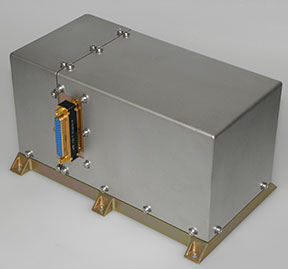
Highly accurate timing is core to satellite navigation. Each Galileo carries four atomic clocks to ensure strong, quadruple redundancy of the timing subsystem: two Rubidium Atomic Frequency Standard (RAFS) clocks and two Passive Hydrogen Maser (PHM) clocks.
The current Galileo constellation consists of 18 satellites in orbit, adding up to a total of 36 RAFS clocks and 36 PHM clocks.
Rubidium atomic clock, or RAF.
RAFS clocks
In recent months, a total of three RAFS clocks unexpectedly failed on Galileo satellites — all on Full Operational Capability (FOC) satellites, the latest Galileo model. These failures all seem to have a consistent signature, linked to probable short circuits, and possibly a particular test procedure performed on the ground, with investigations continuing to identify a root cause.
No RAFS clock failures have occurred aboard the four Galileo In Orbit Validation (IOV) satellites, the original Galileo model. In addition the RAFS clock on ESA’s very first test navigation satellite, GIOVE-A launched in 2005, has been checked, and was reactivated successfully.
Continuing investigations on the ground have identified potential weaknesses in the RAFS clock design, but no root cause has yet been yet established.
PHM Clocks
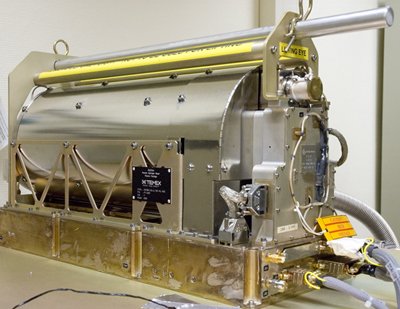
Passive hydrogen maser atomic clock of the type flown on Galileo, accurate to one second in three million years. (Photo: ESA)
In the past two years, there have been five PHM clock failures on the IOV satellites and one PHM failure on the FOC satellites.
These failures are better understood, linked to two apparent causes. One is a low margin on a particular parameter that leads, on some units, to a failure. The second is related to the fact that when some healthy PHM clocks are turned off for long periods, they do not restart because of a change in clock characteristics in orbit. To date, two PHM clocks have failed owing to the first mechanism, and four to the second.
Corrective Actions
For the remaining 33 RAFS clocks in orbit, the risk of failure is believed to be lower owing to different testing procedures on the ground before launch. In addition, new operational measures have been put in place to further mitigate the risk. All these measures have no effect on Galileo’s overall performance.
While investigations by ESA and its industrial partners are continuing, there is consensus that some refurbishment is required on the remaining RAFS clocks still to be launched on the eight Galileo satellites being constructed or tested, and awaiting launch.
For the remaining 30 PHM clocks working in orbit, operational procedures are being studied to significantly reduce the risk of future failure. These measures are being validated, ahead of their planned introduction in a few weeks.
Looking Forward
Overall, three out of four IOV satellites have experienced clock anomalies, and two out of 14 FOC satellites.
As ESA Director General Jan Woerner commented during his Jan. 18 press briefing, no individual Galileo satellite has experienced more than two clock failures, so the robust quadruple redundancy designed into the system means all 18 members of the constellation remain operational. This includes one satellite that supports only the Open Service for mass-market applications, and two satellites in elliptical orbits that are nevertheless expected to be reintegrated into the full constellation for use from these orbits.
Similarly, Galileo’s Initial Services, which began on Dec. 16, have been unaffected by these anomalies.
The impact of RAFS and PHM clock refurbishment on Galileo’s launch schedule is under study, but ESA is confident that the clock issues will be resolved and remains committed to launch the next four Galileo FOC satellites before the end of this year.
Director General Press Briefing
January 18, 2017
Clock problems are discussed at about the 12-minute mark, and in the Q&A portion started at the 52-minute mark.
In an update to our July 2 story (recapped below), correspondent Peter de Selding wrote in Space News on July 3 that the trouble aboard the fourth in-orbit (IOV) Galileo satellite arose from a sudden, unexpected loss of power. The power outage flashed on May 27, shutting down the satellite’s E1 signal. The signal “re-established itself almost immediately. But as soon as it was back in service, the two other channels’ power dropped and did not recover. The full satellite then was shut down by ground teams,” reported de Selding.
European Space Agency (ESA) officials stated on July 3 that they would power-on the satellite again sometime this week (July 7–11) to continue investigating the problem. That investigation has been ongoing since the shutdown but has not identified a cause; officials state they have established that it is not related to the onboard atomic clocks.
The four IOV satellites currently aloft differ in both technology and manufacturer from the next phase of Galileo satellites to be launched. Two of these newer generation are at the Guyana spaceport awaiting a possible late August lift date.
________________________
July 2 GPS World story:
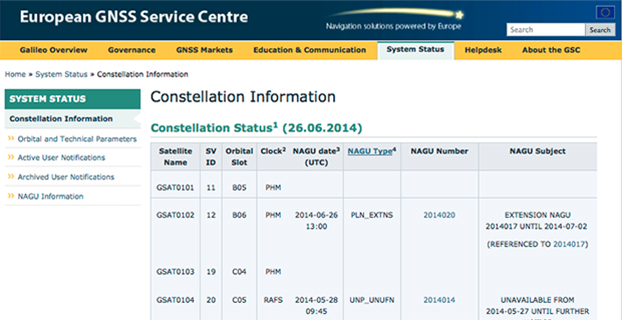
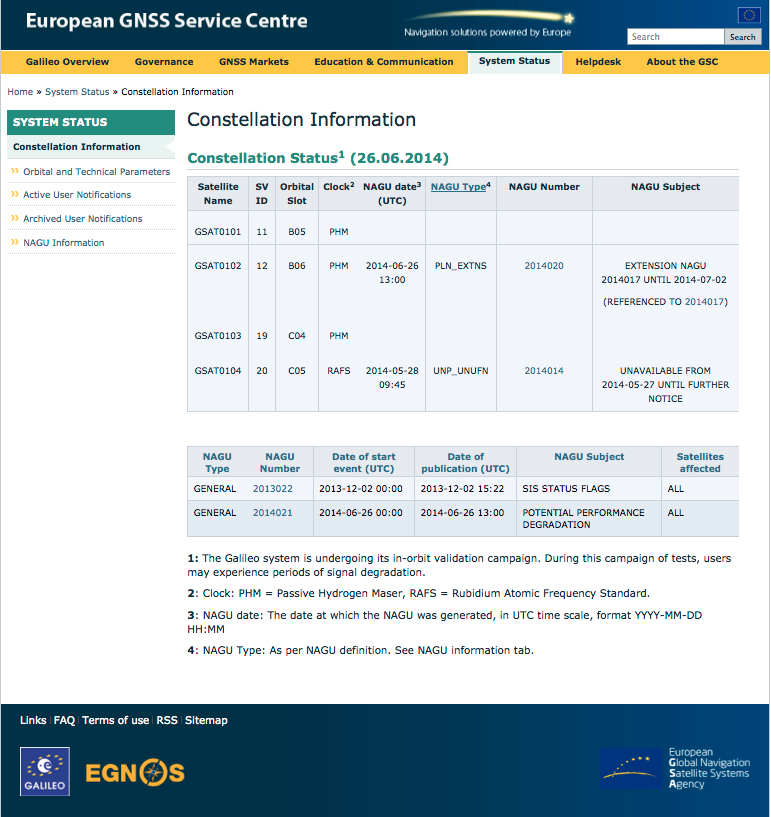
Galileo GSAT0104, the fourth in-orbit validation (IOV) satellite, has been set “unavailable until further notice” according to the European GNSS Service Centre. International observers (not associated with the European Space Agency, ESA) including those of the International GNSS Service tracking the satellite have not detected a signal from GSAT0104 since May 27. A constellation update appeared June 26 at www.gsc-europa.eu/system-status/Constellation-Information, and is reproduced here.
Speculation by unofficial sources is mounting that something is wrong with the satellite, in particular with its passive hydrogen maser, used for timing the signal for synchronous transmission with other Galileo satellites. The hydrogen maser has “a known problem” according to one source. This is why the web site shows GSAT0104, also known as FM04 and E20, as currently using a rubidium atomic frequency standard.
No statement has been made by the ESA.
According to reports, the root cause of the outage is under investigation. Some unofficial sources have gone so far as to speculate that GSAT0104’s useful transmission life may be over.
The setting of unavailability may be due to in-orbit validation testing, as the website implies may be the case, but no further official statement has appeared. On May 27, an active user notifications (NAGU) appeared at www.gsc-europa.eu/system-status/user-notifications regarding GSAT0104 stating ” Unavailable from 2014-05-27 until further notice.” On June 26, another NAGU appeared for “All” satellites and stating “potential performance degradation.” A footnote states “The Galileo system is undergoing its in-orbit validation campaign. During this campaign of tests, users may experience periods of signal degradation.”
According to the ESA website, “The Galileo satellites carry two types of clocks: rubidium atomic frequency standards and passive hydrogen masers. The stability of the rubidium clock is so good that it would lose only three seconds in one million years, while the passive hydrogen maser is even more stable and it would lose only one second in three million years. However this kind of stability is really needed, since an error of only a few nanoseconds (billionths of a second) on the Galileo measurements would produce a positioning error of metres which would not be acceptable.”
Tim Reynolds is director of Inta Communication Ltd. and a long-term Brussels observer writing on many aspects of European government policy and implementation for a range of clients and publications. He is the contributing editor for GPS World’s new quarterly e-newsletter, EAGER: the European GNSS and Earth Observation Report. Subscribe free at env-gpsworld-integration.kinsta.cloud/subscribe.
 Microchip Technology has launched its Precise Time Scale System (PTSS), which is not dependent on GNSS.