Tag: imaging

  • FLIR to join Teledyne in big sensing acquisition

    FLIR to join Teledyne in big sensing acquisition

    logosTeledyne Technologies will acquire FLIR Systems in a cash and stock transaction valued at $8 billion, both companies announced on Jan. 4.

    Teledyne is a provider of sophisticated instrumentation, digital imaging products and software, aerospace and defense electronics, and engineered systems. Its operations are primarily in the United States, Canada, the United Kingdom, and Western and Northern Europe.

    Founded in 1978, FLIR is an industrial technology company focused on intelligent sensing solutions for defense and industrial applications.

    Under the terms of the agreement, FLIR stockholders will receive $28 per share in cash and 0.0718 shares of Teledyne common stock for each FLIR share, which implies a total purchase price of $56.00 per FLIR share based on Teledyne’s five-day volume weighted average price as of December 31, 2020. The transaction reflects a 40% premium for FLIR stockholders based on FLIR’s 30-day volume weighted average price as of Dec. 31, 2020.

    As part of the transaction, Teledyne has arranged a $4.5 billion 364-day credit commitment to fund the transaction and refinance certain existing debt. Teledyne expects to fund the transaction with permanent financing prior to closing. Net leverage at closing is expected to be approximately 4.0x adjusted pro forma EBITDA with leverage declining to less than 3.0x by the end of 2022.

    Teledyne expects the acquisition to be immediately accretive to earnings, excluding transaction costs and intangible asset amortization, and accretive to GAAP earnings in the first full calendar year following the acquisition.

    “At the core of both our companies is proprietary sensor technologies. Our business models are also similar: we each provide sensors, cameras and sensor systems to our customers. However, our technologies and products are uniquely complementary with minimal overlap, having imaging sensors based on different semiconductor technologies for different wavelengths,” said Robert Mehrabian, executive chairman of Teledyne. “For two decades, Teledyne has demonstrated its ability to compound earnings and cash flow consistently and predictably. Together with FLIR and an optimized capital structure, I am confident we shall continue delivering superior returns to our stockholders.”

    “FLIR’s commitment to innovation spanning multiple sensing technologies has allowed our company to grow into the multi-billion-dollar company it is today,” said Earl Lewis, chairman of FLIR. “With our new partner’s platform of complementary technologies, we will be able to continue this trajectory, providing our employees, customers and stockholders even more exciting momentum for growth. Our board fully supports this transaction, which delivers immediate value and the opportunity to participate in the upside potential of the combined company.”

    “We could not be more excited to join forces with Teledyne through this value-creating transaction. Together, we will offer a uniquely complementary end-to-end portfolio of sensory technologies for all key domains and applications across a well-balanced, global customer base,” said Jim Cannon, FLIR president and CEO. “We are pleased to be partnering with an organization that shares our focus on continuous innovation and operational excellence, and we look forward to working closely with the Teledyne team as we bring our two companies together to capitalize on the important opportunities ahead.”

    Fourth-quarter financial results. In a separate press release issued today, Teledyne announced improved preliminary financial results for the fourth quarter and full year 2020. The Teledyne press release is available on www.teledyne.com. FLIR noted today that it expects to meet or exceed the full year fiscal 2020 guidance it provided on Oct. 30.

    Approvals and timing. The transaction, which has been approved by the boards of directors of both companies, is expected to close in the middle of 2021 subject to the receipt of required regulatory approvals, including expiration or termination of the applicable waiting period under the Hart-Scott-Rodino Antitrust Improvements Act, approvals of Teledyne and FLIR stockholders and other customary closing conditions.

    Advisors. Evercore is acting as exclusive financial advisor and McGuireWoods LLP is acting as legal advisor to Teledyne in connection with the transaction. Goldman Sachs & Co. LLC is acting as exclusive financial advisor and Hogan Lovells US LLP is acting as legal advisor to FLIR in connection with the transaction. Teledyne has entered into a 364-day senior unsecured bridge facility credit agreement with Bank of America as sole lead arranger and administrative agent.

    Conference call and webcast. Teledyne and FLIR hosted a conference call to discuss the acquisition. ​A replay is available and will be available for one month.
  • New imaging method uses time to create pictures

    New imaging method uses time to create pictures

    Alex Turpin (Photo: University of Glasgow)
    Alex Turpin (Photo: University of Glasgow)

    A new method of imaging that harnesses artificial intelligence to turn time into visions of 3D space could help cars, mobile devices and health monitors develop 360-degree awareness.

    Photos and videos are usually produced by capturing photons with digital sensors. 3D images can be generated either by positioning two or more cameras around the subject to photograph it from multiple angles, or by using streams of photons to scan the scene and reconstruct it in three dimensions. Either way, an image is only built if spatial information of the scene is gathered.

    Now, researchers based in the United Kingdom, Italy and the Netherlands describe how they have found an entirely new way to make animated 3D images — by capturing temporal information about photons instead of their spatial coordinates. The team’s paper, “Spatial images from temporal data,” was published in Optica.

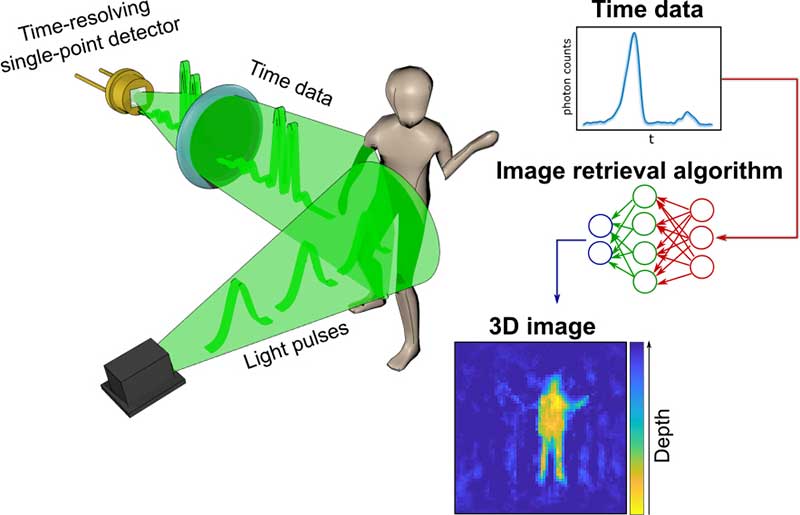
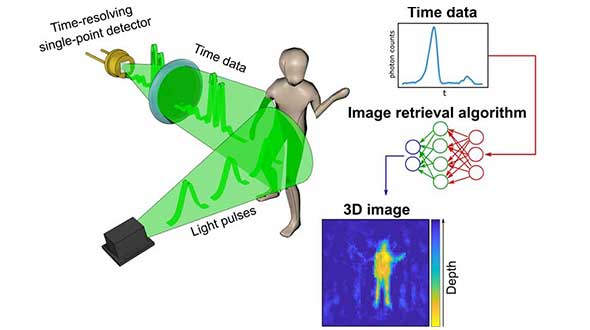
    Their process begins with a simple, inexpensive single-point detector tuned to act as a kind of stopwatch for photons. Unlike cameras, which measure the spatial distribution of color and intensity, the detector only records how long it takes the photons produced by the split-second flash of a pulse of laser light to bounce off each object in any given scene and reach the sensor. The farther away an object is, the longer it will take each reflected photon to reach the sensor.

    The information about the timings of each photon reflected in the scene — temporal data — is collected in a simple histogram. Those graphs are then turned into a 3D image using a sophisticated neural network algorithm. The researchers “trained” the algorithm by showing it thousands of conventional photos of the team moving and carrying objects around the lab, alongside temporal data captured by the single-point detector at the same time. Eventually, the network learned enough about how the temporal data corresponded with the photos that it was capable of creating highly accurate images from the temporal data alone.

    In the proof-of-principle experiments, the team managed to construct moving images at about 10 frames per second from the temporal data, although the hardware and algorithm used has the potential to produce thousands of images per second.

    Alex Turpin, a Lord Kelvin Adam Smith Fellow in Data Science at the University of Glasgow’s School of Computing Science, led the university research team with Prof. Daniele Faccio and support from colleagues at the Polytechnic University of Milan and Delft University of Technology.

    “Cameras in our cellphones form an image by using millions of pixels,” explained Turpin. “Creating images with a single pixel alone is impossible if we only consider spatial information, as a single-point detector has none. However, such a detector can still provide valuable information about time. What we’ve managed to do is find a new way to turn one-dimensional data — a simple measurement of time — into a moving image that represents the three dimensions of space in any given scene.”

    After data collection, 3D images are retrieved from the temporal histograms. (Image: University of Glasgow)
    After data collection, 3D images are retrieved from the temporal histograms. (Image: University of Glasgow)

    The approach is capable of decoupling light altogether from the image-capture process, and the paper discusses how the team managed to use radar waves for the same purpose. “We’re confident that the method can be adapted to any system which is capable of probing a scene with short pulses and precisely measuring the return ‘echo.’”

    Right now, the neural net’s ability to create images is limited to what it has been trained to pick out from the temporal data of scenes created by the researchers. But with further training and by using more advanced algorithms, it could learn to visualize a range of scenes, widening its potential applications in real-world situations.

    “The single-point detectors that collect the temporal data are small, light and inexpensive, which means they could be easily added to existing systems like the cameras in autonomous vehicles to increase the accuracy and speed of their pathfinding,” Turpin said. “Alternatively, they could augment existing sensors in mobile devices like the Google Pixel 4, which already has a simple gesture-recognition system based on radar technology. Future generations of our technology might even be used to monitor the rise and fall of a patient’s chest in a hospital to alert staff to changes in their breathing, or to keep track of their movements to ensure their safety in a data-compliant way.”

    Next, the team will work on a self-contained, portable system-in-a-box as well as examining options for furthering research with input from commercial partners. The research was funded by the Royal Academy of Engineering, the Alexander von Humboldt Stiftung, the Engineering and Physical Sciences Research Council (ESPRC) and Amazon.

    Citation. A. Turpin, G. Musarra, V. Kapitany, F. Tonolini, A. Lyons, I. Starshynov, F. Villa, E. Conca, F. Fioranelli, R. Murray-Smith, and D. Faccio, “Spatial images from temporal data,” Optica 7, 900-905 (2020), https://doi.org/10.1364/OPTICA.392465.

  • L3 system selected by Airbus Helicopters for militaries

    L3 system selected by Airbus Helicopters for militaries

    L3 Technologies’ WESCAM division has received an order from Airbus Helicopters to provide 37 MX-15 electro-optical and infrared (EO/IR) imaging systems for installation on multiple fleets of H225M Caracal helicopters.

    The systems will be installed in France before being delivered to two foreign governments for military deployment.

    “This order expands L3’s international business base while creating a new market opportunity for our leading WESCAM products,” said Michael T. Strianese, L3 chairman and chief executive officer.

    “L3 WESCAM is proud to have been chosen to supply its MX-15 systems, as it highlights our role as a trusted global supplier of advanced imaging technologies to the OEM marketplace,” added Mike Greenley, president of L3 WESCAM. “Additionally, it confirms that the highly specialized optics and leading technologies in L3’s systems continue to meet the needs of emerging mission portfolios, ranging from combative military to time-sensitive response and recovery operations.”

    The first delivery of 19 units will support a variety of missions, including search and rescue, aeromedical evacuation and assistance and disaster relief.

    The second delivery will provide a highly detailed, multispectral view of combat search and rescue, naval operations, medical evacuation and military transportation efforts to mission operators.

    L3’s MX-15 can be configured with up to six imaging and laser payloads, each of which shares the highest level of stabilization. It incorporates a GPS receiver and antenna, with options available for a GPS time sync interface and GPS data interface.

    Sensor options include a high-definition (HD) thermal imager, color low-light continuous zoom, daylight step zoom spotter, day/night spotter, laser rangefinder and a laser illuminator. L3’s MX-15 can be found on additional models of Airbus helicopters, including the H125 and UH-72A.

    L3 WESCAM serves all segments of the airborne, land and maritime markets with advanced EO/IR imaging and targeting systems (MX-Series) and modular system solution kits (MatriX).

    MX-Series turrets are operational across 74 countries and on more than 137 different types of platforms, and are supported by more than 14 globally deployed authorized service centers and a team of field service technicians who are available for dispatch 24/7 to anywhere in the world. L3 WESCAM is a unit of L3’s Sensor Systems business segment.

  • Sentera launches fixed-wing Phoenix 2 imaging UAV

    Sentera launches fixed-wing Phoenix 2 imaging UAV

    Sentera LLC, a global provider of UAV hardware, sensors and data management platforms, has launched the Phoenix 2 fixed-wing unmanned aerial vehicle (UAV). The Phoenix 2 is light-weight and highly durable, and can follow precise grid patterns.

    “The Phoenix 2 brings a level of precision and accuracy to UAVs that hasn’t been seen before,” said Todd Colten, chief aerospace engineer for Sentera. “Users can now collect highly detailed data quickly, and with complete certainty about its accuracy.” Colten went on to describe the professional-grade autopilot: “The grid pattern you specify is mapped pre-flight. The drone knows exactly what line to follow to get the exact looping radius, and the exact flight level needed for perfect tiling.”

    Sentera Phoenix 2.
    Sentera Phoenix 2.

    At only 4 pounds, the Phoenix 2 is easily hand-launched in just a few steps, and can carry multiple sensor options for up to an hour of flight time. The professional-grade autopilot is part of what makes the precision possible. It constantly auto-calculates and auto-optimizes according to the grid pattern specified to ensure the data collected meets exact specifications.

    “Growers are using the Phoenix 2 with agriculture-specific sensors to collect RGB, NIR, and NDVI imagery. That imagery is so precise – [the growers] tell us they’re targeting and treating specific parts of their fields, and then they’re using fewer chemicals, saving money and increasing yields,” continued Colten. “Follow-up flights can be programmed to use the same pattern for exact data comparison at multiple times throughout the growing season. We’re getting great feedback from our customers.”

    Attributes

    Payload Solutions: The Phoenix 2 is a highly-versatile UAV that accepts multiple sensors, including the Sentera Double 4K Sensor, providing true RGB and normalized difference vegetation index (NDVI) data in a single flight. The Sentera Quad Sensor, a multi-spectral six-band imager with red edge capabilities is also popular in agriculture applications. Other compatible mapping sensors include the Sentera-Q for high-resolution orthomaps and the Radiometric Thermal Sensor, which quickly builds high-resolution true temperature maps. Sentera also offers EO and IR gimbaled payloads for live video public safety missions.

    Precision: Up to a 60-minute endurance and cruise speed of 30 mph, the Phoenix 2 is capable of covering broad areas that other UAVs of the same size cannot. The highly reliable and accurate Kestrel OnBoard autopilot ensure images are captured with precise, even spacing and overlap that is auto-calculated and can be adjusted by the user at the click of a button.

    Ease-of-Use: Effortlessly hand-launched in just a few steps, the 4-pound Phoenix 2 flies autonomously on a predetermined flight pattern that can be updated during flight by accessing the easy-to-use ground station software. Upon completion, the Phoenix 2 automatically returns to safely land.

    End-to-End Solution: The Phoenix 2 includes the aircraft, ground station, transportation cases, batteries, chargers, and software with multiple training options available. Sentera offers a wide variety of sensors, ensuring every application has the perfect imagery solution. Sentera’s AgVault and OnTop Open Software Platforms manage the multitude of images and data collected during flight, and allow near-real time reading and analysis of the data, including working with other data sources via APIs.

  • Trimble Launches Multirotor UAS for Tight Spots

    Trimble Launches Multirotor UAS for Tight Spots

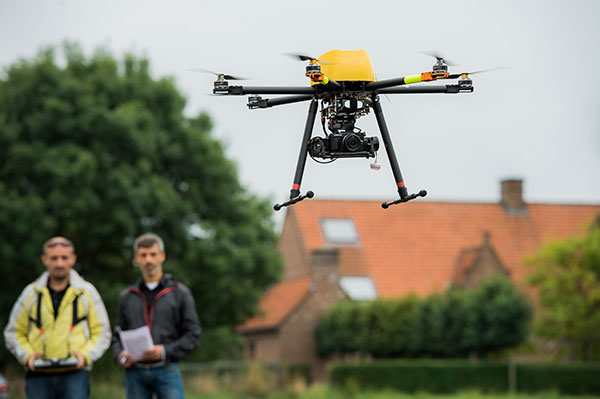
    The Trimble ZX5 can reach smaller, remote environments faster, while providing accurate mapping data.
    The Trimble ZX5 can reach smaller, remote environments faster, while providing accurate mapping data.

    Trimble’s new ZX5 Multirotor Unmanned Aircraft System (UAS) — announced today — is an aerial imaging and workflow solution that captures and processes geo-referenced photo and video data for mapping, agriculture and inspection applications. The Trimble ZX5 complements the UAS portfolio with the ability to reach smaller, remote environments faster, while providing accurate mapping data for improved productivity in the field and back office, Trimble said.

    “Unmanned aerial systems are powerful tools that are transforming geospatial-based mapping and inspection applications to positively impact our world,” said Todd Steiner, product marketing director in Trimble’s Geospatial Division. “Adding a multirotor solution to our portfolio provides options for our customers working across multiple environments to collect accurate spatial data, transform it to intelligence and create deliverables.”

    With the ZX5, Trimble extends its unmanned aerial portfolio to include both fixed-wing and multirotor solutions, providing customers with a choice to meet their specific requirements. Trimble’s fixed-wing UX5 provides longer flight capabilities for large, open environments including farms, mines, canals, flood areas and forests — while the ZX5 is more suited for mapping smaller sites, including facades, obstructed areas, construction sites and standard aerial mapping applications.

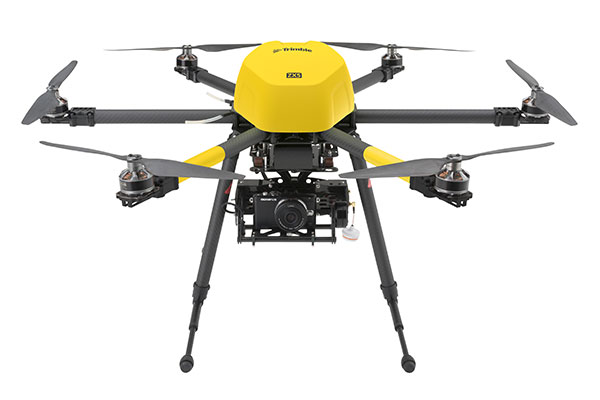
    The Trimble ZX5 multirotor UAS.
    The Trimble ZX5 multirotor UAS.

    The ZX5 Multirotor is built for everyday jobs where image capture from tight spaces is common. Its vertical takeoff and landing capabilities allow users to work in tight places and obstructed environments where fixed-wing solutions are less suitable. It requires no launcher, is easy to assemble and includes everything needed to capture high-quality geo-referenced photos for aerial mapping and inspection applications.

    The ZX5 includes a 16-megapixel camera to capture high-quality aerial imagery, down to 1-mm ground sample distance. The ZX5 also can be equipped to capture live video imagery for civil infrastructure, utility and oil and gas pipeline inspections.

    Data captured by the ZX5 can be imported into Trimble Business Center Photogrammetry Module software to create detailed ortho-photos, digital elevation models, point clouds, volume calculations and 3D models, all without requiring specialized photogrammetry knowledge or experience. It also integrates with Trimble’s Inpho UASMaster module for advanced photogrammetric processing.

    In addition, the Trimble ZX5 has been granted a Section 333 exemption from the Federal Aviation Administration.

  • Spectracom Offers Master Clock/GPS/Inertial Module for Intelligence

    Spectracom Offers Master Clock/GPS/Inertial Module for Intelligence

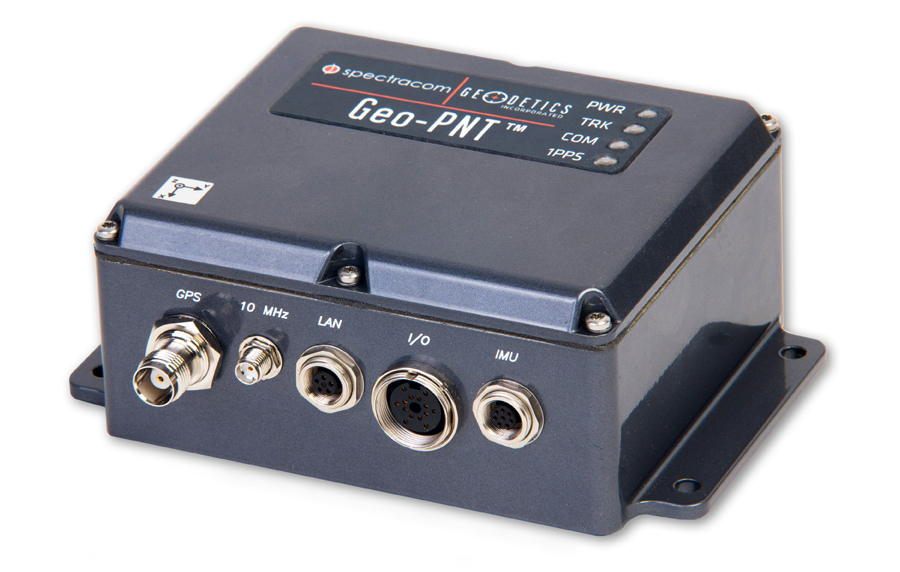
    Spectracom's Geo-PNT Photo: Spectracom
    Spectracom’s Geo-PNT integrates precision references for position, attitude, and timing. Photo: Spectracom

    A new combination master clock and GPS-aided inertial navigation system is now available from Spectracom to reduce redundant subsystems in mobile applications. The Geo-PNT integrates precision references for position, attitude, and timing all in one box. Applications include radar, optoelectronic sensing, electronic warfare, satcom on the move, and mobile test platforms.

    Geo-PNT benefits any mobile intelligence, surveillance, and reconnaissance (ISR) platform because signal/electronic intelligence applications require precision positioning, navigation, and timing references. Electro-optic sensors and other imaging technologies, antenna steering, and encrypted communications always need a combination of precision motion compensation, geolocation, time stamping, and frequency reference.

    The high degree of integration within the Geo-PNT supports the goals of low size, weight and power (SWaP) and cost optimization while achieving a high level of performance for ISR platforms and mobile communications systems. A single subsystem for all PNT functions in a volume of about 40 cubic inches is about three times less than the traditional approach of deploying dedicated devices.

    The Geo-PNT is a highly configurable platform to provide the capabilities needed for the mission:

    • Single-box solution combining precision local oscillator, inertial motion unit (IMU), and GPS receiver.
    • Configurable output interfaces for timing and navigation.
    • Standalone or RTK/differential GPS, commercial (non-ITAR) or SAASM GPS receiver.
    • Choose from a variety of IMUs to meet performance specifications.
    • NTP server, precision 1PPS, 10 MHz with low phase noise.
    • Rugged and tested to MIL-STD-810G.
    • Low SWaP (< 0.7 liters, <0.8 Kg, <10 watts).

    “Our time and frequency technology, combined with geodetics positioning and navigation capability in the same module, provides an opportunity for platform designers to lower SWaP requirements while staying within the limits of today’s demanding system specifications,” said Rohit Braggs, Spectracom’s sales and marketing VP.

    Geo-PNT is the latest example of Spectracom’s flexible configure-to-COTS approach. The use of commercial technology reduces lead time and offers the lowest cost of ownership for both standard and semi-custom configurations. Hardware and software can be adapted to meet the needs of the application.

  • Trimble Updates Aerial Imaging Application

    Trimble Access Aerial Imaging 3

    Trimble has added enhancements to its Trimble Access Aerial Imaging 2.0 application to make it more robust, intuitive and easier to use. Part of the Trimble Access field software suite of applications, the Aerial Imaging application is a software tool used with the Trimble Tablet Rugged PC for planning aerial missions, performing pre-flight checks, and monitoring flights for the Trimble UX5 Aerial Imaging Rover.

    The software enhancements include a full redesign of the user interface for a streamlined workflow, and major upgrades to flight design and control. These improvements provide greater flight planning flexibility in applications such as boundary and topographic surveying, mining assessment and exploration, heavy construction modeling and much more.

    The announcement was made at Trimble Dimensions.

    Trimble Access Aerial Imaging 2.0 enhanced user interface enables Trimble UX5 pilots to prepare a flight in minutes and quickly begin collecting data, such as orthophotos, point clouds or surface models. The full interface redesign simplifies the user experience for flight planning by using a step-by-step, tabular navigation to guide the user through the flight process from planning to completion.

    Project management is also easier with new project overview thumbnails and detailed project properties. These interface enhancements are designed to save time in the field, and provide users with an optimal flight planning and monitoring experience.

    The new Trimble Access Aerial Imaging 2.0 functionality optimizes flight times and enables corridor mapping along rivers, roads, and railways that have areas not connected to each other. Pilots can now import multiple map layers, such as georeferenced background maps, ground control point locations, and areas of interest. The software also enables users to fly irregular shaped areas, cover multiple areas and heights in a single flight, and plan multiple takeoff and landing locations. Once a plan has been established, users can perform flight simulations to confirm the flight plan, give a demonstration to clients and aviation authorities, and export the flight plan to a KML file to check terrain clearances. These new enhancements benefit pilots by saving time in flight planning, increasing safety, and meeting requirements of their mission through customized planning before takeoff, Trimble said.

    New features with in flight control build an additional level of viewing options and safety for landing when air traffic or weather conditions suddenly change. Pilots can now check flight settings, view or hide map layers, adjust landing properties, select an alternative landing, and execute pre-programmed interventions while the system is in-flight.

    “Delivering the premium UAV experience for trained geospatial professionals means we need to have the most advanced flight planning and inflight control capabilities to offer, and Trimble Access Aerial Imaging 2.0 shows our commitment to doing just that,” said Phil Sawarynski, business area director of Imaging Solutions for Trimble’s Geospatial Division. “Our customers can feel confident that we are committed to providing tools to streamline flight operations and automate capabilities for safe and successful use of their Trimble UAV systems.”

    Trimble Access Aerial Imaging 2