Tag: Indian Space Research Organisation

  • Indian navigation satellite stranded in transfer orbit after valve malfunction

    Indian navigation satellite stranded in transfer orbit after valve malfunction

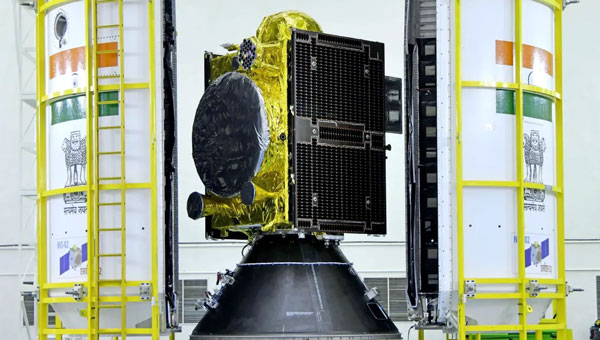
    The Indian Space Research Organisation (ISRO) has encountered a significant setback with its recently launched NVS-02 navigation satellite. Launched on Jan. 28, 2025, the satellite is currently stranded in a transfer orbit due to a critical failure in its onboard propulsion system, ISRO stated in a report. The issue occurred when the valves admitting the oxidizer to fire the thrusters for orbit raising failed to open, which prevented the satellite from reaching its intended orbital position.

    The NVS-02 satellite, part of India’s Navigation with Indian Constellation (NavIC) program, was launched using a Geosynchronous Satellite Launch Vehicle (GSLV) Mark II rocket from the Satish Dhawan Space Centre. The launch placed the satellite into a geostationary transfer orbit with a perigee of approximately 165 km and an apogee of approximately 37,582 km.

    ISRO noted in its statement that other systems on the spacecraft were working well, including a successful deployment of its solar panels.

    “The satellite systems are healthy and the satellite is currently in elliptical orbit. Alternate mission strategies for utilizing the satellite for navigation in an elliptical orbit are being worked out,” ISRO stated.

    The space agency is now exploring alternative mission strategies to utilize the satellite for navigation in its current elliptical orbit. However, the low perigee of NVS-02 poses a significant risk, as it exposes the spacecraft to high atmospheric drag, potentially leading to an early reentry if the orbit cannot be raised.

    NVS-02 is based on ISRO’s I-2K satellite bus, which has been used for other Indian communications and navigation satellites operating in geostationary orbit. The spacecraft had a launch mass of 2,250 kg.

    The spacecraft was intended to operate at 111.75 degrees east in GEO, replacing the IRNSS-1E spacecraft there. It is the second of five satellites planned for India’s Navigation with Indian Constellation, or NavIC, program to provide positioning, navigation and timing services in India and the surrounding region. The first, NVS-01, launched in 2023 and operates in GEO.
  • ISRO offers free online course on GNSS

    ISRO offers free online course on GNSS

    Logo: Indian Space Research OrganisationA free 12-day online course on GNSS will be offered by the Indian Institute of Remote Sensing (IIRS), part of the Indian Space Research Organization (ISRO).

    “Overview of Global Navigation Satellite System” (Course-ID: 107) will be held Sept. 19-30. The course is designed to help with the urgent demand for trained manpower in remote sensing, geographic information systems (GIS), GNSS and associated geospatial technologies. The course will introduce GPS and GNSS, receivers, processing methods, errors and accuracy.

    The course will cover the following topics:

    • GPS receivers, processing methods, errors and accuracy
    • satellite-based augmentation systems and GPS-aided and GEO-augmented navigation (GAGAN)
    • GPS signal characteristics and data formats (broadcast and precise ephemeris)
    • Indian Regional Navigation Satellite System (IRNSS)
    • DGPS demonstration
    • advanced GNSS processing
    • development of satellite navigation technology, TRANSIT, TSKLON, GNSS (GPS, GLONASS, Galileo and BeiDou), principles of GNSS, segments and applications
    • satellite navigation.

    The course is open to undergraduate and postgraduate students; technical or scientific staff of central or state government; and faculty or researchers at university or institutions.

    Course study materials — lecture slides, recorded video lectures, open-source software and handouts of demonstrations — will be made available through the IIRS learning management system E-CLASS.

    Visit the IRSS website for details.

  • IRNSS-1H navigation satellite launch unsuccessful

    The Aug. 31 launch of a new Indian Regional Navigation Satellite System (IRNSS) satellite failed when the protective fairing did not separate.

    Indian Space Research Organisation (ISRO) chairman AS Kiran Kumar confirmed that the mission to launch India’s eighth navigation satellite, IRNSS-1H, from the second launch pad at the spaceport of Satish Dhawan Space Centre, Sriharikota, was unsuccessful.

    The 1425-kg satellite was expected to expand the existing seven satellites of the NavIC constellation. The launch vehicle PSLV-C39 lifted the satellite on Aug. 31 using the XL variant, of PSLV equipped with six strap-ons, each carrying 12 tons of propellant.

    The three phases of the launch went smoothly, but unfortunately, the heat shield which was supposed to be separated in the fourth stage could not be detached.

    IRNSS-1H was planned as a replacement satellite for IRNSS-1A.

  • ISRO inaugurates advanced GNSS research lab

    The Indian Space Research Organisation (ISRO) has launched the Advanced GNSS Research Laboratory (AGRL) in the Department of Electronics and Communication Engineering at the Osmania University College of Engineering in Hyderabad, reports The Hindu.

    ISRO Chairman A. S. Kiran Kumar inaugurated the facility on April 27. He discussed various technical aspects related to NavIC Satellite Navigation System of India (formerly the INSS).

    He also advised students and faculty to carry out research work on differential corrections, development of various modules using IRNSS, atmospheric effects, work related to mutli-constellation, kinematic applications, fisheries applications and innovative applications for the public.

    The laboratory was established to enable research projects for Ph.D., M.E. and B.E. students. It was developed under the Memorandum of Understanding (MoU) between the University College of Engineering with the Space Applications Centre (SAC), ISRO, Ahmedabad.