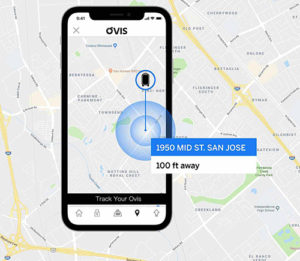
Chinese company Forward X Robotics showed off its Ovis luggage at the 2019 Consumer Electronics Show.
Ovis uses cameras for facial recognition and a movement tracking algorithm to lock in on its owner and stick with her or him at a speed of six miles per hour. Ovis is able to avoid collisions as it makes its way through crowds, according to its maker, which is now producing the suitcase after an IndieGoGo campaign.
Image: Forward X Robotics
The Ovis suitcase comes with a smart wristband that sounds and vibrates if the case gets more than six feet away. Its embedded GPS provides real-time monitoring and tracking via smartphone; the location tracker is in an uncuttable luggage tag.
Similar following suitcases include 90Fun’s Puppy 1, which uses remote control to follow, and the Travelmate Robotics, which provides a removable GPS chip to enable tracking of the bag or anything else of value.
U-blox is collaborating with LynQ, which developed a location tracker that doesn’t use cellphones, networks, apps or monthly fees. By syncing up the devices before heading out, group members can find each other within a five-mile radius and link up again.
LynQ surpassed its fundraising target on the Indiegogo crowdfunding platform, raising more than $1.5 million, and is now on pre-sale.
The device uses the u-blox CAM-M8Q GNSS receiver, a GPS/GLONASS/BeiDou positioning module with an embedded antenna. With its slim size of 9.6 x 14 x 1.95 millimeters, it is easy to integrate it into handheld devices, u-blox said.
The first generation of the weather-proof tracker uses long-range, low-power radio frequencies to connect devices. Up to 12 people can join a group, split up, and use the only button on the clip-on device to toggle through the group members and find out in which direction and how far away each one is.
LynQ’s crowdfunding success shows the extent to which the company’s founders uncovered an unmet demand on the market. While smartphone-based solutions to locate friends and family, for instance in a crowd, abound, they are limited by the availability of mobile network reception.
LynQ’s location tracker helps friends regroup outdoors or at crowded events, parents keep an eye on their children, and caregivers watch over the safety of people with special needs, elderly family members, or loved ones suffering from diseases such as Alzheimer’s.
The tracker has been field-tested on numerous continents and in most topographies and use cases.
“We found the u blox CAM-M8Q to be the best solution for us to achieve the requirements our use cases demand,” said Drew Lauter, COO at LynQ. “We’re extremely price sensitive, yet we need a highly dependable GPS module; u-blox worked closely with us to deliver that.”
For u blox, accompanying LynQ in the development of its product has been an exciting adventure, said Suresh Ram, president of u-blox America. “We’re thrilled to see how well their idea has been received by the public and look forward to our continued collaboration in the future.”
Geoporter, a non-profit focused on leveraging advanced mapping technology to empower communities to address burgeoning problems from within, has launched an Indiegogo crowdsourcing campaign to help support continued work and expansion. Funds will be used to provide resources to current projects in Costa Rica, while allowing the team to establish new operations in other areas globally.
Besides financial donations, the group is seeking serviceable digital cameras, GPS units, and laptop computers — worn but working well.
The organization uses GPS-driven technology to map behaviors in a community, allowing them to better define problems, develop and implement solutions, and evaluate the effectiveness of their efforts for continual improvement. The technology can be used to address a wide variety of problems, from tackling trash build up in the area to monitoring whale patterns in order to facilitate more sustainable tourism practices. In Costa Rica, the Geoporter team worked to map mosquito larva and water treatment to help reduce the risk of exposure to dengue fever.
“It’s exciting and rewarding work,” said co-founder Anita Palmer. “We’re going into areas where we can make a real difference in the everyday lives of people through the power of data analysis. What’s more, we’re helping to reverse trends that would otherwise have regional and, in some cases, global implications.”
Geospatial mapping is not new, but it has traditionally been executed by teams of experts in the aftermath of a crisis. Geoporter’s approach is a proactive one, where experts move into communities as challenges are developing so they can effect change before there’s a real problem. Still, building and sustaining a team of experts would have been cost-prohibitive, so Geoporter decided it would try something radical: teaching people within these communities to use the technology themselves.
“We started by training adults and youth,” explains Geoporter Director Amy Work. “Now, children in the area are taught how to use the technology in and outside of school. We have eight-year-olds navigating commercial-grade geospatial mapping technology like Esri ArcGIS Online better than some of the professionals I’ve known. The lessons they’re learning today will not only enable them to take ownership of their communities, but provide them with skills they can leverage through adulthood.”
Geoporter is hoping to use the IndieGoGo campaign to raise the funds necessary to continue their work in Costa Rica, and are looking to expand into other areas over the course of the next year. Donations will go towards funding technology, educator travel and living expenses, and community staffing.
To support the Geoporter mission or learn more about their work, visit the Indiegogo campaign by clicking here.