Tag: industry

  • Tell us the future: State of the Industry survey open for input

    Tell us the future: State of the Industry survey open for input

    What technical and business challenges are getting your attention this year?

    What are the most important benefits of, and the key challenges posed by, new modernized GNSS signals? How are you driving business in today’s economy?

    What issues are you concerned about?  What solutions hold the most promise for positioning, navigation and timing (PNT) in challenged and indoor environments — regardless of which technology provides them?

    We want to know, and so does the rest of the industry.
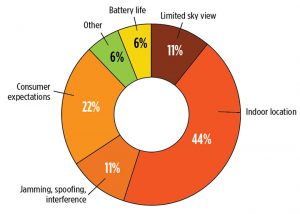
    What is the key challenge for positioning and navigation in the wireless and consumer space? (Source: GPS World 2018 State of the GNSS Industry survey)
    What is the key challenge for positioning and navigation in the wireless and consumer space? (Source: GPS World 2018 State of the GNSS Industry survey)

    GPS World is asking PNT professionals about the developing technology frontiers, the state of their business, the economic climate for products and services, driving market factors, the effects of jamming, the Issue of the Year — and more! Please give us your opinions in the 2019 State of the Industry survey. It should take less than 10 minutes, and your responses are confidential.

    A handful of lucky participants drawn at random will win TWO $100 gift cards good (virtually) anywhere.

    Complete the survey by June 30. Then look for a complete report of our findings in the September issue of GPS World.

    Thank you for taking the time to share your feedback and help us improve our magazine content, industry awareness — and your own business!

    While asking questions that have appeared in past State of the Industry surveys, to reveal industry changes that have taken place over the last five years, the 2019 Survey presents these new issues for your consideration:

    • With multiple constellations, signals and services now beginning to emerge, what are the challenges to keeping open and seamless access to these in the international marketplace ? 

    • Among the many benefits of modernized signals, which is the most important in your field of work?

    • Among the key challenges in utilizing modernized signals, which gets most of your attention? 

    The question above offers such answer choices as: increases die size without ability to increase chip cost; longer code sequences are difficult to acquire; increases RAM/ROM; increases number of RF channels; increases number of digital channels; higher CPU processing required; and software complexity with many signal types. 

    What one word would you use to describe your company’s No. 1 opportunity to grow in 2020? 

    What one word would you use to describe your company’s No. 1 obstacle to growth in 2020?

    Overall, the 2019 Survey covers such topics as:

    • Technology Trends.  PNT is rapidly diversifying among a number of complementary technologies, as GNSS looks to inertial, lidar, laser, cellular, WiFi and other beacons, signals of opportunity, low-Earth orbit satellite constellations and more. Different market sectors have, naturally, different requirements, and these lead to different integration combinations. Where do you see the most promise?
    • The Global Economy and how it affects business in your sector. Customers’ availability of capital to invest is top-of-mind for most industry professionals, whether designers, manufacturers, integrators, suppliers/dealers, or end users.
    • Industry Confidence in the road ahead. Sound business navigation requires a fluid, responsive combination of technology, capital, investment, and often most important, human capital. .
    • Issues of Concern. To what extent do industry leaders take into account the following as well as further factors?
      • Pricing and competitive issues;
      • GNSS jamming, spoofing, other RF interference;
      • Developing compatibility and interoperability of GNSS: GPS, GLONASS, BeiDou, Galileo;
      • Advantages and drawbacks of other positioning and navigation technologies.

    The survey report, complete with insightful articles and infographics, will appear in the September issue. Look for it!

    Please click here to begin the survey.

  • Australia funds ‘trusted autonomous systems’ for defense

    The government of Australia has launched the first $50 million Defence Cooperative Research Centre (CRC), announced July 6 by the minister for Defence Industry, the Hon Christopher Pyne MP.

    The Defence CRC is a collaborative program that brings together academia, publicly funded research agencies and industry (particularly small to medium enterprises) to create an interlocking research and innovation capability focused on driving a Defence outcome.

    The first Defence CRC will focus on Trusted Autonomous Systems to deliver game-changing unmanned platforms that ensure reliable and effective cooperation between people and machines during dynamic military operations.

    “Existing autonomous and robotic systems that operate in the manufacturing and mining sector are effective in controlled environments, but not suitable for the uncertain situations in which Defence operates,” Pyne said.

    “To be effective, Defence needs autonomous systems to be highly trusted, robust and resilient and this initiative will bring together the best researchers from industry and universities to develop the intelligent military platforms of the future.”

    The CRC for Trusted Autonomous Systems will receive annual funding of $8 million with a maximum of $50 million over a seven-year period.

    The CRC will be chaired by Jim McDowell, a businessman who has had an extensive career in the defence industry, and most recently at the University of South Australia.

    “As Chair, Mr. McDowell will be responsible for leading the development of the research program and business plan and work with industry on transitioning the research results into capability outcomes,” Pyne said.

    This is the first of several CRCs that the Australian government is announcing. Further CRCs will be established on projects also aligned with priorities in the country’s Next Generation Technologies Fund.

    Defence will be a member of each CRC along with universities, research agencies and industry. Participating members will be selected on the basis of their research excellence and technology expertise.

    “The CRC environment offers excellent synergies for Defence, industry and universities to collaborate closely on Defence innovation,” Pyne said.

    The CRC is an initiative of the Next Generation Technologies Fund which complements the Defence Innovation Hub as the two core initiatives of the new Defence Innovation System outlined in the Government’s Defence Industry Policy Statement. These two signature innovation research and development programs, together with the Centre for Defence Industry Capability, deliver on the Government‘s $1.6 billion commitment to grow Australia’s defence industry and innovation sector.

    For more information, visit www.business.gov.au/cdic.

  • GPS World editor to moderate innovation panel at Munich Summit

    GPS World editor to moderate innovation panel at Munich Summit

    Munichphoto
    Photo: GPS World

    This year, the Munich Satellite Navigation Summit features an interactive session on the topic “Industry Meets Research: Innovation Drivers and Barriers in SMEs.” Fabio Dovis from Politecnico di Torino will chair the session, and GPS World magazine Publisher and Editor-in-Chief Alan Cameron will moderate the discussion.

    “Small and medium-sized enterprises (SMEs) and their innovative ideas are an important factor of economic growth,” states the conference program. “Therefore it is important to improve the environment in which innovative business ideas can be created. A main factor is the promotion and facilitation of technology transfer, thus the access to scientific results. In order to enable a dynamic and creative GNSS product, service and application development, a stronger and more structured link between the most promising results of GNSS research and companies should be fostered.”

    Enter the Fishbowl

    This session will be organized according to the so-called fishbowl method that will involve GNSS experts from universities, research centers and industry in an interactive discussion. Everybody is welcome to join the fishbowl and to be part of the GNSS Knowledge Triangle to strengthen the knowledge transfer and the future success of GNSS.

    According to the fishbowl method, five chairs will be arranged in circles and one chair is always unoccupied. Any member of the audience can, at any time, occupy the empty chair and join the fishbowl. When this happens, an existing member of the fishbowl must voluntarily leave the fishbowl and free a chair. The discussion continues with participants frequently entering and leaving the fishbowl.

    The Munich Satellite Navigation Summit takes place March 14–16.