Tag: intelligence

  • UAVOS announces S1-V300 MALE unmanned platform prototype

    UAVOS announces S1-V300 MALE unmanned platform prototype

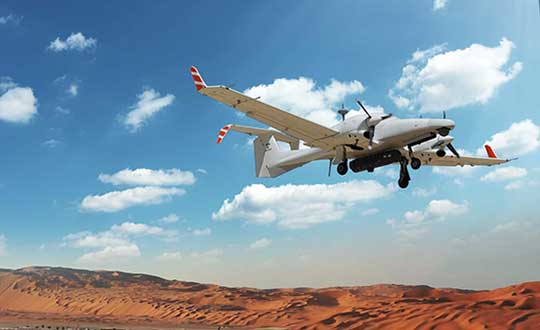
    UAVOS has successfully completed the S1-V300 medium-altitude long-endurance (MALE) unmanned aerial system (UAS) prototype designed to check basic aircraft systems.

    The advanced UAS model is based on the Saker MALE UAS design that achieved operational capability in 2020. The S1-V300 MALE UAS prototype is an upgrade to the unmanned system and features a new design and a more powerful heavy fuel engine with 260 HP offering greater speed, payload, and endurance of 28 hours with a range of 4,020 km.

    Work performed under UAVOS’ MALE UAS program using its proven Saker aircraft capabilities has enabled it to create a new-generation S1-V300 MALE unmanned platform. The aircraft features unique UAVOS avionics solutions and a redundant flight control system that will enable complex missions.

    The S1-V300 UAS will be able to support a variety of overland and maritime intelligence, surveillance and reconnaissance (ISR) missions. The improved S1-V300 prototype is equipped with both line-of-sight (LOS) and beyond-visual-line-of-sight (BVLOS) datalink systems for over-the-horizon operations. Additionally, the aircraft can be integrated with multiple ISR sensors, including electro-optical infrared (EO/IR) cameras and a synthetic aperture radar (SAR) that offers all-weather, day/night performance for a wide-area search capability.

    The S1-V300 MALE UAS next-generation capabilities combined with medium-altitude persistence make it a suitable platform to add with long-range radar, signals intelligence (SIGINT) payloads,  communication-relay payloads, and counter electronic-warfare systems. Additional retrofits include stronger wings and extra hard points for carrying an external payload of 300 kg.

    The S1-V300 has fully autonomous operation capability. It is equipped with automatic taxi-takeoff and landing systems, satellite communication for extended range, and fully redundant avionics. It is designed to operate in harsh environments and is adapted to perform in extremely hostile, dry and dusty ambient air. The aircraft features a 8.7-meters-long fuselage and a 18.7 meters wingspan, is capable of flying at 220 km/h, and has an endurance of more than 28 hours.
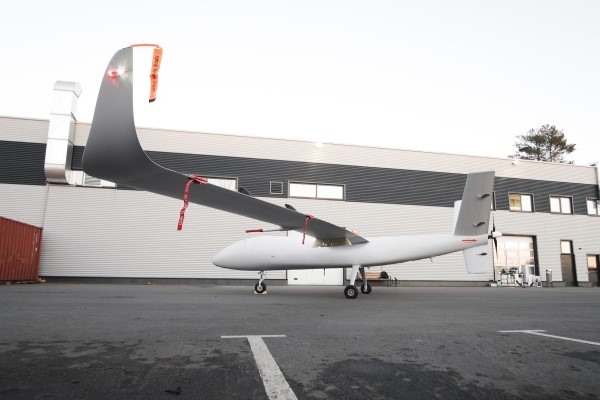
    The S1-V300 MALE prototype. (Photo UAVOS)
    The S1-V300 MALE prototype. (Photo UAVOS)
  • Nearmap and DroneShield join forces to protect against unmanned aerial threats

    Nearmap and DroneShield join forces to protect against unmanned aerial threats

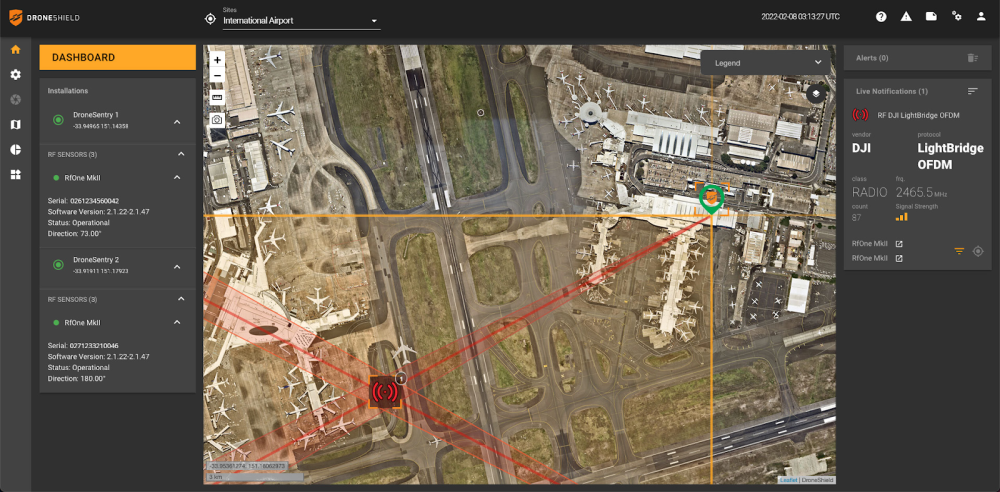
    DroneSentry-C2 with Nearmap location data. (Screenshot: DroneShield)
    DroneSentry-C2 with Nearmap location data. (Screenshot: DroneShield)

    DroneShield Limited, an Australian/U.S. global leader in artificial-intelligence-based platforms for protection against advanced threats such as drones and autonomous systems, has announced an enhanced version of its DroneSentry-C2 command-and-control software in partnership with location intelligence firm Nearmap.

    Nearmap provides city-scale 3D content, artificial-intelligence data sets, geospatial tools, and high-resolution aerial imagery in Australia, New Zealand and North America.

    DroneSentry-C2 provides an intuitive and feature-rich software platform, providing counter-UAS awareness and reporting capability. It integrates both DroneShield and third-party C-UAS sensors and effectors. Those include multiple AI-enabled sensing and tracking products, such as RfOne long-range direction-finding sensors for UAS detection and tracking, and camera-agnostic DroneOptID optical/thermal camera AI software.

    DroneSentry-C2 will come with a standard mapping solution for cost-sensitive customers, and an optional Nearmap mapping upgrade for mapping data for markets requiring high performance, such as government, intelligence, Homeland Security and defense.

    The software comes as an on-premises, air-gapped solution for intelligence, Homeland Security and defense users, or secure cloud for enterprise customers. The on-premises solution also includes a high-grade physical server. Both options come with regular mapping updates, including the ability for the user to load their own maps for sensitive locations.

    “One of DroneShield’s differentiators is that we are both a sensor manufacturer and an integrator,” said Oleg Vornik, DroneShield CEO. “Providing a streamlined and standardized hardware / software bundle that gives our user community an easy-to-deploy and run command-and-control software will be critical as more fixed and pop-up site users seek to deploy counter-UAS products. Importantly, the offering is already validated by deployments such as U.S. Air Force and Australian Army, among a number of other tier 1 end users globally.”

  • FLIR Systems acquires Altavian for defense sUAS

    FLIR Systems acquires Altavian for defense sUAS

    Photo: FLIR Systems
    Photo: FLIR Systems

    FLIR Systems Inc. has acquired Altavian Inc., a privately held manufacturer of small unmanned aerial systems (sUAS) for defense and public-safety customers.

    Altavian’s airframes integrate multiple sensors, including FLIR thermal technology, to provide users with decision support and intelligence, surveillance and reconnaissance (ISR) capability.

    Based in Gainesville, Florida and founded in 2011, Altavian designs and manufacturers Group 1 UAS solutions for long or short range operations. With both quadcopter and fixed-wing UAS designs, Altavian’s expertise includes aeronautics, avionics, and software, and its solutions are engineered around an open system architecture aligned to the needs of government and defense customers.

    Altavian is one of five drone manufacturers approved by the U.S. Department of Defense under the Blue sUAS program to sell to the U.S. military and federal agencies.

    “Altavian’s proven engineering expertise and assets will allow us to offer customers the most comprehensive solution portfolio of any American sUAS provider,” said Roger Wells, general manager of the Unmanned Systems and Integrated Solutions business of FLIR Systems’ Defense Technologies Segment, under which Altavian will be integrated. “With the addition of both a low-cost, rapidly deployable quadcopter and a longer range fixed-wing UAS, FLIR is strengthening its already impressive drone lineup, including our Black Hornet and SkyRaider platforms used extensively by militaries around the globe. We’re excited about the multiple new franchise opportunities FLIR will be able to pursue for defense, public safety, and industrial markets worldwide.”

    For more information about FLIR Systems’ existing sUAS solutions, visit flir.com/defense-uas.

  • 2-in-1 UAS system ready for US defense and security

    2-in-1 UAS system ready for US defense and security

    The Scorpion. (Photo: Quantum-Systems)
    The Scorpion. (Photo: Quantum-Systems)

    Two new small unmanned aerial systems (sUAS) are available to the U.S. government defense and security markets.

    Auterion Government Solutions Inc. and Quantum-Systems GmbH have partnered to bring the Vector and Scorpion to market. The partnership brings together high-quality sUAS hardware with a secure, scalable, open source, operating system, Auterion OS.

    Auterion OS is employed on sUAS from small multi-rotors to hybrid VTOL Group 2 air vehicles. The open-source operating system aligns with the Defense Department’s Group 1 UAS Architecture.

    2-in-1 UAS

    Vector and Scorpion form a 2-in-1 system kit. Scorpion is a tri-copter that can be used for dynamic urban environments and other mission sets that require a combination of maneuverability and hover to collect intelligence, surveillance and reconnaissance (ISR) data, as well as situation awareness information. If required, it comes with a tethering system to enable 24/7 operations.

    By configuring the base fuselage with fixed wings and tail section, Scorpion transforms into Vector, an energy-efficient, fixed-wing VTOL for longer range, longer endurance ISR missions.

    The Vector. (Photo: Quantum-Systems)
    The Vector. (Photo: Quantum-Systems)

    Command and control

    Quantum-Systems uses a proprietary flight control stack as well as its qBase command and control software on the two air vehicles.

    When the platforms are integrated with Auterion Enterprise PX4 software, Auterion Ground Station software, and the Auterion Hand-Held Ground Control Station (H-GCS) they form an open ecosystem that is aligned and integrated with DoD’s Group 1 UAS Architecture and requirements for a common Group 1 control system.

    The integration enables these sUAS to be extensible, tailorable and interoperable for customers in both the U.S. defense and security markets.

    “We are excited to be working with Quantum-Systems to bring forth a new, integrated, rucksack portable sUAS that we feel will transform the way our customers collect, process and disseminate ISR and Situation Awareness information, in all environments,” said David Sharpin, CEO of AGS.

    “By setting up a U.S. entity, Quantum-Systems will move closer to the customer while working on setting up a large-scale U.S. production,” said Florian Seibel, CEO of Quantum-Systems.

  • New UAS manufacturer specializes in defense drones

    New UAS manufacturer specializes in defense drones

    CP Aeronautics offers American-built combat-proven unmanned aerial systems for defense, homeland security and civil applications

    CP Technologies has launched a new division, CP Aeronautics, to provide integrated turn-key solutions based on unmanned aerial systems (UAS) platforms, payloads, data links, ground control stations (GCS) and communications for defense and civil applications.

    Designed as leading-edge UAS-based solutions, CP Aeronautics’ systems offer operationally proven solutions for intelligence, surveillance and reconnaissance (ISR) systems requirements. CP Aeronautics’ broad product portfolio has demonstrated excellent performance and operability in demanding environments, the company stated in a press release. Backed by continuous research and development, these systems are built on three decades of technological and operational experience.

    “Through our in-house capability as a UAS manufacturer and integrator with specialist subsidiaries and technology partners, we offer a complete range of subsystems including air vehicles, inertial navigation and avionics, electro-optical payloads (EO), communications, propulsion systems, launch and retrieval systems, command and control units,” said Brad Pilsl, vice president of business development at CP Aeronautics. “We also offer high-end training solutions for our partners and customers.”

    CP Aeronautics will support government and commercial customers with the entire infrastructure necessary for development, production, integration, flight-testing, certification and operational support of UAS throughout their service.

    The combat-proven operational systems include:

    • Orbiter 2 Small-UAS (SUAS)
    • Orbiter 3 Small Tactical UAS (STUAS)
    • Orbiter 4 Small Tactical UAS (STUAS)
    • Aerostar Tactical UAS (TUAS)
    • Dominator XP (MALE UAS)
    • Pegasus 120 high-performance multi-mission vertical takeoff and landing (VTOL) UAS
    The Dominator XP UAS. (Photo: CP Aeronautics)
    The Dominator XP UAS. (Photo: CP Aeronautics)
  • Red Hen’s modular defense kits capture first-person views

    Red Hen’s modular defense kits capture first-person views

    THISR modular kits provide the tools needed to capture the first-person view on the battlefield. (Photo: Bruce Donaldson, THISR team leader, Red Hen Systems)
    THISR modular kits provide the tools needed to capture the first-person view on the battlefield.
    (Photo: Bruce Donaldson, THISR team leader, Red Hen Systems)

    The Tactical Handheld Intelligence Surveillance Reconnaissance (THISR) by Red Hen Systems is an advanced intelligence, surveillance and reconnaissance (ISR) asset providing a real-time solution to operators and mission teams.

    The modular kits provide the tools needed to capture the first-person view on the battlefield. The THISR is a custom integration of cameras, a laser rangefinder, GPS unit and software linked through Red Hen System’s VMS-333 mapping system.

    THISR is the integration of three core collection technologies:

    • Random Access Full Motion Video (RAFMV) with mapping integration
    • 360° immersive rendering
    • light UAV/UAS

    Together, all three technologies provide critical information to the operator for use in planning superior missions, enhancing situational awareness and protecting forces, the company said.

    The kits offer near-real-time dissemination and surveillance, and can be integrated with other technologies.

    The THISR options.
    The THISR options.

    Mapping system. The VMS-333 encodes multiple geo-referenced sensor metadata records into a single data stream and combines this metadata with photographic and video imagery. Data multiplexing capabilities are available for two different mission types–nadir and oblique ground observation missions.

    The nadir mission provides an automated process to create a seamless orthogonal geo-referenced photographic mosaic of the entire flight path that can be used to produce 3D terrain models of the ground below.

    The oblique mission provides the functionality to take at-will photographs of ground-based areas of interest from a handheld SLR camera, and geo-reference these photographs with the location of the ground target using coupled laser range finder technology.

  • US Navy unmanned system passes tests on submersible

    US Navy unmanned system passes tests on submersible

    A surrogate LDUUV is submerged in preparation for a test to demonstrate the capability of the Navy's Common Control System at the Naval Undersea Warfare Center Keyport in Puget Sound, Washington. (U.S. Navy photo)
    A surrogate LDUUV is submerged in preparation for a test to demonstrate the capability of the Navy’s Common Control System at the Naval Undersea Warfare Center Keyport in Puget Sound, Washington. (U.S. Navy photo)

    The U.S. Navy tested its newly developed Common Control System (CCS) with a submersible unmanned vehicle during a series of underwater missions at the Naval Undersea Warfare Center Keyport in Puget Sound, Washington.

    The CCS successfully demonstrated its capability to provide command and control to a surrogate Large Displacement Unmanned Undersea Vehicle (LDUUV).

    CCS is a software architecture with a common framework, user interface and components that can be integrated on a variety of unmanned systems. It will provide common vehicle management, mission planning and mission management capabilities for the Naval unmanned systems portfolio.

    During the test events in Dec. 7-11, operators from Submarine Development Squadron 5 Detachment UUV used CCS to plan and execute several surveillance and intelligence preparation missions. The CCS sent pre-planned missions — via radio link — to the LDUUV’s autonomous controller and displayed actual vehicle status information to operators during the test. The vehicle was able to maneuver to the target areas and collect imagery.

    “These tests proved that operators could use CCS from a single global operations center to plan, command and monitor UUVs on missions located anywhere in the world,” said Capt. Ralph Lee, who oversees the Navy’s CCS program at Patuxent River, Maryland. “This event also showed us that CCS is adaptable from the UAV (unmanned aerial vehicle) to UUV missions.”

    Teams from the Navy’s Strike Planning and Execution and Unmanned Maritime Systems program office (PMA-281), Naval Air Warfare Center Weapons Division, Space and Naval Warfare Systems Command Pacific, John Hopkins and Penn State universities worked together to design, develop and test the software before executing the live demonstration in December.

    “We had a really talented group of people working on this project,” said Vern Brown, who supports the CCS Advanced Development team based in China Lake. “It was exciting taking the CCS concept of controlling an undersea vehicle from inception early in the year to a successful in-water demonstration.”

    CCS is intended to be compatible across all domains — air, surface, undersea and ground. The Navy initially plans to deploy the CCS on unmanned air vehicles. It will provide common vehicle management, mission planning and mission management capabilities for the Naval unmanned systems portfolio.

    “Ultimately, CCS will eliminate redundant efforts, encourage innovation and improve cost control for unmanned systems,” Lee said.

    Personnel supporting the Navy's CCS program review data during a test event in December 2015 at the Naval Undersea Warfare Center Keyport in Puget Sound, Wash. (U.S. Navy photo)
    Personnel supporting the Navy’s CCS program review data during a test event in December 2015 at the Naval Undersea Warfare Center Keyport in Puget Sound, Wash. (U.S. Navy photo)
  • Insitu Blackjack UAS receives ‘go’ for Navy, Marine ops

    Insitu Blackjack UAS receives ‘go’ for Navy, Marine ops

    The Navy and Marine Corps’ RQ-21A Blackjack unmanned aircraft system (UAS) received the official green light for operation Jan. 13, marking a major milestone for the program.

    The program has achieved Initial Operational Capability (IOC), announced Marine Corps Deputy Commandant for Aviation Lt. Gen. Jon Davis. IOC confirms that the first Marine Unmanned Aerial Vehicle Squadron (VMU) squadron is sufficiently manned, trained and ready to deploy with the RQ-21A system.

    “We are ‘go for launch’,” said Col. Eldon Metzger, program manager for the Navy and Marine Corps Small Tactical Unmanned Aircraft Systems Program Office (PMA-263), whose team oversees the Blackjack program. “Achieving IOC designation means the fleet can now deploy using this critical piece of intelligence, surveillance, and reconnaissance architecture to enhance mission success.”

    Blackjack-insitu-O
    An RQ-21A Blackjack in flight during testing aboard USS Mesa Verde (LPD-19) in 2015. The Marines will deploy for the first time with the unmanned air system this summer. (U.S. Navy photo)

    In December 2015, builder Insitu delivered the first system from low-rate initial production (LRIP) lot 3 to VMU-2. The Blackjack system will support of the 22nd Marine Expeditionary Unit (MEU), based in Camp Legeune, North Carolina. The Marines will make their first shipboard deployment with the system this summer.

    “The Blackjack team has endured many long hours seeing this program to fruition and I am very proud to lead such a dedicated team of professionals,” Metzger said.

    A Blackjack system is comprised of five air vehicles, two ground control systems, and launch and recovery support equipment. At eight feet long and with a wingspan of 16 feet, the air vehicle’s open-architecture configuration is designed to seamlessly integrate sensor payloads, with an endurance of 10-12 hours.

    The expeditionary nature of the Blackjack, which does not require a runway for launch and recovery, makes it possible to deploy a multi-intelligence-capable UAS with minimal footprint from ships.

  • DigitalGlobe receives $335M in commitments for satellite imagery

    DigitalGlobe has received a third customer commitment for direct access capacity on the WorldView-4 satellite, bringing the total in commitments for both WorldView-3 and WorldView-4 to $335 million. The WorldView-4 satellite will provide 30-cm imagery, the highest resolution commercially available, to international defense and intelligence customers.

    WorldView-4 is scheduled to launch in September and begin commercial operations of gathering digital imagery in early 2017. DigitalGlobe is a global provider of commercial high-resolution Earth observation and advanced geospatial solutions.

    Artist's depiction of the WorldView-4 satellite (previously named GeoEye-2). Photo: Digital Globe
    Artist’s depiction of the WorldView-4 satellite (previously named GeoEye-2). Photo: Digital Globe

    Since the end of the third quarter of 2015, DigitalGlobe has received contracts and letters of intent from international defense and intelligence customers totaling $335 million for capacity on WorldView-3 and WorldView-4, representing $38 million of incremental annual revenue starting in 2017.

    DigitalGlobe accelerated the launch of WorldView-4 to meet strong international demand for the world’s highest resolution commercial satellite imagery, and these pre-launch commitments ensure that the satellite will begin generating revenue in early 2017.

    Approximately 60 percent of this potential future revenue is under firm contract. While there is no assurance that revenue reflected in the letters of intent will turn into contracts, this has historically been the case.

    WorldView-4 revenue is expected to start to be recognized in the first quarter of 2017.

    “The fact that we have this level of commitment from multiple international customers — more than half in the form of firm contracted revenue — this far in advance of the WorldView-4 launch is unprecedented,” said Jeffrey R. Tarr, DigitalGlobe president and chief executive officer. “It is a testament to the unique value of our resolution and accuracy and our long history of performance with these customers who rely on us for the safety and security of their nations.”

    With the most advanced constellation of satellites in orbit, DigitalGlobe is investing in the best technology to meet the growing needs of its customers. The company has been upgrading the ground stations of its Direct Access Program customers to a common architecture to fulfill the demand for rapid access to the entire DigitalGlobe constellation and offer more imaging opportunities to these customers. Four of these Constellation Direct Access Facilities are now online, with a fifth ground station expected to be upgraded in the second quarter and all facilities upgraded for full constellation access by early 2017.

    “We are in discussion with many other nations interested in our high resolution, high accuracy 30 cm satellite imagery, and the launch of WorldView-4 will allow us to satisfy unmet customer demand across much of the world,” said Daniel L. Jablonsky, DigitalGlobe general counsel and general manager for International Defense & Intelligence. “The investments we are making to enhance our customers’ direct access facilities will expedite access to WorldView-4 in 2017 and allow us to provision additional access facilities with greater speed and efficiency.”