Tag: ISS-Reshetnev

  • GLONASS company to build 27 more satellites

    GLONASS company to build 27 more satellites

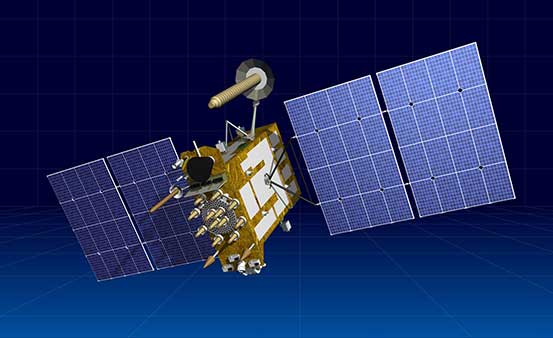
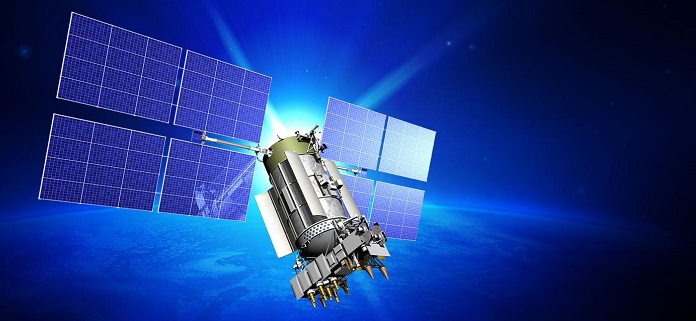
    Artist's rendering of a Glonass-K satellite. (Image: ISS-Reshetnev)
    Artist’s rendering of a Glonass-K satellite. (Image: ISS-Reshetnev)

    ISS-Reshetnev Company — the primary GLONASS contractor — has a backlog of orders for navigation satellites up to 2025, according to General Director Nikolay Testoyedov.

    Testoyedov discussed GLONASS production on Dec. 30, 2019, at a meeting hosted by ISS-Reshetnev Company for Russia’s Science and Technical Council.

    “Within the Federal Target Program, GLONASS ISS-Reshetnev Company is tasked with the production of 27 navigation satellites,” Testoyedov said. “Taking all things together, we plan to double the number of satellites launched in 2020 compared to 2019.”

    The orders require production at full capacity at the company’s facilities. At any given time, about 50 satellites are in varying stages of production, including 12 ground spares. Some of them are slated for launch in 2020.

    In 2019 eight satellites designed and built by the company were launched into various orbits. As of today,  104 ISS-Reshetnev-made satellites are in space, or two-thirds of Russia’s entire orbital fleet of satellites. ISS-Reshetnev also successfully completed several projects for the manufacture of satellite onboard systems and instruments, including the international ExoMars-2020 program slated to launch this year.

    Glonass-M satellite goes into service

    The Glonass-M navigation satellite launched on Dec. 11, 2019, entered service Jan. 13.

    A joint team of experts representing ISS-Reshetnev Company and the operating organization successfully completed all procedures moving the Glonass-M satellite to its proper orbital position, and switched on its main instruments. To this date, all the required data has been received from the satellite, which allowed it to be commissioned into service.

    The new Glonass-M replaced a retired satellite of the GLONASS constellation that had surpassed its designed life expectancy by seven years.
  • GLONASS-M satellite delivered for launch

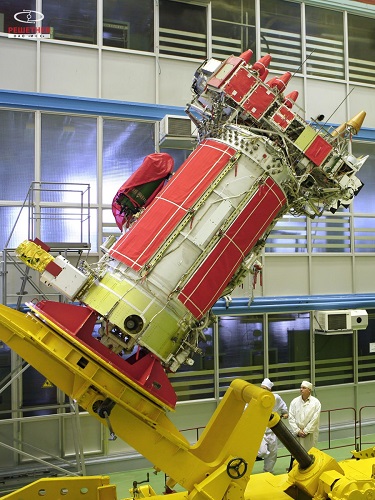
    Another GLONASS-M satellite, designed and built by a team of Information Satellite Systems – Reshetnev Company, has been delivered to the Plesetsk cosmodrome.

    Accompanied by the company’s technical team and housed in a dedicated high-technology container, it was shipped to the Yemelyanovo Airport of Krasnoyarsk and then flew to the Plesetsk cosmodrome aboard a cargo aircraft IL-76.

    At the cosmodrome, ISS-Reshetnev technicians will begin preparing the satellite for its launch, which is expected to take place in late May.

  • ISS Reshetnev to build 11 new GLONASS-K satellites

    ISS Reshetnev has signed a contract with Russian space agency Roscosmos to build 11 new GLONASS satellites, according to the Roscosmos website. ISS Reshetnev is Russia’s leading spacecraft developer and manufacturer.

    ISS Reshetnev will build nine GLONASS-K1 satellites and two GLONASS-K2 satellites. The GLONASS-K1 satellites will be transition satellites between the existing GLONASS-M satellites and the future GLONASS-K2 satellites.

    GLONASS-K2 satellites will begin flight tests in 2018, with mass production of GLONASS-K2 satellites to begin in the 2019–2020 time frame.

    The GLONASS-K1 satellites are expected to have a 10-year lifetime. The first of the new batch of GLONASS-K1 satellites will be launched in 2018.

    Flight tests of the two GLONASS-K1 satellites now in orbit have been completed.

    — written with assistance from Richard Langley, “Innovation” editor.

  • Next-generation GLONASS-K2 won’t launch until 2017 at earliest

    The test flight of the first GLONASS-K2 satellite — a new generation GLONASS satellite with a design life of 10 years — is expected to take place from late 2017 to early 2018, RIA Novosti reports. The Russian news agency quoted Nikolai Testoyedov, CEO of Information Satellite Systems—Reshetnev, speaking at the 2015 Dubai Air Show.

    According to Testoyedov, the GLONASS-K2 satellites had difficulty being equipped following international sanctions imposed on a number of electronic components. The first unit of the series has been built, he said.

    Nine GLONASS-M satellites are currently in reserve, and another nine GLONASS-K1 satellites are in production, Testoyedov said. Mass production of GLONASS-K2 satellites is expected to take place following the test, so that by the end of 2018 GLONASS-K2 satellites would be subsequently mass produced, while maintaining the regular structure of the orbital group.

    With a GLONASS-M lifetime of seven years, and GLONASS K-1 and GLONASS-K2 of 10 years, the GLONASS system will be updated through 2028-2030, concluded Testoyedov.

  • Final GLONASS-M Satellite Passes Tests

    Final GLONASS-M Satellite Passes Tests

    Artist's rendering of the GLONASS-M satellite.
    Artist’s rendering of the GLONASS-M satellite.

    News courtesy of CANSPACE Listserv.


    The last of the GLONASS-M satellites (serial number 61) has been built and has passed all acceptance tests, reports the July 20 issue of Sibirskii Sputnik (Siberian Satellite), the internal newspaper of ISS Reshetnev. It will join eight other GLONASS-M satellites in storage on the ground awaiting launch between now and 2017.

    Following the launch of the last GLONASS-M satellite, 11 GLONASS-K1 satellites will be launched through 2020. The GLONASS-K2 model is currently under development and will be launched beginning in 2017, according to a presentation made by ISS Reshetnev at the Workshop on the Applications of Global Navigation Satellite Systems held in Krasnoyarsk in May 2015.

    Photo: GLONASS-M

  • GLONASS-M Satellite Shipped to Launch Site

    GLONASS-M Satellite Shipped to Launch Site

    GLONASS-M54

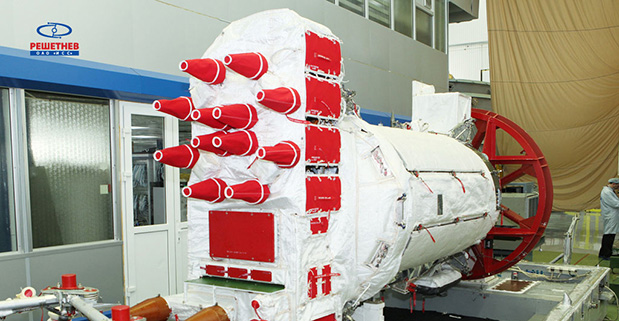
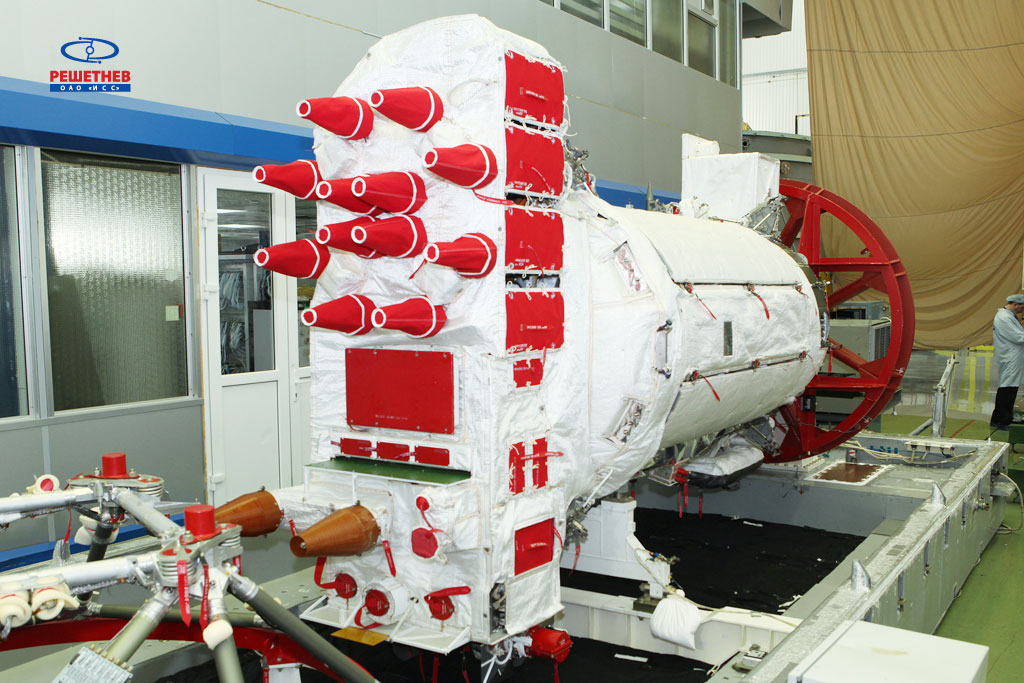
    On the night of February 12-13, the GLONASS-M #54 spacecraft left ISS-Reshetnev’s facilities in Zheleznogorsk, Russia, and was transported by air to the Plesetsk cosmodrome.

    A Soyuz 2.1b / Fregat rocket with the navigation satellite GLONASS-M #54 on board is scheduled for launch in mid-March. The exact launch date is due to be set at a meeting of the state commission.

    As soon as the satellite arrived to the spaceport, the joint team of ISS-Reshetnev specialists and the cosmodrome’s staff members started the launch preparation campaign.

    Five satellites of the GLONASS-M series are planned for launch in 2014 to maintain GLONASS in its full operational capability. Three satellites will be launched in a single batch, while the other two will fly into orbit in two single launches.

    GLONASS-M #54 will also carry an additional instrument – a high-accuracy thermal stabilization unit that was installed on the spacecraft to undergo testing and flight qualification. Next-generation spacecraft intended for the GLONASS system are going to be equipped with this instrument to provide increased positioning accuracy.

    Three more GLONASS-M spacecraft have already been built by ISS-Reshetnev and are being stored at the company’s premises waiting for launch.

    GLONASS-M54-2