Tag: ITT Exelis

  • New Report on Global Military GPS/GNSS Market Looks at Next Decade

    Reportstack has announced a new report on The Global Military GPS/GNSS Market 2013-2023.  This report offers the reader detailed analysis of the global military GPS/GNSS  market over the next 10 years, alongside potential market opportunities to enter the industry, using detailed market size forecasts, Reportstack said.

    A satellite navigation system provides GPS positioning from a global perspective, and is therefore of utmost importance for modern-day military operations, which rely on accurate real-time data on hostile forces in order to carry out precision attacks, Reportstack said. It is here that GPS/GNSS devices assume an important role, as they are imperative to transfer signals from these satellites back to earth.

    The U.S. is the highest spender on military GPS/GNSS navigation, and is responsible for 42.9% of the global military GNSS devices market. Others major spenders in this sector include Russia, the UK, China and India. In July 2013, India launched the IRNSS-1A, the first of seven satellite constellation to be deployed under the Indian Regional Navigation Satellite System (IRNSS) program to be completed between 2015-2016. And China’s BeiDou is scheduled to be operational by 2020.

    Another factor driving the market is the integration of satellite navigation technology with other navigation systems, such as the inertial navigation system (INS) and gyro, as GPS devices are to be used in order to decipher data correctly, Reportstack said.

    The increasing demand for satellite navigation and communications is driven primarily by the desire of militaries to monitor more areas and derive accurate information by a range of GNSS receivers/sensors in the shortest time possible. Major military aircraft and helicopters are dependent on GPS embedded INS systems for effective navigation. Similarly, naval vessels and guided munitions are increasingly relying on the collaboration of laser, gyro, INS, and satellite navigation technologies to derive accurate real time data.

    Furthermore, it has been observed that the usage of standard positioning services/open service receivers, which use unencrypted signal for non-combat purposes has increased, and is expected to drive demand and encourage expenditure, Reportstack said. The military GPS/GNSS technology is expanding its horizon beyond the basic characteristics of navigation and tracking. The use of GPS, in conjunction with a number of software applications, has expanded its use in military operations. A number of new technologies are now embedded with GPS receivers to produce a more sophisticated military tool.

    Recently, a Swiss-based company developed a device called GPS Log Book based on u-blox technology. The new device has extended the scope of GPS technology to the administrative side of military operations. It provides an easy way for military drivers to automatically keep an accurate travel log book which can be securely accessed later from anywhere via a web interface. Information logged includes route, speed, and distance traveled. It also keeps a close record of fuel used by the vehicle, based on the distance traveled at various speed levels.

    The advent of Differential GPS (DGPS), an enhancement to GPS, which provides improved location accuracy, from the 15-meter nominal GPS accuracy to approximately 10 cm, has further expanded the scope of GPS in missile technology. The intercontinental ballistic missiles, which are capable of hitting targets across thousands of miles navigation, use inertial navigation with DGPS receivers. The advent of DGPS is expected to be one of the most significant steps in accurate missile targeting for militaries across regions.

    The companies mentioned in this report are Northrop Grumman, Raytheon, Rockwell Collins , Lockheed Martin, ITT Exelis, Thales, and BAE Systems. More details and table of contents about this report can be found by visiting The Global Military GPS/GNSS Market 2013-2023 report.
  • ITT Exelis Completes Signal Sentry 1000 Product Integration

    An ITT Exelis product that detects and locates GPS interference sources in 3-D by using longitude, latitude and altitude has successfully completed a significant integration milestone.

    Signal Sentry 1000, formerly known as GPS Interference, Detection and Geolocation, may now be deployed to collect actionable intelligence for law enforcement, such as tracking high-value targets and protecting critical infrastructure.

    Signal Sentry 1000 is a proprietary product that leverages GNSS signal domain knowledge; it is based upon patented technology developed by Exelis through many years of designing and fielding electronic intelligence systems, ITT Exelis said.

    “Exelis developed Signal Sentry 1000 to help protect critical infrastructure and to deliver intelligence to law enforcement operations that depend upon GPS availability,” said Kevin Farrell, positioning, navigation and timing general manager for Exelis Geospatial Systems. “Jamming devices can transmit signals capable of disrupting the synchronization of critical infrastructure, such as utility power grids, and timing information of financial transactions. This is why we are continually making improvements in our technology, and the latest milestone achievement is a testament to our goal to deliver actionable interference intelligence to agencies that rely upon GPS operational availability.”

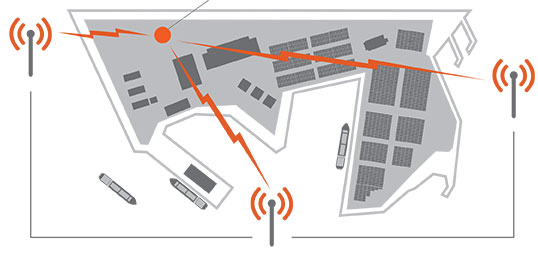
    Signal Sentry 1000 technology is a network of threat-detection sensors, which are part of a centralized server executing Exelis‐developed proprietary location algorithms. These sensors can be strategically located around areas of critical infrastructure, such as shipping ports, utilities and government facilities to automatically sense and locate any intentional or unintentional GPS jamming source. Should a threat be detected, users would receive accurate location information and actionable intelligence in order to determine an interference-mitigation plan.

    “Signal Sentry 1000 builds upon Exelis expertise in the field of GPS and positioning, navigation and timing. Exelis payloads and payload components have been on board every GPS satellite for nearly 40 years,” said Farrell.  “Today, Exelis is involved in GPS modernization initiatives, building tomorrow’s GPS III satellite constellation by developing and integrating the navigation payloads. Exelis is also providing navigation processing components, precision monitor station receivers, and key components of the system security design for the GPS Operational Control System, also known as OCX.”

  • ITT Exelis Offers Signal Sentry to Detect Jamming Sources

    ITT Exelis Offers Signal Sentry to Detect Jamming Sources

    ITT Exelis is offering the Signal Sentry 1000, a proprietary product  that detects, geolocates, and characterizes sources of intentional and unintentional interference to the U.S. GPS signals, and provides actionable intelligence to the user.

    The system leverages GNSS signal domain knowledge, and is based upon patented technology developed through the company’s history of designing and fielding electronic intelligence systems, ITT Exelis said.

    Leveraging Exelis GNSS signal domain knowledge, the system is implemented using commercially available GPS receiver and computer server/data technology. Actionable intelligence is available in the form of pin mapping of interference sources in addition to longitude/latitude/altitude data, all available through a web-enabled graphical user interface.

    Signal Sentry 1000 can assist efforts to ensure GPS spectrum integrity and aid in law enforcement operations that require GPS availability. Benefits for users include:

    • Instantaneous identification and geolocation of jamming sources, improving situational awareness.
    • Detect multiple jamming occurrences, geolocate multiple jammers simultaneously in harsh electromagnetic environments.
    • Defend against disruption of GPS guidance, traffic and asset control systems.
    • Protect against interference of GPS tracking of high-value assets.
    • Quickly identify jamming sources in open forums and emergencies, detecting disruption of critical  communications.
  • GPSWorldTV – ITT Exelis at ION GNSS

    GPSWorldTV talks with Stephan Spaulding and Emil Kobylarz of ITT Exelis at the ION GNSS 2012 conference.

  • ITT Exelis Announces New Capability in GPS Interference, Detection and Geolocation

    ITT Exelis has announced what it calls a significant development in the field of GPS technology. Exelis GPS Interference, Detection and Geolocation (IDG) will provide near real-time geolocation of intentional and unintentional GPS jamming sources through a network of sensors and advanced geolocation technology, the company announced at ION-GNSS, being held this week in Nashville, Tennessee.

    “From security to transportation and almost every sector of the economy, the world relies on receiving precise GPS timing and positioning data,” said Mark Pisani, vice president and general manager, Precision Instruments and Positioning, Navigation and Timing (PNT) Systems, ITT Exelis Geospatial Systems. “As GPS jamming devices become cheaper and more accessible, there is a greater need to protect military, commercial and industrial systems from a diverse range of threats. This technology is a major step forward in delivering actionable interference intelligence to an array of GPS users.”

    IDG technology is based upon a network of threat detection sensors that are networked to a centralized server running Exelis-developed geolocation algorithms. These sensors would be strategically located around high-risk areas, such as airports or utility grids, to instantaneously sense and triangulate the location of the jamming source. Should a threat be detected, users would receive pin-point geolocation information and actionable intelligence in order to respond.

    The Exelis solution would benefit a broad range of GPS customers and users. Jamming devices can send out signals capable of disrupting the synchronization of a utility power grid and creating significant infrastructure and economic damage. In each of these scenarios, IDG would detect, analyze and geolocate the hostile signal, sending the intelligence through a secure network in order for the user to mitigate the threat.

    Exelis payloads and payload components have been aboard every GPS satellite for almost 40 years. Today, Exelis is involved in developing and integrating the navigation payloads for GPS III. Exelis is also providing navigation processing components, precision monitor station receivers, and key components of the system security design for the GPS Operational Control System, also known as GPS OCX.

  • ITT Exelis at the ESRI International User Conference

    GPS World magazine interviews at the ESRI International User Conference 2012, talking with Bo LaGeire of ITT Exelis.

  • Geodetics, ITT Exelis Announce SAASM RTK Solutions

    Geodetics Inc., in cooperation with Exelis, has announced the availability of a new Selective Availability Anti-Spoofing Module (SAASM) high-accuracy real-time kinematic (RTK) GPS capability. The new capability is based on a collaborative effort between the two companies.

    It incorporates proven RTK technologies and products from Geodetics integrated with the high-precision and GPS security features of the Exelis SAASM.
    The new Geodetics/Exelis offerings provide high-accuracy GPS capabilities using the military Precise Position Service (PPS) Y-code on both L1 and L2. The Exelis SAASM produces pseudorange and integrated carrier-phase observables at a selectable output rate. These observables are fully integrated into Geodetics' high-accuracy GPS technologies and is compatible with a full line of turn-key positioning and navigation products including inertial navigation (GPS/INS) and relative navigation systems, GPS-based attitude determination, GPS reference network/survey and post-processing tools.

    The result is a cost-effective SAASM capability, integrated with a solution suite designed to support a wide range of positioning and navigation applications for manned and unmanned air, sea, and ground vehicles, the companies said.

    "Geodetics is delighted to be working with Exelis. Our collaboration provides the authorized military user with turn-key solutions providing unprecedented centimeter-level position accuracy with full SAASM compliance," said Lydia Bock, Geodetics president and CEO.