

Tag: Jack Dangermond

  • Building a better world: Esri UC announces plenary speakers

    Building a better world: Esri UC announces plenary speakers

    logo

    The 2021 Esri User Conference — taking place virtually July 12-15 — has announced its plenary session theme and speakers.

    “At this year’s plenary session, we’ll explore a vision for building a better world,” said Esri President Jack Dangermond, who will deliver the keynote address. With the theme of GIS—Creating a Sustainable Future, attendees can learn from leaders in human storytelling, racial equity, ocean preservation and climate resilience, as well as discover the latest geospatial innovations.

    Following the keynote, a two-part Plenary Session provides conversations and stories from these speakers:

    • Paul Salopek | Founder, Out of Eden Walk, National Geographic
      A Walk Through the Anthropocene
    • La June Montgomery Tabron | President and CEO, W.K. Kellogg Foundation
      Expanding Racial Equity through Community Action
    • Enric Sala | Explorer in Residence, National Geographic Pristine Seas
      2021–2030: Our Last Best Chance to Protect the Ocean for the Benefit of Humanity
      Protecting the Global Ocean for Biodiversity, Food and Climate
    • Secretary Wade Crowfoot | California Natural Resources Agency
      Nature-Based Solutions in California: Combating Climate Change and Achieving 30×30

    The Esri UC will also provide a look at new GIS technologies in expert-led demonstrations, including ArcGIS Image for ArcGIS Online. Attendees can learn to directly integrate imagery into your workflows by fast-tracking image analysis and easily sharing data to derive and communicate critical insights.

    Registration for the Plenary Session is complimentary. Full event access is available to Esri users current on their maintenance or subscriptions.

    The detailed agenda for the conference is available online.
  • Esri acquires nFrames for 3D capabilities

    Esri acquires nFrames for 3D capabilities

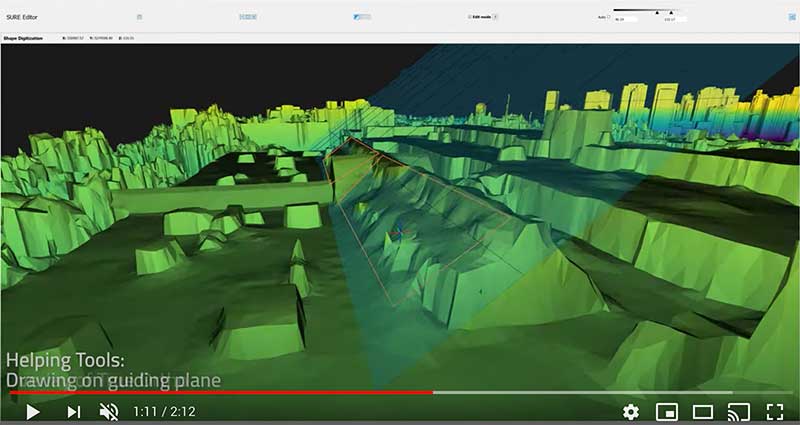
    Esri has acquired nFrames, a technology company that develops SURE, an imagery and lidar 3D surface reconstruction software.

    According to Esri, this will enable the fusion of imagery with 3D GIS, allowing nFrames and Esri users to seamlessly capture and analyze 3D data from aerial, drone and ground-based sensors in an automated end-to-end process.

    SURE scales 3D data creation to large city and countrywide airborne image datasets and projects. According to nFrames, it gives professional photogrammetry workflows improved precision, speed and simplicity on premises or in the cloud. SURE can be used for a number of industries, including those in government; national mapping; insurance; and architecture, engineering, and construction (AEC).

    Through this acquisition, Esri gains a robust production engine that transforms imagery and lidar data into point clouds, phototextured 3D meshes and true orthos, Esri said.

    SURE software editor (Screenshot: nFrames)
    SURE software editor (Screenshot: nFrames)

    In addition, SURE allows its users to generate 3D maps at scales from individual construction sites to entire cities and countries. These maps are fully automated at high resolution and repetition rates, nFrames added.

    “nFrames is a leading provider of 3D image reconstruction software and services, and I am excited to welcome the company to the Esri family,” said Jack Dangermond, Esri founder and president. “As Esri continues down its path of innovation to create a multidimensional experience, this acquisition enhances our ability to create extremely high-quality 3D data from imagery, which is critical for our customers in the municipal, planning and AEC industries.”

    SURE software will become a part of Esri’s ArcGIS platform. According to Esri, it will make SURE capabilities available in ArcGIS Drone2Map and Site Scan for ArcGIS so users can create better meshes, point clouds and true orthos from their drone imagery.

    “Together with Esri, we will be able to unlock the full value of 3D surface data through GIS by connecting geometry with metainformation to provide spatial context,” said Konrad Wenzel, CEO and co-founder of nFrames. “This fully automatic chain from data capture to analytics will enable smarter decision-making.”

    The nFrames headquarters will now serve as a new Esri research and development center based in Stuttgart, Germany.

  • Esri offers COVID-19 resources for nonprofits

    Esri offers COVID-19 resources for nonprofits

    Logo: Esri

    Esri will be providing a COVID-19 Response Package for free to all nonprofit organizations responding to the pandemic. According to Esri, this includes data, templates and solutions that are accessible through Esri’s Disaster Response Program.

    By mapping data with capabilities such as spatial analysis, Esri’s software allows organizations to track where COVID-19 cases are spreading, and — through predictive modeling — determine where additional capacity will be needed. Using data visualization in maps and dashboards, nonprofits can see affected populations, share information with stakeholders virtually and measure the impact of their response efforts, Esri said.

    “Esri enables us to identify vulnerable communities, whether they currently have unmet needs or appear to have a thin cushion with which to absorb a crisis,” said Raj Kamachee, Team Rubicon CTO and CIO. “Thanks to this wealth of location-based data, we have responded not only reactively, but have also been able to reach out proactively to these vulnerable communities, establishing a relationship during ‘blue skies’ so they have someone to call when disaster strikes.”

    According to Esri, it has supported more than 10,000 nonprofits to advance their missions with geospatial data and tools through the Esri Nonprofit Program, which was launched in 2010.

    “It’s never been more critical to ensure that nonprofits have the solutions that will enable them to target and serve vulnerable populations, understand disease spread, gauge their effectiveness and engage their communities,” said Jack Dangermond, Esri founder and president. “Our company was founded as a nonprofit, and so we share a deep commitment to the goals and mission that these organizations pursue.”

    Founded in 1969, Esri provides geographic information system software, location intelligence, and mapping.

  • Esri User Conference goes virtual because of COVID-19

    Esri User Conference goes virtual because of COVID-19

    The Esri User Conference, which usually takes place in San Diego in July, will this year be held virtually.

    “As a result of the coronavirus disease 2019 (COVID-19) crisis, we are making the decision to move the 2020 Esri User Conference in San Diego to a virtual format. This is a great disappointment to me personally, as I know it will be for many of you,” Esri CEO Jack Dangermond told those planning to attend in an April 22 e-mail.

    The following is an outline of Esri’s current plan, with more information available in the Esri UC FAQs:

    • The event will take place July 13–15, 2020.
    • The plenary session, technical workshops and Esri Showcase will be virtual, featuring many demonstrations and live discussions during the conference.
    • There will be many opportunities for networking, collaboration and real-time interaction with Esri experts and staff.
    • User presentations and the map gallery will be featured digitally.
    • A library of recorded sessions and demos will be created and kept available as an ongoing resource.
    • Registration will be complimentary for all Esri customers who are current on their maintenance or subscription.

    Dangermond also asked for ideas and suggestions solicited through a survey by April 29.

    “Forty years ago this month, we had our first User Conference in Redlands, California, with only a handful of participants,” Dangermond wrote. “While initially no one was quite sure of what the outcome would be, the event started an ongoing tradition where Esri and our users would come together, share our work, learn and create a community of common interests.

    “That first meeting on the Esri campus provided the groundwork for the annual event at which thousands of professionals from every corner of the globe meet one another, share inspiring examples of work and learn from each other’s experiences.

    “While we can’t replicate the experience of being together in person, we will do our best to create an amazing event that will continue to move you and our community forward. One of the benefits of going with a virtual format will be that organizations will be able to send an unlimited number of attendees.”

    Photo: GPS World Staff
    Photo: GPS World Staff
  • Esri to provide mapping resources to WHO Member States

    Esri to provide mapping resources to WHO Member States

    Advanced geospatial technology offered to global communities during COVID-19 crisisPhoto:

    Global mapping company Esri will provide a COVID-19 Response Package for the World Health Organization (WHO) Ministries of Health and Global Outbreak Alert and Response Network (GOARN) partners.

    The package will enable these organizations to have access to Esri’s geospatial platform and tools that can be used for reporting and analysis of cases and deaths, public health and response activities at the national level, in addition to managing testing sites, community activities and impact, and much more at the local level.

    “The intent of our partnership with WHO is about providing technology and capacity building to all the national and local Ministries of Health,” said Jack Dangermond, Esri founder and president. “Having integrated geospatial data and analytics is important to a comprehensive and dynamic response to the rapidly changing situation related to COVID-19. This is particularly true in low resource countries.”

    This contribution to the global COVID-19 response will support the digital transformation of global health information systems through mapping and analytics technology. Esri’s geospatial software helps organizations understand complex and vast amounts of data by placing it in a geographic context with sophisticated analysis capabilities such as artificial intelligence (AI).

    “While our company has always supported the efforts of governments and NGO’s when facing crises, the COVID-19 pandemic is different and requires a rapid and global response,” said Dangermond. “Our work with WHO is about helping MoHs around the world in equipping and assisting communities with our technology. We strongly believe these efforts will help combat its spread.”

    Ministry of Health or GOARN partners can request their COVID-19 Response Package here.

    Software access for students

    Esri is also providing free access to its ArcGIS platform and learning resources through its Learn.ArcGIS.com website to support college and university students who no longer have access to campus computer labs during the COVID-19 outbreak.

    Students will receive access to ArcGIS Online and over 20 apps including ArcGIS Pro, along with a library of lessons to continue their learning and complete courses. Access is available globally to students ages 18 and over.

  • Esri hits the airwaves with ‘See What Others Can’t’ campaign

    Esri has launched its first major advertising campaign with a slogan Esri President Jack Dangermond introduced at the Esri User Conference in July.

    “Unlike anyone else on this planet, you and your fellow GIS colleagues truly ‘See What Others Can’t.’ My sense is, it’s now time to share this perspective with the rest of the world,” Dangermond said.

    The campaign includes broadcast commercials, industry magazines and newspapers, at airports, on billboards and on websites.

    “We are inviting the public to join us in understanding how we see the world and how we want them to see the world,” Dangermond said. “We are hopeful this will help expand the understanding and appreciation of what our users do. We ultimately want to bring more people into our community — sharing information, working together, and finding new ways to solve the greatest challenges of today and the future.”

  • Esri, Jane Goodall Institute partner to protect ecosystems

    Esri is partnering with the Jane Goodall Institute to develop a set of tools that will help communities map and manage the ecosystems around them through a collaborative design and planning approach, aided by GIS software.

    According to the partners, these tools will help communities map, monitor, and better manage their natural resources from community forests and wildlife reserves, to water catchment and flood control areas, as well as human settlement, agriculture and agroforestry spaces.

    The Jane Goodall Institute’s community-centered conservation approach — Tacare — partners local communities and governments to create sustainable livelihoods while planning for and advancing environmental protection. The Tacare approach also achieves conservation results and addresses environmental threats — including incompatible expansion of agriculture, human settlements, harvesting forest products, disease, wildlife trafficking and illegal bushmeat trade — by consulting communities about their needs and priorities, and working together to collaboratively plan for and implement land use practices that enable their own development.

    “A key component of our success is that we work to help villagers find ways to make livelihoods that do not destroy the environment, and help them understand that protecting the environment not only conserves wildlife, but their own future,” said Dr. Jane Goodall, DBE, founder of the Jane Goodall Institute and United Nations Messenger of Peace.

    The Jane Goodall Institute uses Esri’s ArcGIS platform and Survey123 mobile app to help communities and governments in western Tanzania, Uganda and other countries in Africa to plan, monitor and protect chimpanzee populations in local protected forests outside designated national parks.

    “Conservation at the community level is essential to sustaining our natural world,” said Jack Dangermond, Esri founder and president. “Protecting global ecosystems cannot work on a global scale unless it starts locally, which is why we are honored to work with our friend and partner, the Jane Goodall Institute, on this collaboration, leveraging their years of experience working at the local scale in pursuit of conservation, balanced with the needs of human communities.”

  • Esri Living Atlas updates to shed light on global change

    Esri is updating the ArcGIS Living Atlas of the World, a vast collection of geographic information from around the globe. The updates include new data and capabilities for users to gain insight for helping in decision making, as well as a more complete and dynamic picture of the world.

    The new features were introduced at this year’s Esri User Conference, held July 9–13 in San Diego, California.

    The new Earth Systems Monitor app, powered by Living Atlas data, showing Sea Surface Temperature. (Image: Esri)
    The new Earth Systems Monitor app, powered by Living Atlas data, showing Sea Surface Temperature. (Image: Esri)

    Earth Systems Monitor. This new app (currently in beta) is powered by Living Atlas data. It allows users to see — on a 2D map or a 3D globe — historical, forecasting and real-time data for depicting land, the oceans and even the human footprint.

    Users can see where events or phenomena such as marine temperature shifts are occurring at any time on the planet, or even model global population growth and its effects, the company said.

    The configurable app will be released later this year. The app can be used with Living Atlas data layers or with other layers from an organization’s own data or ArcGIS Online.

    Wayback Imagery. This digital archive of the World Imagery basemap enables users to access more than 80 different versions of world imagery captured over the past five years.

    Each record in the archive represents a version of world imagery as it existed on the date it was published. Users can move back and forth in time and choose the imagery they want to use.

    OpenStreetMap Vector Basemap. Moving to a local scale, OpenStreetMap (OSM) is an open, collaborative project to create a free editable map of the world, built by a community of mappers who contribute and maintain data about roads, trails, buildings, restaurants and more.

    Until now, OSM was only available as a raster basemap in ArcGIS Online. The new vector basemap, introduced in beta, will be available for free to all ArcGIS users and developers.

    “The Living Atlas shows how our community of users continues to contribute to the innovations that power our technology,” said Jack Dangermond, Esri founder and president. “The beauty of these new features is that they transform the data that users are supplying into valuable online services like Earth Systems Monitor.”

    Living Atlas can be used to create indexes displaying properties such as vegetation health or soil moisture and quantifying the changes over time, enabling better understanding of the environment.

    Earth Systems Monitor, OSM Vector Basemap and Wayback Imagery are all examples of how online GIS technology is transforming traditional mapping organizations into web service providers, Esri said. These innovations are just the latest steps in creating a living digital twin of the systems and processes that help run organizations, cities and even nations.

    By fostering the adoption of apps, web maps, and collaborative efforts, Living Atlas is supporting end users who face increasing geospatial data demands, enabling them to be self-sufficient with the application of location intelligence across their organizations.

    Wayback Imagery is currently accessible, while both OSM Vector Basemap and Earth Systems Monitor will be available soon in ArcGIS Online.

  • Esri User Conference to highlight mapping technology

    Esri will be hosting its 38th annual Esri User Conference July 9-13 at the San Diego Convention Center in San Diego. The company expects more than 18,000 mapping and GIS users to attend the event, which will include 345 technical workshops and 243 presentations.

    Futurist Juan Enriquez will present the keynote speech, “Evolving Ourselves — Redesigning the Future of Humanity.” According to Esri, his talk will explore the future of humanity as it depends on the intersection of geography and genetics as we design our places and ourselves.

    Attendees will also hear presentations from users who are creating smarter organizations that can tackle complex global issues, including how to create more sustainable businesses, address homelessness, diminish poverty and counter the effects of climate change, Esri added.

    Other presenters will include:

    • Civil rights leader and activist Dolores Huerta, who will discuss how the Dolores Huerta Foundation utilizes Esri technology to inspire and organize communities to build volunteer organizations empowered to pursue social justice;
    • New York Times best-selling authors James and Deborah Fallows, who will discuss their book “Our Towns: A 100,000-Mile Journey into the Heart of America,” which provides anecdotal stories about the challenges small-town America faces; and
    • Felix Finkbeiner, a recent college graduate and recipient of the German Federal Cross of Merit, will detail his Trillion Trees Campaign — a commitment to the environment that has grown from planting 1 million trees to planting more than 15 billion trees in 190 countries under the guidance of the United Nations Environment Programme.

    “The Esri User Conference is truly as the name suggests — a conference for our users,” said Jack Dangermond, Esri founder and president. “This is an opportunity for all of us to come together and learn from each other so we can take part in personal development and organizational advancement to further the impact that we can have on our planet.”

  • Esri tech to help power UN’s new global data hub

    Esri and the United Nations Statistics Division (UNSD) are working with a number of member states to utilize a data hub that will allow countries to measure, monitor and report on sustainable development goals (SDGs) in a geographic context.

    This new hub, called the Federated System for the SDGs, is based on Esri’s ArcGIS platform and will use location intelligence to make it easier for countries to collect, analyze, and share the data required to monitor progress toward the SDGs.

    The SDGs are a set of global goals that include such objectives as poverty eradication, access to safe water, clean oceans, eliminating hunger, gender equality, climate action, peace and justice, education and other important areas on the U.N. agenda.

    The Federated System explores new pathways for facilitating dataflows and action through data hubs. It then supports and informs data-driven decision-making by making the data open, usable, interoperable and visual.

    Based on the early success, UNSD and Esri are working to advance the initial research exercise to support broader adoption by other member states and organizations in 2018.

    “The Federated System for the SDGs leverages enabling technologies and capabilities to strengthen the ability of the national and global statistical systems to manage and share data and good practices for the SDGs,” said Gregg Scott, inter-regional advisor, UNSD Global Geospatial Information Management. “This has already provided the opportunity for National Statistical Offices to condition and structure data so that it can be portrayed in a geographic context and provide more insights and enable us to look at dependencies and interdependencies across SDG indicators.”

    First introduced as a research project, participation was by invitation only and consisted of six countries: Ireland, Mexico, the Philippines, Qatar, South Africa and Senegal. These countries helped define the requirements and deployment of a web mapping and data management platform that would eventually become the hub.

    The Federated System was announced in Mexico City, Mexico, by Esri founder and president Jack Dangermond.

    “The key challenge to collaboration between nations is a common digital context,” said Dangermond. “Data hubs provide this context with location intelligence and use organizations’ core data to engage stakeholders, communicate policy, inform the public, and measure progress.”

    Participants of the UN forum in Mexico City issued a declaration on the importance of geospatial technology’s role in implementing the SDGs. Using Esri’s capabilities to enable access, collaboration, analyticsand powerful maps provides visualization and awareness that supplies the critical information needed to ensure each country meets its commitment to these goals.

    Most importantly, the Federated System allows collaboration across countries and makes it possible to measure the success of global SDG initiatives for the first time.

    For more information on how Esri supports the UN and SDG requirements, visit go.esri.com/Sustain_Dev.

  • Esri book details Native American perspective on GIS

    esri-tribal-GIS-bookA new book from Esri, “Tribal GIS: Supporting Native American Decision-Making,” tells the stories of how Native American tribes use geographic information system (GIS) technology to help manage and govern their sovereign nations.

    According to Esri, the book, in its second edition, details how dozens of tribal governments have used GIS for a number of projects, including conserving and protecting the environment, monitoring and managing infrastructure and natural resources, preserving history and culture, studying health issues and planning how to use ancestral lands. Tribes have also used GIS to conduct road inventories, manage and protect archaeological sites, plan economic development projects, and analyze and visualize health data.

    “GIS has become a common platform for problem solving by helping tribes organize and analyze data, as well as collaborate and communicate on countless issues,” said Esri President Jack Dangermond in the book’s foreword.

    The book also contains a chapter on new applications of GIS, which describes how tribal governments are taking advantage of the latest geospatial technology, including Web GIS, 3D GIS, Esri Story Maps apps and ready-to-use field data collection apps.

    Most of the stories are told by the Chickasaw Nation, the Navajo Nation, the Confederated Tribes of Siletz Indians, the Seminole Tribe of Florida, the Agua Caliente Band of Cahuilla Indians and Fond du Lac Band of Lake Superior Chippewa.

  • ‘Maps Are Alive’: Highlights from the Esri UC plenary

    Esri President Jack Dangermond describes the value of GIS at the plenary session of the Esri UC.

    “Maps are alive,” declared Jack Dangermond, Esri founder and president, on the plenary stage at the world’s largest GIS event. The 38th annual Esri User Conference is taking place July 10–14 at the San Diego Convention Center.

    We are on the cusp of a data and information explosion, Dangermond explained while introducing the conference theme “The Science of Where.”

    “We are about to launch in to a different scale,” he predicted. GIS is changing rapidly with numerous new information streams and advances in real-time data, and maps are central to understanding our changing world. GIS provides a platform for managing, analyzing and applying that data and information, he said.

    His advice? “Share, collaborate. Communicate so we collectively can learn all bout world. Let’s take our work collectively to scale.”

    GIS is vital to understanding developments in numerous areas: population growth, climate change, social changes, natural disasters and political polarization, to name a few. “We have to do everything we can to better understand and form collaborations to address these areas,” he said.

    “Today’s businesses and governments require new ways of thinking,” said Dangermond. “Our users are leading the charge, using mapping and analytics to empower digital transformation, accelerate understanding of big data, and democratize technology. It is an inspiration to see how so many different organizations are applying the science of geography and the technology of GIS to gain insight into their data and reveal hidden patterns and spatial relationships.”

    Dangermond presented numerous examples of organizations using GIS in new ways. For instance, Oak Ridge National Laboratory has created an “energyshed” map similar to a watershed map. An orchard is using GIS and GPS tracking to collect data on cherry picking. The Democratic Republic of Congo is making use of crowdsourcing to generate maps.

    Story Maps are aiding what Dangermond calls “geo-journalism,” telling stories about new developments in virtually every field.

    A screenshot of “Washington's Ice Age Floods” story map from the Washington Geological Survey.
    A screenshot of “Washington’s Ice Age Floods” story map from the Washington Geological Survey.

    Dangermond also presented the following awards:

    • Ice Age Floods, by the Washington Geological Survey, won Best Story Map.
    • The GIS Digital Transformation Award went to Abu Dhabi, which “has taken GIS to new frontiers” in every government agency with every citizen, Dangermond said.
    • The Enterprise GIS Award went to the U.S. National Geospatial-Intelligence Agency for maintaining the largest GIS database in the world, with daily updates and a user-friendly portal.
    • The President’s Award, chosen personally by Dangermond, was given to the United Parcel Service (UPS), which saves up to $400 million a year with its location-enabled Orion system. It puts the ability to update maps in the hands of supervisors, who constantly are optimizing routes. Now deployed in the U.S., the Orion system is going worldwide.

    Other speakers and their topics at the first-day plenary included:

    • Renowned author and theoretical physicist Geoffrey West — His book Scale: The Universal Laws of Growth, Innovation, Sustainability, and the Pace of Life in Organisms, Cities, Economies, and Companies, explores dynamic growth and the challenges of achieving that growth sustainably.
    • Oakland County, Michigan — Making government services more cost-effective
    • Chesapeake Conservancy — Analyzing imagery and sensor data to protect watershed areas
    • Taylor Shellfish Farms — Transforming the family-run business by implementing cloud GIS solutions so staff can perform spatial data collection in the field
    • Severe Trauma Air Rescue Service (STARS), Calgary, Canada — Powering real-time decision support systems to improve emergency services
    • Smart Dubai — Empowering one of the smart cities of the future with citizen engagement and smart growth
    • Walt Disney Animation Studios — Behind the scenes of Zootopia.