Tag: Johannes Kepler Award

  • Virginia Tech’s Mark Psiaki receives ION’s Kepler Award

    Virginia Tech’s Mark Psiaki receives ION’s Kepler Award

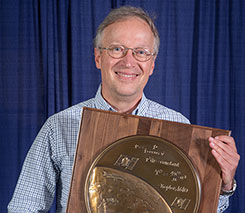
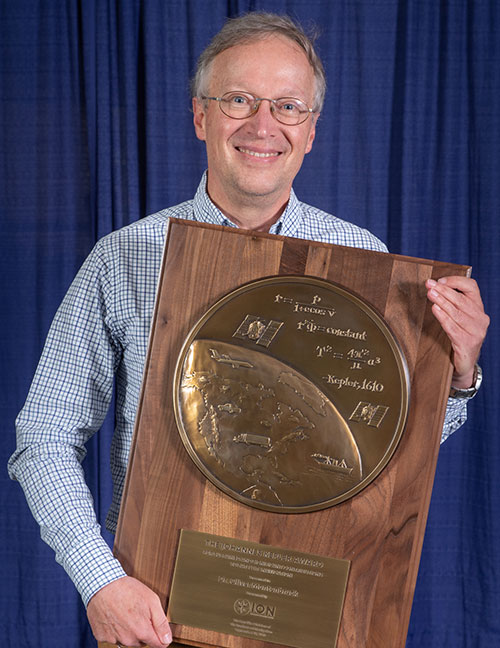
    Mark Psiaki received the  2021 Johannes Kepler Award. (Photo: ION)
    Mark Psiaki received the  2021 Johannes Kepler Award. (Photo: ION)

    The Institute of Navigation’s (ION) Satellite Division presented two prestigious awards Sept. 24 at its ION GNSS+ 2021 Conference, which took place in St. Louis, Missouri.

    Mark Psiaki received the  Johannes Kepler Award for setting a standard of rigor, clarity and thoroughness in addressing key estimation and signal processing problems in positioning, navigation and timing (PNT).

    The Johannes Kepler Award recognizes and honors an individual for sustained and significant contributions to the development of satellite navigation. It is the highest honor bestowed by the ION’s Satellite Division.

    Psiaki originated the technique of bit-wise parallel RF signal processing for use in general-purpose processors. This enabler of software-defined GNSS led to the first space deployment of a fully software-defined GNSS receiver on a general-purpose digital signal processor (DSP) and to the widespread adoption of software-defined GNSS across the aerospace industry.

    Psiaki’s real-time software radio expertise also enabled the development of a spoofer cultivated in his research group. He led the development of spoofing detection algorithms based on cross-correlation of unknown P(Y) codes and based on direction-of-arrival sensing.

    Psiaki was the lead signal processing designer/analyst for the iGPS program that combined Iridium L-band downlink signals, GPS signals and inertial navigation system (INS) data to enhance GPS anti-jam capabilities. Recent work on navigation based on low-Earth-orbit (LEO) satellites fuses observables from an existing global communications constellation with INS and other sensor data to provide a backup to GPS.

    Another contribution demonstrates how Doppler-based navigation could replace pseudorange-based navigation if implemented using a large LEO constellation.

    Psiaki has made many contributions to the practice of modeling, estimation, and detection applied to GNSS, including the study of GNSS carrier phase modeling for space-based applications.  His campaign to decode the GIOVA-A L1 BOC(1,1) PRN codes enabled Galileo receiver manufacturers to test their systems before the ESA published the codes.  His group’s work on ionospheric scintillations led to the first commercially-available scintillation simulators.

    Psiaki holds the Kevin T. Crofton Faculty Chair of Aerospace & Ocean Engineering at Virginia Tech.  He studied at Princeton University, completing a B.A. in physics in 1979 (magna cum laude) followed by an M.A. (1984) and a Ph.D. (1987) in mechanical and aerospace engineering.

    He is a past recipient of the ION’s Burka Award, its Tycho Brahe Award, and the Pride at Boeing Accomplishment Award. He is a Fellow of both the AIAA and the ION.

    PARKINSON AWARD
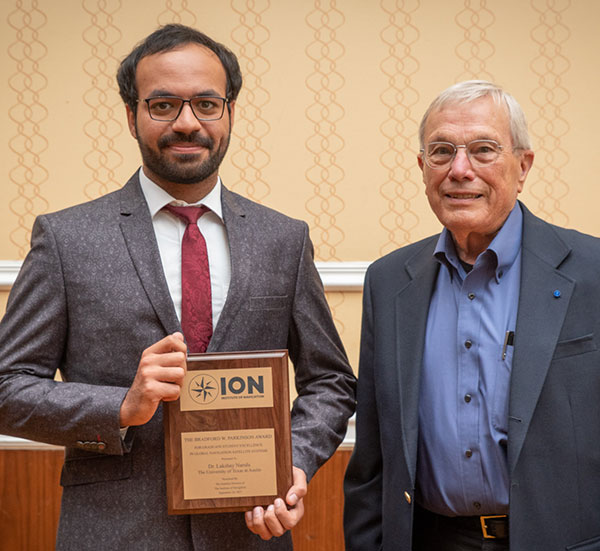
    Lakshay Narula with Brad Parkinson. (Photo: ION)
    Lakshay Narula with Brad Parkinson. (Photo: ION)

    The Institute of Navigation’s (ION) Satellite Division also presented Lakshay Narula with its Bradford W. Parkinson Award for his thesis, “Towards Secure & Robust PNT for Automated Systems.”

    The Bradford W. Parkinson Award is given annually to an outstanding graduate student in the field of GNSS. The award, which honors Parkinson for his leadership in establishing both GPS and the Satellite Division of the ION, includes a personalized plaque and a $2,500 honorarium.

    Any ION member who is a graduate student completing a degree program with an emphasis in GNSS technology, applications or policy is eligible for the award.

     

  • Jade Morton honored with ION’s Kepler Award

    Jade Morton honored with ION’s Kepler Award

    The Institute of Navigation’s (ION) Satellite Division presented several annual awards Sept. 25 during the ION GNSS+ Virtual Conference.

    Morton Honored with Kepler Award

    Dr. Y Jade MortonY. Jade Morton received the Johannes Kepler Award for advances in scientific and navigation receiver technology, automated data collection, robust carrier phase tracking, remote sensing, and profound impact as an educator and author.

    Morton is the director of the Colorado Center for Astrodynamics Research at the University of Colorado, Boulder ,where she mentors students, faculty, staff and an ever-expanding international network of collaborators throughout the world. She is a prolific author with more than 270 publications. She was awarded her Ph.D. in Electrical Engineering at Pennsylvania State University. She has also authored articles for GPS World.

    Receiver Technology Pioneer. Morton has made pioneering contributions to the advancement of GNSS receiver technology and utilization of these enhanced capabilities for scientific discovery. Her work brings together scientific rigor with state-of-the-art engineering innovations to simultaneously improve PNT, while revealing remarkable new applications for GNSS.

    Morton’s lab-developed event-driven GNSS data acquisition systems (EDAS), designed to capture severe space weather and ionosphere disturbances of GNSS signals, which could not be handled by existing GNSS monitoring receivers. Her lab designed and built remotely-configurable, multi-GNSS, multi-band, SDR hardware using off-the-shelf components; and developed software including machine-learning algorithms for automatic event detection to trigger raw data recording during these events.

    Network established. Her lab deployed these receivers worldwide. The network has enabled unprecedented studies and forecasting of ionosphere/space weather phenomena, detection of satellite oscillator anomalies, and development of advanced GNSS receivers for navigation and remote sensing under challenging conditions.

    Morton’s group has made groundbreaking advances in GNSS carrier-phase processing and established theoretical performance bounds. Her group developed optimal carrier tracking loop architectures and implementations, and successfully applied the techniques to processing signals experiencing strong ionospheric scintillation for ionosphere and space weather research; radio-occultation signals traversing moist lower troposphere for weather and climate modeling; weak coherent reflected signals from ocean, land, and sea ice for precision altimetry applications; and navigation in urban canyons and on high dynamic platforms.

    Morton is an expert on space weather and ionosphere monitoring. Her research findings range from climatology and morphology of ionospheric plasma irregularities to spatial, temporal and frequency domain characteristics; cause-effect relationships between solar-geomagnetic activities and GNSS signal disturbances; and radio wave propagation theory and simulation. The studies, based on data from her GNSS networks, magnetometers, radar and satellite-based measurements, cover the globe from the arctic to the equator and span an entire solar cycle.

    Volunteer service. Morton has served numerous organizations with thousands of hours of volunteer service including organizing each of the ION’s large technical conferences and leading over 10 student teams participating in ION’s autonomous lawn mower and snowplow competitions, is credited as one of the co-organizing founders of the ION’s Pacific PNT conference, has served as the ION Satellite Division Chair and is the current ION President. Dr. Morton is a past recipient of the IEEE Kershner Award and the ION’s Burka and Thurlow Awards. She is a Fellow of the ION, RIN and the IEEE.

    The Johannes Kepler Award recognizes and honors an individual for sustained and significant contributions to the development of satellite navigation. It is the highest honor bestowed by the ION’s Satellite Division.

    Kimia Shamaei Honored with Parkinson Award

    ION’s Satellite Division presented Kimia Shamaei with its Bradford W. Parkinson Award Sept. 25 for her thesis, “Exploiting Cellular Signals for Navigation: 4G to 5G.”

    The Bradford W. Parkinson Award is awarded annually to an outstanding graduate student in GNSS. The award, which honors Dr. Parkinson for his leadership in establishing both the U.S. Global Positioning System and the Satellite Division of the ION, includes a personalized plaque and a $2,500 honorarium.

    Any ION member who is a graduate student completing a degree program with an emphasis in GNSS technology, applications, or policy is eligible for the award. ION thanks the altruistic experts who served on this year’s selection committee.

  • ION GNSS+ 2020 advanced conference program available online

    ION GNSS+ 2020 advanced conference program available online

    Illustration: ION

    The Institute of Navigation’s (ION) ION GNSS+ 2020 advance conference program is now available online.

    The show, which is the the 33rd International Technical Meeting of the Satellite Division of the Institute of Navigation, is slated to take place Sept. 21-25 in St. Louis.

    According to ION, the show will feature Commercial and Policy tracks and Research tracks with more than 36 technical sessions Sept. 23-25, in addition to a commercial exhibit.

    ION GNSS+ 2020 will offer short courses on pre-conference tutorials to provide in-depth learning of specific GNSS-related disciplines and will again facilitate the CGSIC meeting. These will take place Sept. 21-22. ION’s Satellite Division will also bring back complimentary short courses, taught by internationally recognized PNT experts and educators on Sept. 21.

    This year’s ION GNSS+ 2020 Plenary Session will feature two dynamic keynote addresses from Dr. Christine Darden, retired NASA program manager and one of the key researchers featured in the book Hidden Figures, and Dr. Bradford Parkinson, who will be presenting “Radio Navigation from Marconi to GNSS.”

    Finally, nominations are currently being accepted for ION’s Johannes Kepler Award, which honors an individual during their lifetime for sustained and significant contributions to the development of satellite navigation, as well as the Bradford W. Parkinson Award, which recognizes an outstanding graduate student in the field of GNSS. Nominations, along with required reference letters, are due June 30.


    Check out ION GNSS+ 2019 show coverage here.

  • And ION’s prestigious awards go to…

    And ION’s prestigious awards go to…

    The Institute of Navigation (ION)’s Satellite Division presented two prestigious awards Sept. 20 at the ION GNSS+ Conference in Miami.

    Peter Teunissen receives the prestigious 2019 Johannes Kepler Award from ION's Satellite Division. (Photo: ION)
    Peter Teunissen receives the prestigious 2019 Johannes Kepler Award from ION’s Satellite Division. (Photo: ION)

    Peter Teunissen was honored with the career-highlight Johannes Kepler Award. The Johannes Kepler Award recognizes and honors an individual for sustained and significant contributions to the development of satellite navigation. It is the highest honor bestowed by the ION’s Satellite Division.

    Teunissen was recognized for his influential and groundbreaking contributions to the algorithmic foundations of satellite navigation, and for sustained dedication to the global education of the next generation of navigation engineers.

    Teunissen invented the Least Squares Ambiguity Decorrelation Adjustment (LAMBDA) method, the worldwide standard for ambiguity resolution, which revolutionized high precision GNSS positioning capabilities. LAMBDA has thus become an indispensable tool that is most widely used in land, air and space navigation; positioning and attitude determination; differential and network processing; and in surveying and geodesy. He also extended the method to MC-LAMBDA, a multivariate constrained resolution method for optimal GNSS attitude determination.

    Among others, Teunissen laid the mathematical and algorithmic foundation of reliability theory, which enables a proper understanding of the quality of different integer ambiguity resolution methods and a rigorous characterization of their failure rates, which even led to the development of an optimal test for ambiguity validation.

    His findings are particularly important for multi-GNSS processing, which require a proper understanding of individual system characteristics and their respective contributions to achieve navigation solutions of the highest precision and integrity.

    Teunissen has made contributions in the field of precise point positioning, the exploitation of triple-frequency observation, and the joint use of new GNSS such as Galileo, BeiDou and QZSS. Pioneering work in this area include the early setup of multi-GNSS receiver test beds in the Asia-Pacific area; the discovery and proper handling of mixed-receiver inter-satellite-type biases, which were vital to fully exploit ambiguity resolution in the regional, BeiDou-2 system; and the first demonstrations of mixed GPS/Galileo/IRNSS/QZSS L5 processing for precise positioning applications.

    Teunissen has made significant contributions to educating future generations. He is currently a Professor of Satellite Navigation at Delft University of Technology, The Netherlands and Curtin University, Australia.

    He received his Ph.D. at Delft University of Technology in Mathematical and Physical Geodesy. He holds several honorary professorships and fellowships of numerous international organizations, including Australia’s prestigious Federation Fellowship of the Australian Research Council.

    He has published more than 300 papers, seven books, is co-editor and author of the Handbook of Global Navigation Satellite Systems, and is a member of 13 editorial boards.

    He is a regular contributor to ION and ION programs. He is a Fellow of the ION, the RIN and the Royal Netherlands Academy of Sciences.

    Advanced RAIM topic earns Diaz the Parkinson Award

    Santiago Perea Diaz receives the 2019 Bradford W. Parkinson Award from ION's Satellite Division. (Photo: ION)
    Santiago Perea Diaz receives the 2019 Bradford W. Parkinson Award from ION’s Satellite Division. (Photo: ION)

    The Bradford W. Parkinson Award recognizes an outstanding graduate student in GNSS. It is presented in honor of Parkinson for his leadership in establishing the U.S. GPS and for his work on behalf of ION’s Satellite Division.

    Santiago Perea Diaz was recognized for graduate student excellence in GNSS in his thesis, “Design of an Integrity Support Message for Offline Advanced RAIM.”

    Any graduate student who is a member of the ION and is completing a degree program with an emphasis in GNSS technology, applications, or policy is eligible for the award.

  • Oliver Montenbruck honored with ION’s Kepler Award

    Oliver Montenbruck honored with ION’s Kepler Award

    The Institute of Navigation presents Dr. Oliver Montenbruck with prestigious Johannes Kepler Award at the ION GNSS+ 2018 Conference. (Photo: ION)
    The Institute of Navigation presents Dr. Oliver Montenbruck with prestigious Johannes Kepler Award at the ION GNSS+ 2018 Conference. (Photo: ION)

    The Institute of Navigation’s (ION) Satellite Division presented Oliver Montenbruck with its Johannes Kepler Award on Sept. 28 at the ION GNSS+ Conference in Miami. The Kepler Award recognizes and honors an individual for sustained and significant contributions to the development of satellite navigation. It is the highest honor bestowed by the ION’s Satellite Division.

    Montenbruck was honored for his pioneering contributions to GPS for navigation of space vehicles, the advancement of multi-GNSS understanding, and tracking networks to support scientific and societal benefit.

    He is head of the GNSS Technology and Navigation Group at DLR’s German Space Operations Center and an affiliated professor for GNSS at the Technical University of Munich. His research activities have been devoted to spaceborne GNSS applications, where he made contributions in the fields of receiver technology, autonomous navigation systems, spacecraft formation flying and precise orbit determination.

    These range from development of the first meter-level autonomous navigation system for micro-satellites based on Kalman-filtered GPS observations, to detailed modeling of user spacecraft antenna phase-center variations, non-gravitational forces and ambiguity fixing techniques that support GNSS-based POD precision to the 1-centimeter level in support of space geodesy.

    His unique expertise in the field has resulted in numerous consultancy tasks for national and European space industry and agencies. Focusing on the new satellite navigation systems, he has pioneered the advancement of monitoring networks, characterization of new navigation signals, GNSS performance assessment and multi-GNSS processing.

    A GPS World Leader

    In 2014, Montenbruck was honored with the GPS World Leadership Award, Products Category, for “Bringing SatNav Future into View: A Platform for Early Familiarization with New Constellations” (see his remarks here.) He also has authored several articles for the magazine, including:

    He pioneered the expansion of global monitoring networks for new and modernized GNSS, initiating the Cooperative Network for GNSS Observation (CONGO), which has been a primary source of information for early assessment of Galileo, BeiDou, GPS L2C and L5 signals. His leadership and research have contributed to a thorough understanding of new GNSS constellations, enabled the full exploitation of new signals, advanced satellite technology and made multi-GNSS available to a wider community.

    Montenbruck is an active member ION and past member of council. He serves on the IGS Governing Board and key working groups. Within the International GNSS Service (IGS), Montenbruck chairs the Multi-GNSS Working Group and coordinates the performance of the Multi-GNSS Project (MGEX).

    Montenbruck is widely recognized for his frequently cited textbooks, ~100 publications in peer-reviewed journals, more than 250 conference papers and the Springer Handbook of Global Navigation Satellite Systems, which he co-edited and authored/co-authored. He is a recipient of the ION’s Tycho Brahe Award and the DLR Senior Scientist Award as well as the GPS World Leadership Award.

    Montenbruck received his Ph.D. in 1991 and Habilitation in 2006 from the Technical University of Munich. He has supervised more than 25 master and a dozen Ph.D. theses, and served on defense committees at several international universities. As a visiting scientist, he conducted joint research projects at various international institutions, including the University of Texas at Austin, the European Space Agency, and the University of Bern.

  • GPS World advisor honored with ION award

    Terry Moore

    Shortly after GPS World’s 2017 Leadership Awards ceremony during ION GNSS+ week, the Institute of Navigation rolled out its own distinguished panel of award recipients at a conference luncheon.

    ION’s Satellite Division presented Terry Moore with the Johannes Kepler Award, its highest honor. It is perhaps a bit of editorial license to call Terry Moore “one of our own,” but he has been an advisor to the magazine for lo, these 17 years or more. During that time his technical papers have formed the basis for several feature articles, and he has guided many of his students and colleagues to authorship in these pages.

    Director of the Nottingham Geospatial Institute (NGI) at the University of Nottingham, where he has long served as professor and dean, he is also a consultant and advisor to European and UK government organizations and industry. He did extensive work on the introduction and implementation of WGS 84 as the standard reference system for air and marine navigation, developed software tools for coordinate transformations and map projections, and pioneered the use of raw GPS code- and carrier-phase data from low-cost receivers.

    He is the founding director of the GNSS Research and Applications Centre of Excellence, which targets knowledge transfer between the NGI and business. He has a long career of volunteer service for both ION and the Royal Institute of Navigation. In this as in other things he exemplifies the best of the scientific community, or of any community for that matter.

    Among his articles for the magazine are “Not Just a Fairy Tale: A Hansel and Gretel Approach to Cooperative Vehicle Positioning,” 2014; “Network RTK for Intelligent Vehicles,” 2013; “Aiding Indoor Pedestrian Navigation with Building Heading,” 2011; “Integrating Computer Vision and Inertial Navigation for Pedestrian Navigation,” 2011; “Assessing Network RTK Wireless Delivery,” 2009; “Ubiquitous Positioning: Anyone, Anything: Anytime, Anywhere,” 2007; and “Simulation GPS in Urban Traffic Environments,” 2005.

    I was privileged to serve as in-house editor for many if not all of these articles. A learning experience that could have been more so had I applied myself harder. Story of my life.

    Nowhere to be found in the curriculum vitae of this Ph.D. in space geodesy are his performance as Commander Bond in “GNSS Murder, Mystery and Mayhem at the Mansion,” where he drank a mean martini, shaken not stirred, nor his regular appearances as vocalist at the NavtechGPS Open Mic Night, most recently dueting on “Paradise by the Dashboard Lights.”

    All of us at the magazine join in congratulating Terry on this well-deserved honor!

  • Terry Moore honored with Kepler Award

    Terry Moore honored with Kepler Award

    Terry Moore
    Terry Moore

    The Institute of Navigation’s (ION) Satellite Division presented Professor Terry Moore with its Johannes Kepler Award for his outstanding contributions to the development of satellite navigation through a sustained and distinguished professional career devoted to research and teaching.

    Moore received the award Sept. 29 at the ION GNSS+ Conference in Portland, Ore. Moore is a member of the GPS World Editorial Advisory Board.

    Terry Moore has more than 30 years of research experience in surveying, positioning and navigation technologies, and is a consultant and advisor to European and U.K. government organizations and industry.

    He has taken a leading role in national and European initiatives aimed at integrating academic research and teaching activities in GNSS and interacting closely with industry.

    Moore is credited with extensive work on the introduction and implementation of WGS 84 as the standard reference systems for air and marine navigation, as well as the development of standard software tools for coordinate transformations and map projections used extensively through the aviation industry.

    Additionally, he is known for the development of GRINGO software that pioneered the use of raw GPS code and carrier phase data from low cost Garmin receivers. His work has also includes the pioneering of novel methods and algorithms for GPS orbit relaxation; which led to reduced dynamic GPS-based orbit determination for LEO spacecraft, with a real-time implementation.

    Moore is the Director of the Nottingham Geospatial Institute (NGI) at the University of Nottingham where he has responsibility for all of NGI’s research and teaching. He is also the founding Director of GRACE, the GNSS Research and Applications Centre of Excellence, which was jointly funded by the University of Nottingham and East Midlands Development Agency, and targets knowledge transfer between the NGI and business. Additionally, he leads the university-wide Aerospace and Transport Technology Research Priority Area.

    Moore has supervised numerous research projects funded by industry, research councils, the European Space Agency and the European Commission, and has supervised more than 30 Ph.D. students.

    Moore is involved in the volunteer activities of numerous international professional and scientific bodies. He is currently a Royal Institute of Navigation (RIN) Vice-President (now also President Elect) and a member of their Technical Committee, while simultaneously serving on the ION Council as a Technical Representative and as a co-chair of the ION’s Satellite Division’s Technical Peer Review Committee.

    He has served on the ION’s Satellite Division Executive Committee on numerous occasions and is a past ION GNSS+ program and general chair.

    Moore is a Fellow of both the Institute of Navigation and the Royal Institute of Navigation (RIN). He is also a Fellow of the Chartered Institution of Civil Engineering Surveyors, a Fellow of the Royal Astronomical Society and an Associate Fellow of the Remote Sensing and Photogrammetry Society. In 1999 and 2008 he was awarded the RIN Richey Medal (best paper in the RIN Journal of Navigation), in 2013 was awarded the RIN Harold Spencer-Jones Gold Medal (outstanding contributions to navigation), and in 2016 the RIN J.E.D. Williams Medal (contributions to the RIN).

    He holds a BSc degree in Civil Engineering and Ph.D. degree in Space Geodesy, both from the University of Nottingham, where he was promoted to the U.K.’s first Chair of Satellite Navigation in 2001.

    The Johannes Kepler Award recognizes and honors an individual for sustained and significant contributions to the development of satellite navigation. It is the highest honor bestowed by the ION’s Satellite Division.