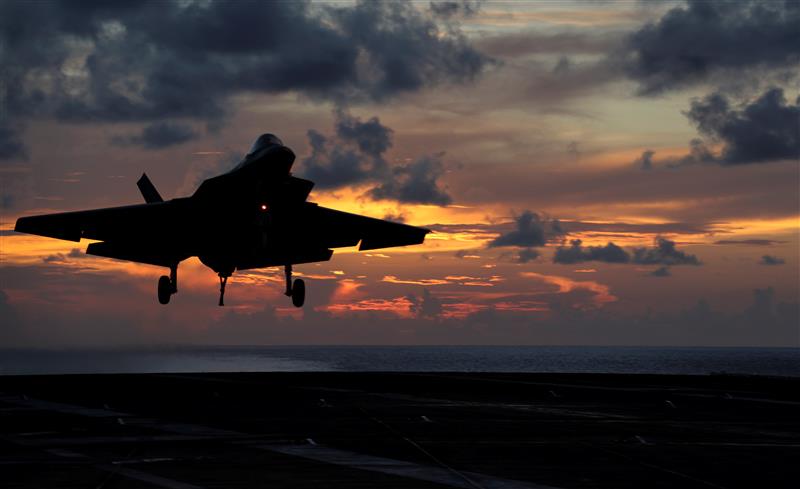
Tag: JPALS

  • Raytheon completes JPALS delivery to U.S. Navy

    Raytheon completes JPALS delivery to U.S. Navy

    Image: U.S. Department of Defense / Raytheon Technologies
    Image: U.S. Department of Defense / Raytheon Technologies

    Raytheon Technologies has delivered all 23 contracted Joint Precision Approach and Landing Systems (JPALS) low-rate production units to the U.S. Navy to ship to Japan. Raytheon announced the contract with the Navy back in February to provide JPALS to the Japan Maritime Self-Defense Force (JMSDF), which will be deployed on the JMSDF JS Izumo carrier in 2024.

    JPALS is a software-based GPS navigation and precision approach landing system that guides aircraft onto carriers and amphibious assault ships regardless of sea state or weather conditions, bolstering safety and operational capability.

    JPALS is deployed on all U.S. Navy aircraft carriers and amphibious assault ships, as well as all F-35 aircraft. In addition, JPALS are deployed on platforms from two countries: the UK Royal Navy’s HMS Queen Elizabeth, and the ITS Cavour, an Italian aircraft carrier, to support their F-35 squadrons.

    Raytheon has also developed an expeditionary variant of JPALS called eJPALS, which is a smaller, portable system that could be packaged in ruggedized cases, mounted on small vehicles, and deployed in austere, remote locations for precision landings. The system could establish up to 50 different landing points within a 20-nautical-mile radius.


  • Raytheon claims Navy contract to provide JPALS to Japan

    Raytheon claims Navy contract to provide JPALS to Japan


    Image: Raytheon Technologies video screenshot
    Image: Raytheon Technologies video screenshot

    Raytheon Intelligence and Space has been awarded a contract from the United States Navy’s Naval Air Traffic Management Systems Program Office to deliver the Joint Precision Approach and Landing Systems (JPALS) to the Japan Maritime Self-Defense Force (JMSDF). The GPS navigation and precision landing system will be deployed on the JMSDF JS Izumo carrier.  

    The JPALS system guides aircraft onto carriers and assault ships in all weather and surface conditions and is integrated on all F-35 aircraft. JPALS is also being deployed on all U.S. Navy aircraft and assault ships. 

    In addition, JPALS will be deployed on two international platforms, including the United Kingdom Royal Navy’s HMS Queen Elizabeth, and an Italian aircraft carrier, the ITS Cavour, to support its F-35 squadron. 

    The primary work locations for JPALS are in Largo, Florida and Fullerton, California.   

  • GPS-based portable JPALS landing system sets up fast

    GPS-based portable JPALS landing system sets up fast

    Raytheon’s F-35 precision landing system can be set up anywhere in less than 1.5 hours

    A Raytheon Company team has conducted a rapid set-up demonstration of a land-based expeditionary version of its Joint Precision Approach and Landing System (JPALS) to a group of global military officials at Naval Air Station Patuxent River, Maryland.

    JPALS is a GPS-based precision landing system that guides aircraft to precision landings in all weather and surfaces conditions.

    “The entire system was fully operational in 70 minutes on Day One and 50 minutes on Day Two,” said Matt Gilligan, vice president at Raytheon’s Intelligence, Information and Services business. “Raytheon is offering the U.S. and its allies fast and accurate precision landing systems that support operations from bare-base locations.”

    During the demonstration, military officials from all four services, as well as representatives from Japan, United Kingdom, The Netherlands and Italy, watched multiple F-35Cs land on the same designated runway landing point every time over the course of six different approaches.

    This was the second proof-of-concept event in 2019 showing how F-35s can use a reconfigured mobile version of JPALS to support landings in austere environments.

    JPALS is a differential, GPS-based precision landing system that guides aircraft onto carriers and amphibious assault ships in all weather and surface conditions up to the rough waters of Sea State 5. It uses an encrypted, jam-proof data link to connect to software and receiver hardware on the aircraft and an array of GPS sensors, mast-mounted antennas and shipboard equipment.

    A Raytheon technician operates the rapidly installed JPALS equipment during a demonstration at the Naval Air Station. (Photo: Raytheon)
    A Raytheon technician operates the rapidly installed JPALS equipment during a demonstration at the Naval Air Station. (Photo: Raytheon)
  • Raytheon demos land-based version of GPS-based landing system

    Raytheon demos land-based version of GPS-based landing system

    Photo: Raytheon
    Photo: Raytheon

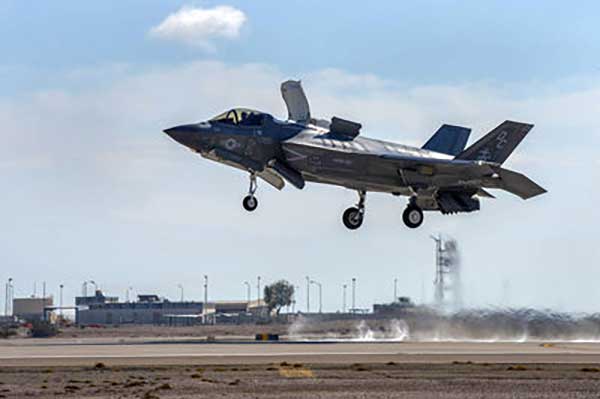
    Earlier this year, Raytheon Company demonstrated a land-based expeditionary version of its Joint Precision Approach and Landing System (JPALS) for the first time to U.S. Air Force, Navy and Marine Corps officials at Marine Corps Air Station, Yuma, Arizona.

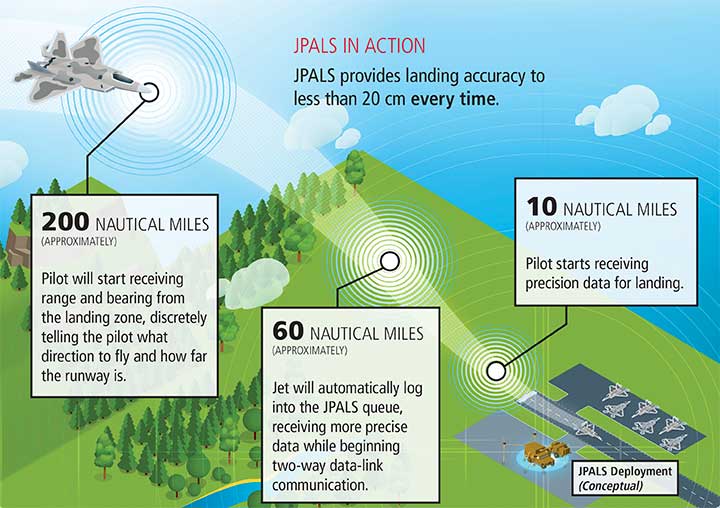
    During the demonstration, F-35B pilots used the JPALS system on the jet to connect with the expeditionary system on the ground from 200 nautical miles away. From there, the system guided the pilot to a designated landing point on the runway.

    “The need for precision landings in harsh environments isn’t limited to one military service and one airplane,” said Matt Gilligan, vice president at Raytheon’s Intelligence, Information and Services business. “JPALS can help any fixed or rotary-wing aircraft land in rugged, low-visibility environments at austere bases worldwide.”

    The proof-of-concept event showed how the GPS-based system, which is currently used to guide F-35Bs onto ships in all weather, could be reconfigured into a mobile version to support landings in a traditional airport setting.

    Infographic: Raytheon
    Infographic: Raytheon

    Expeditionary JPALS supports the U.S. Air Force’s desire to use more austere, bare-base locations for future flying operations.

    Currently in five transit cases, it could be repackaged for a variety of small transit vehicles transportable by C-130. Once on the ground, the system can be fully operational in under 90 minutes.

  • USS Wasp first carrier to use GPS-based JPALS on deployment

    USS Wasp first carrier to use GPS-based JPALS on deployment

    F-35Bs can use JPALS for precision landings in zero visibility conditions.

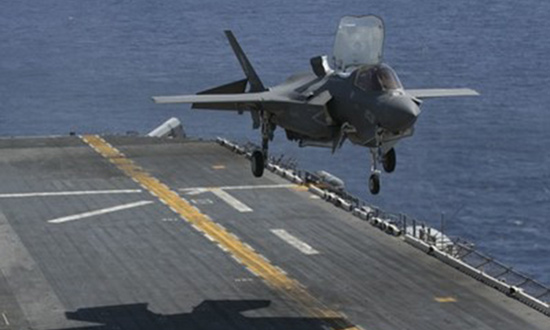
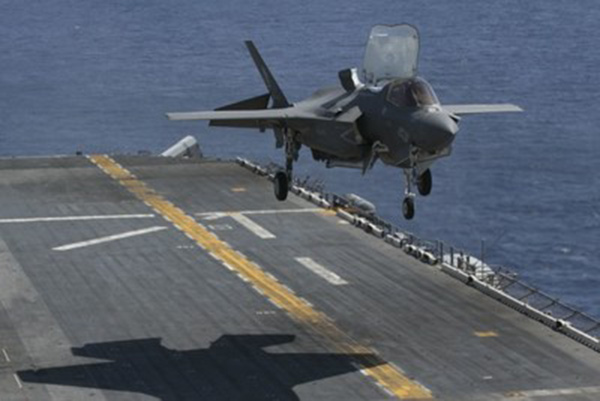
    Early in 2018, U.S. Marine Corps F-35B Lightning II fighters deployed to the Pacific aboard the USS Wasp amphibious assault ship, and used Raytheon Company’s  Intelligence, Information and Services business’ Joint Precision Approach and Landing System (JPALS) to guide them onto the ship’s deck.

    An F-35B Lightning II prepares to land on the flight deck of the USS Wasp while underway in the Philippine Sea, March 23, 2018. (Photo: U.S. Marine Corps/Lance Cpl. Amy Phan)
    An F-35B Lightning II prepares to land on the flight deck of the USS Wasp while underway in the Philippine Sea, March 23, 2018. (Photo: U.S. Marine Corps/Lance Cpl. Amy Phan)

    JPALS is a differential, GPS-based precision landing system that guides aircraft onto carriers and amphibious assault ships in all weather and surface conditions, including rough waters.

    It uses an encrypted, jam-proof datalink, connecting to software and receiver hardware on the aircraft and an array of GPS sensors, mast-mounted antennas and shipboard equipment, the company said.

    “We’re asking our pilots to land in some of the most difficult conditions on Earth,” said U.S. Navy Captain B. Joseph Hornbuckle III, program manager, Naval Air Traffic Management Systems Program Office. “JPALS goes a long way toward ensuring the safety of our aircrews and the success of our missions.”

    JPAL’s precision navigation is equally effective ashore. A land-based version of the system can be small enough to be either dropped into an austere environment via parachute or driven in on a trailer.

    “Deploying with the F-35 is a good start, but it’s just the beginning,” said Matt Gilligan, Raytheon vice president of Navigation, Weather and Services. “There are many fixed and rotary wing aircraft around the world and across the services that deploy to harsh, low-visibility environments where JPALS would be extremely valuable.”

    The system is slated to go into production in 2019 and will be outfitted on the U.S. Navy’s newest fighter — the F-35 Lightning II — allowing pilots to land with accuracy.

  • US Navy awards Raytheon $255 million for precision landing

    US Navy awards Raytheon $255 million for precision landing

    System equips the F-35 and unmanned aircraft with safer, more accurate landing guidance

     
    The U.S. Navy has awarded Raytheon Company a $255 million contract for development and production readiness of its next generation precision landing system. The Joint Precision Approach and Landing System uses GPS satellite navigation to provide more accurate landing guidance for manned and unmanned aircraft, replacing radar and beacons used in older systems.

    This contract, announced by the Department of Defense on Sept. 21 and Raytheon on Oct. 19, includes options which, if exercised, would bring the value to $270 million.

    Raytheon will complete development for an auto-land capability to be used by both manned and unmanned aircraft, as well as finalize the integration with the F-35 Joint Strike Fighter: the first aircraft to be equipped with JPALS technology.

    A U.S. Navy F-35C Lightning II lands aboard the aircraft carrier USS Nimitz in the Pacific. (Photo: US Navy)
    A U.S. Navy F-35C Lightning II lands aboard the aircraft carrier USS Nimitz in the Pacific. (Photo: US Navy)

    When operational in 2018, the U.S. Navy and Marine Corps will use JPALS on the F-35C carrier variant, F-35B short takeoff/vertical landing variant and the MQ-25A multi-mission unmanned vehicle.

    “The JPALS solution revolutionizes landings for manned and unmanned military aircraft,” said Dave Wajsgras, president of Raytheon’s Intelligence, Information and Services business. “Aviators will be able to trust this technology to provide safe, secure, and reliable landing guidance, at any time of day, in all kinds of weather and environments.”

    Developed in partnership with the U.S. Navy to provide pinpoint landing guidance on carriers in rough seas, JPALS is tailorable to a wide range of environments including contingency operations requiring rapid deployment, or land-based airfields with curved, segmented and specialized approaches, and can integrate and modernize landing systems on legacy aircraft for joint interoperability.

    JPALS improves navigational alignment prior to approach, allowing aircraft to land on any aircraft carrier or amphibious assault ship, day or night, even in adverse weather conditions. As the only military ground-based augmentation system in the world, the system features anti-jam protection to ensure mission continuity throughout a range of threat environments.