Tag: Jupiter

  • Telit autonomous nav module uses internal sensors, GNSS

    Telit autonomous nav module uses internal sensors, GNSS

    Telit has announced the commercial availability of the SL869-3DR, a GNSS module for global use that leverages information from internal gyros, accelerometers and a barometric pressure sensor to perform dead-reckoning navigation for application areas such as track and trace and in-vehicle systems.

    The module delivers accurate position data either directly from its multi-constellation receiver or from a fully autonomous dead-reckoning system, requiring no connections to external devices or components other than an antenna for satellite signal reception and power.

    The module allows integrators to design zero-installation, in-vehicle navigation and tracking devices for fleets and other commercial or consumer applications that operate perched on the dashboard, connected only to vehicle power.

    Photo: TelitThe SL869-3DR is a flash-memory based module capable of tracking three constellations simultaneously. The module integrates an array of micro electromechanical systems (MEMS) designed to provide it seven degrees of freedom. The innovative design of the internal sensor array in conjunction with the Telit MEMS-only Dead Reckoning (MoDR) software and intellectual property, deliver the host device unparalleled portable, turnkey dead-reckoning performance.

    The Telit MoDR solution ensures that reliable position, velocity and time information is constantly available to the host application even when GNSS coverage is compromised, without the need for connection to the vehicle for wheel-ticks for speed or reverse-gear data. Its standard footprint lets navigation and tracking system integrators reuse existing device designs, eliminating complexity from external sensors and other apparatus, getting to market quickly with updated designs or product innovation.

    “A significant number of the millions of commercial vehicles and fleets on the roads today are still operating with no or unreliable navigation systems because installation costs to connect the device to vehicle sensors are too high and require very specialized skills,” said Felix Marchal, executive vice president of GNSS and Short Range Wireless. “With the SL869-3DR we overcome that barrier because it enables devices that you simply connect to vehicle power and go. Up until now, ‘power-and-go’ navigation systems have largely relied on open-sky visibility, which is not typically where most commercial fleets operate. They are moving through tunnels, urban canyons and other environments where these systems cannot produce a position solution. Reliable MEMS-only dead reckoning, or MoDR as we call it, relies on very complex mathematical modeling and expert design of the sensor array. Developers must therefore, thoroughly scrutinize performance of the different products in the market. I am delighted that the SL869-3DR has outperformed competing products in its class across a wide range of test cases.”

    The SL869-3DR is designed to support GPS, QZSS, GLONASS, Beidou and is Galileo ready. Telit MoDR technology boosts position accuracy in areas with adverse satellite reception conditions like urban canyons, overhead foliage, tunnels and parking garages. It integrates an embedded array of sensors including accelerometers, gyroscopes and a barometer (pressure sensor).

    An antenna ON, antenna sense (open / short circuit) feature, allows the host application to inform the user of problems with the connection to the external antenna. An additional LNA delivers better sensitivity in harsh environments, better enabling devices with integrated antennas. The module also features fast calibration and is pin-to-pin compatible with the SL869, SL869-V3 and SL869-ADR.

    Below is a video where performance the autonomous SL869-3DR MoDR is compared with the SL869-ADR automotive navigation module connected to vehicle sensors (wheel ticks and reverse signal).

    https://youtu.be/H9V0tIM8CDw
  • Telit Introduces Jupiter GPS Module for Migration to Full GNSS

    Telit Introduces Jupiter GPS Module for Migration to Full GNSS

    The Jupiter SL871-S.
    The Jupiter SL871-S.

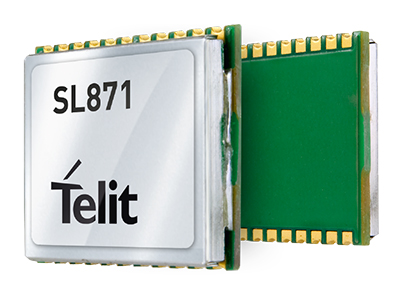
    Telit Wireless Solutions has debuted the Jupiter SL871-S, designed for easy migration between a full-GNSS solution for top-ranked applications and a simple GPS-only solution for less demanding applications. The Jupiter SL871-S is designed to track and navigate GPS and QZSS constellations while ensuring pin-to-pin and protocol compatibility with its multi-constellation companion module, the SL871.

    The module comes in a 9.7 x 10.1 millimeter LCC package with an ARM7 baseband processor, embedded ROM memory, and integrated LNA. It delivers geolocation data using NMEA protocol through a standard UART port. It supports ephemeris file injection (A-GPS) as well as Satellite Based Augmentation System (SBAS) for increased position accuracy.

    In addition, its extremely low power consumption in all conditions is suited to applications requiring long battery life.

    SL871-S has been designed to ensure hardware and software compatibility with SL871, allowing customers to design once and take advantage of the xL871 common form factor. Benefits include:

    • Pin-to-pin compatibility with SL871 family,
    • Same protocol used in SL871,
    • Straightforward migration between full-GNSS solutions and GPS-only solutions,
    • Satellite Based Augmentation System (SBAS) support for increased position accuracy, and
    • Assisted GPS.

    The SL871-S can replace the SL871, allowing customers to design once and interchangeably mount the appropriate solution depending on the required features.

    “The new SL871-S module designed to be easily swapped with other xL871 modules for enhanced simplicity and scalability,” said Taneli Tuurnala, CEO of Telit GNSS Solutions. “It is an ideal example of how buying a module from Telit enables our customers to avert the need to keep track of the latest chipset technology on their own. We keep them on top of the best available technology, pre-packaged in a module that is easy to replace as needed, without having to redesign their entire application to stay up to date.”

  • Parsec Antennas Designed for Telit Mini GPS Receiver

    Parsec Antennas Designed for Telit Mini GPS Receiver

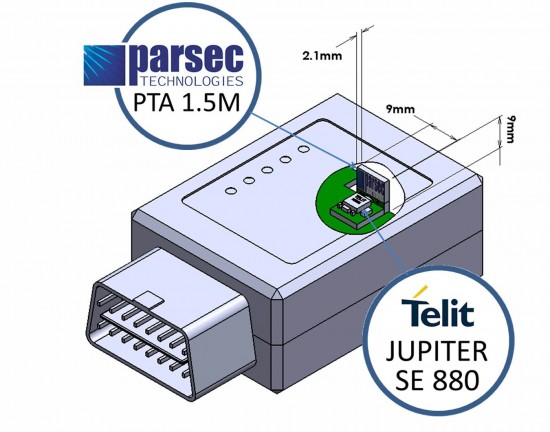
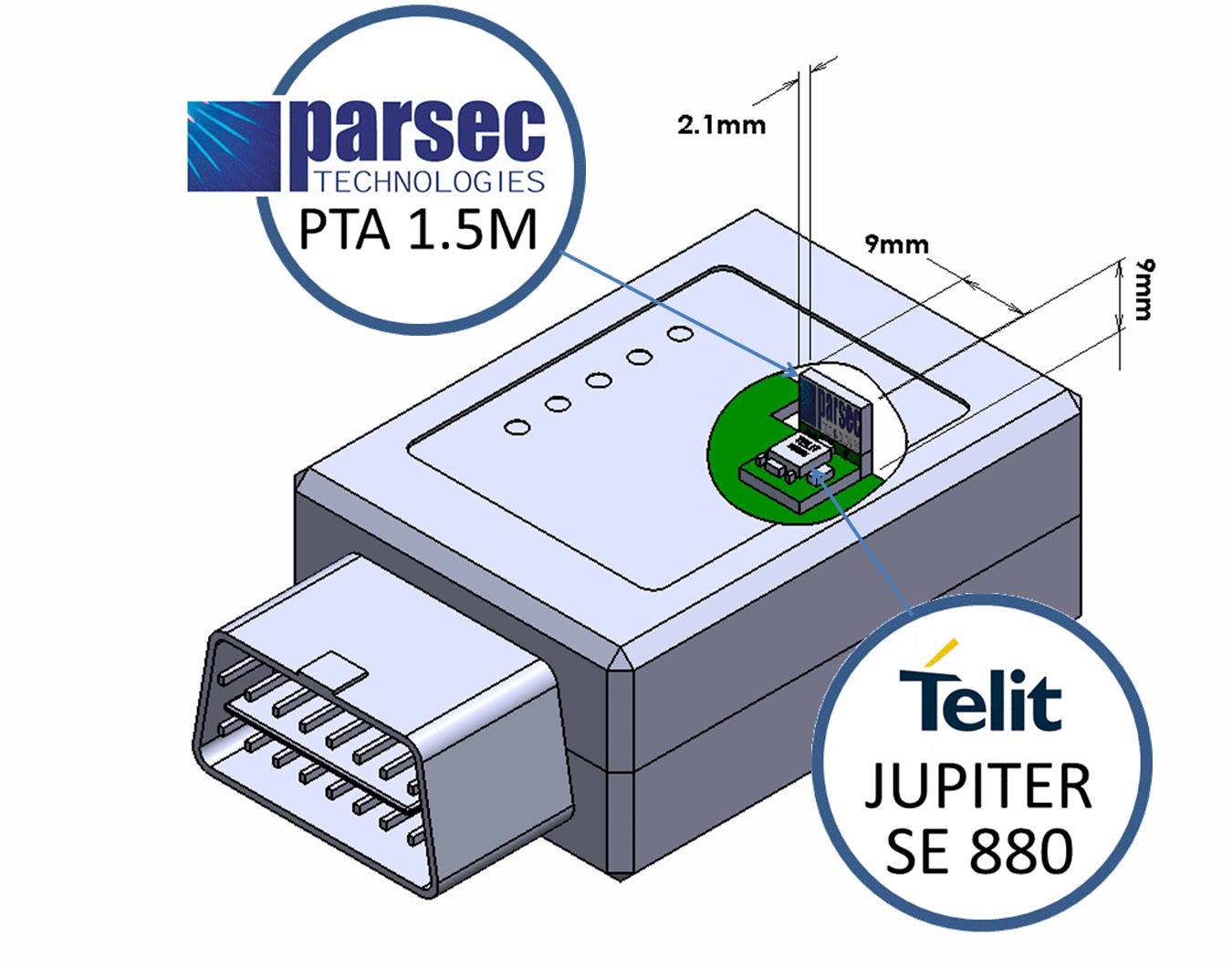
    Telit Wireless Solutions and Parsec Technologies today announced that a combination of the companies’ technologies results in a low profile  companion solution for GPS receiver and antenna. For host devices able to accommodate higher volumetric symmetry, assembly of the components can be made to fit a 6 x 16 x 8 millimeter volume. A flat component arrangement can yield an ultra-low-profile volume of 6 x 16  x 2.4 millimeters.

    ParsecTelitFig1 OBD“Receivers combining the Parsec PTA/PT Family and Telit’s Jupiter SE880 modules deliver good user experience in finished LBS (location-based services) critical products without sacrificing design flexibility, ease of implementation or cost,” said Michael A. Neenan, CEO and founder of Parsec Technologies, Inc. “The combination is ‘bullet-proof’ in providing a rewarding design experience making RF work reliably, passing end-product regulatory compliance testing without re-test.”

    “Miniaturization is a major enabler of new application areas for positioning and M2M,” said Taneli Tuurnala, Vice President and Head of GNSS Division of Telit Wireless Solutions. “With the Parsec antennas, the complete receiver features the industry’s ‘smallest landed footprint,’ making it suitable for use in wearable electronics, UBI devices or adapters for the mobile computing industry.”

    Along with miniaturization, the receiver outperforms top traditional designs, handling a loss of 10 dB or greater in GPS signal reaching, for example, the typical OBD port under a vehicle’s dashboard where many usage-based insurance (UBI) dataloggers are installed. The PTA1.5M active antenna delivers the ultra-sensitive Jupiter SE880 micro receiver over 15 dB of additional gain in the operating frequency range. Both companies are making available complete application notes to simplify the engineering effort for system integrators.

    The miniature 4.7 x 4.7 millimeter LGA (Land Grid Array), SiRFstarIV-based Jupiter SE880 receiver module employs heterogeneous 3D integrated technology to achieve best-in-class performance in all dimensions critical for regular or size-constrained GPS applications. Its RF front-end employs spatially calibrated waveguide-quality radio paths inside the three-dimensional space of its architecture, reducing parasitic impedances characteristic of traditional 2-D RF designs. Inside, a multi-filter system includes not only the traditional SAW filters typical in GPS receiver designs but also a 2.4-GHz notch-filter capable of nullifying the jamming effects of high-energy radio devices such as Wi-Fi hot-spots, Bluetooth systems, cordless phones, and others, which greatly affect a GPS receiver’s ability to resolve timid satellite signals in the hostile radio environment where they need to operate.

    The PTA1.5M, with a gain of 15dB, and PTA1.5x2M, with a gain of 30dB, are tiny GNSS active antenna modules capable of receiving signals down to -192 dBm with frequency centered at 1575.42 (±1.023) MHz. Either model delivers a radiated efficiency greater than 60% when mated to the Jupiter SE880 receiver. Parsec’s PT1233D LNA also has the highest available IP3 at low voltage, helping eliminate interference. Both PTA1.5M and PTA1.5x2M can incorporate the antenna element, an optional SAW filter, the cascadable PT1233D LNA, matching and passives components, on a low cost, easy to integrate 10×16 mm single sided PCBA with “back side” copper clad ground plane. The height of the PTA1.5M and PTA1.5x2M modules vary according to application, allowing their use in even the smallest form factors including Intel’s M.2 Next Generation Form Factor (NGFF) module (23x30x2.4 mm, LxWxH).

  • CSR Launches SiRFstarV 5e GNSS Location Solution

    CSR Launches SiRFstarV 5e GNSS Location Solution

    Photo: CSR plc CSR plc has debuted the SiRFstarV 5e, a GNSS engine optimized to enable highly accurate location positioning for devices including mobile phones, cameras, and health and fitness products. By supporting fully concurrent GLONASS, GPS, QZSS, and SBAS from ROM, the highest accuracy and fastest time-to-first-fix (TTFF) are ensured.

    Wireless solutions specialist Telit Communications plc will be using the solution for its Jupiter SE868-V2 module, which was launched at CTIA Wireless 2013 in Las Vegas. The 11 x 11 millimeter QFN packaged receiver module integrates 5e, TCXO, SAW, and RTC oscillator into a small convenient package, accelerating time-to-market and reducing product development risks. CSR believes its advanced power saving modes make it extremely battery-power friendly and ideal for wearable and personal navigation applications.

    “The Jupiter SE868-V2 excels in all positioning tasks and foremost in applications requiring high reliability navigation,” says Felix Marchal, Chief Product Officer at Telit Wireless Solutions. “By using CSR’s SiRFstarV 5e solution, we have been able to create a quick and convenient upgrade path for our Jupiter JF2 GPS module customers to the latest and most robust multi-constellation support available in the market.”

    SiRFstarV 5e offers a range of features to increase accuracy, improve time to first fix and preserve battery power to enable a better user experience. These include:

    InstantFix Extended Ephemeris (EE) — Devices without wireless connectivity, such as cameras, are able to overcome slow TTFF, a common annoyance for the end user. 5e is capable of autonomously forward predicting EE for three days locally, and for connected devices the solution supports server based EE for up to 31 day for GPS and up to 14 day GLONASS EE

    Direct to battery capability — The GNSS chip can connect directly to a Lithium battery supply, enabling system cost reduction and increased power efficiency. This is implemented by an integrated switched PMU, reducing system level power and eBOM costs

    Design flexibility for optimal solution cost — With clear attention to solution implementation, 5e is designed for small size and low power. For example, UART and SPI Flash drive levels are drivable from 1.8v to 3.3v, eliminating the need for level shifters and increasing implementation flexibility

    Intelligent design — The 5e is designed to be optimised for low power battery operated devices. For instance, in asset tracking applications, the 5e engine will intelligently decide how long to try to acquire satellite signal based around its environment, saving a significant amount of battery power

    “The SiRFstarV 5e device allows our customers to select a high performance solution that will deliver end users a seamless navigation and location experience whatever the application,” says Dave Huntingford, Director of Location at CSR. “The fact that Telit has already seen the potential of SiRFstarV 5e and selected it for its Jupiter SE868-V2 module reflects the location accuracy benefits afforded by the 5e.”

    SiRFstarV 5e is offered in a size optimal 0.4-mm pitch Wafer Level Chip Scale Package (WLCSP) and a 0.5-mm pitch Ball Grid Array (BGA) for low cost PCB applications.