Tag: KVH FOG

  • KVH and VectorNav collaborate to offer precision inertial navigation system

    KVH and VectorNav collaborate to offer precision inertial navigation system

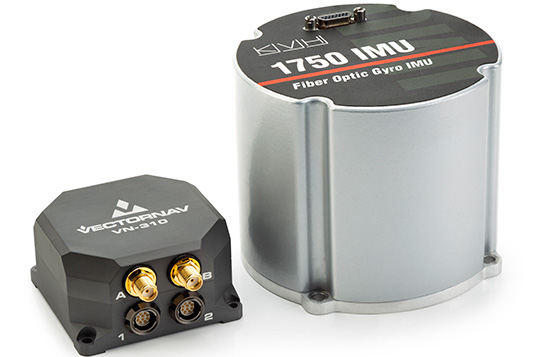
    VectorNav’s Tactical Series line of inertial navigation systems now supports KVH’s high-performance fiber optic gyro-based 1750 IMU and 1775 IMU.

    Inertial sensor companies KVH Industries Inc. and VectorNav Technologies LLC have announced that KVH’s fiber optic gyro (FOG)-based 1750 IMU and 1775 IMU will now be offered to enhance the operation of VectorNav’s VN-210 and VN-310 Tactical Series GNSS-aided inertial navigation systems.

    The products are on display in KVH’s (#2600) and VectorNav’s (#2214) booths at the AUVSI Xponential conference in Denver, Colorado, taking place April 30-May 3.

    The VectorNav Tactical Series products with KVH’s FOG-based inertial measurement units (IMUs) combine the precision and reliability of KVH’s FOG technology with the robust filters and high-performance navigation algorithms of VectorNav’s inertial navigation systems.

    The combined capabilities represent an affordable, effective alternative to larger, higher-cost inertial navigation systems and provide improved accuracy in challenging environments, the companies said.
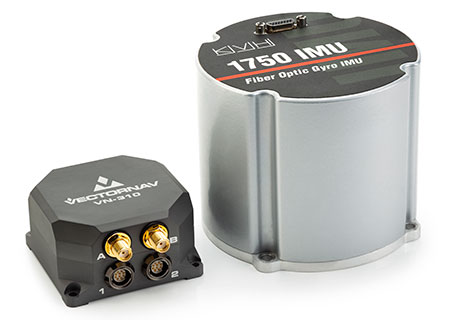
    Photo: VectorNav/KVH
    Photo: VectorNav/KVH

    VectorNav’s Tactical Series includes an onboard micro-electromechanical systems (MEMS)-based IMU, which provides some advantages for customers who have constraints in terms of size and weight in their navigation and stabilization applications.

    However, in terms of inertial accuracy, the most demanding applications require performance that can only be delivered by FOG-based IMUs, for which KVH is a leading provider.

    The VectorNav Tactical Series products with KVH FOG-based IMUs are designed for such applications as:

    • Satcom On The Move
    • gimbal and camera pointing and stabilization
    • weapons systems targeting and stabilization
    • autonomous vehicle navigation
    • lidar mapping
    • georeferencing

    or any application where MEMS-based solutions are unable to deliver sufficient accuracy and precision.


    Watch this video from Xponential 2018 to learn more about the partnership.


    A single cable connects the two systems, running from KVH’s 1750 IMU or 1775 IMU directly to the auxiliary port on the VN-210 or VN-310. This pairing creates a fully integrated FOG-based inertial navigation system designed to provide a high-accuracy, continuous positioning, velocity, and attitude solution.

    KVH is a leading innovator for assured navigation and autonomous accuracy using high-performance sensors and integrated inertial systems. KVH’s widely fielded TACNAV systems are in use by the U.S. Army and Marine Corps as well as many allied militaries around the world.

    KVH’s FOGs and FOG-based IMUs are in use today in a wide variety of applications ranging from optical, antenna, and sensor stabilization systems to mobile mapping solutions and autonomous platforms and cars.

    “We are pleased to feature KVH technology in our Tactical Series and give our customers the option of utilizing a FOG-based IMU for higher precision performance to support a wide range of demanding applications,” said Jakub Maslikowski, director of sales and marketing for VectorNav.

    “The combination of VectorNav’s Tactical Series products with our FOG-based IMUs provides a great solution for applications that require advanced inertial navigation capability and FOG-level IMU performance,” said Jay Napoli, vice president of FOG/OEM sales for KVH.

  • PNT Roundup: Self-driving cars need FOG, inertial

    New products come to market poised for take-off

    KVH high-precision fiber-optic gyro. The red illumination in the photo represents light moving through the FOG’s optical circuit of coiled fiber. This circuit is the FOG’s sensing unit, mounted with power and processing electronics within a driverless car to provide precise data for the car’s navigation systems.
    KVH high-precision fiber-optic gyro
    The red illumination in the photo represents light moving through the FOG’s optical circuit of coiled fiber. This circuit is the FOG’s sensing unit, mounted with power and processing electronics within a driverless car to provide precise data for the car’s navigation systems.

    Fiber-optic gyros (FOGs) and FOG-based inertial measurement units (IMUs) form key parts of the integrated sensor systems essential for highly accurate autonomous car performance. For example, FOGs provide precise azimuth measurements that an autonomous car’s logic processing unit and control systems need to determine motion through a curve.

    An IMU — which can include FOGs and accelerometers in one compact package — also provides highly accurate six-degrees-of-freedom angular rate and acceleration data to precisely track the position and orientation of the car even when GPS is unavailable, helping the car stay on course.

    KVH Industries is developing a FOG-based, low-cost inertial sensor for self-driving cars. The company has also released a Developer’s Kit to assist design engineers with integrating FOG technology into driverless car control systems.

    “Extremely precise heading based on fiber-optic gyro technology is absolutely essential for autonomous vehicle performance,” said Martin Kits van Heyningen, KVH’s chief executive officer. “This is something we learned from having been involved with more than a dozen driverless car development programs over the years.”

    “What we are seeing now is that each driverless vehicle concept in development around the world is being designed in a unique way,” van Heyningen continued. “With so many different possibilities, developers can accelerate their progress by working with a proven technology such as KVH’s FOGs and FOG-based IMUs and leveraging our experience to ensure their success.”

    Developer’s Kit

    The new Developer’s Kit includes the user interface software and all components needed to connect a KVH FOG or FOG-based IMU to a computer to configure, analyze and test a unit. “The kit is designed to help engineers get up and running in minutes, making it easier to run diagnostics and accelerate their system development,” said Roger Ward, KVH’s director of FOG product development.

    “We have successfully produced more than 90,000 fiber-optic gyros for an extensive range of unmanned applications, in part because of our ability to tailor size, performance and cost to meet different design needs,” said Jeff Brunner, KVH’s vice president for FOG operations. “Controlling the entire FOG design and manufacturing process gives us that advantage, and makes it possible to produce a low-cost sensor when driverless cars enter full-scale production.”

    KVH’s FOGs and FOG-based IMUs are in use in prototype programs not only for autonomous cars, but also for production programs for underwater unmanned vehicle navigation and rail/track geometry measurement systems, to name just a few. In addition, KVH’s inertial products have been widely adopted for commercial applications such as land-based street-mapping platforms, unmanned aerial systems, camera-stabilization systems and remotely operated subsea systems.

    KVH’s 1750 IMU was an integral part of 11 of the 23 humanoid robot finalists in last year’s DARPA Robotics finals, a competition designed to showcase robots capable of intervening for and even replacing humans in high-risk situations such as fires, earthquakes and other natural disasters.