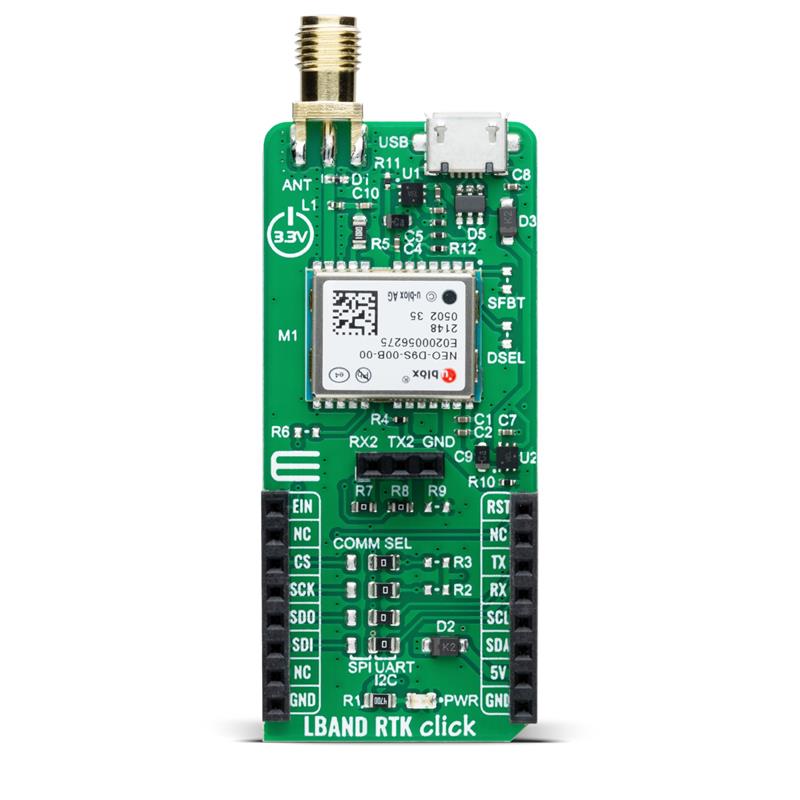
LBand RTK Click is a compact add-on board that provides access to L-band GNSS corrections. The board features the NEO-D9S-00B, a professional-grade, satellite data receiver for L-band corrections from u-blox.
Operating in a frequency range from 1,525 MHz to 1,559 MHz, the NEO-D9S-00B decodes the satellite transmission and outputs a correction stream. This enables a high-precision GNSS receiver to reach accuracies down to centimeter-level. An independent stream of correction data, delivered over L-band signals, ensures high availability of position output.
LBand RTK Click also uses several mikroBUS pins. The EIN pin routed to the AN pin of the mikroBUS socket is used as an external interrupt feature activated through a population of the R6 0Ω resistor.
In addition, LBand RTK Click contains an SMA antenna for connecting a Mikroe-brand antenna. This antenna easily allows positioning in space, supporting GNSS L-band frequencies.
LBand RTK Click implements advanced security features such as signature and anti-jamming mechanisms. It can also be integrated with other GNSS receivers from the u-blox F9 platform.
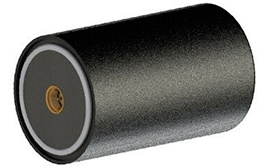
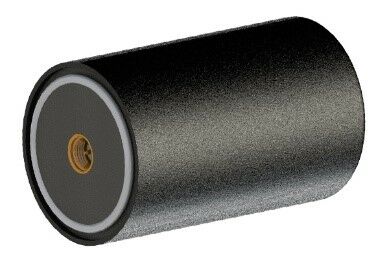
Maxtena has introduced a new multi-frequency antenna shaped for high-precision applications featuring L-band corrections.
Photo: Maxtena
The design will offer simultaneous GNSS reception on L1: GPS, GLONASS, Galileo, Beidou, L2: GPS L2C, Galileo E5B, and GLONASS L3OC, and L5: GPS + L-band corrections in a rugged, compact, and ultra-lightweight form factor. The antenna is well suited for high precision applications. The M9HCT-A-SMA is a great fit for the UAV markets, where high performance and low weight are driving features in antenna selection.
The new rugged active helix antenna is designed and manufactured using automotive grade electronics for GIS, RTK and other GNSS applications.
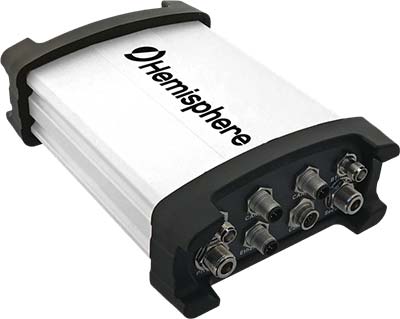
Hemisphere GNSS has introduced the Vector V1000 GNSS receiver for precision marine applications. The V1000 provides high-accuracy heading, position, pitch, roll and heave data.
The company made the announcement at the Oceanology International conference being held this week in London, U.K.
The V1000 supports multi-frequency GPS, GLONASS, BeiDou, Galileo, QZSS and IRNSS (with future firmware upgrade and activation) for simultaneous satellite tracking. The receiver is powered by Hemisphere’s Athena real-time kinematic (RTK) engine and is Atlas L-band capable.
The new V1000 is designed for professional marine applications, such as hydrographic and bathymetric surveys, dredging, oil platform positioning, buoys and other applications that demand the highest level 3D positioning accuracies. Based on Hemisphere’s Eclipse Vector technology, the V1000 uses the most accurate differential corrections including RTK and Atlas L-band.
The V1000 is Hemisphere’s flagship receiver, with an integrated display, that can be conveniently installed near the operator. The two antennas can be installed at user-specified separation, providing valuable flexibility in terms of install locations and desired heading accuracy.
The V1000 has heading accuracy of better than 0.01 degree when using a 10-meter antenna separation. With CAN, serial, Bluetooth, Wi-Fi and Ethernet support and flexible installation, the all-new rugged enclosure gives the V1000 the advantage of working reliably in harsh environments, the company said.
It used to be that professionals using precision GNSS applications had to go to the expense of buying, operating, and maintaining RTK base-stations and radio set-ups. Then L-Band corrections came on the scene and things changed. Most precision receiver manufacturers supply an L-band option for a nominal fee, and also sell PPP service subscriptions. There are now a number of PPP correction service providers offering higher precision, including a couple of new options.
As a quick overview — L-band is just like WAAS, but with privately owned assets, rather than provided by a state agency. WAAS focuses on high integrity and accuracy, while L-band corrections are largely more focused on providing accuracy to users. A geographically distributed ground network of base stations sends receiver data to one or more central processing facilities, which formulate wide area corrections. A number of uplink stations then send these corrections up to geostationary satellite transponders (time on a number of satellites is often rented, but L-band companies could also own and operate their own satellites), and the transponders transmit the wide area corrections at L-band frequency for reception by suitably configured user receivers. Users are able to buy subscriptions that enable them to receive corrections for a period of time — and that’s how the private L-band suppliers make money. The accuracy a user can achieve depends on the service, but anything from a few meters to a few centimeters is now possible.
Before WAAS was fully operation in the U.S., L-band corrections supplied by private companies were already available. It became possible to regularly get meter-level accuracies without base-stations, and it was clear that this could well turn into a major benefit for users. Operations like agricultural automation, asset tracking, mining, marine navigation, and others that could get by with a few meters of accuracy began to rely on L-band corrections. Geographic Information Systems (GIS) could even work without base stations, and vehicle tracking could determine which side of the road a truck was on. Then with expanding worldwide ground networks, more satellites and ever-improving clock and orbit algorithms, we started talking about corrections that gave us decimeter accuracies. That’s when PPP began to outpace WAAS for some applications requiring higher precision.
Never quite got the significance of why the original marine PPP companies were spinning off land-focused providers from their marine businesses, but the original marine correction providers now have successfully established “land-only” provider companies. It makes sense to have a supplier talk to you in marine terms if you’re running a shipping company, and for that provider to focus on providing higher integrity corrections to your shipping fleet. Land-based machine control, GIS and vehicle tracking outfits, on the other hand, want their own land-based support networks and don’t want to talk in marine terms. So we now have a number of providers supplying different sets of PPP corrections. It’s also possible that segment pricing for the different markets might have played a role in these spin-offs.
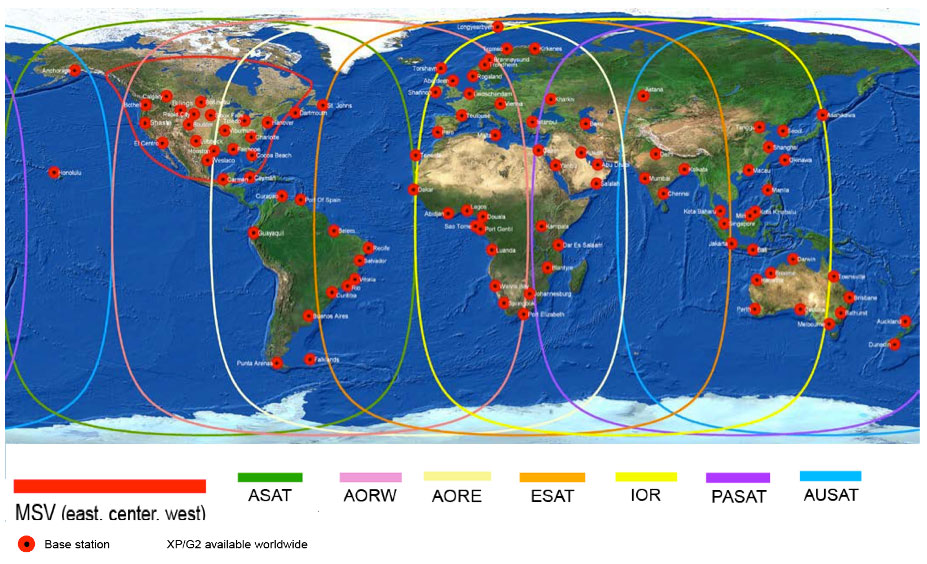
The granddaddy system would seem to be Fugro’s OminSTAR — whose services are now marketed by Trimble following acquisition of OminSTAR marketing rights by Trimble in 2011, while Fugro retained its marine services. OminSTAR HP, G2, XP and VBS services are available courtesy of a worldwide network of reference stations, data networks, carrier-phase measurements and sophisticated “clocks and orbits” correction algorithms which provide sub-meter thru 10-cm capability to users.
The OmniSTAR network.
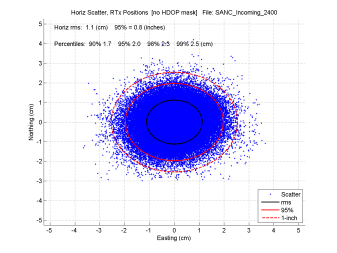
And of course Trimble is also running its own RTX service alongside OmniSTAR. With a world-wide reference station network, and a number of concentrated regional networks, CenterPoint RTX is regularly achieving less than 4cm for users. RTX is available over regular L-band satellite and over internet. Overall an impressive PPP capability.
The CenterPoint RTX network, by Trimble.
Then NavCom — and Deere & Co, its parent company — fielded the StarFire system for both NavCom and John Deere customers, who not surprisingly use it mainly for agriculture. However, use of the system has grown since it was introduced in 1999 and currently around 10 percent of customers are in markets other than ag — in offshore, survey, construction, aerial, GIS, and government/military applications. The StarFire signal is available worldwide but NavCom offers two differently priced services: “Land Only” and “All Area” for non-ag applications. You have to have Navcom or John Deere equipment to be able to use it, but the network and the receivers come from the same people, so the system has been optimized for peak performance and there shouldn’t be concerns about third-party integrators or service providers.
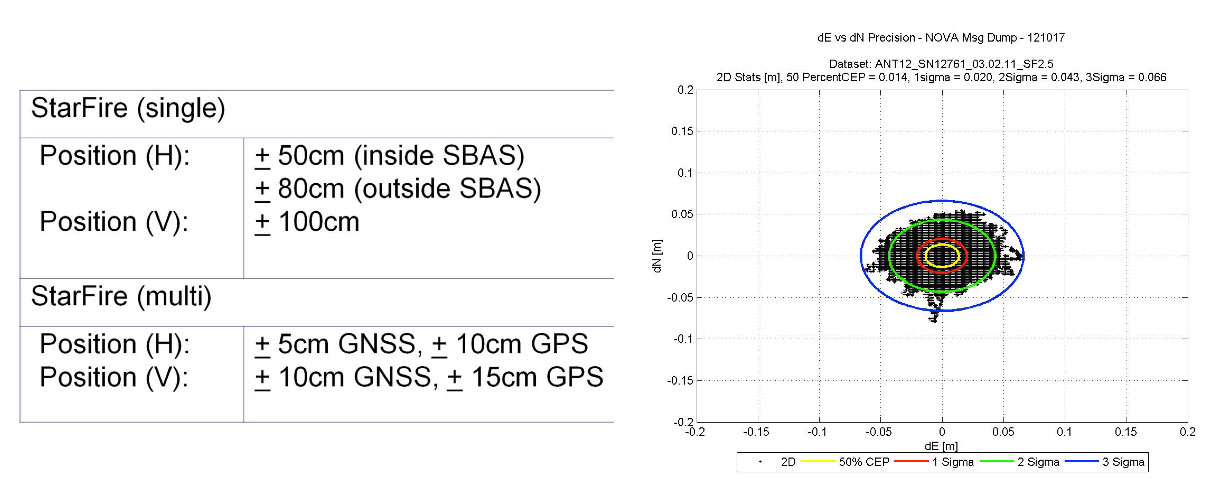
In 2001 in collaboration with JPL, Real Time GIPSY (RTG) was combined with the existing StarFire clocks and orbits algorithms and a StarFire GPS 10-cm service was offered. Nowadays StarFire GNSS has evolved out of that original correction service and claims impressive 5-cm accuracies using its multi-constellation GPS and GLONASS corrections.
The Starfire GNSS network.
StarFire also uses over 80 reference stations with mostly GPS/GLONASS receivers providing carrier phase data for redundant processing and distribution by L-band transmissions over the Inmarsat satellite network.
Then we come to the latest entrant into the land PPP business – TERRASTAR. The parent company Veripos has been around since 1989 and has been extremely successful in its marine business, going public in 2012 on the Oslo stock exchange. Veripos recently launched TERRASTAR to better address the land market for all the same good reasons discussed earlier. TERRASTAR provides two correction services: –M is meter level DGNSS and –D is a decimeter solution using both GPS and GLONASS. All the 80+ owned and operated reference sites around the world have dual-frequency GPS/GLONASS receivers, and there are plans to add Galileo and even COMPASS in the future.
Dual-redundant processing and network servers ensure uninterrupted distribution of GPS and GLONASS orbit and clock corrections, enabling decimeter accuracy for users. TERRASTAR distributes corrections over all seven Inmarsat GEOs, providing most land users with redundant L-band visibility.
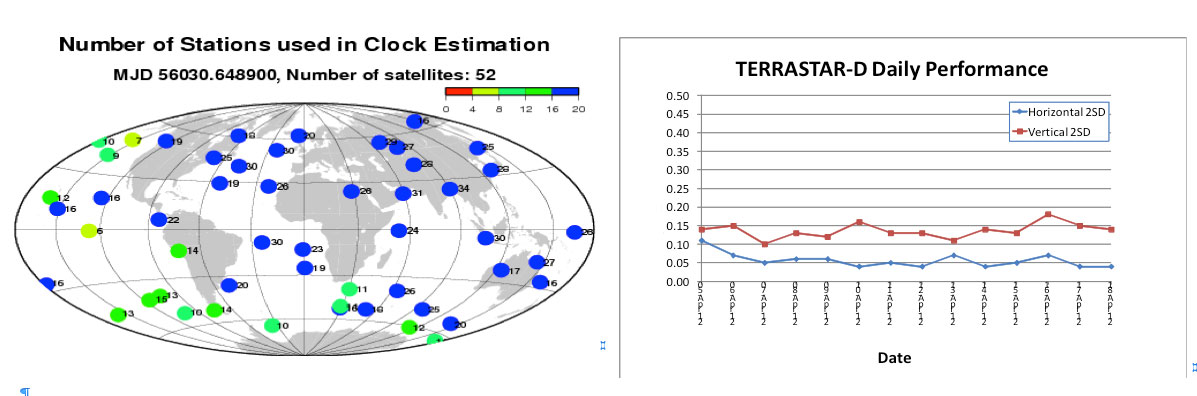
Correction quality and availability are largely dependent on the number of reference stations that track the same GNSS satellite. The figures below show the location of satellites at a given time and the number of stations simultaneously tracking those satellites. For the TERRASTAR ground network, there are often more than 30 stations tracking the same satellite. This makes for high-quality clock and orbit corrections, and TERRASTAR-D claims to provide consistent, stable horizontal 5-10 cm and vertical 10-15 cm performance.
The TERRASTAR network.
As a new player, TERRASTAR has yet to corner a whole bunch of customers, but it already has some significant customer applications. It “GEO-Gates” its corrections like other providers to ensure usage on land, but it extends coverage to land areas plus about 6 km beyond the coastline — termed “nearshore.” So TERRASTAR has been able to capture in-shore dredging and construction business in Europe that otherwise might have had to go to more expensive marine correction services.
In addition, a new customer is using TERRASTAR for airborne geophysical applications. There are also ongoing trials on excavators in road construction, on trains, in oil and gas, for GIS/surveying, and with integrated agricultural sprayer-control and harvesters. TERRASTAR plans shortly to offer a web-based e-Commerce System for users to control their subscriptions. TERRASTAR and Septentrio/Altus have long-term relationships for receivers/systems, and Septentrio and Altus also retail the TERRASTAR service.
So, just when you think you have a good picture of PPP, another option for users has started to show up. PPP over internet — or iPPP as Nexteq Navigation in Calgary, Canada terms their service – is designed to provide similar corrections as PPP, but over cellular phone or Wi-Fi connection to the internet, rather than over satellite. With single frequency GPS, Nexteq claims accuracies of around 50cm, and 10cm with dual frequency, although their T5 and T5A handhelds only currently support L1. Of course Trimble has had corrections over the internet for a number of years.
So its clear that PPP services continue to evolve and become more and more sophisticated to match the growing complexity of customer applications. And as achievable accuracies improve, we’re seeing use in higher precision applications which would have seemed impossible just a few years ago, where local RTK base-stations and radio links would have been the only way to go.
With several very capable sources to choose from, GNSS industry customers have several options to carefully assess and fit to their business. Each PPP supplier has specific advantages and features available to meet customer expectations. The market now appears to be large and specialized enough that its inviting for new entrants. And each new entrant seems to bring with them new twists and capabilities which sell their services. As a customer, it’s a good time to trial new precision applications with PPP.