The ITU World Radiocommunication Conference (WRC-15), in session in Geneva Nov. 2-27, has decided that further studies are required on the impact and application of a future reference time-scale, including the modification of Coordinated Universal Time (UTC) and suppressing the so-called “leap second.”
Leap seconds are added periodically to adjust to irregularities in the earth’s rotation in relation to UTC, the current reference for measuring time, in order to remain close to mean solar time (UT1). A leap second was added most recently on June 30 at 23:59:60 UTC. The proposal to suppress the leap second would have made continuous reference time-scale available for all modern electronic navigation and computerized systems to operate while eliminating the need for specialized ad hoc time systems.
The decision by WRC-15 calls for further studies regarding current and potential future reference time-scales, including their impact and applications. A report will be considered by the World Radiocommunication Conference in 2023. Until then, UTC shall continue to be applied as described in Recommendation ITU‑R TF.460‑6 and as maintained by the International Bureau of Weights and Measures (BIPM).
WRC-15 also calls for reinforcing the links between ITU and the International Bureau of Weights and Measures (BIPM). ITU would continue to be responsible for the dissemination of time signals via radiocommunication and BIPM for establishing and maintaining the second of the International System of Units (SI) and its dissemination through the reference time scale.
Studies will be coordinated by ITU along with international organizations such as the International Maritime Organization (IMO), the International Civil Aviation Organization (ICAO), the General Conference on Weights and Measures (CGPM), the International Committee for Weights and Measures (CIPM), the International Bureau of Weights and Measures (BIPM), the International Earth Rotation and Reference Systems Service (IERS), the International Union of Geodesy and Geophysics (IUGG), the International Union of Radio Science (URSI), the International Organization for Standardization (ISO), the World Meteorological Organization (WMO), and the International Astronomical Union (IAU).
“Modern society is increasingly dependent on accurate timekeeping,” said ITU Secretary-General Houlin Zhao. “ITU is responsible for disseminating time signals by both wired communications and by different radiocommunication services, both space and terrestrial, which are critical for all areas of human activity.”
“The worldwide coordination of time signals is critical for the functioning and reliability of systems that depend on time,” said François Rancy, Director of the ITU Radiocommunication Bureau. “ITU will continue to work with international organizations, industry and user groups towards providing coherent advice on current and potential future reference time-scales.”
“Time waits for no one,” Mick Jagger lamented in song when he turned 30. But tonight, on the evening of June 30, our clocks will stand still for a moment, waiting for the passage of a “leap second.”
The International Earth Rotation and Reference Frames Service (the world’s time monitor) has decreed that the last day of June will contain an extra second. Rather than the usual 86,400 seconds in a day, June 30 will have precisely 86,401 seconds.
National time-keeping centres around the globe, such as the National Research Council in Ottawa, will insert this extra second or leap second into their master clocks so that they remain synchronized with an international time standard. All other clocks that get their time from a master clock will be updated similarly. This includes all of the so-called time servers on the Internet, which keep our computer clocks in sync.
This global time standard is called UTC or Coordinated Universal Time. The standard was established in the 1960s once it was demonstrated that the newly developed atomic clocks could keep time with unprecedented precision and that clocks, even if they were on different continents, could be synchronized with each other to a fraction of a microsecond.
UTC is the time system kept in most countries straddling or bordering the prime meridian at zero degrees of longitude. The civil time systems in regions to the east and west of the prime meridian are typically offset by an integral number of hours from UTC. Atlantic Time, for example, is currently three hours behind UTC, so the leap second will occur here just before 9 p.m.
UTC (and the various zone or regional time scales related to it such as Atlantic Time) has replaced the previously used time scale based on the Earth’s rotation with respect to the sun for most civil time-keeping purposes.
Although the Earth appears to rotate uniformly with night following day since time immemorial, the Earth actually does not spin at a constant rate. It fluctuates slightly due to a variety of causes including variations in winds and ocean currents, the motions of the Earth’s fluid core, and the friction of tidal currents flowing along the bottom of the oceans.
Tidal friction and the other effects has resulted in a long-term or secular decrease in the Earth’s rate of rotation resulting in an increase in the length of the solar day of a little over 1 millisecond per day per century. Currently, the length of the day is roughly 2 milliseconds longer than it was in the early 1800s when it was exactly 86,400 seconds. This means that over a period of 1,000 days, a clock keeping time based on the rotation of the Earth, a time scale known as UT1, would lose about 2 seconds compared to UTC, which is based on the atomic second and referenced to the period of the Earth’s rotation around 1820.
To keep UTC to within 0.9 second of UT1, leap seconds are periodically added to UTC. While tidal friction is the primary reason for adding these leap seconds, the other factors responsible for the variation in the Earth’s spin contribute as well. In fact, negative leap seconds are theoretically possible, although all leap seconds to date have been positive.
The last leap second occurred on June 30, 2012. There have been 25 leap seconds added to UTC since the current system began in 1972. Leap seconds are applied either on December 31st or June 30. Two thirds of them have occurred on New Years Eves with the rest taking place at the end of June like the one coming up.
The world runs on UTC. Everything from financial transactions to air traffic control depends on UTC and so these systems will have to properly accommodate the leap second when it happens. This includes satellite navigation systems. The Global Positioning System itself is unaffected by the introduction of a leap second because it has its own time system, GPS (System) Time, which is not adjusted for leap seconds. GPS Time was set equal to UTC back in 1980 and is currently 16 seconds ahead of it. On July 1st, this offset will increase to 17 seconds. GPS does provide UTC to its users by transmitting the necessary adjustment data in the satellite signals, permitting a receiver to compute UTC from GPS Time.
The upcoming leap second might be the last. The International Telecommunication Union is considering a proposal that leap seconds be abolished. The justification for the proposal is that leap seconds are cumbersome and their incorrect use could lead to problems with time-dependent infrastructure including safety-of-life navigation systems.
At an ITU meeting in Geneva in January 2012, national delegates debated a motion to eliminate the use of leap seconds in the UTC time scale. However, there was no agreement with countries evenly split in favour of, against, and undecided about abolishing leap seconds. Many of the undecided delegates said they were not sufficiently informed about the proposal to make a decision. The ITU will next consider the proposal in November 2015.
The world’s clocks will be adjusted by one second on June 30, when a leap second will be inserted into Coordinated Universal Time (UTC), the standard international time scale.
In theory, all UTC clocks should insert a second labeled 23h 59m 60s (the leap second) following one labeled 23h 59m 59s UTC. This is equivalent to having all of the clocks in the world stop for one second at that time, as explained in May’s Expert Advice column.
The financial market has prepared for potential disruptions. The adjustment could present technical difficulties for traders and exchanges, as some computers might not be programmed to account for the adjustment.
One company preparing is Racelogic, who makes the LabSat simulator. Racelogic will be recording the leap second as it happens and will then have the scenarios available for customers to replay. A variety of recordings will be taken: GPS, GLONASS, and BeiDou constellations will each be captured as a single channel, and also as a simultaneous triple-constellation recording. These will then be available to use with the LabSat.
Jackson Labs has released new firmware versions for various products that address any potential issues for the pending and future leap second events, and that add a number of additional commands to query and handle leap second events.
Precise Time and Frequency, Inc., has published a paper, “Phase Error Correction — Precision versus Speed,” which describes atechnique for rapidly eliminating very large phase offsets (up to 0.5 seconds) between two 1 pulse per second pulses. The change is achieved without a sudden step change (which can be unwelcome in numerous applications) while retaining the ability to tune the phase with high precision (resolution of 0.006 pico seconds) once the large error is eliminated.
“Like many novel ideas, the simplicity of this technique belies its effectiveness,” according to the paper. “With hindsight it seems like an obvious solution; however, the engineering mind is trained to know that to generate a one-second pulse from a reference frequency (in this case 10 MHz), it must be divided by the frequency itself, and the concept of an ‘incorrect’ divisor is not necessarily so obvious. In this case, however, the technique provides an ideal solution that reduces the phase-lock capture time from something that would be intolerable to a very acceptable time period.”
The paper is sponsored by the National Cybersecurity and Communications Integration Center (NCCIC) in coordination with the United States Naval Observatory, National Institute of Standards and Technology (NIST), the USCG Navigation Center, and the National Coordination Office for Space-Based Positioning, Navigation and Timing (PNT).
The paper is intended to assist federal, state and local governments and private-sector organizations prepare for the June 30 leap second event. Entities using precision time should be mindful that no leap second adjustment has occurred on a non-holiday weekday in the past decade. Of the three leap seconds implemented since 2000, two have been scheduled on December 31 and the most recent was on July 1, 2012.
The U.S. Coast Guard Navigation Center (NAVCEN) asks anyone who experiences any operational challenges relating to the leap second insertion to report it via the NAVCEN website under “Report a GPS Problem”.
In theory, on June 30, all UTC clocks should insert a second labeled 23h 59m 60s (the leap second) following one labeled 23h 59m 59s UTC. This is equivalent to having all of the clocks in the world stop for one second at that time, as explained in May’s Expert Advice column.
The coming leap second on June 30 sounds as scary as the (turns out not-so-scary) Y2K bug. But the world has experienced leap second issues before, and most affected industries are taking steps to prepare.
The world’s clocks will be adjusted by one second on June 30, when a leap second will be inserted into Coordinated Universal Time (UTC), the standard international time scale. In theory, all UTC clocks should insert a second labeled 23h 59m 60s (the leap second) following one labeled 23h 59m 59s UTC. This is equivalent to having all of the clocks in the world stop for one second at that time, as explained in May’s Expert Advice column.
A problem with some GPS receivers implementing the extra second caused the U.S. Civil GPS Service Interface Committee (CGSIC) to issue a notice in February. But GPS receivers aren’t the only thing that could be affected.
The Wall Street Journal is reporting that financial regulators and market participants are worried enough about the leap second that they’re planning for potential disruptions. The adjustment could present technical difficulties for traders and exchanges, as some computers might not be programmed to account for the adjustment, according to a Dow Jones report.
“These guys are agonizing over it,” Steve Allen, a programmer-analyst at the University of California’s Lick Observatory, told Dow Jones. “It is definitely a hassle.”
A U.S. Commodity Futures Trading Commission spokeswoman said that “For the most part, we’re not too worried,” told Dow Jones. “But of course as the regulator, we do need to ensure folks are ready.”
The last leap second occurred on June 30, 2012, and that leap second caused technical problems for websites and computing systems — including Reddit, Mozilla, Gawker, FourSquare, Yelp and LinkedIn.
Google had prepared ahead of time and was unaffected. Google gradually adds a couple of milliseconds to its servers’ clocks throughout the day when a leap second is to occur. According to a 2011 Google blog, “We modified our internal NTP servers to gradually add a couple of milliseconds to every update, varying over a time window before the moment when the leap second actually happens. This meant that when it became time to add an extra second at midnight, our clocks had already taken this into account, by skewing the time over the course of the day.”
But many web services didn’t follow Google’s lead in 2012 and experienced disruptions. Qantas‘ computer system went down for hours, forcing employees to check in passengers by hand. For background on the 2012 event, and a good explanation on the reason for a leap second, read “Time to Get in Sync” by Richard Langley, GPS World Innovation editor.
Amazon Web Services said it plans to “implement alternative solutions to avoid the ‘:60’ leap second. This means that AWS clocks will be slightly different from the standard civil time for a short period of time.”
In the U.S., stock exchanges such as the New York Stock Exchange and Nasdaq are working around the leap-second time (8 p.m. in the U.S.) by closing its after-hours trading a half-hour early, which is scheduled for 8 p.m.
The Hong Kong Observatory is advising stakeholders and operators in information technology, telecommunication, transport, and finance to review whether systems under their management can handle leap seconds properly, and if necessary, consider testing and adjusting their systems to ensure normal operation during and after the introduction of the leap second.
Time and frequency company EndRun Technologies is offering leap-second information on its website, and Cisco is offering its customers guidance on how to deal with it.
Racelogic, who make the LabSat simulator, will be recording the Leap Second as it happens and will then have the scenarios available for customers to replay. A variety of recordings will be taken: GPS, GLONASS, and BeiDou constellations will each be captured as a single channel, and also as a simultaneous triple-constellation recording. These will then be available to use with the LabSat.
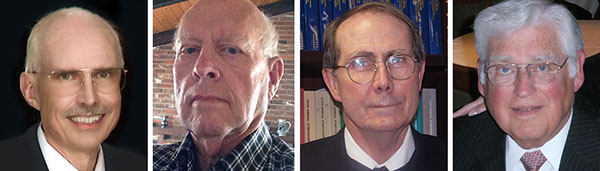
From left: Dennis McCarthy, Wayne Hanson, Ronald Beard and William Klepczynski
By Dennis McCarthy, Wayne Hanson, Ronald Beard and William Klepczynski
Once again we are going to adjust the world’s clocks by one second. This time it will happen on June 30, when we insert another leap second in Coordinated Universal Time (UTC), the standard international time scale. In theory, all UTC clocks should insert a second labeled 23h 59m 60s (the leap second) following one labeled 23h 59m 59s UTC. This is equivalent to having all of the clocks in the world stop for one second at that time.
Are you ready for it?
The last leap second occurred two years ago on June 30, 2012, and the continuation of the process of making these one-second adjustments has stirred a growing controversy over the last few years.
How did the leap second come about — and why do we continue making these sporadic adjustments?
From Sun to Caesium
Historically, it has been easy to make use of the apparently uniform repetition of various astronomical phenomena to measure the passage of time. We’re familiar with the Sun rising and setting, and this regularity provides us a convenient measure of time: the solar day. In recent times until 1960, the average solar day was used as the basis for timekeeping, and if we divide the day into 24 hours, each containing 60 minutes made up of 60 seconds, we can define the second as 1/86,400 of the mean solar day. This meant that the length of the second depended on the Earth’s rate of rotation because it is the rotating Earth that causes the Sun to appear to move across the sky.
In the mid-1930s, astronomers concluded that the Earth did not rotate uniformly as measured by the most precise clocks then available. This causes the duration of a second to vary as the Earth’s rotation rate varies. We now know that a variety of physical phenomena affect the Earth’s rotational speed, and consequently this definition of a second became impractical for applications that require a truly uniform time scale. So, in 1960, the second was redefined in terms of the Earth’s yearly orbital motion around the Sun. The time scale provided by this astronomical phenomenon was called Ephemeris Time (ET), to call attention to the fact that its realization depended on the conventionally adopted positions and motions (that is, the ephemeris) of the Sun (or Moon) that was used in the analyses of the required astronomical observations. The second defined in this manner was called the Ephemeris second.
Although Ephemeris Time does provide a more uniform measure of the duration of a second, it is inconvenient to make the necessary astronomical observations that would be required to maintain a practical time scale for applications that demand high precision. So, in 1967, the second was redefined again, this time in terms of the frequency of an energy level transition in the Caesium atom, which had already been calibrated with respect to Ephemeris Time by using astronomical observations of the Moon’s motion. Caesium frequency standards, by the early ’60s, had become known as reliable, uniform, accurate and precise clocks. The second defined in this way provided, and continues to provide, a uniform standard of time that can easily be measured in a laboratory with greater precision and accuracy than any astronomical phenomena.
Lab Clocks Rule
Although the second defined using the frequency of an atomic energy level transition does provide a unit of time duration that is precise and uniform, it does mean that the passage of time measured in this way is no longer connected to astronomical phenomena. Indeed, with the advent of more accurate observational techniques, astronomers could measure variations in the Earth’s rotation rate by measuring its changing orientation in space and comparing the rate of change with laboratory clocks. They established that among the various variations in the Earth’s rotation rate is the gradual slowing down with respect to a uniform atomic time scale. This deceleration is consistent with theoretical tidal effects and observed terrestrial deglaciation.It is also apparently consistent with ancient observations of solar eclipses, indicating that that this slowing has been going on for thousands of years
As a result, if we were to observe a recurring astronomical event, we would see it happening earlier from day to day. To bring our clock back into agreement with the astronomical event, we would have to add some time to the face of our atomic clock. While astronomers can cope with this situation by applying the appropriate corrections derived from astronomical observations that measure the Earth’s rotation rate, navigators that relied on astronomical observations to determine their positions considered this situation problematic.
When the definition of the second based on the Caesium atom was introduced, it was known that there would be a time varying discrepancy between a clock running at a uniform rate and a theoretical one using a second defined by the Earth’s rotation rate. Starting from 1961, the observed discrepancy was modeled by making small adjustments on the order of a few milliseconds (thousandths of a second) to our clocks at first, and later by making small adjustments to the frequency of the atomic clocks from time to time, usually on an annual basis. This meant that the duration of a second could vary depending on when it was measured.
No More Changes
In 1970 the International Radio Consultative Committee (CCIR and now known as the International Telecommunications Union Radiocommunications Sector, or ITU-R) in collaboration with other international agencies adopted a definition of UTC that did away with any periodic changes to the duration of the second. Instead it was decided that the discrepancy between UTC and the observed rotation angle of the Earth would be accounted for by making one-second adjustments when needed, so that the absolute difference between UTC and the Earth’s rotation angle measured in time units would always be less than 0.9 seconds. A finer correction would also be provided frequently so that the Earth’s rotation angle in time units designed as Universal Time 1 (UT1) could be derived to 0.1 second precision.
It was specified that the one-second adjustments, either positive or negative, were to be made preferably at 23h 59m 59s on the last day of the months of December or June, but could also be made, if necessary, at 23h 59m 59s on the last day of the months of March and September, and further if required at 23h 59m 59s on the last day of any month. The implementation of this definition actually began in 1972, a year in which two leap seconds were introduced.
These one-second adjustments came to be known as “leap” seconds by analogy with the “leap” day inserted in calendars. This definition then fixed the second in UTC to be uniformly established as the international standard atomic second defined by the resonance frequency of Caesium and known as the SI (Système International) second.
Compromise Overcome by GNSS
The introduction of the concept of the leap second was historically a compromise with practitioners of celestial navigation who needed to base their observations on astronomical time to determine their longitude. If UTC doesn’t differ from the observed rotation angle of the Earth by more than a second, navigators could use UTC directly as a substitute without introducing a systematic error greater than a quarter of a mile. However, the routine practice of using celestial navigation has been overcome by the success of Global Navigation Satellite Systems (GNSS), inertial navigation systems, and radar navigation.
In fact, the U.S. Naval Academy stopped including celestial navigation in its curriculum in 1998. In the time span since the introduction of the idea of a leap second, computer networks, wireless telecommunication systems, satellite communications, telephone networks, air traffic control systems and even industrial processes have developed to the point where precise time is an essential component of their successful operation. Users and suppliers of these systems are concerned with the impact of sporadic, essentially unpredictable, one-second adjustments.
Most of these modern systems derive their time using GPS timing receivers. Although the navigational solutions make use of GPS System Time, these receivers provide UTC by means of a broadcast correction that provides the time-varying difference between GPS System Time and UTC. This correction normally provides the varying difference between the two times to less than a microsecond but must also keep track of when a leap second is introduced. As the leap second changes occur sporadically, there may be worries that problems could arise because hardware or software may never have been tested thoroughly for a leap second occurrence. As a result of these concerns, as well as the cost of stopping all of the clocks in the world for one second, the ITU-R has been discussing a possible revision of the definition of UTC by dropping the future use of leap seconds.
Leap or Not Leap?
The question of the future of UTC was raised in 2000 with the suggestion of modifying it to be a continuous timescale without leap seconds. Consideration of this question is still ongoing. The 2012 World Radiocommunication Conference (WRC-12) identified this issue as urgent, requiring further examination by the 2015 World Radiocommunication Conference (WRC-15) “to consider the feasibility of achieving a continuous reference time-scale, whether by the modification of Coordinated Universal Time (UTC) or some other method, and take appropriate action…”.
With the aim of providing adequate technical background for WRC-15 to make an informed decision on this issue, the International Bureau of Weights and Measures (BIPM) and the ITU agreed to organize jointly a workshop on the future of the international time scale. This workshop was held in Geneva, Switzerland, in September 2013. It provided a unique opportunity to present available information on current and possible future precise frequency and time standards, sources and their characteristics, time scales and dissemination systems and different views on the future of UTC.
Contributions to the workshop were specifically invited to ensure that the breadth of the issue would be covered. Included were the relevant international organizations (the International Astronomical Union, the International Earth Rotation and Reference Systems Service, the International Union of Geodesy and Geophysics, the International Organization for Standardization, the International Maritime Organization, the International Civil Aviation Organization, the Union Radio-scientifique Internationale), the providers of GNSS services (GPS, GLONASS, Galileo and BeiDou), the national metrology institutes that realize and maintain local representations of UTC, the ITU member administrations, and the ITU-T and authorities responsible for electronic time services. Information on the workshop, agenda and presentations is available.
Final Decision in November
A special issue of ITU News magazine dedicated to the workshop has also been published; an online version is available. It did not provide a decision on the issues, but rather a forum for issues to be discussed, since there is some controversy over modifying the global reference time scale. The final decision is to be made at the WRC-15 in November when the method for satisfying the feasibility of achieving a continuous time scale will be determined as well as how it would be implemented.
As preparations begin for the June leap second, hardware and software will undergo testing. This process is likely to be repeated for some time to come, even if the decision to eliminate the use of leap seconds in UTC is made. Legacy systems reliant on the use of leap seconds will require an adequate period of time to adapt to any change in the definition of UTC. If the suppression of leap seconds would be decided, it is recommended that a period of time no less than five years be allowed before the Final Acts of the WRC-15 go into effect. So, leap seconds could be with us for some time yet.
Editor’s Note: For an earlier discussion on the leap second by McCarthy and Klepczynski, download the Innovation article “GPS and Leap Seconds: Time to Change?” from the November 1999 issue of GPS World.
Dennis McCarthy is retired, and serves as a contractor with the U. S. Naval Observatory, where he was science advisor, director of the Directorate of Time, and head of the Earth Orientation Department. Internationally, he has served as president of the Commissions on Time, Commission on Earth Orientation, and Division 1 (Fundamental Astronomy) of the International Astronomical Union (IAU). He was also secretary of Commission 5 of the International Association of Geodesy.
Wayne Hanson has been a consultant and president of Time Signal Engineering since his retirement in 2001 as chief of the Time and Frequency Services Group in the Time and Frequency Division of the National Institute of Standards and Technology. He is the U.S. chairman of the International Telecommunication Union – Radiocommunication Sector, Working Party 7A concerned with Time Signal and Frequency Standard Emissions.
Ron Beard is the head of the Advanced Space PNT Branch at the Naval Research Laboratory and International Chairman of ITU-R Working Party 7A, Precise Time and Frequency Broadcast Services. During the early development of GPS in the 1970s, he was the project scientist in the NRL GPS Program Office that developed Navigation Technology Satellites One and Two that operated the first atomic clocks in space.
William Klepczynski is now retired. During his career, he was a consultant to the Institute for Defense Analyses and the head of the Time Service Department of the U.S. Naval Observatory, where he managed the USNO Master Clock, timing operations for GPS and time distribution systems that utilize communications and navigation systems.
During preparation of playback scenarios for the upcoming leap-second event taking place in June, engineers at Racelogic identified a potential pitfall for GNSS engineers. The difficulty arises from the fact that BeiDou uses a different “day number” for the date to apply the leap second, compared with GPS and Galileo. GPS and Galileo use 1-7 as week day numbers, and BeiDou uses 0-6.
If this fact has been missed during development, then the result is that the leap second may be implemented a day early on GNSS engines that are tracking the BeiDou constellation, said Mark Sampson, product manager for Racelogic.
“We tested four different Beidou enabled receivers, from four leading GNSS companies, and none of them appeared to handle the Beidou leap second correctly. This included an engine which originates from China!” Sampson said. “We have since been in contact with two of these companies, who have confirmed that their hardware does have a bug in the leap-second code due to the numbering of the days.”
The error presents itself when the receiver is running on the BeiDou constellation alone, and when the date is June 29 of this year. In some cases, the BeiDou leap second will be adjusted from 2 to 3 seconds from midnight on June 29, which should in fact occur on midnight of June 30. This will result in an error for the reported UTC time of 1 second for the period of this day. In other cases, the leap second was not implemented at all when running on BeiDou alone.
“We have also checked the output of a BeiDou signal generator from a different simulator company, and this too uses the 1-7 range for the BeiDou leap-second date instead of the correct 0-6 range,” Sampson said. “This may explain why a number of commercial receivers appear to have been caught out by this issue.”
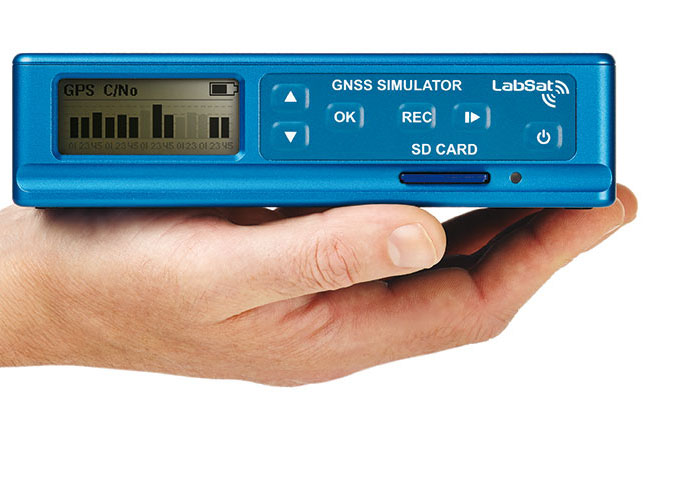
Racelogic LabSat3 simulator.
In order to help companies test for this problem, Racelogic has generated simulated RF data for June 29 and 30, starting 15 minutes before midnight. “We have two sets of files. One set contains BeiDou only signals and the other contains a combination of BeiDou and GPS signals,” Sampson said. “Note that on some of the receivers we have tested, when GPS is being tracked as well, the GPS leap-second message overrides the one coming from BeiDou and applies the leap second correctly.”
The scenarios are compatible with Racelogic’s LabSat3 triple constellation simulator, which is available on a free 15-day loan or can be purchased from Racelogic.
A leap second will be introduced this year at 23:59 on June 30. This phenomenon comes around periodically and is necessary for keeping Coordinated Universal Time (UTC) in line with the small vagaries of the Earth’s slowing rotation. Although it is an event that will pass unnoticed by the majority of people, it has implications for anyone involved in the development of GNSS-enabled devices. For some, it can be the cause of a major headache.
Part of the problem with the leap second is its irregularity. Occurring every two or three years, it means that receiver technology moves on in between — and because the Earth’s slowing rotation is not at a constant rate of change, it cannot be predicted when the next one will be announced. A rapidly developing market of GNSS products having to deal with random alterations to its time framework is not an ideal situation. Suitable preparations, clearly, should be employed.
The behavior of a new receiver when subjected to a leap second may prove critical in certain instances, and without robust characterization it can lead to inconsistent performance. It has already happened this year: on January 21, GPS signals started to include information which effectively announced this year’s leap second event, with the relevant data for future delta time, and week and day numbers. This caused issues with some receivers that weren’t expecting it: some units applied the additional second immediately. It would be interesting to see how these systems might have reacted during an actual leap second transition.
Receiver logic flow requires testing so that any GPS receiver can remain compliant with the IS-GPS-200 standard, and potential problems mustbe mitigated and controlled. The use of a GNSS simulator — which outputs a scenario containing the leap second event — allows for the receiver and any systems around it to be exercised over and over again, ironing out any anomalies, to ensure total reliability.
The recent issues with those non-compliant GPS engines highlights the advantage that simulation provides. The consistency it delivers enables a very thorough testing schedule, which will in turn lead to a straightforward application of the time change.
One school of thought holds that leap seconds should be abandoned, and that we should stick to atomic time from now on. Their removal would mean that by 2100, the Earth’s rotation would be some two to three minutes behind humanity’s precise, atomic-powered, 24-hour clock, and half an hour or so by 2700.
The World Radiocommunication Assembly, which has control over such matters, had been postponing a decision on whether to abolish the leap second for over a decade; another vote is due this year. It wouldn’t be any great wonder if this prevarication continues, so whilst it still exists, it is best to concentrate on what this June’s extra second might have in store for anyone currently developing a GNSS product. Armed with a simulator, the unpredictability of leap second scheduling should no longer be a major concern. Should this year’s vote be again inconclusive, those who have taken the positive step of acquiring a GNSS simulator will be in good shape to deal with the next time the clocks show 23:59:60.
Mark Sampson is LabSat product manager for RaceLogic.
The United States Civil GPS Service Interface Committee (CGSIC) has issued a notice about a problem some receivers are having implementing the correct time. The U.S. Coast Guard Navigation Center has received reports of synchronization issues since the implementation of a leap second on Jan. 21. Users experiencing this problem should contact the receiver manufacturer for a firmware or software update.
Below is the text of the CGSIC notice:
All CGSIC: 2015 GPS Future Leap Second Implementation
The GPS 50 bit-per-second navigation message transmitted by each GPS satellite (specifically Page 18, subframe 4) includes the parameters needed to relate GPS time to UTC (Coordinated Universal Time). That relationship is maintained through leap second implementation transitions by IS-GPS-200 compliant user equipment. For leap second transition, user equipment must utilize the notice regarding a scheduled future delta time due to leap seconds (ÄtLSF), together with the week number (WNLSF) and the day number (DN), at the end of which the leap second becomes effective.
On or about Jan. 21, 2015, those GPS navigation messages began to include future leap second data which indicates an increase in the leap second to become effective at the end of June 2015. IS-GPS-200 revision H, dated 24 Sep 2013 paragraph 20.3.3.5.2.4 Coordinated Universal Time (UTC), documents the appropriate algorithm details to ensure correct utilization of the parameters above (including all potential truncated week number transitions and variations in time of processing relative to satellite upload timing near the future leap second effectivity).
The data upload for the June 30 leap second, initiated with SVN48/PRN07 at 18:33:56z on Jan. 21, was correctly executed. However, there are several receivers brands/models that seem to be mishandling this information and applying the leap second now. This is creating a negative one-second offset in faulty receivers. The U.S. Coast Guard Navigation Center has reports of these receivers causing synchronization issues with radios, computer systems, and data logging equipment.
Users experiencing issues with GPS receivers that began on Jan. 21 should contact the receiver manufacturer to determine if the latest firmware or software patch can correct the issue.
V/R Rick Hamilton
CGSIC Executive Secretariat GPS Information
Analysis Team Lead USCG Navigation Center
703-313-5930
Likely none of us needs a reminder as the upcoming leap second has been all over the news outlets for the past few days. But just to provide the details again, read this article.
Presumably, all GPS receiver manufacturers have checked to make sure their receivers will handle the leap second properly. However, at least one late-model high-end receiver from a leading manufacturer is currently reporting incorrect advance leap second information in its data files.
The European Satellite Services Provider (ESSP), the EGNOS system operator and EGNOS safety-of-life service provider, announced in a service notice dated 22 May that there might be an interruption in service for a 72-hour period should the leap second not be managed correctly.
AGI, a company that develops commercial modeling and analysis software for the space, defense and intelligence communities, has warned: “The consequence of failing to accommodate this event is that orbit in-plane motion and corresponding Earth orientation will both become inaccurate by at least one second until the leap second is properly implemented. This will also affect estimating orbits using time sequences of observations spanning this leap second event. GEO satellites might be inaccurate to about 3 km and LEO satellites to about 8 km. How great the discrepancy will be depends on how long one waits to implement the leap second. The probable inaccuracies may be within the collision keep-out zones of many satellites, causing either false alarms or totally missed threat detections.”
And it has also been reported that some computer operating systemsmight hang due to improper handling of the leap second.
An article on the upcoming leap second for the popular press may be found here. And, in case you missed it, a recent Physics Today article on the leap second and its future can be found here.
Likely none of us needs a reminder as the upcoming leap second has been all over the news outlets for the past few days. But just to provide the details again, read this article.
Presumably, all GPS receiver manufacturers have checked to make sure their receivers will handle the leap second properly. However, at least one late-model high-end receiver from a leading manufacturer is currently reporting incorrect advance leap second information in its data files.
The European Satellite Services Provider (ESSP), the EGNOS system operator and EGNOS safety-of-life service provider, announced in a service notice dated 22 May that there might be an interruption in service for a 72-hour period should the leap second not be managed correctly.
AGI, a company that develops commercial modeling and analysis software for the space, defense and intelligence communities, has warned: “The consequence of failing to accommodate this event is that orbit in-plane motion and corresponding Earth orientation will both become inaccurate by at least one second until the leap second is properly implemented. This will also affect estimating orbits using time sequences of observations spanning this leap second event. GEO satellites might be inaccurate to about 3 km and LEO satellites to about 8 km. How great the discrepancy will be depends on how long one waits to implement the leap second. The probable inaccuracies may be within the collision keep-out zones of many satellites, causing either false alarms or totally missed threat detections.”
And it has also been reported that some computer operating systemsmight hang due to improper handling of the leap second.
An article on the upcoming leap second for the popular press may be found here. And, in case you missed it, a recent Physics Today article on the leap second and its future can be found here.