Tag: Leica Captivate

  • Hexagon survey-grade GNSS rover measures what you see

    Hexagon survey-grade GNSS rover measures what you see

    Photo: Hexagon
    Photo: Hexagon

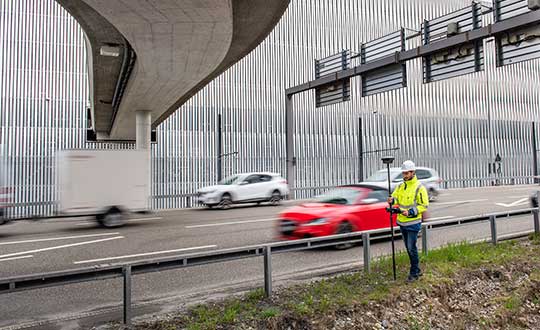
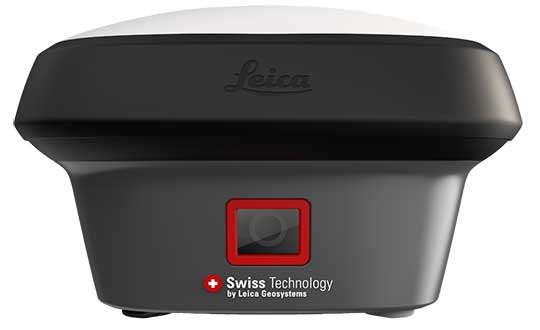
    Hexagon AB has introduced the Leica GS18 I, a versatile, survey-grade GNSS RTK rover so powerful it enables surveyors to measure what they see, even structure in difficult-to-reach places, the company said.

    It comes equipped with all the innovative functionality of the Leica GS18 T — Hexagon’s calibration-free, tilt-compensating GNSS solution immune to magnetic disturbances, plus the power of survey-grade visual positioning.

    Through sensor fusion of GNSS, motion (IMU) and image (camera) technology, the Leica GS18 I enables the measurement of points from images. The ability to capture and measure sites via images goes far beyond the advantages of the GS18 T, which introduced the quick and convenient ability to measure points in spaces that cannot be measured with vertical poles, such as building corners, walls and points underneath obstacles (for instance, cars).

    With the Leica GS18 I, professionals can now map areas that are difficult to reach physically, such as trenches, high power lines and busy roads, or blocked from GNSS signals, such as areas underneath bridges or canopies — safely and effortlessly from a distance.

    “With the Leica GS18 I, mapping and surveying just got simpler, safer and more productive than ever before,” said Ola Rollén, Hexagon president and CEO. “The ability to quickly document an entire area of interest without the need to switch between tools or manoeuvre through obstacles frees up equipment and crews. Additionally, the simple and intuitive workflow of the Leica GS18 I brings the versatility of visual positioning to new user segments and applications — from utility service providers to crash scene investigators.”

    The Leica GS18 I enables users to measure hundreds of points within minutes. Integration with Leica Captivate field software enables intuitive onsite point measurements and quality assurance from the field.

    Further measurement of the captured images is supported by integration with Leica Infinity office software, which also enables the creation of automatically registered and referenced 3D point clouds from the images in standard export formats for use in a variety of point cloud software.


    Feature image: Hexagon
  • New Leica Nova MS60 enables surveying with one instrument

    New Leica Nova MS60 enables surveying with one instrument

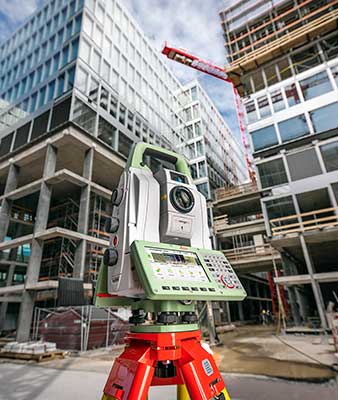
    The new version of all-in-one MultiStation addresses a wide range of needs. (Phoeo: Leica Geosystems)
    The new version of all-in-one MultiStation addresses a wide range of needs. (Photo: Leica Geosystems)

    The new Nova MS60 MultiStation combines upgraded, faster 3D laser-scanning capabilities, GNSS connectivity and digital imaging with a high-end total station. According to Leica Geosystems, part of Hexagon, the multi-station brings sensor fusion to the “next level.”

    The MS60 features several laser scanning updates, including an fast scanning speed of up to 30,000 points per second, optimized scan area definitions, adapted scan managements, and an improved scanning path for zenith scans.

    It is also equipped with the unique AutoHeight feature, enabling users to save time by automatically measuring the instrument’s height with a simple button press. Measurement professionals can make decisions directly in the field, performing point-cloud analysis such as flatness analysis and as-built checks in the Inspect Surface app of the MS60.

    “Scan data combined with traditionally measured points, whether it’s from the total stations or the GPS receivers, is one of those immediate deliverables that help our clients see what we’re doing. With the scan data of the Leica Nova MS60 MultiStation, we can graphically show — the same day it is collecting — the locations in the field to any person,” said Donald Smith, senior land surveyor and principal at BL Companies. “When you deliver on time and provide customers with a deliverable they can see, you’ve just got yourself a recurring client.”

    The MS60 speeds up workflows by combining technologies in this all-in-one instrument. The MultiStation  total station offers advanced imaging, scanning capabilities and GNSS connectivity. With Leica Captivate field software, all measurement and scanning data can be visualized in 3D for quality and completeness checks.

    MS60 users can seamlessly transfer all data into Leica Infinity software to manage, process, analyze and perform a quality check. The MultiStation helps users deliver projects on time, save money and have high flexibility in the field.

    “The MS60 merges data in a multi-level process — total station measurements are complemented by 3D point clouds, which are automatically registered and coloured by the image information. All data perfectly fits within the same coordinate system, globally referenced by GNSS measurements or by measuring known points,” said Falko Henning, senior product manager at Leica Geosystems.

    “Unlike other measurement devices, the MS60 offers familiar total station capabilities and scanning functionality to fulfil job requirements on site.” Henning said. “The operator can use the red laser pointer to perform reflectorless measurements for direct remedial work on-site or stakeout points and use the field controller even while a scan is performed.”

  • True tilt compensation GNSS presented by Leica

    Leica Geosystems has released the Leica GS18 T, a fast GNSS RTK rover, as well as the latest versions of Leica Captivate field software and Leica Infinity office software.

    Leica made the announcement at Intergeo 2017, held Sept. 26-28 in Berlin, Germany.

    The announcement expands the Leica Captivate Experience. With the addition of calibration-free GNSS and various upgrades to the Captivate field software and Infinity office software, users continue the immersive experience with self-learning GNSS and engaging, intuitive software interfaces.

    “In my business, speed is the name of the game,” said Manny Sangha, owner of Sangha Geomatics & Land Survey Inc. in Vanderhoof, Canada. ” With my GS16, I’ve been able to reduce time spent on every project. I can only see this getting faster and improving efficiency with the GS18. No longer having to level the pole nor calibrate the system, this is a real value for me and a game-changer in the industry.”

    Calibration-free tilt compensating GNSS

    According to Leica Geosystems, the GS18 T is the a calibration-free tilt compensating GNSS solution immune to magnetic disturbances.

    GNSS measurements can be taken from any position on site, saving users up to 20 percent of time in the field over conventional surveying practices, because they no longer need to hold the pole vertical to level the bubble.

    The GS18 T uses precise inertial measuring units (IMUs) and not a compass, so that users can measure with a tilted pole close to buildings, underneath cars and close to metallic objects.

    With integrated quality assurance, the GS18 T records exactly how the pole was leveled during the measurement. The GS18 T then stores the values, ensuring measurement traceability and complete quality reporting.

    Software updates

    Fully supporting the GS18 T, Leica Captivate v3.0 field software and Leica Infinity v2.4 office software now offer users a more immersive means of control on site and at the desk.

    Captivate now allows configuration of the GS18 T for all measuring and staking applications and the visualization of tilt compensated measurements. Measured data can be directly imported into Infinity or exported into a variety of formats suitable for CAD packages.

    Within Infinity, users can visualise the measured data, including the creation of reports providing full traceability and quality assurance for themselves and their clients.