
Tag: Leidos

  • Leidos uses quantum technology to thwart GPS jamming

    Leidos uses quantum technology to thwart GPS jamming

    Susceptibility to jamming is a significant military vulnerability of the GPS signal. Through a Defense Innovation Unit contract, Leidos is developing an alternative navigation technology that measures variations in the Earth’s magnetic field and harnesses the quantum properties of nitrogen in diamonds. 

    “With magnetic navigation (MagNav) there’s no signal to jam,” said Aaron Canciani, manager of the Leidos Transition of Quantum Sensing (TQS) team and a former U.S. Air Force scientist who is a pioneer of the technology. “The one thing MagNav does need is a very sensitive magnetometer, which is where quantum comes in.”

    Quantum sensing uses microscopic particles that can simultaneously exist in multiple states to more accurately detect aspects of geophysical properties like magnetic fields. Leidos has been doing quantum work for years, applying it to a variety of cyber security and sensing applications. 

    “Quantum magnetometers have the potential to greatly increase position and attitude accuracies in magnetic navigation systems,” Canciani said. “Nitrogen vacancy-diamond magnetometers use the crystal structure of a diamond to define a sensing axis in which quantum measurements of the complete vector field can be known to exquisite accuracies.”

    The sensor is being developed by Frequency Electronics Inc. under subcontract to Leidos and in collaboration with MIT Lincoln Lab.

    Compared to classic magnetometers, which tend to drift due to reliance on relative measurements, Canciani added, “These quantum measurements are linked to the magnetic field through fundamental physics-based constants.” 

    Ultimately, Leidos intends to fly a MagNav system with the new magnetometer. If successful, the technology has the potential to significantly advance navigation technology for military use.  
  • New APNT in an old box

    New APNT in an old box

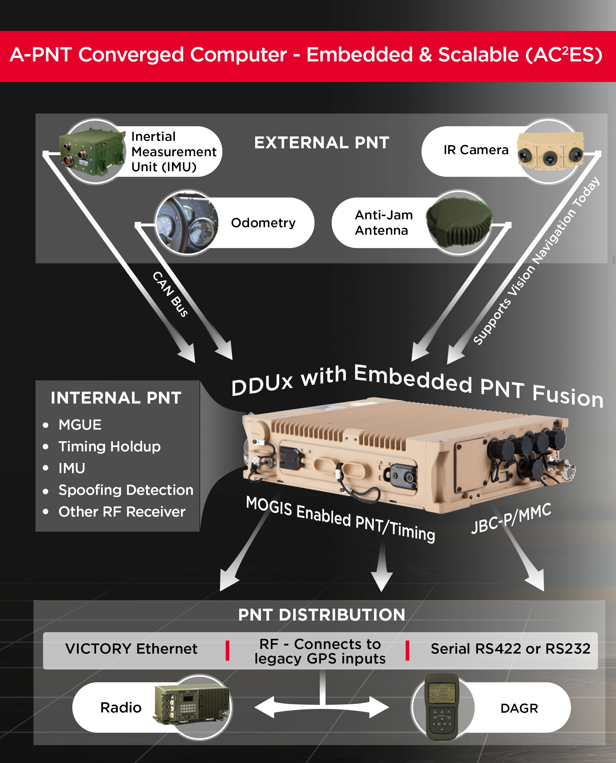
    Leonardo DRS’ A-PNT Converged Computer – Embedded & Scalable (AC²ES) adds capabilities to its widely used DDUx. Photo: Leonardo DRS
    Leonardo DRS’ A-PNT Converged Computer – Embedded & Scalable (AC²ES) adds capabilities to its widely used DDUx. Photo: Leonardo DRS

    To help counter attacks that degrade GNSS capability on combat vehicles, Leonardo DRS developed a modified data-distribution unit computer, the DDUx II, with an embedded assured positioning, navigation and timing (APNT) capability the company calls Assured Positioning, Navigation and Timing Converged Computer Embedded & Scalable (AC²ES). It augments standard military GPS PNT sources with technologies such as anti-jam, anti-spoof, M-code receivers, additional RF sources, vehicle infrared (IR) sensor vision navigation, wheel rotation and inertial measurement units (IMUs). It also offers a choice of multiple timing holdup modules that increase accuracy proportionately with cost.

    The DDUx II and military variants, fielded by the U.S. Army and Marine Corps, allow for integration of APNT functionality with the Battle Management System (BMS). It can provide APNT distribution to all other devices needing PNT within the vehicle without adding to its size, weight and power (SWAP).

    Following a five-year development program, Leonardo DRS launched the AC²ES in September 2021 as a commercial option while continuing discussions with the U.S. Army and Marine Corps, which have not yet adopted it. “We have tested it,” said Mike Stucki, business development manager for the company’s land electronics division. “We have gone to Army jamming and testing events. We have performance and results. However, it has not been officially tested under the Army or Marines programs, with which we are moving forward this year.”

    Leonardo DRS wants to offer the armed services the additional components they need to achieve APNT “and not require them to buy anything they don’t need or want,” Stucki said. Those additional components include multiple GNSS receivers for timing and a low-end internal IMU to provide continuous navigation in case GNSS is disrupted. All these components fit directly into the existing DRS hardware. Under the Mounted Family of Computer Systems (MFoCS) program alone, the Army has fielded more than 100,000 DDUx units. Some vehicles already have high-end INS, wheel encoders, and other sensors, and MFoCS can ingest their data.

    Navigating with Infrared

    For vision navigation, Leonardo DRS uses software developed by its partner Leidos that ingests data from existing hardware on the vehicles, many of which already have IR cameras. In a GNSS-denied environment, this enables the system to navigate by matching what the IR camera sees to an imagery database. Leidos’ software is based on work it began in 2011 with the DARPA All-Source Positioning and Navigation (ASPN) program.

    “Leidos developed algorithms that use these other sensor inputs in the sensor-fusion engine to provide more accurate absolute positioning in a completely RF-denied environment,” said Kevin Betts, PNT director for Leidos. “We take the live images from the vehicle’s existing IR camera and match them to a satellite-derived model of the environment. When the images match, we have an absolute position update that we can provide to the navigation filter.”

    MFoCS “is the heart that runs the Blue Force tracker system that the soldiers use,” said Bart Blanchard, director of advanced programs at Leonardo DRS. “We’ve added the APNT components inside that box. They’re leveraging the hardware that they already own. It’s a very cost-effective solution.”