
Tag: letters

  • Worry about PNT and national security, not just eLoran

    Worry about PNT and national security, not just eLoran

    Headshot: Dana Goward
    Dana Goward, President, Resilient PNT Foundation

    Letter to the Editor

    February 2022


    In November’s issue of GPS World, Editor-in-Chief Matteo Luccio opined that eLoran is part of the solution to GNSS vulnerability.

    In January’s issue, he listed 10 questions from a PNT expert perhaps unfamiliar with eLoran.

    These are important questions that must be asked of any technology, especially one under consideration to augment and back up our essential, but very weak and vulnerable, GNSS signals.

    Yet the expert’s concerns pale in comparison to the essential questions about GNSS and PNT facing the United States and the West.

    While I look forward to answers to the “10 questions” as a part of our ongoing professional dialogue, there are two important points of context we all need to keep in mind.

    A Broad Consensus

    First, Mr. Luccio’s assertion about eLoran being a part of the solution is more than reasonable. It also has a lot of impressive support from a wide variety of authoritative sources.

    In 2008 and 2015, after much study each time, the U.S. government decided on and committed to building eLoran systems. Also, the U.S. government-sponsored National Space-based Positioning, Navigation and Timing (PNT) Advisory Board recommended eLoran in 2010 and 2018 as a part of securing the nation’s critical PNT capability.

    In 2021, the U.S. Department of Transportation told Congress that wide-area terrestrial broadcast was a necessary part of a national PNT architecture. They later commented that infrastructure required per coverage area would be a key selection criterion for that broadcast technology. In other words, a system like eLoran.

    Overseas, support for Mr. Luccio’s statement on eLoran is even stronger.

    • The United Kingdom has long endorsed eLoran and operates an eLoran transmitter as a timing reference.
    • Russia operates Chayka, a version of Loran.
    • Available information points to Iran’s terrestrial PNT system being a form of Loran or eLoran.
    • China and South Korea have long had Loran-C systems, and both are in the process of upgrading to the eLoran standard.

    Each of these countries has publicly announced that it operates Loran/eLoran as a matter of national security in case space-based systems are jammed or destroyed, and to generally avoid overdependence on space-based PNT signals.

    So, Mr. Luccio’s assertion was not at all revolutionary. Given all the studies, recommendations and existing uses, it would be surprising if he did not consider eLoran a part of the solution.

    The Important Questions

    Second, modern keying, encryption, authentication and other tech advances will help make all PNT technologies much safer and more resilient than they would have been decades ago, Loran and eLoran included.

    Yet all will still have their strengths and weaknesses.

    The most important questions we must ask are about how to establish the right level of national PNT security. These include:

    • What is the right combination of technologies and systems with different delivery and failure modes that complement and reinforce GNSS and each other?
    • How can the systems be efficiently and effectively implemented?
    • How can the services they provide be easily accessed and widely adopted to ensure all parts of society are protected?

    Countries such as China have answered these questions and are well down the path to implementation and wide adoption. Their robust national PNT architectures support easier rollout of 5G, rural broadband and other systems. They also serve as solid tech infrastructure upon which to build myriads of technologies and applications yet to be conceived.

    Those nations not so advanced must accelerate their efforts. Otherwise, they must resign themselves to perpetually coping with GNSS vulnerabilities, including the possibility of attacks, and an eventual second or third place in the world because of their shortsightedness.

    Dana A. Goward, President
    Resilient Navigation and Timing Foundation

  • Letters: Galileo Sync, GLONASS Scoop, an Open Letter

    GPS_May_enews_160June Cover Story

    In the June issue’s cover story, “Interchangeability Accomplished,” is a paragraph headed, “Satellite Intersystem Biases,” which appears to assert that Galileo System Time (GST) is 3 seconds ahead of UTC.

    However, in the version of the Galileo Signal In Space Interface Control Document posted at: http://ec.europa.eu/enterprise/policies/satnav/galileo/files/galileo-os-sis-icd-issue1-revision1_en.pdf, paragraph 5.1.2 appears to indicate that Galileo System Time (GST) was synchronized, at the second level, with GPS time on 22 August 1999 (that is, 13 seconds ahead of UTC).  And, given that a) GST, like GPS time, does not step for announced leap seconds, and b) the IERS has, as of today, announced 3 leap seconds since 22 August 1999, such would appear to suggest that GST is presently roughly 16 seconds (vice 3 seconds) ahead of UTC.

    — Stuart Eventhal
    Fountain, Colorado

    Author Frank van Diggelen replies:

    Yes! You are right, the article should have said 16 seconds for Galileo, not 3. Thanks for catching that. I’ve corrected the text that appears in the online version of the article, and the accompanying figure.

    Media Scoop

    The online article covering Javad Ashjaee’s input on the GLONASS situation makes a positive statement that clarifies what has been a horrible reporting job across the board by news channels.

    Fox, CBS, NBC, and ABC should all be ashamed that GPS World scooped them on what appears to be a simple story.

    Good work.

    — Mark Silver
    IGage Mapping Corporation
    Salt Lake City, Utah

    To Consumer-Grade GNSS Chip Manufacturers

    I would like you to consider including a very simple feature in your GPS functionality that will permit elevation to be identified to decimeter level in many instances. The changes needed to the chip are simply the ability to accept an accurate latitude and longitude input, and an elevation calculation function that uses input latitude and longitude.

    In addition to enabling instantaneous calculation of an accurate elevation, it may be that a “residual better accuracy” will remain for some time after the calculation, and that this will permit substantially improved latitude and longitude identification at a close distance.

    The geo-location scene has evolved rapidly over the past 20 years. It is now very commonplace to be able to locate the latitude and longitude of a location extremely quickly and extremely accurately. For instance, the Google Earth image from the front of my house shows the dotted dividing line in the center of the road. Measuring one of these lines in Google Earth gives a size of 3.1 meters by 20 to 30 cm wide. The lines actually measure 3.0 meters by 12 cm wide. From within Google Earth I can identify the latitude and longitude of the end point on the centre of this line to within ±10 cm with a high degree of confidence. In addition there may be some other small errors in Google’s reporting of the latitude & longitude (for example due to placement of the image or distortion of the image), but these are hopefully minimal.

    Now if I place my GPS unit on the end center of this line in the road, I am provided with a result that I know is erroneous. The GPS horizontal location shown in Google Earth is very rarely within two meters of my known location. It is known that altitudinal accuracy is always some two times worse than horizontal accuracy.

    If I can simply tell the GPS unit that I am at this known horizontal location, it is a relatively simple calculation to recalibrate the clock and pseudoranges to provide my elevation, which will have an accuracy of a two times the accuracy of the horizontal position. Decimeter horizontal accuracy will provide 2-decimeter altitude accuracy. This is close to 100 times better than the elevation accuracy currently available on any consumer grade stand-alone device and is also effectively instantaneous!

    This functionality is simple to implement. I would hope that it could be implemented with nothing more than an upgraded ROM which includes a new API function to allow the input of “I know this is my current horizontal location” and an enhanced calculation process which uses this horizontal location to calculate altitude.

    I am unsure whether a residual improvement in accuracy can be attained. Even an improved accuracy for 1 minute after the fix would be useful in many situations, and an improved accuracy for 5 to 10 minutes would be a boon.

    — Glenn Thorpe
    Holder, Australia

  • Letters to the Editor: Of Services, Commercial and Non

    Letters to the Editor: Of Services, Commercial and Non

    Veripos ground receiver station network.
    Veripos ground receiver station network.

    In a comment posted to GPS World’s website on Tony Murfin’s recent column, “Hexagon’s Acquisition of Veripos: Why Did This Go Down?”, Craig Roberts of Australia wrote:

    Tony, I do take issue with the suggestion that the International GNSS Service (IGS) is somehow inferior and not reliable. I understand that Veripos is a commercial service designed for specific markets, but in central New South Wales (most populous state of Australia) it is 800 kilometers to the nearest base station.

    You mention “So Veripos and other commercial providers overcome the weaknesses of IGS by providing a worldwide network that is well maintained — an infrastructure designed for high reliability and availability. Each base station has dual-redundant receiver and communications links.”

    The IGS has 400+ base stations. How many does Veripos have? If a station goes down on the IGS there are still 399+ backups.

    “There are three processing centers, two active and one on warm standby.”

    The IGS has seven processing centers using different algorithms and combined solutions.

    “There are seven geostationary satellites with a large degree of coverage overlap.”

    OK, IGS is not a real-time service —yet… but some sites are.

    How does Veripos handle coordinate dynamics (station velocities)?

    Don’t get me wrong, Veripos looks like a very good service for its clients, but please don’t bag the IGS, which I liken to the United Nations of geodesy. Many good people and nations contribute (through their taxes which support infrastructure and personnel) to this service for the benefit of all.

    Thanks for putting together this article. It’s good to know more about Veripos, and I hope to try it out soon.

    Our survey editor Eric Gakstatter chimed in with this comment:

    Good points. Have you used the IGS service yet? I’d like to give it a spin.

    Craig Roberts replied:

    Not me personally, but one of my students and some researchers have. You can download some open-source software (there are a few options) and try it out. Early days for the RT IGS but results seem encouraging. Still the standard issues with initialization times for RT PPP processing. We are also looking at the LEX message from QZSS which graces our shores thanks to the Japanese. Basically investigating near real-time positioning options for remote locations in the absence of CORS networks and/or mobile phone coverage.

    Tony Murfin added:

    No IGS bashing from me. IGS is a different tool of a different color. Point of the article is that if you want to run a business requiring PPP performance, you need to use a commercial service. If your application can stand some potential down-time and tolerate longer initiation times — for university and engineering R&D for instance — IGS is perfect. It’s free of charge and accurate and as reliable as you need. Good luck with IGS, it’s a great system!

  • Letters to the Editor

    Letters to the Editor

    Orbital Planes, Nightmares, Pioneers

    Good morning, Dr. Langley,

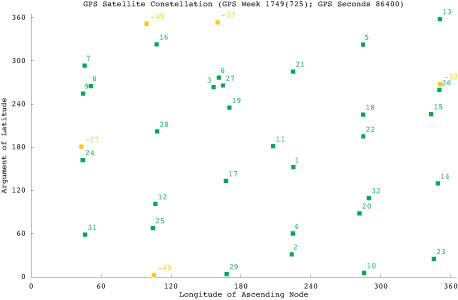
    I have a seven-year-old drawing of GPS satellites in their orbital planes that I found (can’t recall where) some years ago, either on a website or from a colleague who attended some GPS forum. Would you know of a site where I can find current information on GPS satellite locations, which ones have been decommissioned, and which ones have been replaced?

    — Grace Pazos

    Richard Langley replies:

    I don’t know of a plot that shows the locations of all decommissioned and/or replaced satellites (some of them would have been boosted out of the GPS orbit planes), but relatively current information on the active and backup satellites can be found here, and a plot here (and depicted below). I update the table and plot roughly every six months. Earlier versions are available on request.

    Constellation snapshot for a specific date/time: GPS week 1749 (725) and GPS seconds 86400 = July 15, 2013, at midnight GPS Time.
    Constellation snapshot for a specific date/time: GPS week 1749 (725) and GPS seconds 86400 = July 15, 2013, at midnight GPS Time.

    Survey Scene Newsletter Mail

    Thanks for the insightful update on the ESRI User Conference and the Survey Summit. For those of us who can’t afford to travel, it helps to get the scoop on these events. It is interesting to me that the push towards the future includes heavy emphasis on lighter and simpler small platform apps, cloud-based GIS, and 3D visualizations, and less emphasis on the building blocks of geodesy, cadastral data, and surveying. It almost seems like the GIS community is pushing the hard stuff under the rug and focusing on what is new and shiny. And doing this while talking about higher quality standards.

    Keep up the good work, thank you.

    — David Scherf, Manager of GIS/Technical Services, Torrington, Connecticut

    Eric Gakstatter replies:

    Thanks for the comments. If you’ve followed my series “Nightmare on GIS Street,” you’ll see that I’m trying to raise awareness of the importance of geodesy in GIS. I don’t believe that most people are sweeping this subject under the rug because it’s a difficult subject, but just that they aren’t aware that it’s a problem. Secondly, if they do recognize the problem, many don’t know how to solve it. There’s definitely a knowledge gap, and an opportunity for geodesists (or qualified surveyors) to contribute.

    Defense PNT Newsletter Mail

    Thank you for your tribute to Col. Duke Kane’s many contributions beyond the GPS community. I was also sad to hear of his passing. I met Duke in the late 1980s and watched with considerable interest as he established the GPS International Association.

    He felt strongly that the GPS users needed their own forum to voice user interests similar to that which had recently been established for GPS industry via the U.S. GPS Industry Council. His foresight and energy will be missed.

    — Jules McNeff, Overlook Systems Technologies, Inc., Vienna, Virginia

    Don Jewell replies:

    Thanks for your kind words. Of course you and I knew Duke well, and you are correct, he made many significant contributions beyond GPS, even though it was a major accomplishment in which he was always very proud to have had a role to play.

    Duke Kane was my uncle, and I can tell you the germinal event that grabbed his interest in flight. While a young boy, Duke and my father Jack (Duke’s older brother) pooled their resources and bought a very popular adolescent novel by Nordoff and Hall (these authors also wrote Mutiny on the Bounty) called Falcons of France, written about two young American boys who volunteered to fly for France in World War I before the United States entered the conflict. Duke’s eyes were set skyward ever after.

    — Michael Kane

  • Letter to the Editor: Our First Mistake

    Our first mistake is to presume an environment of perfection and security. Nothing is foolproof and spoof-free. Every product or service is an envelope of packaging that can be opened, peeled back, reversed engineered, and replicated. I have seen “ultimate security” defeated repeatedly.

    GPS is no exception, of course. We put our signatures and seals on these things; enterprising competitors, adversaries, and curious people find a way to steam open our envelopes, create seals indistinguishable from the original, or simply use products in ways unexpected.

    We exist in a world headed pell-mell toward the product consumerization, as GPS World tells us, as if this is new. We BYOD [bring your own device, a business policy of employees bringing personally owned mobile devices to their place of work and using those devices to access privileged company resources such as email, file servers, and databases, as well as their personal applications and data.  — Ed.] to work with its purchase by credit card and reimbursement by petty cash. This is nothing new than a newer terminology for mass-merchandizing.

    Wars will be fought that way too, as if they always weren’t. Soldiers built their own grenades, brought their own weapons, horses, uniforms, and food to the contested game … always. Patton had his own pair of pearl-handled Colt sidearms.

    The pressure for encrypted GPS and inconvenient milspec devices misses this reality. Our every weapon will fail unintentionally, get repurposed by knowledgeable adversaries, and be turned intentionally against us. We cannot engineer away these consequences. We can only be better readers. We must be flexible competitors. We have to be open to the reality that everything fails in ways we will not anticipate but should expect.

    War is not fought in rows with toy soldiers equal and alike arrayed with fair rules. Fourth generation warfare is here. War is an expediency when diplomacy, economics, and reason fail with adversaries and friends alike. It is fought with a dangerous expediency.

    — Marty Nemzow
    Miami, Florida


  • Letter to the Editor: Using One Part of GPS, Ignoring Another

    The article “Drone Hack” in the August issue of GPS World and Todd Humphreys’ testimony before a House Subcommittee overseeing the Department of Homeland Security cited results of a spoofing experiment Humphreys conducted with University of Texas colleagues, demonstrating that a drone helicopter, navigating principally on the civil GPS signal, could have its vertical channel spoofed, causing it to descend. Reaction, quite strong from some directions, prompted one observer to investigate whether a “sky-is-falling” perception is fully warranted. Partly for that reason, emails started circulating among various individuals, including some directly involved in the design. When first brought into the group I was not expecting to be the one to summarize, but, as events unfolded, I’m called on to act as techno-sleuth.

    Let me first state the conclusion: the sky is not falling. That’s not intended to discourage corrective measures — and it is immediately acknowledged that definitive answers remain unresolved (detailed configuration of the Kalman filter, state estimates, weighting of the baro altimeter). But this much is clear: conditions weren’t 100 percent normal. From here I’ll cover the supporting facts, followed by possible corrective measures. Discussion will be technical, without any hint of administrative authority or approval.

    Key revelations came to light in discussion with the chief scientist of Adaptive Flight, who designed the drone’s nav system software and operator interface.

    “The reason Todd and his team were able to modify the vertical position of the aircraft even though altitude aiding is actually coming from the pressure sensor,” he stated, “is that the GPS vertical velocity was being used. The spoofed GPS position (altitude error) was actually being ignored.”

    We might call that a hybrid mode, using one part of GPS and ignoring another. Selectivity isn’t intrinsically unwise — we need options to reject some data without automatically rejecting other information — but, with GPS-derived altitude ignored for any reason, why not reject all vertical-channel influence from GPS? In fact that’s consistent with normal operation; disabling (again a quote) “GPS vertical velocity as an aid … can be done with a command from the control station (and saved as default for the aircraft).”

    Well, then, the demo doesn’t reflect 100 percent normal procedure. Relief: our drones aren’t as vulnerable as we thought, and the fear expressed in various publications can be reduced.

    For further support of that conclusion, additional major information from that same designer includes a quote that “The baro altimeter is used to provide a vertical position discrete update to the Kalman filter. This is true for both normal and GPS-denied modes. There are no (automatic) divergence tests in this system. There is some outlier detection/rejection on the GPS (which probably was not triggered in the spoofing tests, but I haven’t seen the data). There is nothing on the baro altimeter.” Finally, he says “it is a trivial change from the control station to make the vertical channel ignore GPS in normal mode by turning off the down GPS velocity measurement update; it would still fly fine.”

    The combined weight of all that can justifiably reduce the level of concern — but not all the way down to zero. Now that all this happened, the subject of prevention needs to be addressed.

    As Todd Humphreys correctly noted, without spoofing but with existing errors, GPS position updating cannot adequately mitigate low-cost IMU drift.

    High-end IMUs bring budget issues (and their motion-sensitive errors limit performance anyway). Spectrum and signal quality is seen by many as an important consideration; residual monitoring is another. For the latter to be effective, the existing (loose) coupling needs upgrading (loose coupling wastes information content; the loss is greatest when GPS coverage is marginal). Extent of refinement (tight/ultratight/deep) and usage of carrier phase (while sidestepping its usual traps) open up a subject with much wider scope: cross-checking. I offer just a few fundamentals here.

    • Known data-edit capabilities available with existing provisions (for example, baro altimeter cross-checking), rather than something that “can be done” can always automatically disallow any partial influence from GPS instantly upon spoof detection, regardless of its genesis (Kalman filter bias state traceable to past history or any other source).
    • The step just noted generalizes to include all sensor data extant onboard, including carrier phase. The specter of huge expense for this particular step is nonessential; some receivers output raw measurements that can be put into public domain algorithms.
    • With access to all the raw data, every solution combination — federated and integrated — can be generated for cross-checking. In all cases, thresholds for residual testing are set with conservative assessments of sensor error statistics; this overbounding enables integrity testing to err on the side of caution (sacrificing some valid data to better ensure rejection of bad). Integrity test algorithms are likewise public domain.

    I close by paraphrasing an observation offered by Mitch Narins in a LinkedIn discussion: Deter threats before they happen. With a robust non-GNSS PNT alternative, spoofing will have no affect on safety or security.

     — James L. Farrell
    President, VIGIL, Inc.
    Severna Park, Maryland

  • Letter to the Editor: Suggestion to Protect Bandwidth

    In your March editorial, “The Fire Next Time,” you ask for suggestions to protect against another LightSquared encroachment. The solution is remarkably simple. Just let the same bandwidth be used for space downlink as it was originally intended. That would be both innocuous to GPS receivers and, more importantly, stake the ground against future challenges like LightSquared.

    — Alan Browne
    Lorraine, Quebec

  • Letters to the Editor: Antennas and the Human Body

    GPS0212_01_Cover_lowres  Cover: GPS WorldAntennas and the Human Body

    We have been reading with much interest the Innovation column, “GNSS Antennas and Humans” (Innovation, February issue). As the interaction with the human body is something many companies designing GPS into their products do not consider, it is great to see this topic being given some recent attention. We do feel, however, that we should comment on some issues we see in the article, especially as one of our antennas has been used as part of the testing.

    As rightly mentioned in the article, many of the products using GPS where performance close to the body is potentially an issue are consumer products. These typically are of small size or at very least have major space constraints placed on those designing them. As such it is very unlikely that they would use either a large active patch antenna or in fact an active antenna from Sarantel. In the vast majority of consumer applications, either smaller patch antennas (12 × 12 millimeters, maximum) will be used with smaller ground planes or even small chip or planar inverted-F antenna (PIFA) style antennas.

    From a Sarantel perspective, we would recommend our smallest antenna, the passive SL1300, for these types of applications. In terms of how this would then affect the results of the test described in the article, our extensive testing of various antennas would suggest that with smaller patch antennas and linear antennas like chip and PIFA types, the impact of the body on antenna performance is greater than you would typically see with a large patch with a large ground plane. In addition, one of the reasons we would recommend our smaller antenna for this kind of application is because the ceramic material used has a much higher dielectric value than our larger products and as such is affected much less by the body or other interfering aspects of a product design.

    As I mentioned, we have done extensive testing of various antennas, much of which is available through the Application Centre section of our website. Further information can be shared if it would be of interest to your readers.

    — Chris Muir
    Director of Sales, Sarantel Limited

    Spectrum Swap

    I read with interest your article today (Latest News, February 1) concerning LightSquared looking at a possible spectrum swap in the current Aeronautical Mobile Telemetry band, used heavily by both the DOD and commercial side, primarily for aircraft and missile testing. I found it more interesting that the DOD MIDLANT Area Frequency Coordinator had been contacted concerning the same.

    First let me say that both the DOD and civil aviation and defense industries guard these bands quite strongly as individual users and via the Aerospace Flight Test Radio Coordinating Council (AFTRCC). AFTRCC is also the recognized non-government coordinator for these bands and resists any encroachment in these bands, while additionally allowing some temporary sharing when feasible.

    Secondly, I would add the the DOD has seven total Area Frequency Coordinators geographically spread across the United States, so contacting one would serve little purpose. Additionally, the coordinators are members of the DOD Frequency Management Group who one would say is the DOD equivalent of AFTRCC and believe me, both organizations are on the same sheet of music when it comes to defending AMT for flight-test purposes and even meet jointly twice a year to do just that. Combined with the DOD and if one looks at the member companies of AFTRCC any attempt to wrest any portion ATM spectrum away from the aerospace industry and DOD would be an expensive and lengthy process.

    This email does not constitute a response from either DOD or AFTRCC but that of a private citizen.

    — Wayne Morris
    Greenville, Texas

    Privacy Matters

    Good editorial (“When the Gavel Comes Down,” February issue). The three or four bases for the unanimous ruling in the instant case show a diversion of philosophy on this matter that is dangerous for resolution only through case and constitutional law.

    You are dead right, legislation is needed at the federal level before a hodgepodge of states and other jurisdictions make up their own policies for a global utility with manifold applications affecting privacy and personal and intellectual property, for good and for evil; morally neutral technology, as always….not just GNSS but as in most instances, GNSS enhanced.

    It would not be popular with the federal legislature, but I think some European Union deliberations on these subjects would be instructive for the U.S. Congress to heed in writing legislation. I wish that the White House and an interagency group like EXCOM could first take a non-political look at the trades and lead Congress, but that is unlikely to happen. Look at what nearly happened with the Software Owners Protection Act (SOPA) because of the lobbying power of media interests.

    Truly we live in interesting times, also from the stress on our constitutional concepts which often use tortured analogies to keep the law inside the four corners of the constitution.

    — James D. Litton
    President/CEO, Litton Consulting Group, Inc.

  • Letters to the Editor: The Cost of Reliability

    Thanks to Richard Langley for the constellation update in November GPS World, from ION-GNSS. I’m a GPS constellation junkie, and if there was a history of each GPS space vehicle on orbit, I’d read them all. I love hearing the operational tidbits, about a IIF having problems with its cesium clock, or a reaction wheel failing, or how many spare SVs are on hand, and if SVs are slated to be disposed of, and so on. I’ve never been able to find a good centralized source of that type of information, as it seems to be something that just kind of leaks out into the industry press, from uncited sources. I’d been waiting for an update to The Almanac but it’s a moving target, so I understand why you don’t rush to update it every time a new SV is launched, or an SV’s clock changes. Especially with the increase in GNSS launches.

    So thanks for those new updates, and passing them along as they happen.

    A second thing, just kind of my musing of the state of the GNSS constellations, and how the U.S. GPS system is so much different than the others: The cost of reliability.

    With continued launches by Russia, the GLONASS system has, for all practical purposes, reached a fully operational status with 27 satellites set healthy, being commissioned or in flight tests. They are definitely putting far more SVs into orbit faster than the GPS program ever has. Over the years, they’ve put up so many satellites that they have three times as many disposed satellites (90) as they have operational (27) satellites.
    Compass has launched 13 satellites; at least eight are known to be usable.

    In the GPS constellation, there are still more SVs active on orbit than have been disposed of, in the entire history of the GPS program. Think about that for a minute.

    30 active satellites on orbit, and in the entire 40-year history of the program, only 29 have been disposed of. This is a testament to both the forward-thinking design of the GPS system by its many architects, contractors, and builders of the SVs and their payloads. And of course the Air Force that manages the constellation. The GPS system sets the standard for all other GNSS systems. It is not only the most accurate and dependable GNSS system in the world, it is also the most obsolete, in terms of age of spacecraft on orbit.

    The user segment enjoys reliability, at the expense of new features. Because the Block II and II-A satellites exceeded their design life, and now the last of the II-R satellites are reaching their design life, we don’t have all of the signals we could have from a more modernized constellation. Non-professionals like myself don’t have an operational L2C, for ionospheric correction in consumer-level devices. (Waiting on OCX.) We don’t have operational L5 (Waiting on OCX, again.) And what about all of those inter-satellite links for ranging that the IIR, IIR-M, and the IIF (and IIA as well?) satellites have? Are those waiting on OCX too?

    Originally, the IIF satellites were supposed to number 51. Then it was reduced to 33. Then 15. Now 12. 12 isn’t even enough to replace the entire remaining IIA fleet, while maintaining the current level of active SVs. Of course, it doesn’t make any sense to launch lots of IIF birds when GPS III is out there on the horizon, only three short years — we hope — away.

    If the II, IIA, IIR, and IIR-M GPS spacecraft would have had lifetimes similar to GLONASS satellites, the whole constellation would have either fallen into disrepair, or, more likely, been upgraded to IIF satellites a decade ago. And we’d have all of the modern signals that we could ever hope to need. Civilians have the same signals that we’ve had since the beginning of the GPS program. We could have had new signals years ago. but the old birds keep on flying, and so far, we only have two IIF satellites in orbit.

    — Jerry Pasker
    Monticello, Iowa

    Occupy GPS

    It occurred to me recently that maybe all these people all over the country are protesting the fact that 1 percent of the world’s GNSS receivers control 99 percent of the attention.

    While 99 percent of receivers actually outperform that select 1 percent in most metrics — time to fix, accuracy in cities, power consumption, sensitivity, dynamic range, jam immunity, and so on — because they live and work in cell-phones and tablets, they are poorly compensated and don’t always get the respect of their better-dressed cousins.

    — A Reader

  • Letters to the Editor

    Help Exposing

    Thanks for all your help in exposing the LightSquared fiasco. GPS World played a significant role in bringing the issue to the GNSS community and by exposing the ineptness (or was it venality?) of the FCC. I know there were many people involved in the effort to scientifically document the effects of jamming of GPS by the LightSquared signal, something obvious to any RF engineer. But like all government decisions, the politics and the economics always take precedence in decision making. The battle isn’t over yet but I hope the FCC will do what is best for the billion GPS/GNSS users worldwide and keep LightSquared and anyone else from interfering with our vital national resource. Your efforts and those of others like the GPS Industry Council will continue to play a key role in protecting GPS from intentional interference.

    — Len Jacobson
    Global Systems and Marketing Inc.
    Long Beach, California
    (and on GPS World’s Advisory Board.)

    Daughter of Time

    A terrific think piece, or call-to-action (Out in Front, July issue). I hope it galvanizes many to write, and write again. I am convinced of the urgency and importance of the situation.

    Your earlier column “Tech and Techer” (Out in Front, February) also struck a chord with me and no doubt with many readers of a certain age (and others, of course). It seems many folks now have little patience with the printed word. No doubt the ability to acquire new knowledge (which has a kind of lawlessness to it) is hampered when we are unwilling to take the time to absorb information in a slow and possibly nonproductive way. So many great inventions happened by accident.

    As you suggest, the Internet is a double-edged sword and GNSS is, too, for the shortcuts of everyday life (not for the professional). Still, these are wonderful inventions and here to stay. The good news is folks are aware of the dangers.

    — Jo Joslyn
    Villanova, Pennsylvania

    Bundling Pal

    You wrote “Genachowski has a long-term and reportedly close relationship with President Obama, who appointed him to the FCC chairmanship.” Researching another topic, I came across this:

    “In March 2009, Obama appointed $500,000 bundler and law school pal Julius Genachowski to chair the Federal Communications Commission, an independent agency.”

    A bundler in politics turns out to be someone who solicits and then gathers a number of smaller donations to a candidate, and turns them in as a large handful of individual checks. It’s quite legal, but I understand that it does preserve the anonymity of individual donors.

    I always enjoy your editorial pieces, and I trust the industry will eventually be able to push LightSquared off their frequencies — or at least off the high-band one. But clearly it won’t be without a major struggle — there’s too much money at stake.

    — Adrian Lucas
    former commercial pilot, Canada

  • Letters to the Editor: LightSquared Satellite Case Skimpy

    LightSquared Satellite Case Skimpy

    Thank you for the story “LightSquared, FCC Rebuttals Distort Record.” One thing worth clarifying: you state, “It appears that the purpose of Lightsquared’s satellite service is, now, to provide ancillary service in remote areas not covered by the ubiquitous primary terrestrial network, or in the event that the terrestrial network is destroyed — exactly the opposite of what the FCC authorized and the GPS industry had understood and agreed to.”

    But even this can’t work unless they are going to limit the number of subscribers in remote areas. A 4G user will expect decent wireless data throughput, but the subscriber’s connection is shared with other users within a spotbeam covering a large area. All connections must fit within the bandwidth of the single beam.

    Cell networks get around this problem by frequency re-use, possible since each cell covers a small geographic region. The key characteristic of a cellular network is the ability to re-use frequencies to increase both coverage and capacity.

    Admittedly, the LightSquared satellite, SkyTerra-1, is a very sophisticated space vehicle with a record 500 spotbeams. However, it provides a maximum user data rate of 300–400 Kbps, quite a bit short of what you would expect from a 4G-LTE connection. And at 400 Kbps, a 20-MHz spotbeam could still support only 50 to 100 connections.

    Another problem with using the satellite link is that although they have managed to solve the problem of requiring a special user handset, the user will still have to be outdoors and in the open to communicate with the satellite. And it is a geostationary satellite, which means high latency — at least 1/4 second. Using this for voice would create user annoyance.

    LightSquared should stop using the word “ancillary” and stop pretending that their network has a significant satellite component. It is going to have to be all ground-based if they are to provide 4G connectivity. It’s really starting to sound like the satellite is just a way for LightSquared to meet their FCC requirement.

    — Mike Whitehead
    VP Technology, Hemisphere GPS

    [Ed: citations and some discussion ommitted for space; available on request.]

    On Eric Gakstatter’s Survey columns:

    Keep up the good work. I find your e-newsletter columns the best way to stay informed [on the LightSquared issue].

    — editor, survey magazine

    Sounding Off

    When someone comes onto the basketball court with a hockey stick, the referees should not negotiate rule changes. Anything that allows LSQ to proceed either on the high or low ends of their allocated spectrum will in the long run be a blow to PNT users and suppliers worldwide. While this may very well end up as a compromise to the detriment of us all, now is not the time to concede any ground. He who flinches, loses, and this is not the time for engineers to give ground. It will set a precedent that lawyers will use again to decimate the spectrum in the future.

    —Informed particpant

  • Letters to the Editor: Hope

    Hope

    I was fortunate enough in 1993 to have three minutes of fame on 60 Minutes in a program about GPS that aired between Christmas and New Year’s that year. Also in the 13-minute segment was a short demo of a GPS PLGR. A reporter asked a lieutentant colonel outside Shreiver AFB to demonstrate how far and in what direction New York City lay. The colonel said, given the bearing and distance shown on the two-line display, he theoretically could navigate all the way from Colorado to New York. That lieutenant colonel was Willie Shelton. So I have hope that he will do the right thing for GPS during his tenure as head of Space Command. [System news, p. 14]

    — Len Jacobson
    Global Systems and Marketing Inc.
    Long Beach, California
     

    Down and Deep

    Wow! The article “Down and Deep” by Frank van Diggelen [December 2010 issue] was so useful for explaining the alternatives to GPS to a bunch of suits that normally don’t get it. I’ve shared it with many of my colleagues and they’ve all had the same reaction. Thank you!

    — Ed Harrison
    Orange County Probation Department
    Santa Ana, California