Tag: Libya

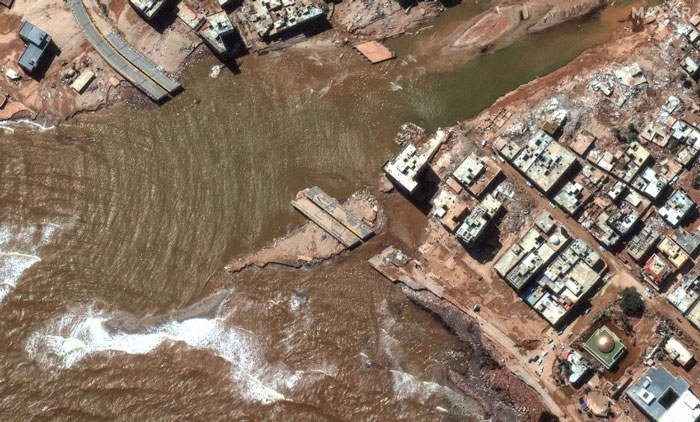
  • Satellite imagery released in response to Libya flooding

    Satellite imagery released in response to Libya flooding

    Image: Maxar Technologies
    Image: Maxar Technologies

    On Sept. 10, floodwaters overpowered dams and wiped out entire neighborhoods in eastern Libya, taking the lives of thousands of people and displacing more than 40,000 people, reported the Associated Press.

    Maxar Technologies has responded by publicly releasing satellite imagery data that maps the affected areas to support emergency response efforts as a part of its Open Data Program.

    The Maxar imagery or data distributed through the program can be quickly integrated into first responder workflows with organizations such as Team Rubicon, the Red Cross and other nonprofits.

    Derna and other parts of eastern Libya were hit with extreme flash flooding the night of Sunday, Sept. 10 — an effect of the Mediterranean storm, Daniel.

    The National Meteorological Center of Libya had issued early warnings for Daniel 72 hours before it occurred and notified all governmental authorities by e-mail and through media urging them to take preventive measures, reported the Associated Press.

  • Euromed Conference on Satnav Services Set for Dec. 17 in Tunis

    As part of European project MEDUSA coordinated by Telespazio (Finmeccanica/Thales), a workshop will be held in Tunis on Dec. 17 with stakeholders in civil aviation to promote the use of European satellite navigation systems in Libya, specifically EGNOS.

    MEDUSA (Mediterranean follow-up for EGNOS Adoption) is a project funded by the European Commission as part of Euromed program GNSS with the objective of promoting the use of European satellite navigation services (E-GNSS), starting from EGNOS (European Geostationary Navigation Overlay Service) ahead of Galileo, in the Euromed area.

    MEDUSA assists and prepares countries in the area (Algeria, Egypt, Jordan, Israel, Lebanon, Libya, Morocco, Palestine, Syria and Tunisia) in the adoption process of E-GNSS services, mainly in aviation as well as in other transportation sectors. To this end, MEDUSA implements a ”program of assistance actions” in countries from the area to transfer abilities, create technological capacities and share good practices.

    Moreover, MEDUSA has created an operational and cooperation structure, called GEMCO (Galileo EuroMEd Cooperation Office), with a long-term working plan providing for the participation at a regional level of all beneficiary countries.

    Located in Tunis, GEMCO acts as a reference point and catalyzer for all Euromed countries and towards Europe. Through GEMCO, MEDUSA favors initiatives connected to E-GNSS in the Euromed region, and contributes to the implementation of assistance actions of the project like national and regional workshops, training sessions, and days dedicated to studying.

    GEMCO will host the MEDUSA meeting with stakeholders of Libya’s civil aviation to analyze the country’s needs, identify priorities and help define a strategic vision in the short, medium and long-term in relation to the possible operative introduction of the use of EGNOS. Libya, which has repeatedly shown interest in the project and EGNOS (whose perspective of availability of coverage of respective service is provided for in the short and medium-term), represents an opportunity for EGNOS mainly in the aviation and helicopter sectors.

  • British Trade Delegation to Libya Taps Proteus for Mapping Expertise

    Proteus, a provider of satellite-derived bathymetric mapping and seabed classification services, represented the mapping industry in a British trade delegation to Tripoli organized by the Libya-British Business Council (LBBC). Proteus presented potential solutions to coastal mapping challenges faced by Libya during meetings with the National Oil Corporation, Ports and Maritime Transport Authority, University of Tripoli, and Libyan Center for Remote Sensing.

    “At every meeting, we were introduced to government ministers and business leaders who are eager to begin rebuilding Libya,” said Proteus CEO, David Critchley. “Libya recognizes that mapping will be the critical first step in rebuilding infrastructure across the country.”

    Invited to participate by Tilden International, Proteus was the sole mapping representative in the LBBC delegation, which included British companies involved in the energy, security and computing sectors. Held in late September 2013, the delegation mission was led by Sir Dominic Asquith, former British Ambassador to Libya.

    Since 2011, Proteus has been delivering offshore mapping projects for environmental, oil and gas, marine biology and other coastal zone applications in Europe, the Middle East and Caribbean, completed in a fraction of the time and cost of traditional methods. Proteus is currently engaged in a major offshore project in the Arabian Gulf, providing bathymetric and seabed classification services in the coastal zone using satellite imagery.

    “Whether exporting petroleum products from its shores or bringing tourists into the country, Libya sees development of its Mediterranean shipping ports as key to future economic success,” said Critchley. “Upgrading existing ports and building new ones will require mapping the seafloor several kilometers from the coast, and that’s why Proteus was invited to join the delegation.”

    Proteus uses commercially developed processes to derive bathymetric and seafloor classification information from high-resolution, 8-band multispectral imagery collected by DigitalGlobe Inc.’s WorldView-2 satellite and acquired by Proteus through its direct relationship with DigitalGlobe. Derived products have high accuracy, meeting the requirements of engineering, environmental monitoring and strategic geospatial planning applications.

    “Compared with maritime sonar and airborne LiDAR, satellite-derived bathymetric surveys are completed at a fraction of the time and cost,” said Critchley. “The ecological constraints, submerged reefs, and political issues that hamper traditional hydrographic mapping methods are of no hindrance to us.”