
Tag: location platform

  • Rx Networks provides assistance GNSS data tailored for IoT devices

    Rx Networks provides assistance GNSS data tailored for IoT devices

    Rx Networks logoRx Networks Inc., a mobile location technology and services company, has announced an update of its location.io platform to provide GNSS assistance data to enable better positioning in internet of things (IoT) devices.

    The company has updated its location.io HTTP interface to provide real-time GNSS ephemeris data with a reduced payload, a smaller predicted GNSS ephemeris client while maintaining full featured accuracy.

    Rx Networks is demonstrating location.io at its booth at ION GNSS+, being held this week in Miami.

    The location.io HTTP interface is now leaner and requires fewer requests and less data. In providing an interface for IoT devices, specifically, Rx Networks extends the delivery of their reliable and accurate assistance data to new and emerging use cases.

    “Rx Networks is a proactive company endeavoring to provide excellent solutions and services for our customers,” said John Carley, director of sales and product strategy at Rx Networks. “By adding another use-case focused interface, we are able help customers create top-quality solutions targeted for their customer needs. By adding another interface designed for specific use cases, we help our customers create top-quality solutions targeted for their customer needs. Especially in the areas of smaller processors, longer product life time and lower battery consumption.”

    location.io includes technologies already used by more than 1 billion smartphones, laptops and wearables worldwide. Specific components are:

    • Real-time GNSS assistance. The real-time assistance service is designed to work with all popular location servers such as Ericsson, TCS, ZTE, and Qualcomm. Rx Networks also offers RINEX files and a generic HTTP interface for independent access to the assistance data. It supports over five constellations, including GPS, GLONASS, Beidou, Galileo, QZSS and SBAS. RT-GNSS assistance can now be filtered by location or Cell ID to provide only Satellites in View.
    • Predicted GNSS assistance. The predicted service provide seed data that enable client devices such as smartphones, laptops, and wearables, to generate up to 14 days of extended ephemeris for fast and sensitive GNSS fixes. Predicted GNSS assistance support GPS, GLONASS, BeiDou and Galileo, and has been updated to have a smaller footprint, use less resources and support OSs and RTOSs.

    All location.io services are delivered from Rx Networks’ geo-redundant and cloud-based service delivery network, via a lean API ensuring a 99.999 percent service level availability.

    NTRIP Data. Rx Networks has also added NTRIP-formatted data services to location.io. Customers can now choose from a variety of data formats, including Rx Networks proprietary format, NTRIP, LPP, RRLP, proprietary real-time, IoT-optimized and a few custom formats.

    Observation data from our multiband multi-constellation global reference network is now available in NTRIP format, and customers are already on board.

    High availability is assured with geographically redundant secure NTRIP casters, the company said. The innovative High Accuracy Assistance Service (HAAS) product will also be available in RTCM format via NTRIP casters.

    With the addition of RTCM formatted data via an NTRIP data feed, Rx Networks continues to expand its constellation support with the largest variety of terrestrial delivery mechanisms. The solution architecture includes an NTRIP server, caster and client, providing a complete solution.

    “Our customers love the reliability and plug-and-play convenience of our NTRIP service,” said Brian Marciniak, head of business development at Rx Networks. “With Rx Networks’ expanded reference network, secure NTRIP observations and real-time data, we are enabling our customers to expand their businesses in exciting new ways.”

    location.io includes technologies already in use by more than 1 billion smartphones, laptops and wearables worldwide.

    All location.io services are delivered from Rx Networks’ geo-redundant and cloud based service delivery network.
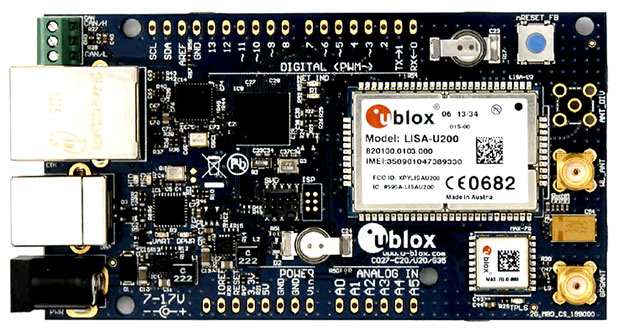
  • u-blox, ARM Join Forces on Location-Aware Prototyping Kit

    u-blox, ARM Join Forces on Location-Aware Prototyping Kit

    Photo: u-blox
    Photo: u-blox

    u‑blox and ARM, a semiconductor IP company, have joined forces to create a prototyping kit for designing wirelessly connected, location-aware Internet devices: the ARM mbed-enabled u‑blox C027 “Internet of Things (IoT) Starter Kit.”

    “The Internet is reaching into every aspect of our lives, connecting everything from smartphones and tablets to devices for security, safety, surveillance, navigation, healthcare, convenience, and fun,” said Michael Amman, vice president of Platform Partnerships at u-blox. “To help engineers jump start their design of these types of Internet-connected devices, the C027 delivers out-of-the-box wireless Internet connectivity based on a compact u-blox 2G, 3G or CDMA cellular modem plus global positioning module. Together with the ARM Cortex-M3 32-bit processor and access to all the resources of the ARM mbed project, this is an extremely powerful and flexible prototyping tool.”

    “This new kit will enable developers to join the ARM ecosystem and quickly move prototypes of intelligent ARM-based technology into production-ready designs,” said Charlene Marini, Vice President, Embedded Segment, ARM. “It brings together u-blox’s embedded cellular wireless and global positioning modules with the energy-efficient, high-performance ARM Cortex-M3 processor and the ARM mbed development platform. This exciting combination can drastically reduce the time required by manufacturers to build carrier-certified gateways, which will help to accelerate the Internet of Things.”

    The compact C027 kit, measuring 54 x 98 millimeters, contains a u-blox “SARA” GSM or “LISA” UMTS/CDMA cellular modem, “MAX” GPS/GNSS positioning module, and an ARM 32-bit Cortex-M3 microcontroller with 512k of Flash Memory and 64kB RAM, user programmable via USB. CAN bus and Ethernet interfaces are provided. The board also provides direct connector with 22 GPIOs to access components via I2C, SPI, UART, and I2S digital audio. The C027 is an mbed-enabled board with Arduino-compatible connectors which can be easily stacked with additional expansion boards. A complete circuit diagram is provided with the kit.

    To make development easier, the hardware is supported by the powerful and flexible open-source ARM mbed development platform, which provides free software libraries, hardware designs and online tools for professional and rapid prototyping of ARM-based designs. The platform gives access to a high-level standards-based C/C++ SDK for developing applications on the u-blox C027, a large component database of drivers for peripheral components that can be connected to it, and online compiler and developer tools for efficient reuse and collaboration on designs to create products quickly.

  • AirPatrol Quantum Leaps Into Location-Based Services

    Moving to stake a claim in the burgeoning location-based services and applications market, mobile systems developer AirPatrol Corporation has announced a pair of new offerings designed to let organizations and 3rd software developers enable app and information delivery to mobile devices in zones as small as six feet across.

    The first product, ZoneAware, is a locationing and delivery platform made up of passive sensors and a software-based locationing engine that gives organizations the ability to identify both 802.11 Wi-Fi and 2G/3G/4G cellular devices and enable different applications, information delivery, and mobile services as the device moves through monitored zones within a facility. AirPatrol’s other new offering is third-party access to its AirPatrol Zone Engine, which will allow software developers to leverage AirPatrol’s device locationing technologies to enable mobile apps and information delivery based on zones up to 30 times more precise than other locationing tools.

    “We’re heading into a post-PC world where smartphones, tablets and wearable computing will be changing their behavior and the information they provide based on where the user is and what she is doing at the time,” said Cleve Adams, CEO of AirPatrol. “Most locationing technologies can provide a general area of where a device is — within 100 to 1,000 feet — which is fine for generalized activities like finding restaurants within a mile of you, but it’s not particularly useful when you want real precision. AirPatrol’s Zone technologies can notify the maître d’ to prepare a table when a VIP steps into the restaurant, tell an emergency responder exactly what floor and room an E911 caller is in, even securely deliver patient records to a doctor’s tablet when he enters the patient’s hospital room.”

    Key to AirPatrol’s Zone technologies are a combination of passive sensors that detect and identify radio signals emanating from devices on both cellular and WiFi networks, and a software platform that does the heavy work of measuring those signals and adjusting for obstructions like wood, metal, stone and glass, to deliver pinpoint locationing and the triggers to apps and information based on the zone through which the device is traveling.

    “The ability to provide precision locationing in all building types using cellular/Wi-Fi detection and not just WiFi is a major benefit of AirPatrol’s technology,” Adams said. “Wi-Fi coverage is notoriously difficult in indoor locations with lots of obstructions such as walls. Many people are also simply turning mobile’s Wi-Fi off to reduce security risks and, increasingly, because 4G cellular is faster and more reliable. Because we use both, AirPatrol’s Zone technology can provide far more consistent and accurate locationing no matter whether the device is moving or stationary, indoors or outdoors. In short, we’re detecting the other half of the cellular users no other Wi-Fi-only solution can see,” he said.

    AirPatrol’s locationing technologies were originally developed for government and military security applications where precision locationing and forensic tracking of all mobile devices was a requirement. In 2012, the company released an enterprise version of its ZoneDefense mobile security platform which augmented the device monitoring features with the ability to connect to and trigger 3rd party mobile device and application management tools (MDM/MAM), policy managers, network and endpoint security tools based on location. It was the 3rd party connectors that spawned AirPatrol’s new offerings.

    “The moment companies realized we could add a location-based component to all of the mobile apps and tools they were using we started getting inquiries about connecting healthcare applications, retail services, marketing tools, and a whole list of other non-security-related systems to our ZoneDefense platform,” Adams said. “Given how much people use and depend on their mobile devices for work, home and entertainment these days, it only made sense to open the platform up to other applications and developers.”

    AirPatrol’s ZoneAware platform will be available in early Q4 of 2013. Application developers, information providers and other third parties who would like to connect their products to the AirPatrol Zone Engine can apply to join the AirPatrol developer partners program via the AirPatrol website.

  • CSR Location Platforms Go Live with China’s BeiDou-2 Tracking

    CSR plc today announced that its SiRFstarV, SiRFprima and SiRFatlas location platforms are now able to acquire and track satellites and utilize location data from the recently activated BeiDou Satellite Navigation System.

    The addition of the BeiDou constellation is part of CSR’s ongoing efforts to support all global navigation satellite systems as they become available, with software or firmware upgrades, for greater performance and enhanced compliance with existing and future requirements of national GNSS systems, the company said.

    “CSR is committed to supporting all current and future GNSS constellations with its location platforms to boost location performance by increasing service availability, reducing observation time and making measurements more precise for the most demanding applications,” said Dave Huntingford, director of marketing for location at CSR. “With the addition of these new satellites, our location platforms can now actively utilize GPS, GLONASS, QZSS and SBAS, in addition to BeiDou-2, and they are ready to support Galileo as soon as it becomes available to provide continuous location awareness and the best location-based services experience.”

    Rob Yeh, director of product marketing for Automotive SoC at CSR, added, “All CSR’s latest multi-GNSS location platforms, including CSR SiRFatlasVI and SiRFprimaII, are now able to demonstrate live BDS (BeiDou System) navigation, and CSR will include BDS support in all future-generation location platforms. Besides providing flexibility and improved satellite acquisition and location tracking in challenging situations like urban canyons, the BeiDou support also improves CSR’s already industry-leading dead-reckoning technologies.”

    CSR maintains an experienced development team in mainland China to develop and support BeiDou-related products and technology.

    Also known as Compass and BeiDou-2, the Chinese BDS started operations in December 2012 and  has 14 active satellites in service over the Asia-Pacific region available to general users. When fully deployed by 2020, BDS is expected to comprise a total of 35 satellites offering complete coverage around the globe.

  • Pole Star Offers ‘in the Box’ Indoor Location Platform

    Pole Star has launched its new indoor location platform, NAO Cloud. NAO Cloud simplifies the deployment of indoor location solutions by introducing an automated deployment process that dramatically reduces time-to-market and the costs of indoor location-based services, Pole Star said.

    NAO Cloud integrates the NAO Campus Software Deployment Kit (SDK), and enables customers and partners to deploy NAO Campus, Pole Star’s indoor location solution, in just a few hours, by using cloud-based software tools as well as positioning databases already available and shared by worldwide partner program members.

    In addition, third parties will have access to NAO Cloud’s crowdsourcing capabilities, eliminating field interventions for a simpler, faster and more affordable deployment and maintenance process, Pole Star said. Behavioral analytics or geofencing are also supported by NAO Cloud to maximize the monetization of value added location-based services.

    The NAO Cloud platform targets a wide range of businesses such as venue owners, advertising platform providers, application developers, global solution integrators or network operators. NAO Cloud makes deployment, integration in mobile apps and maintenance of indoor positioning services a simple process, from a single venue to a worldwide multi-site coverage, Pole Star said.

    “The indoor location services market has reached maturity. Multi-venue owners, marketing agencies and major telcos understand the challenges and the value of hyper-local information and real-time interactions with customers and related Indoor Location Analytics. Indoor positioning is the core technology that brings high value,” said Christian Carle, CEO of Pole Star. “NAO Cloud is the result of years of innovation and deep market experience through very large and complex field deployments around the world.”

    In 2012, Pole Star achieved several major innovation milestones, such as the integration of Bluetooth Low Energy and Inertial Sensors in its NAO Campus fusion engine, in addition to Map Data, Wi-Fi and GPS signals. The dynamic combination of these technologies provides today the best indoor location performance results in the market, while addressing any type of building and minimizing network infrastructure, deployment and maintenance costs, Pole Star said.

    The NAO Campus solution is now available for more than 80% of the smartphone market, compliant with Android and iPhone devices and embedded in consumer applications on the Google Play Marketplace and the Apple App Store.

    Today, Pole Star’s indoor location solutions have been deployed in more than 43 million square feet, in 15 countries such as airports (Paris Charles de Gaulle), shopping centers in Europe and North-America, museums and department stores. In 2011, Pole Star opened its North American headquarters in Palo Alto and has expanded its international presence in 2012, building deep partnerships with companies in Europe, North-America, Asia, Australia and the Middle East. Finally, at the end of 2012, in time for the holiday season, Pole Star launched, its “living lab” mobile application, Mall Buddy, that covers 9 of the biggest malls in Silicon Valley, from San Francisco to San Jose and demonstrates the worldwide extension capability of Indoor location services.

  • SINA, AutoNavi Launch Social Networking Platform for China

    SINA Corporation, an online media company serving China and the global Chinese communities, and AutoNavi Holdings Limited, provider of digital map content and navigation and location-based solutions in China, have jointly announced a strategic partnership to integrate and enhance each other’s social, location and mobile offerings.

    As a result of this partnership, AMAP, AutoNavi’s mobile map application, users will be able to sign on using Weibo Connect and access content directly from SINA Weibo. SINA Weibo users will also have access to the content and functionality of AMAP. The companies expect such content and product integration will enhance the social networking and navigational aspects of each other’s mobile offerings.

    “Over 70% of SINA Weibo users access the social media platform at least partially via mobile devices,” said Gaofei Wang, vice president and general manager of SINA Mobile. “LBS (location-based services) and mapping services will play a key role in Weibo’s mobile strategy, and we are excited to be partnering with AutoNavi to leverage their expertise in these areas.”

    “In teaming up with Sina, we are proud to provide our mapping and location-based services to more than 400 million Sina Weibo users, while at the same time integrating Sina Weibo’s social content and SNS features into AMAP,” said Congwu Cheng, chief executive officer of AutoNavi. “We believe our collaboration with Sina Weibo will benefit both of our users and we look forward to future cooperation between our two companies as we continue to bring new features and functionalities to our users.”

  • TeleCommunication Systems Selects Locaid as Location-as-a-Service Partner

    Locaid, a location-as-a-service company, and TeleCommunication Systems, Inc., (TCS) mobile communication technology company, have announced that TCS’ portfolio of mobile location-based products and services (LBS) will now incorporate Locaid’s location-as-a-service capabilities. This partnership provides wireless operators with access to rapidly deployable location technology for additional financial yield from their location infrastructure, the companies said.

    The TCS-Locaid partnership provides a turn-key LBS solution that includes location network capabilities via TCS’ Xypoint Mobile Positioning Center (MPC) or Xypoint Gateway Mobile Location Center (GMLC) platforms and cross-carrier, multi-source, location aggregation enablement. Through this partnership, Locaid’s aggregation solution integrates with TCS’ network location platforms and enables wireless operators to rapidly enhance their monetization of a location technology investment. Further, TCS facilities enable hybrids of in-network, hosted or managed services location platforms and cloud-based location aggregation enablement, the companies said.

    Locaid President and CEO Rip Gerber said, “TCS is known for providing carriers with new revenue opportunities and delivering them in a rapidly deployable, hosted and turn-key way. This agreement is testimony to the importance of Location-as-a-Service among the biggest players in mobile, and it is an historic first step between our two companies.”

    “With the appropriate privacy protections, the location of an individual has proven to be a valuable asset that can enhance the value of a carrier or enterprise’s service,” said Lynne Seitz, vice president of location products, TCS. “One of our key goals is to help our carrier customers to monetize this asset by making it available on demand to third parties across a wide-variety of verticals. After an extensive study of the mobile location market and providers, we selected Locaid for their commitment to privacy and impressive portfolio of content providers, enterprises, application developers and merchants who will compensate operators for access to location.”