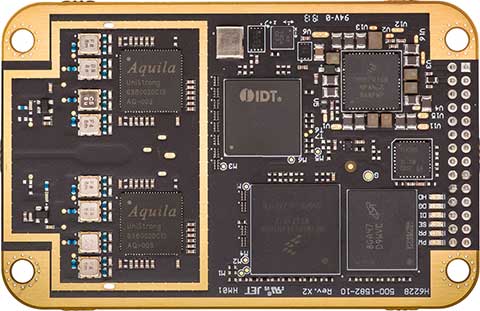
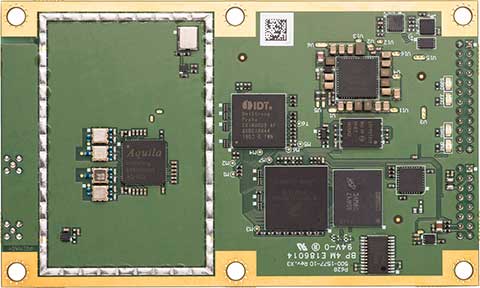
Hemisphere GNSS has added to its lineup another Vega heading and positioning OEM board that uses Lyra II and Aquila chipset technology — the Vega 34. The Vega 60 board was previously announced as using the Lyra II and Aquila chipsets.
Hemisphere’s Lyra II and Aquila application-specific integrated circuit (ASIC) designs simultaneously track and process more than 1,100 channels from all GNSS constellations and signals including GPS, GLONASS, Galileo, BeiDou, QZSS, NavIC, SBAS and L-band.
Integrators who use predecessor Hemisphere 34-pin products, such as Crescent Vector H220 and Phantom 34 OEM boards, can easily transition to the improved positioning performance and the superior satellite tracking abilities of the Vega series, the company said.
The Vega 34 board connectors have no circuitry changes and are identical for all Vector users, enabling them to add Atlas H10 and H30 precise point positioning (PPP) into their solutions.
“Vega 34 gives our integrators an easy path forward to enrich their own product offerings,” said Miles Ware, director of marketing at Hemisphere. “For the first time, Crescent Vector integrators can upgrade to multi-frequency without changing pinouts. They can also take advantage of other standard features like more than 1,100 tracking channels, Cygnus interference mitigation technology and spectral analysis.”
NavIC Upgrade. The introduction of the Vega 34 board also brings a new firmware release. Version 6.05 extends several features and improvements and introduces NavIC (IRNSS) tracking and positioning across the entire Vega and Phantom product lines.
Both real-time kinematic and Atlas positioning solutions are enhanced with improved performance in challenging environments. Users of the BeiDou satellite systems and B2b PPP integrators also will see significant advances in their solutions.
Hemisphere GNSS has announced another Vega heading and positioning OEM board using the Lyra II and Aquila chipsets.
The Vega 60 GNSS board fits industry-standard 46 x 71 mm form factors with a 60-pin connector. It can be used to replace more expensive and lesser abled 60-pin boards with either single- or dual-antenna capabilities.
Hemisphere’s Lyra II and Aquila application-specific integrated circuit (ASIC) designs provide the ability to simultaneously track and process more than 1,100 channels from all GNSS constellations and signals including GPS, GLONASS, Galileo, BeiDou, QZSS, NavIC, SBAS and L-band. The ASIC technology offers Vega 60 scalable access to every modern GNSS signal available.
Cygnus interference mitigation technology is also a standard feature, providing built-in digital filtering capabilities and spectrum analysis. This provides enhanced anti-jamming as well as interference detection and mitigation.
“We are excited for the opportunity to introduce our Vega 60 board,” said Miles Ware, director of marketing at Hemisphere. “Vega 60 brings our industry-leading heading and position solutions to an OEM board footprint with very few affordable upgrade paths.”
Hemisphere GNSS showcased its next-generation digital ASIC and RF ASIC interference mitigation platforms, and five positioning and heading OEM boards — the first products incorporating these powerful technological advancements.
Hemisphere is showcasing its new boards and technology at the Intergeo expo (hall 3, booth C3.030) and conference in Stuttgart, Germany, and the ION GNSS+ conference (booth 411) in Miami, Florida, both taking place this week.
Hemisphere’s Lyra II digital ASIC and Aquila wideband RF ASIC designs optimize performance and provide the ability to track and process more than 800 channels for position-only (the Phantom series boards) and more than 1,100 channels for position and heading (the Vega series boards), the company said.
Phantom 40. (Photo: Hemisphere GNSS)
This new ASIC technology offers flexible and scalable access to every modern and planned GNSS constellation and signal, including GPS, GLONASS, Galileo, BeiDou, QZSS, IRNSS, SBAS and Hemisphere’s Atlas L-band.
Signal support and tracking for AltBOC and BS-ACEBOC, BeiDou phase 2 and phase 3, L5 and QZSS/L6 (L6-D and L6-E) are also available.
The Lyra II and Aquila ASIC technology provides the foundation for a new GNSS receiver chipset architecture that significantly reduces the number of board components, thereby reducing complexity, improving reliability, and dramatically lowering power consumption.
Cygnus interference mitigation. The powerful technology platform also includes Hemisphere’s new Cygnus interference mitigation technology with built-in digital filtering capabilities and spectrum analysis. The new Cygnus technology provides enhanced anti-jamming, interference detection, and mitigation.
“This new technology platform and OEM boards represent significant improvements upon previous generation technology and hardware,” said Farlin Halsey, president and chief executive officer of Hemisphere. “With these outstanding advancements in our core technology and hardware, our customers and OEM partners are future-proofed and have flexibility and scalability with the highest-value access to all modern and planned signals.”
Vega 28. (Photo: Hemisphere GNSS)
The next-generation Lyra II, Aquila, and Cygnus technologies are available with the new Phantom 20, Phantom 34, Phantom 40, Vega 28, and Vega 40 OEM positioning and heading boards.
The Phantom 20, 34, and 40 positioning boards are the first Lyra II-based offerings in a line of all-new, low-power, high-precision OEM boards. They are multi-frequency, multi-GNSS receivers that boast more than 800 channels including access to Hemisphere’s Atlas GNSS global corrections network and offer serial, USB, Ethernet (Phantom 40-only), and CAN connectivity for ease of use and integration.
The Phantom 20 (41 x 72 mm module with 20-pin header), Phantom 34 (41 x 71 mm module with 34-pin header), and Phantom 40 (60 x 100 mm module with 24-pin and 16-pin headers) are significant upgrades for existing designs using these industry-standard form factors and offer power consumption of less than 1.8 W when tracking all signals, including L-band.
The Vega 40 and 28 are the first introductions in a line of all-new, low-power, high-precision, positioning and heading OEM boards. The multi-frequency, multi-GNSS Vega 40 and 28 GNSS receivers offer access to more than 1,100 channels including Hemisphere’s Atlas GNSS global corrections network.
The Vega 40 is a 60 x 100 mm module with 24-pin and 16-pin headers and is the ideal upgrade for existing designs using this industry-standard form factor. The Vega 28 is a 45 x 71 mm module with 28-pin header and is the smallest GNSS OEM heading module ever offered to the geospatial market by Hemisphere.
 Hemisphere GNSS has added to its lineup another Vega heading and positioning OEM board that uses Lyra II and Aquila chipset technology — the Vega 34. The Vega 60 board was previously announced as using the Lyra II and Aquila chipsets.