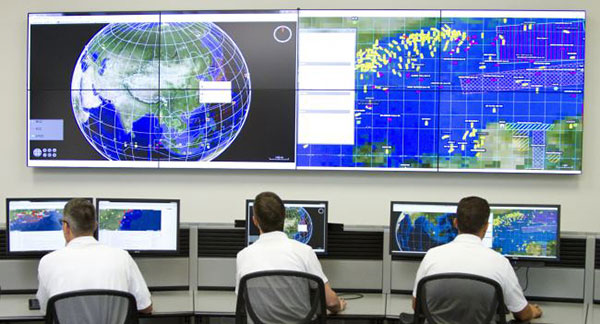
Orolia’s LEOSAR-GEOSAR-MEOSAR (LGM) Mission Control Center (MCC) solutions are now commissioned as Nodal MCCs in Spain and Australia, enabling global distribution of critical search-and-rescue information through the Cospas-Sarsat system.
With the successful commissioning of their Nodal MCCs, Spain and Australia will now be able to share critical information with the U.S. and France, providing worldwide coverage for global search and rescue.
In addition, since they will be authorized to commission other MCCs in their regions, they will also significantly advance the Cospas-Sarsat MEOSAR program.
Orolia’s McMurdo PRISMA MCC features satellite search-and-rescue technology with full LGM capability. It is the commercial solution of choice for search-and-rescue authorities in Norway, the UK and many other countries.
“We’re proud to support the world’s most critical search and rescue operations,” said Steve Ludwig, Orolia’s director of SARSAT Operations. “With Orolia onboard, you can rely on proven solutions in critical environments where failure is not an option. Our PRISMA Mission Control Center systems are the only successfully deployed, Cospas-Sarsat commissioned commercial solutions available, meeting the highest standard for search-and-rescue support.”
The Orolia PRISMA Mission Control Center. (Photo: Orolia)
Orolia has been developing global search-and-rescue programs for nearly 30 years, reaching a major milestone with the Medium-altitude Earth Orbit Search and Rescue (MEOSAR) system in 2011, and completing all global MEOSAR system installations since.
To date, 75 percent of the Earth’s surface is monitored by Orolia’s MEOSAR systems.
Through its McMurdo brand, Orolia has equipped these systems with the latest search-and-rescue technology to increase response times and save more lives worldwide.
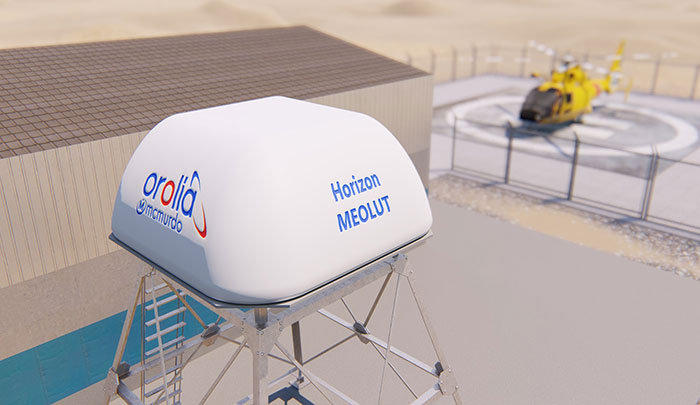
Orolia has introduced the McMurdo Horizon system, an S- and L- band compatible phased array system featuring antennas developed by Ball Aerospace with horizon-to-horizon coverage to capture search-and-rescue signals relayed from orbiting satellites immediately after line-of-sight is established.
The McMurdo Horizon system is now available to enhance regional search and rescue services worldwide with technology to complement existing and emerging ground-based systems at Medium-altitude Earth Orbit Search and Rescue (MEOSAR)ground stations.
Orolia’s McMurdo Horizon Medium Earth Orbit Local User Terminal (MEOLUT) can deliver enhanced search and rescue coverage and second-generation signal processing capabilities, in a compact form factor with no moving parts. The key technology innovation, based on a modified off-the-shelf phased array antenna developed by Ball Aerospace, is a custom-designed Orolia solution.
By pointing to satellites near the horizon, the McMurdo Horizon MEOLUT can detect and locate emergency beacons much farther away. This enhanced detection ability, combined with the McMurdo Selective Schedule Algorithm, enables the system to monitor more diverse regions, including the translation of oblong and irregular data points that are invisible to traditional systems.
The U.S. Army has awarded to Orolia subsidiary McMurdo a $33,986,800 contract to manufacture Personnel Recovery Devices (PRD) for warfighters. The contract is for indefinite-delivery/indefinite-quantity, with an estimated completion date of March 6, 2022.
The PRD is a dual-mode, MIL-SPEC locator beacon that will be integrated into the Army’s Personnel Recovery Support System (PRSS). It will be capable of transmitting both open and secure signals to alert and notify that a soldier has become isolated, missing, detained or captured.
The positioning device will optimize a successful rescue operation for soldiers in a distress situation through secure enhanced capabilities. It has been designed to meet military standards and specifications, and has improved accuracy, decreased size, weight and power (SWaP) requirements.
“We are extremely proud and honored to have been selected by the US Army as the provider of this critical positioning device for the safety of U.S. warfighters,” said Jean-Yves Courtois, CEO of Orolia. “Easy to incorporate into Personnel Recovery operations, the PRD is based on Orolia’s new rugged and small PNT platform dedicated to dismounted soldier Assured PNT applications.”
“This award, which follows the 2016 contract from the U.S. Coast Guard to produce 16,000 FastFind 220 personal locator beacons, is a testimony to Orolia’s world leadership in Resilient Positioning, Navigation and Timing,” he said.
The Personnel Recovery Support System Personnel Recovery Device contract was awarded by the U.S. Army Contracting Command, Aberdeen Proving Ground, Maryland, on behalf of the Army Air Warrior Product Management Office at Redstone Arsenal in Huntsville, Alabama.
Emergency preparedness company McMurdo has launched a new family of Emergency Position Indicating Radio Beacons (EPIRBs) that will accelerate the search-and-rescue process by combining multiple frequencies — including GNSS — into a single EPIRB product.
The McMurdo SmartFind and Kannad SafePro EPIRBs are distress beacons that can support each of the four frequencies used in the search-and-rescue process: GNSS for location positioning, 406 MHz and 121.5 MHz for beacon transmission, and Automatic Identification System (AIS) for localized connectivity.
The multiple-frequency capability will ensure faster detection, superior positioning accuracy, greater signal reliability and, ultimately, accelerated rescue of people or vessels in distress, the company said.
Expanded satellite connectivity. McMurdo SmartFind and Kannad SafePro EPIRBs have a multiple GNSS satellite constellation receiver supporting Galileo (once the constellation is fully operational), GPS and GLONASS — from a single beacon. Advanced GNSS data processing results in faster detection of positioning coordinates and enhances the accuracy of the emergency location.
Most of today’s EPIRBs use 406 MHz and 121.5 MHz frequencies via satellite communication to provide location and positioning data to global search and rescue personnel who may be several hundred miles away.
The additional AIS channels on the new McMurdo SmartFind G8 AIS and Kannad SafePro AIS EPIRBs will send position signal information to standard AIS electronic equipment on nearby vessels for complementary, local tracking and rescue capabilities. This global and local rescue capability will result in quicker signal detection and faster response times.
The McMurdo SmartFind and Kannad SafePro EPIRBs are part of McMurdo’s comprehensive search and rescue ecosystem. As the world’s provider of an end-to-end search and rescue ecosystem — including distress beacons, satellite ground stations, mission control and rescue coordination systems, and rescue response products — McMurdo builds, integrates and tests products as part of a live search and rescue system. This ensures greater cohesion between distress signal transmission and reception so that beacon owners can feel confident that their signals will get to search and rescue authorities quickly.
MEOSAR compatibility. The McMurdo SmartFind and Kannad SafePro EPIRBs are designed to be fully compatible with MEOSAR, the next generation of the Cospas-Sarsat international search-and-rescue satellite system that has helped to save over 40,000 lives since 1982. MEOSAR will increase the speed and accuracy of beacon signal detection and location with new MEOSAR ground network infrastructure and additional MEOSAR satellites.
When fully deployed, a MEOSAR-compatible beacon can be located with an accuracy of location within 100 meters (328 feet), 95 percent of the time — and within five minutes of distress signal activation, all without reliance on GNSS.
McMurdo manufactures approximately 50 percent of the world’s MEOSAR infrastructure and is also leading the design of additional MEOSAR-capable beacons under the European Union’s Horizon 2020 Research and Innovation Program’s HELIOS project.
“McMurdo’s new EPIRB announcement is a major step towards achieving a unified search-and-rescue vision,” said Bruce Reid, CEO of the International Maritime Rescue Federation. “The convergence of products and systems whether AIS and 406 MHz or maritime domain awareness and search and rescue, respectively, will require a comprehensive understanding of the entire search and rescue ecosystem. I look forward to seeing more McMurdo solutions and innovations that will shape the search and rescue industry for years to come.”
The McMurdo SmartFind and Kannad SafePro distress beacons support beacon transmission, GNSS for location positioning, and AIS for localized connectivity.
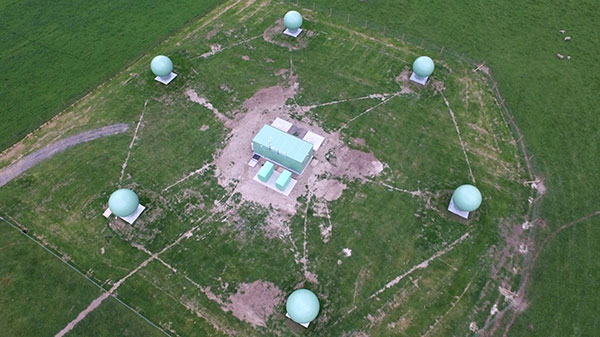
Emergency readiness and response company McMurdo has completed the installation of a six-antenna next-generation Medium-Earth Orbit Search and Rescue (MEOSAR) satellite ground station system in New Zealand.
The project, which is part of a joint initiative with Maritime New Zealand and the Australian Maritime Safety Authority, is expected to significantly boost search-and-rescue capability in the New Zealand and Australia search regions and marks the first implementation of MEOSAR in Asia Pacific.
MEOSAR is the next-generation version of Cospas-Sarsat, the international search-and-rescue satellite system that has helped to save 37,000 lives since 1982. Cospas-Sarsat is in the process of upgrading its satellite system by placing search-and-rescue transponders on new GPS, GLONASS and Galileo satellites. Once qualified as operational, this system augmentation will dramatically improve both the speed and location-accuracy for detecting beacons.
In a typical satellite-based search-and-rescue scenario, ships, aircraft or individuals transmit distress signals from an emergency location beacon via satellite to a fixed ground receiving station or local user terminal. The ground station receives and calculates the location of the distress signal and creates and sends an alert to the appropriate rescue authorities. Today, the beacon-to-alert process depends on a limited number of low Earth orbit (LEO) satellites and may take several hours before a position is confirmed. With MEOSAR, beacon signals will be received more quickly and beacon locations identified with greater accuracy thereby reducing this time to minutes.
“Beacons can take the ‘search’ out of search and rescue, and the MEOSAR system will dramatically increase the global search-and-rescue capability,” said Maritime New Zealand Director Keith Manch. “Emergency distress beacons are key equipment for anyone operating at sea, on land and in the air – whether commercially or recreationally — but they can’t operate without sites like this.”
“This key installation firmly establishes McMurdo as the premier MEOSAR infrastructure provider globally,” said Remi Julien, McMurdo president. “We are committed to partnering with both Maritime New Zealand and the Australia Maritime Safety Authority to ensure that they have the technology, training and long-term support in place to significantly reduce search-and-rescue times and, ultimately, save more lives today and in the future.”
The New Zealand MEOSAR system, and another being installed in Western Australia, will cover one of the largest search-and-rescue areas in the world — from north of Australia/New Zealand to the Equator and south to the South Pole, east to half way across the Pacific, and west half way across the Indian Ocean. The systems will undergo rigorous testing before being officially brought online in late 2017 by Cospas-Sarsat.
There are 58,000 emergency distress beacons registered in New Zealand which, without any changes or updates, will be immediately usable by the new systems. It is estimated, however, that an additional 25,000 beacons are unregistered. Due to the high responsiveness of the MEOSAR system, search-and-rescue authorities strongly recommend beacon registration. This will help the unnecessary deployment of search-and-rescue resources due to inadvertent beacon activations. The Rescue Co-ordination Centre New Zealand, part of Maritime New Zealand, responds to 550 beacon alerts a year.