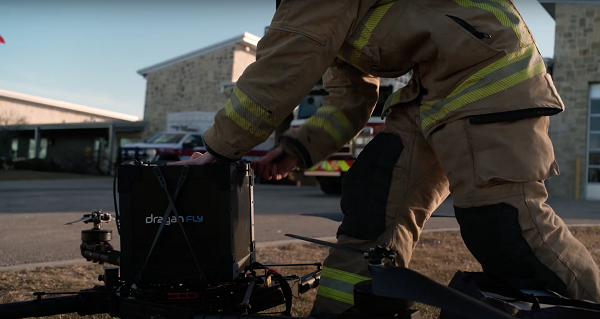
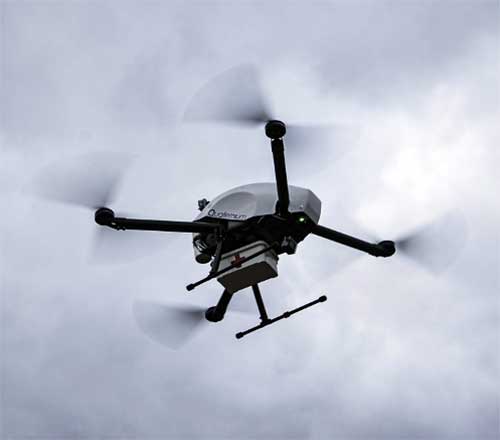
The first Draganfly humanitarian drone shipped to Revived Soldiers Ukraine (RSU) has arrived in Europe and will soon deliver insulin to hard-to-reach hospitals in Ukraine. Draganfly is a North American drone manufacturer.
RSU ordered 200 Draganfly medical response drones equipped with temperature-managed payload boxes that can transport up to 35 pounds of blood, pharmaceuticals, insulin/medicines, vaccines and wound-care kits. Because insulin is a temperature-sensitive product, quick and safe transportation of the hormone is a top priority.
About 2.3 million people in Ukraine live with diabetes. Many are Type 1 diabetics who need multiple daily injections of insulin to survive. For those living in high-conflict areas of the country, access to life-saving insulin is limited or non-existent.
NuGen Medical Devices donated the needle-free injection devices and 5,000 needle-free disposable syringes to be filled with insulin. Not only are life-saving medical supplies like insulin dwindling in Ukraine, but there is also an urgent need for many medicines across the country as hospitals have been under direct attack since Russia invaded on Feb. 24.
Draganfly medical relief drone. (Photo: Draganfly)
German drone manufacturer wins two prizes at renowned Lake Kivu Challenge in Rwanda
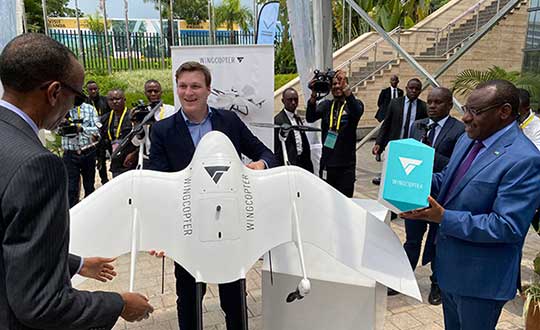
On May 5, the organizing committee of the Lake Kivu Challenge announced the results and named Wingcopter the winner of the Emergency Delivery category.
Wingcopter also received a special award for its safety procedures. As a winner, the company receives a prize money of GBP 65,000.
The Lake Kivu Challenge is a collaboration between the Government of Rwanda, the United Kingdom’s Department for International Development (DFID/UKAID), and the World Bank Group. The drone competition sought to demonstrate use cases for unmanned aircraft systems (UAS) on the African continent.
The challenge took place at the 2020 African Drone Forum in Rwanda in February — a first of its kind on the continent. Hosted by the Rwandan government and inaugurated by President Paul Kagame, the forum showcased advances in autonomous drone delivery — advances that can make a significant difference for isolated communities and rural areas across Africa.
Tom Plümmer, Wingcopter CEO, accepts the award from Rwanda’s President Paul Kagame. (Photo: Wingcopter)
The challenge received 92 applications from 35 countries. Only the top 10 drone companies were invited to put their drones and operators to the test through real-life scenarios at Lake Kivu in Western Rwanda.
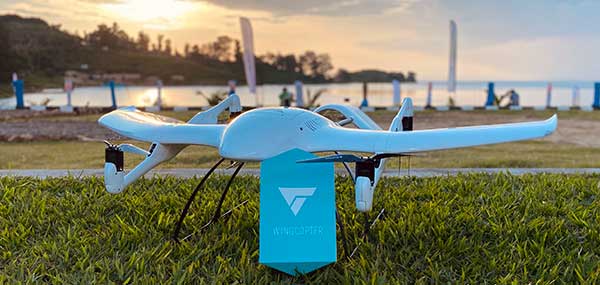
Throughout the three weeks of flights, Wingcopter was able to impress a panel of judges with perfect mission performance. This included fully automated delivery of an emergency package from a droneport on the mainland to Bugarura Island and a secure return landing.
The roundtrip, beyond-visual-line-of-sight-flight (BVLOS) was 40 kilometers and was completed without a battery swap. Wingcopter drones were able to complete the one-way route to the island within 12 minutes, a drastic reduction compared to more than 50 minutes by boat.
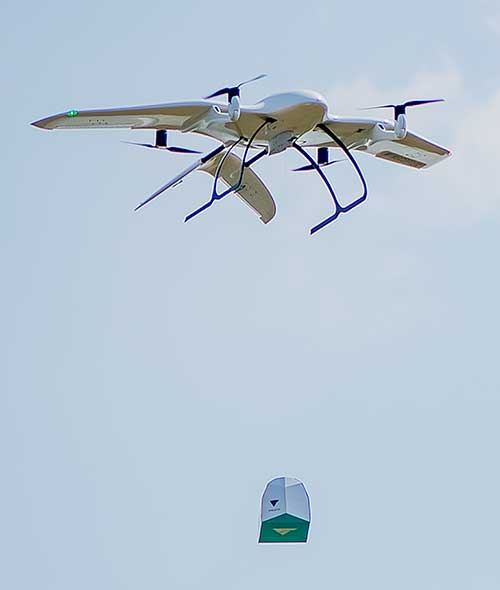
The package drop-off required no landing or human interaction, an attribute of Wingcopter’s innovative winch mechanism. Wingcopter had already successfully deployed a similar type of on-demand vaccine delivery to 19 remote villages in Vanuatu on behalf of the local Ministry of Health and supported by UNICEF.
The Wingcopter winch drop. (Photo: Wingcopter)
“We are very proud to be winners of the Lake Kivu Challenge, as this challenge and the African Drone Forum embody the innovative spirit of humanitarian aid and the African drone community as well as the great potential for sustainable drone deployments,” said Tom Plümmer, CEO and co-founder of Wingcopter. “We strongly believe that Wingcopter drones can leapfrog existing infrastructure by delivering significant social and economic value in Africa and beyond.”
“Wingcopter’s goal is to develop long-term partnerships with local governments, private sector and donor organizations throughout Africa,” added Selina Herzog, project manager at Wingcopter. “It is through these partnerships that we will accomplish the knowledge-sharing and training of the local workforce, ultimately empowering local stakeholders to take over and scale operations. We want our technology to give back to the communities where we operate and create new perspectives.”
The African Drone Forum created a unique platform to tell the Wingcopter story and exhibit its technology to more than 1,000 key players within the international drone and humanitarian ecosystem, allowing immense networking opportunities with the potential for future partnerships and business deals. An initial memorandum of understanding with a Rwandan startup has already been signed; others will likely follow.
Wingcopter recently announced a commercial partnership with UPS Flight Forward to jointly develop the next generation of package delivery drones. The combination of UPS’ experience in logistics and its global network with Wingcopter’s contactless drone delivery technology will put the two companies in a better position to contribute to the fight against the COVID-19 pandemic. Wingcopter is preparing multiple coronavirus-related projects.
Wingcopter on Bugarura Island. (Photo: Wingcopter)
With more than 3 million people infected around the world, the coronavirus pandemic is pushing health authorities to research and develop new ways to react to critical situations, according to drone company Quaternium.
Public and private organizations are racing to develop experimental treatments and vaccines to fight COVID-19. At the same time, many local companies are trying to think outside the box to find ways to minimize the effects of the crisis. “Our current situation has opened up opportunities for innovative solutions, and we are best seeing them within the drone industry,” said Alicia Fuentes, CEO at Quaternium.
Photo: Quaternium
Drones have been deployed in the effort to contain the spread of the pandemic. “We’ve seen drones distributing public information, like voice messages, to those not following social distancing measures as well as delivering medical samples and spraying disinfectants to urban areas,” Fuentes said.
Unmanned solutions are easy to operate and can be quickly mobilized. “In addition to reducing the risk of health of sanitary workers, drones also get to unreachable places; they have become a versatile tool for managing this health catastrophe,” Fuentes said.
In Europe, several startups like Quaternium, Drone Tools and Manna Aero, and in the U.S. and Canada, companies such as Zipline and Draganfly are all exploring how they can help in their regions and neighboring countries to decrease the aftermaths of the pandemic and save more lives.
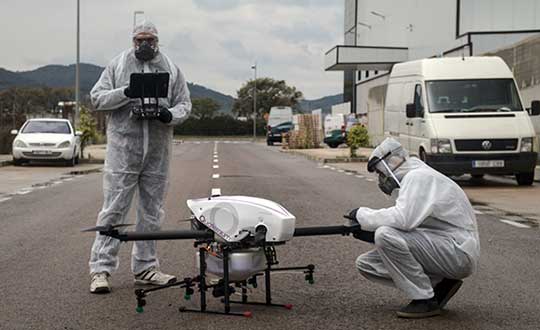
Quaternium demonstrates drone spraying
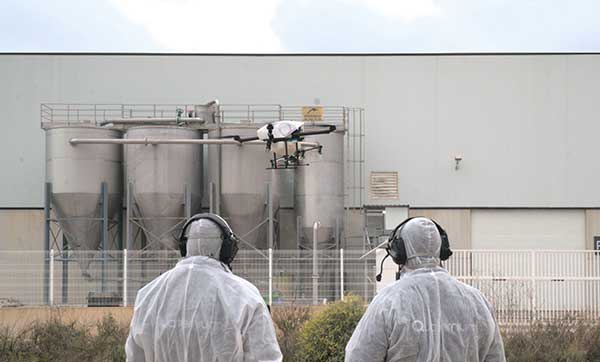
Quaternium has successfully been testing its hybrid drone, HYBRiX, to spray disinfectant products in Spain, showing how drone technology may serve in critical situations and how the company can support public authorities to help end the spread of the virus.
The company has also demonstrated aerial logistics solutions by delivering essential items to people in critical situations. Long-endurance drones can deliver supplies specifically for COVID-19 efforts, such as masks and gloves to first responders. HYBRiX can also deliver medicine to patients who can’t safely get to a pharmacy.
In the U.S., police departments are using drones from Impossible Aerospace to limit personal contact and share COVID-19 information, to reach out to homeless people (who are particularly at risk for coronavirus) and to monitor and enforce social distancing.
These are some of the areas where drones are being used to fight COVID-19.
Delivery drones
Due to COVID-19 being so contagious, it’s safer if human-to-human contact is minimized. UAVs are proving to be a valuable tool when delivering medical samples and essential items to health personnel. Several drone companies have made tests showing the crucial role that unmanned logistics can play against the spread of COVID-19.
Inform and prevent
“In the last weeks, we have seen speakers being mounted on drones to help inform people outdoors and prevent public gatherings. Drones can also be found flying with banners advising people on how to be more precautious when going outside,” Fuentes said. The mobility and flexible use of these UAVs make the mission of security agencies simpler, while avoiding close contact with the population, she said.
Aerial spraying and disinfection
First in China and now in Europe and the U.S., agriculture drones — originally designed to spray liquids on crops — are being adapted to spray disinfecting chemicals in public spaces and impacted areas. Experts have discovered that coronavirus is mainly transmitted by touching contaminated surfaces. This new virus has shown to be very contagious and resistant, staying on some surfaces up to 30 days, which makes disinfectant spray vital to helping reduce transmission mechanisms.
The battle with COVID-19 has just begun. Cases are continuing to rise in and outside of Europe. “Now more than ever, public authorities and private companies need to join forces in order to grow stronger and overcome this pandemic together,” Fuentes said.
The United States Federal Aviation Administration (FAA) has awarded air carrier and operator certification to UPS Flight Forward, an unmanned aircraft system (UAS) delivery company.
Through the DOT’s UAS Integration Pilot Program, the FAA has now approved a Part 135 operating certificate for UPS Flight Forward. This allows the company to perform revenue-generating package delivery activities within federal regulations.
UPS Flight Forward may now operate multiple drones under one certificate. Under Part 135, the company can deliver vital healthcare supplies including by flying beyond visual line of sight.
The UPS subsidiary immediately launched the first drone delivery flight by any company under Part 135 Standard at WakeMed’s hospital campus in Raleigh, N.C. That flight, using a Matternet M2 quadcopter, was flown under a government exemption allowing for a beyond-visual-line-of-sight (BVLOS) operation, also a first in the U.S. for a regular revenue-generating delivery.
UPS said it has proven the need for drone delivery in healthcare operations, where the shortest time in transit can improve efficiency and help healthcare professionals better serve patients.
The medical delivery program at WakeMed is the result of testing conducted by UPS and Matternet in August of 2018 as part of their participation in the UAS Integration Pilot Program (UAS IPP).
UPS partnered with Matternet to launch its healthcare delivery service on the WakeMed campus. The revenue-generating service demonstrated the business case for drone delivery of medical products and specimens.
Now, with its Part 135 Standard certification, UPS is ready to build on this application and expand to a variety of critical-care or lifesaving applications.
Photo: UPS
“This is history in the making, and we aren’t done yet,” said David Abney, UPS chief executive officer. “Our technology is opening doors for UPS and solving problems in unique ways for our customers. We will soon announce other steps to build out our infrastructure, expand services for healthcare customers and put drones to new uses in the future.”
The company will initially expand its drone delivery service further to support hospital campuses around the country, and to provide solutions for customers beyond those in the healthcare industry.
Part 135 Standard certification enables UPS to integrate drones into the UPS logistics network, creating potential for new applications in many industries. The company has a long-term plan with milestones that include:
expansion of the UPS Flight Forward delivery service to new hospitals and medical campuses around the country.
rapid build-out of ground-based, detect-and-avoid (DAA) technologies to verify drone safety, while enabling future service expansion.
construction of a centralized operations control center.
regular and frequent drone flights beyond the operator’s visual line of sight.
partnerships with additional drone manufacturers to build new drones with varying cargo capacities.
adding new services outside of the healthcare industry, including the transport of special commodities and other regulated goods.
“UPS is committed to using technology to transform the way we do business,” said Scott Price, UPS chief transformation and strategy officer. “UPS’s formation of a drone delivery company and application to begin regular operations under this level of certification is historic for UPS and for the drone and logistics industries.”
As a participant in the U.S. Transportation Department’s Unmanned Aircraft Systems Integration Pilot Program, the North Carolina Department of Transportation (NCDOT) partnered with UPS Flight Forward. As the operator, they have been engaged in delivery of healthcare supplies around a major hospital campus in Raleigh, North Carolina. The flights have focused on the delivery of blood for potentially life-saving transfusions, as well as other medical samples for lab work.
The company demonstrated that its operations met the FAA’s rigorous safety requirements to qualify for an air carrier certificate. This is based on extensive data and documentation, as well as test flights.