GPS company NextNav and Spartacus Acquisition Corp, a special-purpose acquisition company, has entered into a definitive merger agreement that will result in NextNav becoming a public company. The combined company will be named NextNav Inc. Its common stock and warrants will be listed on the Nasdaq under the ticker symbol “NN” and “NNW”, respectively.
Gross proceeds of up to $408 million from the business combination are expected to be used to fuel growth in its current businesses, continue to build NextNav’s next-generation GPS platform, expand products (one of which is already deployed in 4,400 cities), and to expand its land-based radio positioning and timing network.
The NextNav platform serves a $100 billion global total addressable market in public safety, E911, mass-market consumer apps, eVTOLs, UAVs and autonomous vehicles, internet of things (IoT), critical infrastructure and other sectors. Beyond its technology and intellectual property, NextNav owns a portfolio of nationwide spectrum licenses for 2.4 billion MHz-PoPs of 900 MHz spectrum.
Gary Parsons, former chairman of the board of Sirius XM Radio, has served as chairman of NextNav’s board of directors for the past 10 years and will continue in that role. Peter Aquino, chairman of the board and CEO of Spartacus, will also join the NextNav board upon closing of the business combination. Aquino has led several companies through fiber and wireless operations and network deployments, and the development of overlay technologies designed to drive new revenue streams.
NextNav will continue to be led by Ganesh Pattabiraman, the company’s co-founder, CEO and president. Pattabiraman, who started at Qualcomm, has experience in building scalable location technologies using terrestrial and satellite-based technologies,
In addition, the full NextNav management team — co-founder Arun Raghupathy, SVP of Engineering; Chris Gates, CFO; and David Knutson, SVP of Network Operations and Deployment — will continue to manage NextNav.
Hogan Lovells is advising NextNav with corporate and finance partner Randy Segal and partners Adam Brown, John Duke, and Jessica Bisignano leading the team. Senior associates Michael Rogers and Liz Banks, and associate Chelsea Shrader assisted as well.
GMV Innovating Solutions Limited — the U.K. aerospace company belonging to the Spanish technology multinational GMV — has signed a merger agreement with Nottingham Scientific Limited (NSL).
GMV trades in the aerospace, defense, ICT and intelligent transportation systems markets, while NSL is a U.K. leader in satellite navigation and critical applications.
After the agreement, GMV becomes sole shareholder of NSL and sets up the company GMV NSL, to be integrated seamlessly into GMV’s set of companies. NSL was founded in 1998 by Vidal Ashkenazi, a former member of GPS World’s Editorial Advisory Board.
Vidal Ashkenazi
In 2013, as part of its international expansion, GMV rolled out a business development strategy in the U.K. This involved setting up a new company, which came on stream in late 2014 to join the suite of companies and offices in Spain, USA, Germany, France, Poland, Portugal, Romania, The Netherlands, Malaysia and Colombia.
Working from its Harwell innovation center in Oxfordshire, GMV’s main U.K. business is Earth observation, space debris tracking, mission planning, flight dynamics, navigation, autonomy and robotics. Its principal clients include the European Space Agency (ESA) and the European Commission (EC), as well as U.K.’s space agency (UKSA), the Defence Science and Technology Laboratory (DSTL), Innovate UK, ASUK, Satellite applications Catapult and the Science Technology Facility Council (STFC).
Set up in 1998 and with a solid and acknowledged track record in high-tech projects, NSL is a U.K.-based SME specializing in satellite navigation and critical applications. From its Nottingham head office in the East Midlands, NSL offers GNSS-based services, systems, solutions and intellectual property, helping to ensure that navigation and positioning are precise and reliable, secure and protected, resistant and robust. NSL’s major clients include UK Space Agency, ESA, U.K. Government departments, QinetiQ, Inmarsat, and the European Commission.
GMV NSL, 80 strong, will be integrated into GMV’s set of companies, which closed 2019 with a staff of 2,176 and a turnover of more than €236 million. Membership of the GMV powerhouse will enable GMV NSL to rise to even greater challenges and tap into the opportunities offered by the U.K. market, especially the space market, not only in satellite navigation and in critical applications, but also in Earth observation, telecommunications and new technologies, with the overarching aim of winning pole position in Britain’s space sector.
Jesús B. Serrano, GMV CEO (Photo: GMV)
“This merger will enable the resultant firm to tap into significant commercial, technological and operational synergies, boosting GMV NSL’s rate of growth and winning it a place in the space programs of both the U.K. and Europe as a whole,” said Jesús B. Serrano, GMV CEO.
“In our different ways, GMV and NSL are regarded as world leading space companies and this agreement will expand our capabilities and capacity enabling us to successfully tackle even greater challenges and consolidate GMV NSL’s position as the benchmark space company,” Mark Dumville, co-founder and director of NSL, added.
The sheer quality of both teams and the like-mindedness of GMV and NSL on company values, heritage, technological excellence and client satisfaction were all deal clinchers in this merger agreement.
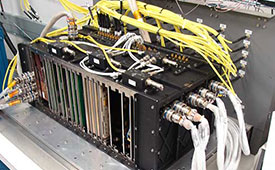
The Harris-supplied navigation payload before integration into the second GPS III SV. (Photo: Harris)
L3Harris Technologies announced the successful completion of the all-stock merger between Harris Corporation and L3 Technologies on June 29. Headquartered in Melbourne, Florida, L3Harris becomes the sixth largest defense company in the U.S., and a top 10 defense company worldwide, with approximately $17 billion in revenue and 50,000 employees, including 20,000 engineers and scientists.
Both companies have long been dominant presences in the U.S. GPS industry: Harris as a provider of the GPS satellite navigation payloads and geospatial intelligence software products, and L3 as a provider of military GPS user equipment and guided munitions. Both companies supply a wide range of other geospatially-related products as well.
L3Harris has organized its operating businesses into four segments to best meet customers’ mission requirements and leverage the combined company’s broad technical capabilities:
Integrated Mission Systems — headquartered in Palm Bay, Florida, with approximately $4.9 billion in revenue. Includes intelligence, surveillance and reconnaissance; advanced electro optical and infrared solutions; and maritime power and navigation
Space and Airborne Systems — headquartered in Palm Bay, Florida, with approximately $4.0 billion in revenue. Includes space payloads, sensors and full-mission solutions; classified intelligence and cyber defense; avionics; and electronic warfare
Communication Systems — headquartered in Rochester, New York, with approximately $3.8 billion in revenue. Includes tactical communications; broadband communications; night vision; and public safety
Aviation Systems — headquartered in Arlington, Texas, with approximately $3.8 billion in revenue. Includes defense aviation products; security, detection and other commercial aviation products; air traffic management; and commercial and military pilot training
Shares of Harris common stock, which traded on the NYSE under the ticker symbol “HRS,” began trading on July 2 under the ticker symbol “LHX.” L3 Technologies shares ceased trading upon market close on June 28 and have converted into 1.3 L3Harris shares for each L3 share.
The merger comes at approximately the same time that two other leading GPS companies, Raytheon and United Technologies, itself a merger including the former Rockwell Collins, now Collins Aerospace, also merged.
The transaction will create a systems provider with advanced technologies to address rapidly growing segments within aerospace and defense, the companies said. Raytheon is a defense contractor, while United Technologies is an aerospace company comprised of Collins Aerospace and Pratt & Whitney.
The combined company, Raytheon Technologies Corporation, will offer a complementary portfolio of platform-agnostic aerospace and defense technologies, expanded technology and R&D capabilities to deliver innovative and cost-effective solutions aligned with customer priorities and the national defense strategies of the U.S. and its allies and friends.
The merger is expected to close in the first half of 2020, following completion by United Technologies of the previously announced separation of its Otis and Carrier businesses, which are not part of the merger. The timing of the separation of Otis and Carrier is not expected to be affected by the proposed merger and remains on track for completion in the first half of 2020. The merger is intended to qualify as a tax-free reorganization for U.S. federal income tax purposes.
The combined company will have approximately $74 billion in pro forma 2019 sales.
Under the terms of the agreement, which was unanimously approved by the boards of directors of both companies, Raytheon shareowners will receive 2.3348 shares in the combined company for each Raytheon share. Upon completion of the merger, United Technologies shareowners will own approximately 57 percent and Raytheon shareowners will own approximately 43 percent of the combined company on a fully diluted basis.
“Today is an exciting and transformational day for our companies, and one that brings with it tremendous opportunity for our future success. Raytheon Technologies will continue a legacy of innovation with an expanded aerospace and defense portfolio supported by the world’s most dedicated workforce,” said Tom Kennedy, Raytheon chairman and CEO. “With our enhanced capabilities, we will deliver value to our customers by anticipating and addressing their most complex challenges, while delivering significant value to shareowners.”
“The combination of United Technologies and Raytheon will define the future of aerospace and defense,” said Greg Hayes, United Technologies chairman and CEO. “Our two companies have iconic brands that share a long history of innovation, customer focus and proven execution. By joining forces, we will have unsurpassed technology and expanded R&D capabilities that will allow us to invest through business cycles and address our customers’ highest priorities. Merging our portfolios will also deliver cost and revenue synergies that will create long-term value for our customers and shareowners.”
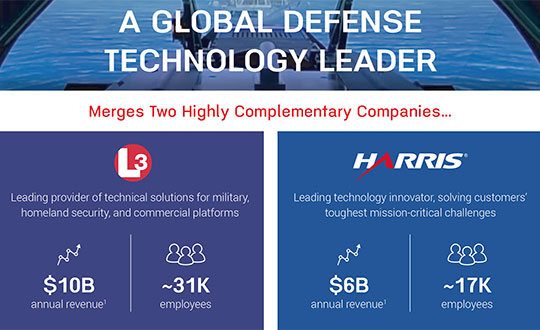
Harris Corporation and L3 Technologies Inc. have agreed to combine in an all-stock merger of equals to create a global defense technology leader focused on developing differentiated and mission-critical solutions for customers around the world.
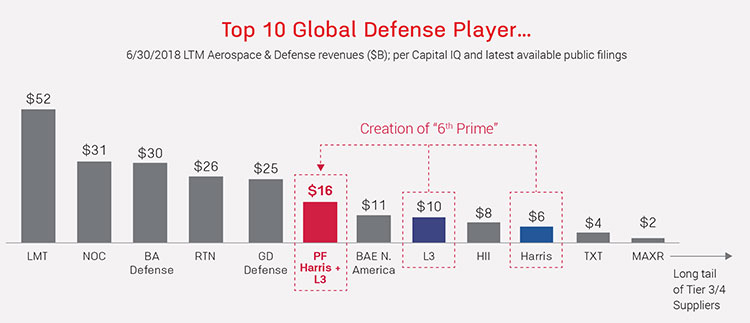
The combined company, L3 Harris Technologies, will be the sixth largest defense company in the U.S. and a top 10 defense company globally, with approximately 48,000 employees and customers in more than 100 countries.
For 2018, the combined company is expected to generate net revenue of approximately $16 billion.
Image: from Fact Sheet by Harris and L3 Technologies
According to the press release, increased scale will enable the combined company to be more cost competitive, expand capabilities to provide end-to-end solutions across multiple domains of air, sea, land, space and cyber, enhance leadership in RF and spectrum technologies and establish a leading platform-agnostic supplier and integrator.
L3 Harris Technologies will be headquartered in Melbourne, Florida, and led by a team that reflects the strengths and capabilities of both companies and will share equally in the integration process, the companies said.
With a combined workforce of 22,500 engineers and scientists, the combined company plans to accelerate investment in select technologies to expand leadership in key strategic domains including national security.
Image: from Fact Sheet by Harris and L3 Technologies
Company Backgrounds
Harris Corporation is a solves customers’ mission-critical challenges by providing solutions that connect, inform and protect. Harris supports government and commercial customers in more than 100 countries and has approximately $6 billion in annual revenue. The company is organized into three business segments: Communication Systems, Electronic Systems and Space and Intelligence Systems.
L3 Technologies is a provider of global ISR, communications and electronic systems for military, homeland security and commercial aviation customers. With headquarters in New York City and approximately 31,000 employees worldwide, L3 Technologies develops advanced defense technologies and commercial solutions in pilot training, aviation security, night vision and EO/IR, weapons, maritime systems and space. The company reported 2017 sales of $9.6 billion.
CEO Statements and Leadership
“This transaction extends our position as a premier global defense technology company that unlocks additional growth opportunities and generates value for our customers, employees and shareholders,” said Harris chairman, president and CEO William M. Brown. “Combining our complementary franchises and extensive technology portfolios will enable us to accelerate innovation to better serve our customers, deliver significant operating synergies and produce strong free cash flow, which we will deploy to drive shareholder value. Integration planning is already underway, and from our extensive experience with integration, we are confident in our ability to realize $500 million of annual gross cost synergies and $3 billion of free cash flow by year 3.”
L3 Chairman, President and Chief Executive Officer, Christopher E. Kubasik said, “This merger creates greater benefits and growth opportunities than either company could have achieved alone. The companies were on similar growth trajectories and this combination accelerates the journey to becoming a more agile, integrated and innovative non-traditional 6th Prime focused on investing in important, next-generation technologies. L3 Harris Technologies will possess a wealth of technologies and a talented and engaged workforce. By unleashing this potential, we will strengthen our core franchises, expand into new and adjacent markets and enhance our global presence.”
The combined company’s board of directors will have 12 members, consisting of six directors from each company. William M. Brown will serve as chairman and chief executive officer, and Christopher E. Kubasik will serve as vice chairman, president and chief operating officer for the first two years following the closing of the transaction. For the third year, Brown will transition to executive chairman and Kubasik to chief executive officer, after which Kubasik will become chairman and chief executive officer.
Additional senior leadership positions for L3 Harris Technologies will be determined at a later date.
Shareholder Information
Under the terms of the merger agreement, which was unanimously approved by the boards of directors of both companies, L3 shareholders will receive a fixed exchange ratio of 1.30 shares of Harris common stock for each share of L3 common stock, consistent with the 60-trading day average exchange ratio of the two companies.
Upon completion of the merger, Harris shareholders will own approximately 54 percent and L3 shareholders will own approximately 46 percent of the combined company on a fully diluted basis.
The merger is expected to close in mid-calendar year 2019, subject to satisfaction of customary closing conditions, including receipt of regulatory approvals and approval by the shareholders of each company.
Extensis and LizardTech are uniting as one global company to help organizations increase their return on investment and the value of their digital assets, fonts and large imagery.
In 2017, Extensis and LizardTech collaborated on the development of new portfolio asset geo-referencing capabilities for applications in the geospatial, infrastructure, architecture/engineering/construction and building information modeling segments.
With Extensis’ market leadership in digital asset and font management combined with LizardTech’s expertise in image management and image compression technology, the united company is situated to provide a suite of solutions and support for digital asset challenges.
“Organizations today are investing in imagery of all kinds, including photography, aerial, and spatial, to name a few,” said Osamu Ikeda, CEO of Extensis. “Fully leveraging these digital files means having an easy and efficient way to organize, store, access and distribute them.”
Ikeda continued, “Uniting Extensis and LizardTech strengthens our ability to support our customers’ success and give them effective and time-tested solutions for maximizing the value of digital assets of all kinds.”
The combined company will operate under the Extensis brand, headquartered in Portland, Oregon, with an office presence in Seattle.
Starting now, LizardTech products (GeoExpress, Express Server, GeoViewer) will become part of the Extensis suite of solutions, which spans digital asset management, font asset management, brand asset management, image management and image compression.
Contrary to the “Out in Front” editorial published in the April issue of GPS World magazine, there was an Izvestia story published on March 28 touting the possibility of a merger of the GLONASS and BeiDou systems, and there will be an International Conference on Advanced Technologies in Manufacturing and Materials Engineering in Harbin, China, at which such a possibility may hypothetically be discussed.
However, neither hard news nor any official statements have emerged to substantiate such a dubious claim, despite repeated queries to officials of both countries.
Javad Ashjaee (far left, above), CEO of JAVAD GNSS and based in Moscow, communicated that he spoke on a panel at an aerospace technology event organized by the American Chamber of Commerce in Russia, alongside representatives from NASA, Boeing, Honeywell and Roskosmos.
Ashjaee asked the Roskosmos official publicly about the prospect of a GLONASS merger with BeiDou, and “he knew nothing.”
“If successful,” the story elaborated, “the project will divide the entire world into two zones of influence by two united systems: GLONASS-BeiDou and GPS-Galileo, operated by the U.S. and the European Union.”
Intriguing. Mind-boggling. With some initial smattering of verisimilitude.
I don’t want to say, “Yet in the end, spurious.” Because we haven’t yet reached the end. But indicators point in that direction.
What. The story claimed that “The countries will reportedly negotiate the merger in May at the International Conference on Advanced Technologies in Manufacturing and Materials Engineering in the Chinese city of Harbin, Izvestia daily reports.”
The primary reason for all GNSS and for GPS itself in the very beginning is military advantage. For these two superpowers in particular to share one military resource is unthinkable; for either to disclose aspects of its security and weapons guidance operations to the other, untenable.
Whence. Who is RT? According to Wikipedia, the outfit formerly known as Russia Today is an international television network funded by the Russian government, operating cable and satellite television channels and internet content directed to audiences outside of Russia. Based in Moscow, it presents around-the-clock news providing “a Russian viewpoint on major global events.” In 2008, Prime Minister Vladimir Putin included RT’s parent organization on a list of core organizations of strategic importance to Russia.
RT has been frequently described as a propaganda outlet for the Russian government and its foreign policy, and has been accused of spreading disinformation, broadcasting “materially misleading” content. In 2017, during the French presidential election, a spokesperson for successful candidate Emmanuel Macron said that both RT and the Sputnik news agency showed a “systematic desire to issue fake news and false information,” and banned them from campaign events.
Why. No one to whom I reached out in either Russian or Chinese government or satnav operations agency has returned any comment. Silence on all fronts.
We can only guess at the underlying reasons for this floated, unsubstantiated story. To stir things up, as has been done in other arenas by these same “news” actors. It’s just a bit stinging, and a bit scary, to find it in our own world of science and technology.
There is no evidence that any GLONASS officials have been in any way involved — there’s no evidence of anything at all, when you come right down to it. The development does not reflect favorably on the Russian news system, and it may be as well to take everything from Moscow with a barrel of salt until something more tangible emerges.
A GLONASS-M satellite is prepped for launched in February 2016. (Photo: Russian Ministry of Defense)
TCarta Marine LLC of Denver, Colorado, has merged with Proteus Geo of Oxford, England, to create a global mapping company that provides bathymetric and marine data sets from the shallow coastal zone out to the continental shelf.
The new company is called TCarta Marine and will maintain offices in Denver and Oxford.
“By merging, we believe the merged company provides a wider and more sophisticated range of products than any other supplier worldwide,” said TCarta Marine CEO David Critchley. “TCarta Marine is now a one-stop shop for bathymetric and marine data.”
Image: Proteus Geo
TCarta Marine will continue offering all existing product lines from the two companies, as well as new products and services under development. Primary markets served will be engineering, oil and gas, government and defense with expansion planned into the insurance, 3D modeling and aquaculture industries.
“Our goal is to make it easier for the marine community to obtain and use quality mapping data,” said TCarta Marine President Kyle Goodrich. “To support every phase of offshore projects, we now offer lower resolution bathymetry for regional planning as well as high-resolution, highly accurate seafloor modeling for precise coastal engineering activities. Additionally, we offer a range of global and regional marine basemaps.”
In recent years, TCarta Marine and Proteus Geo collaborated on many projects and had numerous clients in common due to the complementary nature of their product lines.
David Critchley established Proteus Geo in the United Kingdom in 2011 to leverage a new technology that derives high-accuracy seafloor survey and seabed classification information from multispectral satellite imagery. Operating at a fraction of the cost of traditional ship and airborne bathymetric technologies, the Proteus methodology has been deployed extensively in energy exploration, infrastructure engineering and environmental applications in shallow-water coastal zones.
“The two-meter satellite-derived bathymetric data can be derived to depths of 35 meters depending on water clarity and every depth has an uncertainty value assigned,” said Critchley.
TCarta Marine was started in 2008 by Kyle Goodrich to fill an enormous gap in quality bathymetric data from the littoral zone out to the base of the continental shelf, distance often spanning hundreds of kilometers. The firm developed proprietary techniques for aggregating seafloor depth data from numerous medium- to coarse-resolution sources, including navigation charts, ship tracklines, and boat surveys. TCarta Marine has built an off-the-shelf line of 90- and 30-meter GIS-ready products covering the Earth’s most important marine areas.
“Our bathymetric products are available via annual subscription for streaming directly into our clients’ GIS and mapping applications,” said Goodrich. “Oil, gas and renewable energy companies have become major users of TCarta Marine products.”
As president of the new TCarta Marine, Goodrich will focus on developing additional products and innovative methods for delivering them. The global company seeks to expand its foothold in traditional marine markets and cultivate new applications for seafloor data. Critchley, as CEO of TCarta Marine, will be responsible for business development in new geographic regions of the world.
In the near term, TCarta Marine and Proteus Geo customers can look forward to purchasing the existing 90-, 30- and 2-meter resolution product lines online through a new web portal, now under development. Information can be found and orders placed now through the new unified TCarta Marine website at www.TCartaMarine.com.
Proteus FZC, an affiliated company of Proteus Geo based in the United Arab Emirates, will remain a stand-alone company offering terrestrial geospatial and marine consulting services in the Middle East.
TCarta Marine LLC of Denver, Colorado, has merged with Proteus Geo of Oxford, England, to create a global mapping company that provides bathymetric and marine data sets from the shallow coastal zone out to the continental shelf.
The new company is called TCarta Marine and will maintain offices in Denver and Oxford.
“By merging, we believe the merged company provides a wider and more sophisticated range of products than any other supplier worldwide,” said TCarta Marine CEO David Critchley. “TCarta Marine is now a one-stop shop for bathymetric and marine data.”
Image: Proteus Geo
TCarta Marine will continue offering all existing product lines from the two companies, as well as new products and services under development. Primary markets served will be engineering, oil and gas, government and defense with expansion planned into the insurance, 3D modeling and aquaculture industries.
“Our goal is to make it easier for the marine community to obtain and use quality mapping data,” said TCarta Marine President Kyle Goodrich. “To support every phase of offshore projects, we now offer lower resolution bathymetry for regional planning as well as high-resolution, highly accurate seafloor modeling for precise coastal engineering activities. Additionally, we offer a range of global and regional marine basemaps.”
In recent years, TCarta Marine and Proteus Geo collaborated on many projects and had numerous clients in common due to the complementary nature of their product lines.
David Critchley established Proteus Geo in the United Kingdom in 2011 to leverage a new technology that derives high-accuracy seafloor survey and seabed classification information from multispectral satellite imagery. Operating at a fraction of the cost of traditional ship and airborne bathymetric technologies, the Proteus methodology has been deployed extensively in energy exploration, infrastructure engineering and environmental applications in shallow-water coastal zones.
“The two-meter satellite-derived bathymetric data can be derived to depths of 35 meters depending on water clarity and every depth has an uncertainty value assigned,” said Critchley.
TCarta Marine was started in 2008 by Kyle Goodrich to fill an enormous gap in quality bathymetric data from the littoral zone out to the base of the continental shelf, distance often spanning hundreds of kilometers. The firm developed proprietary techniques for aggregating seafloor depth data from numerous medium- to coarse-resolution sources, including navigation charts, ship tracklines, and boat surveys. TCarta Marine has built an off-the-shelf line of 90- and 30-meter GIS-ready products covering the Earth’s most important marine areas.
“Our bathymetric products are available via annual subscription for streaming directly into our clients’ GIS and mapping applications,” said Goodrich. “Oil, gas and renewable energy companies have become major users of TCarta Marine products.”
As president of the new TCarta Marine, Goodrich will focus on developing additional products and innovative methods for delivering them. The global company seeks to expand its foothold in traditional marine markets and cultivate new applications for seafloor data. Critchley, as CEO of TCarta Marine, will be responsible for business development in new geographic regions of the world.
In the near term, TCarta Marine and Proteus Geo customers can look forward to purchasing the existing 90-, 30- and 2-meter resolution product lines online through a new web portal, now under development. Information can be found and orders placed now through the new unified TCarta Marine website at www.TCartaMarine.com.
Proteus FZC, an affiliated company of Proteus Geo based in the United Arab Emirates, will remain a stand-alone company offering terrestrial geospatial and marine consulting services in the Middle East.
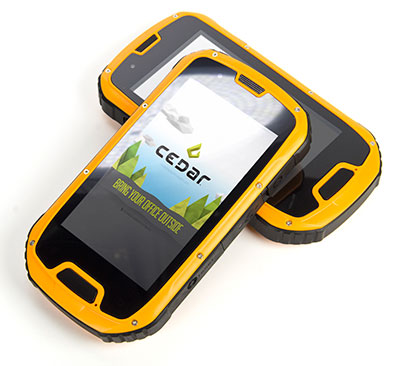
The CT4 and other rugged handhelds by Cedar Tree Technologies will now be available through Juniper Systems.
Juniper Systems is merging its subsidiary company, Cedar Tree Technologies, into Juniper Systems. The move will allow customers to purchase Cedar’s Android-operated rugged handhelds directly from Juniper Systems.
Juniper Systems launched Cedar Tree Technologies as a rugged handheld company in August 2014.
“With a reputation for top-of-the-line, ultra-rugged handheld computers, Juniper Systems aimed to expand its products to meet the needs of customers who may not need the outstanding level of ruggedness or support that Juniper handhelds provide. And that’s how Cedar Tree Technologies began. Cedar handhelds lie somewhere between consumer devices and Juniper Systems’ ultra-rugged handhelds, providing a mesh of both ruggedness and affordability,” said a statement from the company.
Cedar handhelds run on the Android operating system, offering access to thousands of business-ready apps and Google services via the Google Play Store. This provides users with an off-the-shelf product, eliminating the need to download third-party data collection software. Juniper Systems has published a blog post that outlines the differences between Cedar and Juniper handhelds.
The Cedar product line that Juniper Systems will now be carrying includes three new handheld devices:
CT7 Rugged Tablet. Featuring a large, 7-inch display, the CT7 tablet is IP67 waterproof and dustproof, and is priced at $899 USD.
CT4 Rugged Handheld. The CT4 handheld is a more compact device than the CT7. Featuring a 4.3-inch display and an IP68 waterproof and dustproof rating, it is priced at $489.
CMP1 Miniphone. The CMP1 Miniphone is rated IP65 (dustproof and resistant to water), and is ideal for swapping out a regular smartphone for outdoor excursions, for kids, or for use as an emergency phone. The CMP1 sells for $124.
The CT4 and other rugged handhelds by Cedar Tree Technologies will now be available through Juniper Systems.
Juniper Systems is merging its subsidiary company, Cedar Tree Technologies, into Juniper Systems. The move will allow customers to purchase Cedar’s Android-operated rugged handhelds directly from Juniper Systems.
Juniper Systems launched Cedar Tree Technologies as a rugged handheld company in August 2014.
“With a reputation for top-of-the-line, ultra-rugged handheld computers, Juniper Systems aimed to expand its products to meet the needs of customers who may not need the outstanding level of ruggedness or support that Juniper handhelds provide. And that’s how Cedar Tree Technologies began. Cedar handhelds lie somewhere between consumer devices and Juniper Systems’ ultra-rugged handhelds, providing a mesh of both ruggedness and affordability,” said a statement from the company.
Cedar handhelds run on the Android operating system, offering access to thousands of business-ready apps and Google services via the Google Play Store. This provides users with an off-the-shelf product, eliminating the need to download third-party data collection software. Juniper Systems has published a blog post that outlines the differences between Cedar and Juniper handhelds.
The Cedar product line that Juniper Systems will now be carrying includes three new handheld devices:
CT7 Rugged Tablet. Featuring a large, 7-inch display, the CT7 tablet is IP67 waterproof and dustproof, and is priced at $899 USD.
CT4 Rugged Handheld. The CT4 handheld is a more compact device than the CT7. Featuring a 4.3-inch display and an IP68 waterproof and dustproof rating, it is priced at $489.
CMP1 Miniphone. The CMP1 Miniphone is rated IP65 (dustproof and resistant to water), and is ideal for swapping out a regular smartphone for outdoor excursions, for kids, or for use as an emergency phone. The CMP1 sells for $124.
 GPS company NextNav and Spartacus Acquisition Corp, a special-purpose acquisition company, has entered into a definitive merger agreement that will result in NextNav becoming a public company. The combined company will be named NextNav Inc. Its common stock and warrants will be listed on the Nasdaq under the ticker symbol “NN” and “NNW”, respectively.