Tag: Microsemi Corporation

  • Microsemi debuts chip-scale atomic clock for space

    Microsemi debuts chip-scale atomic clock for space

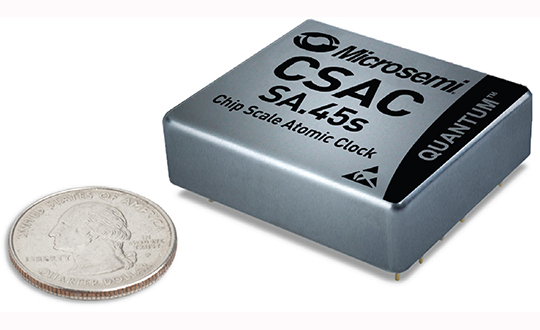
    Microsemi Corporation has launched its SA.45s Commercial Space Chip-Scale Atomic Clock (CSAC), a commercially available radiation-tolerant CSAC suitable for low Earth orbit (LEO) applications.

    The device provides the accuracy and stability of atomic clock technology while achieving significant breakthroughs in reduced size, weight and power (SWaP) consumption, the company said.

    As the newest member of Microsemi’s CSAC product family, the Commercial Space CSAC provides excellent drift performance and built-in 1 pulse per second (PPS) input for GPS disciplining, making the device well-suited for holdover applications.

    It is targeted at several other commercial space and space research applications, including:

    • satellite timing and frequency control;
    • satellite cross linking;
    • assured position, navigation and timing; and
    • Earth observation.

    With many spacecraft manufacturers turning to commercial off-the-shelf (COTS) parts to meet performance, schedule and cost requirements, the Commercial Space CSAC offers a solution for many satellite missions.

    “With the introduction of the Commercial Space CSAC, we now offer a space-deployable atomic precision clock reference with radiation tolerance in support of the space market’s desire to reduce mission costs and design times using COTS devices,” said Peter Cash, director of the clock business unit at Microsemi. “As the first atomic reference clock with low SWaP available for space, our new device is well-suited to applications requiring precise clock synchronization, including a variety of existing and emerging LEO applications.”

    According to a market intelligence report by Euroconsult titled, “Satellites to be Built & Launched by 2026 World Market Survey,” the total revenue for satellite manufacture and launch is expected to be $304 billion between 2017-2026. With revenues of $102 billion, LEO is expected to account for a third of the total market, with 82 percent derived from satellite manufacturing.

    “Harris provides the world’s most advanced sensors, payloads and communications technologies; receiving and information processing systems; and analytics, which provide our customers with the integrated information and actionable intelligence they need for mission and business success,” said Tim Lynch, general manager, Mission Solutions at Harris Corporation’s Space and Intelligence Systems segment. “Microsemi’s latest atomic clock will support Harris in delivering complete mission solutions to our customers.”

    As a stand-alone atomic clock with a 10-megahertz CMOS-compatible output, Microsemi’s Commercial Space CSAC is a timing module providing an impressive short-term stability (Allan Deviation) and frequency stability across the operating temperature (TempCo), the company added.

    A standard CMOS-level RS-232 serial interface is built into the device, which is used to control and calibrate the unit and provide a comprehensive set of status monitors. The interface is also used to set and read the CSAC’s precise internal time-of-day clock.

    Microsemi’s radiation-tolerant ruggedized oscillators also include OCXOs and EMXOs for applications that require higher accuracy and can support higher power consumption.

    Other key features include:

    • Power consumption of less than 120 milliwatts (mW)
    • Less than 17 cubic centimeters volume (1.6 in. × 1.39 in. × 0.45 in.)
    • Radiation-tolerant: 20 krad
    • Single event latch-up (SEL) and single event upset (SEU) tested to 64 megaelectron-volts per square centimeter/milligram (Mev-cm2/mg)
    • Short-term stability (Allan Deviation) of 3.0 × 10⁻¹⁰ at TAU = 1 sec
    • Frequency stability across temperature range (TempCo) less than 5×10⁻¹⁰
    • 1PPS output and 1PPS input for synchronization and time-keeping
    • RS-232 interface for monitoring and control
  • Microsemi timing module designed for IEEE 1588 protocols

    Microsemi timing module designed for IEEE 1588 protocols

    Microsemi Corporation has launched a new IEEE 1588 timing synchronization module, offering a complete self-contained platform for customers to implement IEEE 1588 network timing client protocols.

    The solution, which consists of hardware, firmware and software, combines capabilities from Microsemi’s broad product portfolios by leveraging the company’s SmartFusion2 system-on-chip (SoC) field programmable gate array (FPGA), ZL30363 IEEE 1588 phase-locked loop (PLL) and VSC8575 Ethernet PHY devices.

    Microsemi’s new IEEE 1588 timing synchronization module streamlines customers’ developments to add synchronization network timing to their designs, simplifies the sourcing process and reduces development time while providing an easy integration.

    The module also includes drivers, servos/algorithm firmware, IEEE 1588 Precision Time Protocol (PTP) stack software, a user guide and reference board schematics to deliver a fully tested chip-set solution from a trusted tier-one vendor.

    The IEEE 1588 timing synchronization module blends Microsemi’s expertise in nanosecond-level accurate timestamping for IEEE 1588 via the VSC8575 Ethernet PHY; embedded IEEE 1588 protocol engine and servo via its SmartFusion2 SoC FPGA host processor; and high precision clock generation, holdover and reference switching via its ZL30363 system synchronizer.

    The solution is addressed via a command line interface to minimize software integration efforts.

    The combination of these capabilities makes the new solution suitable for applications within the industrial networking, smart grids, communications, defense and data center markets.

    Depending on the applications holdover and reliability requirements, either an XO, TCXO or OCXO can be used to provide holdover supported by the IEEE 1588 timing synchronization module.

    According to a 2017 GNSS Market Report, issue 5, the timing capability offered by satellite navigation systems is at the core of most vital infrastructures; telecom networks operation, energy distribution, financial transactions and TV broadcast are some examples of areas where a GNSS is used for timing or synchronization purposes.

    The annual shipments of GNSS devices used in the timing and synchronization market will exceed 300,000 units in 2017 and are expected to grow at a compound annual growth rate (CAGR) of 5.3 percent over 2017-2025.

    Catering to this growth opportunity, Microsemi’s new IEEE 1588 timing synchronization module is designed specifically for such applications, which require much more precise timing, including base stations and small cell markets for 5G, 4G, 4G LTE, LTE-Advanced, microwave and millimeter wave based fixed wireless networks, smart grids and secure edge networks.

    Other key features of Microsemi’s new IEEE 1588 timing synchronization module include:

    • High accuracy timestamping of less than 4 nanoseconds
    • Frequency and phase synchronization
    • Holdover with initial accuracy of <1ppb and long-term holdover of 1.5µs over 24 hours using the appropriate performance OCXO
    • Hitless reference switching
    • Precision frequency and phase control
    • Multiple profiles, including IEEE 1588-2008 Annex J.3 End-to-End
    • IEEE 1588-2008 Annex J.4 Peer-to-Peer
    • IEEE C37.238-2011 Power Profile
    • ITU-T G.8275.1 Telecom Profile for Phase
    • ITU-T G.8265.1 Telecom Profile for Frequency
  • Microsemi’s TimeProvider 4100 provides for 4G and 5G base stations

    Microsemi Corporation has launched the TimeProvider 4100, a flexible IEEE 1588 Precision Time Protocol (PTP) grandmaster clock designed to scale from the edge to the aggregation layers of both mobile infrastructure and access networks.

    The TimeProvider 4100 is a gateway clock, a new class of synchronization product which accepts multiple inputs from GNSS, Synchronous Ethernet (SyncE), 1588 PTP and E1/T1 digital transmission links, and distributes timing flows to multiple endpoints such as base stations.

    It supports the GNSS constellations GPS, Beidou, GLONASS and Galileo.

    Mobile and future markets

    Primarily targeting the mobile market, operators and data centers for mobile operator environments, over time the TimeProvider 4100’s platform will also serve mobile network needs associated with machine-to-machine (M2M), internet of things (IoT) and autonomous vehicle applications.

    A gateway clock benefits from multiple layers of protection leveraging other assets in the core of the network. TimeProvider 4100 is a best-in-class 1588 grandmaster complemented by extensive port fan-out for PTP, Network Time Protocol (NTP), SyncE and legacy building integrated timing supplies (BITS), the company said.

    With multiple ports for current, legacy and future networks which can be connected to multiple base stations for 4G and 5G deployments, the device offers customers a cost-effective solution that can be adapted for a wide variety of use cases.

    Mobile operators face tough requirements to drastically increase mobile bandwidth while efficiently leveraging the available spectrum. Cellular networks using only frequency synchronization waste significant spectrum, whereas newer deployments require phase synchronization for efficient spectrum usage and interference mitigation in increasingly densified networks.

    Phase synchronization

    Phase synchronization is imperative for next-generation service deployment. To that end, operators need timing solutions capable of supporting legacy infrastructure and evolving network needs. Microsemi’s TimeProvider 4100 is engineered to provide phase to today’s 4G, LTE and LTE-Advanced (LTE-A) deployments, as well as tomorrow’s cRAN evolutions and 5G networks.

    The device’s platform can be expanded through an internal module, providing customer savings such as power and rack space, and enables great scalability through sub-tenancy mechanisms. TimeProvider 4100 also features port fan-out which can be flexibly used for PTP, NTP, E1/T1, 1 pulse per second (PPS), time of day (ToD) and 10 megahertz (MHz) at the aggregation layer.

    “With our ongoing commitment to delivering system products, Microsemi has demonstrated our leadership in the IEEE 1588 grandmaster market with more than 400 operator deployments worldwide,” said Eric Colard, director of product line management for Microsemi. “We are pleased to leverage this expertise to deliver the TimeProvider 4100. With eight Ethernet ports and four BITS E1/T1 ports in the base unit, TimeProvider 4100 provides a very feature-rich gateway clock device.”

    Microsemi’s TimeProvider family serves the mobile infrastructure market, which is expected by market research firm IHS Markit to be approximately $48 billion in 2018, with hardware expected to account for approximately 62 percent of the market.

    The TimeProvider family is designed to capitalize on growth opportunities related to 5G installations, beginning with trial installations in 2018, growing to a market size of $2.8 billion by 2021 according to the firm’s “Mobile Infrastructure Intelligence Service – 3Q17 Market Tracker.”

    The new device’s flexibility does not compromise its performance and feature set, and meets stringent precise timing requirements, including complying with primary reference time clock (PRTC) and the latest time and phase ITU-T and IEEE industry standards.

    Available upgrades include oscillator options for enhanced holdover performance and an internal expansion module which adds 16 E1/T1 BITS ports to the device. The TimeProvider 4100 also accepts PTP input with assisted partial timing support (APTS) to back up the GNSS signal in case of signal loss for high resiliency of the solution by leveraging 1588v2 grandmasters already deployed at the core of the network.

    Timing and synchronization platform

    TimeProvider 4100 can be managed through Microsemi’s timing and synchronization management platform, TimePictra. In addition, for phase, service providers require more visibility about performance and health of the various network elements participating in the synchronization chain. TimeProvider provides advanced monitoring capabilities, especially for IEEE 1588v2 PTP for phase, and leverages a WebGUI to present results and calculations for easier interpretation.

    In addition to its TimeProvider family, Microsemi also offers highly comprehensive and cost-effective IEEE 1588 and SyncE network synchronization silicon solutions providing time stamping, ultralow jitter (for up to 100G PHYs), IEEE 1588 protocol support (including the ITU-T telecom profile for frequency and phase) and one of the industry’s most established client servos used by numerous carriers worldwide.

    The solutions offered are used by all major equipment vendors across the globe in a variety of wireless and wireline applications and work seamlessly with Microsemi’s full range of TimeProvider equipment.