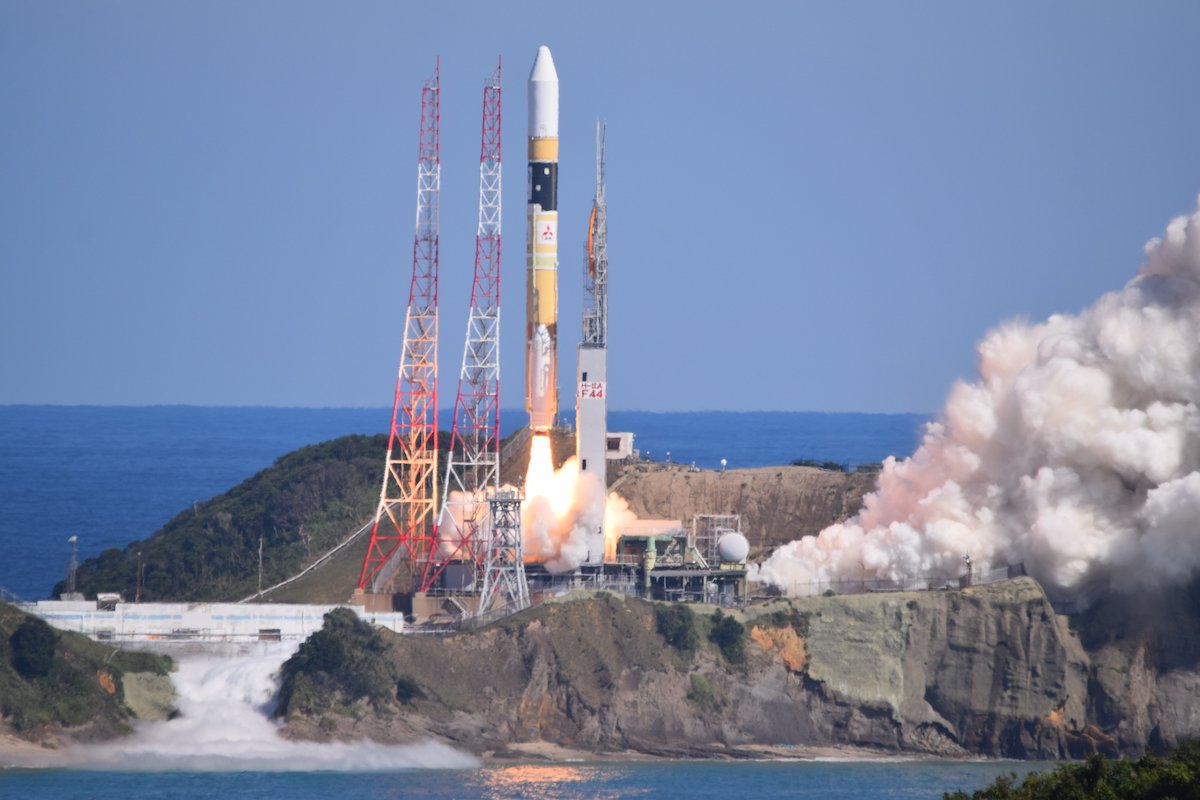
A successor to the first Quasi-Zenith Satellite System (QZSS) satellite, QZS-1R, was launched at 11:19 a.m. Japan Standard Time, Oct. 26, from the Tanegashima Space Center.
QZS-1R was carried aboard H-IIA rocket No. 44 by Mitsubishi Heavy Industries. The flight proceeded as planned, and, 28 minutes 6 seconds after launch, the payload separated from the launch vehicle.
Designed for a 15-year lifetime, QZS-1R will replace the QZS-1 (Michibiki-1). QZS-1 launched on Sept. 11, 2010, and entered its quasi-zenith orbit 10 days later. Three other quasi-zenith navigation satellites launched in 2017 to complete the constellation.
QZSS began service in November 2018 with four satellites. The Japan Aerospace Exploration Agency (JAXA) plans to have seven satellites aloft by 2023.
An H-2A rocket launches from Tanegashima Space Center carrying the QZS-1R satellite. (Photo: MHI)
UPDATE: Because of bad weather, the launch is now scheduled for Oct. 26 (Oct. 25, 18:45 p.m. PT).
The launch of the “QZS-1R”, the replacement for QZS-1 by H-IIA No. 44 scheduled for Oct. 25 is postponed as a result of weather assessment. New launch date is Oct. 26. #H2AF44
A successor to the first Quasi-Zenith Satellite System (QZSS) satellite is planned for launch from the Tanegashima Space Center on Monday, Oct. 25, from 11 a.m. to 12 p.m. Japan Standard Time (2-3 a.m. UTC).
Michibiki Unit 1 was launched on Sept. 11, 2010, and entered its quasi-zenith orbit 10 days later. QZSS began service in November 2018 with four satellites. The Japan Aerospace Exploration Agency (JAXA) plans to have seven satellites aloft by 2023.
The satellite, designated QZS-1R, will be carried aboard H-IIA rocket No. 44. The QZSS launch will be streamed live. The broadcast program will begin at 10:35 a.m. JST.
Local launch times
Houston: Sunday, October 24, 21:00 New York: Sunday, October 24, 22:00 London: Monday, October 25, 03:00 UAE: Monday, October 25, 06:00 Singapore: Monday, October 25, 10:00
To follow upcoming GNSS satellite launches, see our launch table, provided by Innovation editor Richard Langley.
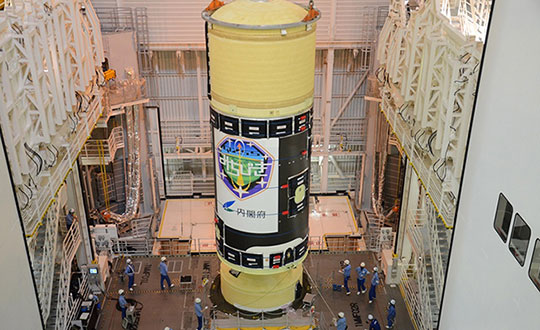
H-IIA Launch Vehicle No. 44 at the Yoshinobu Vehicle Assembly Building, JAXA Tanegashima Space Center. in preparation for launch of the successor to the Michibiki Unit 1 on Oct. 25. (Photo: MHI)
Shinichi Nakasuka, professor at the University of Tokyo Graduate School of Engineering and member of the Cabinet Office Space Policy Committee, released the following statement about the upcoming launch.
“Three years after the full operation of the four-machine Michibiki started in 2018, as the chairman of the Quasi-Zenith Satellite System Business Promotion Committee of the Cabinet Office, we strive to ensure the reliable operation and expansion of the use of this world-class system.
“I feel that high-precision positioning and two-way communication services in the event of a disaster, which cannot be achieved by GPS alone, are gradually taking root as social infrastructure. In modern society, the provision of highly accurate position and time is exactly the infrastructure that is indispensable as the ‘nerve network’ of society.
“To make that more reliable, the successor to the first machine, which pioneered this system, is about to be launched. We pray for the success of the launch and satellite operation, and hope that the Quasi-Zenith Satellite System will become more and more established in society, and that many people will be able to use this system for various purposes, including business.”
Mitsubishi Heavy Industries Ltd. and the Japan Aerospace Exploration Agency (JAXA) successfully launched a second navigation satellite on June 1.
The H-IIA Launch Vehicle No. 34 (H-IIA F34) delivered into orbit Michibiki No. 2 of the Quasi-Zenith Satellite System (QZSS) at 9:17:46 a.m. (JST) from JAXA’s Tanegashima Space Center.
The launch and flight of the rocket proceeded as planned, and the separation of the satellite was confirmed 28 minutes and 21 seconds after the launch time.
Michibiki 2 will be launched aboard H-IIA Launch Vehicle No. 34 from Mitsubishi Heavy Industries Ltd., according to the Japan Aerospace Exploration Agency (JAXA). Launch time is tentatively set for 9:20 a.m. (Japan Standard Time) from Yoshinobu Launch Complex, JAXA’s Tanegashima Space Center. The exact date and time could vary, with a launch window planned for June 1-30.