According to a new report by Research and Markets, the winners in making and operating mobile phones will offer the most compelling new functionality, IPS being a major enabler. The winners in making, integrating and operating RTLS will reduce cost and improve usefulness, not least to encompass mobile phones and other mobile computing. The world’s largest companies are locking horns on this.
Research and Markets has added the report “Mobile Phone Indoor Positioning Systems (IPS) and Real Time Locating Systems (RTLS) 2014-2024” to its offerings.
The term Indoor Positioning Systems (IPS) primarily concerns location-based services on mobile phones where GPS does not work. The term Real Time Locating Systems (RTLS) primarily concerns locating people and things at a distance, securely, using second generation RFID. The subjects are converging with Apple, Samsung, Google, Nokia, Microsoft, Hewlett Packard and IBM clashing for the tens of billions of dollars of business that is emerging.
This subject heavily involves short range communications, notably Wi-Fi and Bluetooth, and inertial navigation and advanced RFID as it progresses to determining 3D position including orientation and line of travel. Emergency services, healthcare, retailing, manufacturing, logistics and many other industries will be transformed by what is becoming possible, Research and Markets said.
The topics of IPS and RTLS embrace a value chain from research and consultancy to software, services, hardware, integration and facilities management. Mobile phone app developers and value added enhancements plus ecosystems of mobile phones, web services and more are also involved.
Most of the development and use is in the USA, but other territories are racing to catch up. For example, the new Indoor Location Alliance came from Europe but has global players and companies, such as Samsung in East Asia, and is taking an exceptionally broad view from new phone design to RTLS in smart cities. Siemens in Europe and several Japanese and U.S. companies seamlessly integrate GPS outdoor navigation and services with IPS and RTLS.
This report consists entirely of evidence-based analysis following seven years of conferences, masterclasses and reports on the subject produced by the PhD level IDTechEx analysts and team.
The main features of the report, which is continuously updated, are the following:
- Ten year forecast of the RTLS market 2014-2024, platform hardware vs system integration/services.
- Full explanation of what IPS and RTLS are and how these technologies are evolving and converging, with detailed, original graphs and diagrams, largest orders landed and lessons arising. Threats, opportunities and company strategies are revealed.
- Comparison of 105 organisations in the IPS/ RTLS value chain by country, basic measuring principle, standards, frequencies, protocol, range, accuracy, applications targeted and background information. Pie charts and graphs give analysis by parameter.
- Comparison of 74 case studies of RTLS with many pie charts presenting the lessons arising.
- Detailed original interviews carried out from mid 2013 with important organisations in this space.
- Glossary of the challenging jargon, which is different between IPS and RTLS yet often refers to the same or similar things.
For more information, visit http://www.researchandmarkets.com/research/kphhwg/mobile_phone.
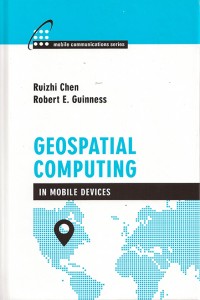 A new text and reference book, Geospatial Computing in Mobile Devices, has been published by Artech House. Recent developments in smartphones enable them to meet many of the demanding requirements for geospatial computing, in terms of computation power, data storage capacity, and memory space. This book, written by Ruizhi Chen and Robert E. Guinness, addresses and instructs in geospatial data acquisition, processing, visualization, context detection, and context intelligence.