Tag: Morocco

  • Casablanca’s Medina buildings monitored during tunnel construction

    Casablanca’s Medina buildings monitored during tunnel construction

    Photo: ETAFAT/Spectra Geospatial
    Photo: ETAFAT/Spectra Geospatial

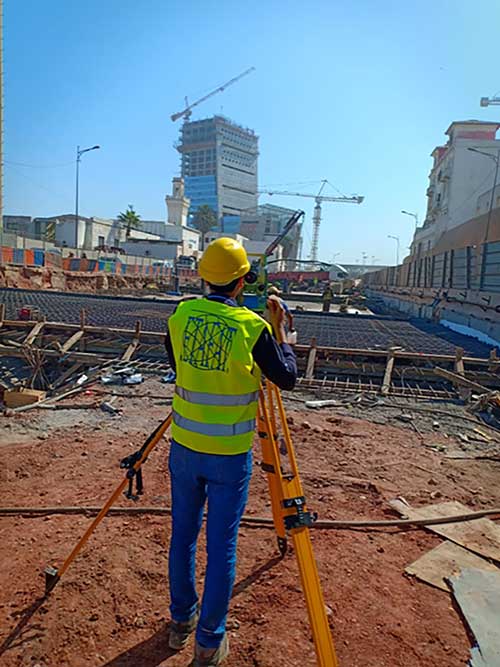
    Engineers are monitoring in real time the effects on Casablanca’s aging buildings during tunnel construction using a Spectra Precision GNSS receiver.

    Vibrations during the construction of a new 1,890-meter tunnel adjacent to Casablanca’s Old Medina, the 250-year-old section of the famed Moroccan city, challenged the stability of its historically important buildings.

    To monitor in real time the effects on the Medina’s aging buildings and to confirm that the construction work meets all engineering standards and guidelines, ETAFAT, a geospatial information acquisition and processing company, used the Nikon XF Total Station to perform more than 100 daily inspections. The ETAFAT team relied on optical targets placed on building facades whose coordinates were determined by forced centering to complete the inspections.

    The new Les Almohades tunnel, beneath the Boulevard des Almohades, runs parallel and adjacent to the old Medina. Together with its 380 meters of access roads, the twin-tube tunnel, which carries traffic in two unidirectional lanes in each tube, was constructed to reduce traffic congestion.

    According to ETAFAT engineers, the Nikon XF 1” with its fast autofocus function, saved considerable field time. The Nikon XF enabled fast collection of highly accurate observations throughout the monitoring and control of the planimetric and altimetric locations of the structure. The monitoring of the buildings during the various phases of the tunnel’s construction generated a large amount of data essential for understanding the consequences of the work and defining any necessary corrective measures.

    The Nikon FX 1,” with its advanced options and Survey Pro software, enabled survey teams to quickly yet accurately perform a variety of other essential field tasks.

    These tasks include digital terrain modeling (DTM), cubature calculations, coordinate geometry (COGO) topometric calculations and layout control with customized report generation. The use of Survey Pro software enabled ETAFAT engineers to fully integrate their total station work with their fleet of Spectra Geospatial SP60 GNSS receivers.

    The Nikon XF 1” is a mechanical total station that stands up to tough worksite conditions. It is designed to quickly capture accurate measurements, and it offers crisp, clear optics for sighting in both bright and low-light conditions.

    Its dual-color touchscreen displays run Survey Pro, Survey Basic and Layout Pro.

    It is also equipped to take advantage of the optional Trimble Protected L2P device for asset security to locate lost, stolen or missing equipment. Its hot-swappable batteries reduce downtime and a PIN enhances security in the field.
  • On the Edge: Sharing GNSS Wealth

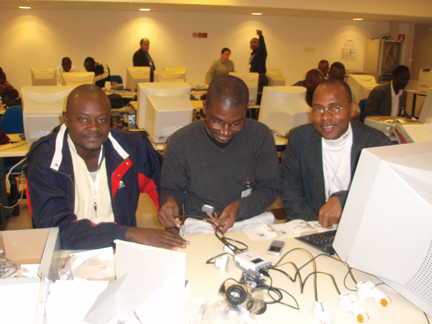
    Workshop participants from Cote d’Ivoire and Kenya assemble a Mindstorm robot to trial autonomous navigation.
    Workshop participants from Cote d’Ivoire and Kenya assemble a Mindstorm robot to trial autonomous navigation.

    By Patricia Doherty

    Last year I helped coordinate a three-week workshop for 50 scientists from 15 African countries, introducing the basics of GPS for applications with socioeconomic benefits and scientific exploration. Held in Trieste, Italy, the workshop was quite successful, producing new initiatives on the African continent. We repeat the workshop next month, 
April 6–24, again in Trieste.

    Since the 2009 training, regional GNSS workshops have taken place in Nigeria, Egypt, Kenya, and Ethiopia. We have initiated scientific collaborations with universities in Nigeria, Kenya, Zambia, Egypt, and Uganda, deploying GPS receivers at each institution, with the understanding that the data will ultimately be shared within Africa and the world.

    This effort is a way to share with Africa and Africans the wealth that GNSS has brought to the developed world.

    Africa’s 2006 Science and Technology Plan of Action states Africa’s commitment to develop and use science and technology for socio-economic transformation and full integration into the world economy. The leading problems that continue to cripple much of Africa include hunger, extreme poverty, erosion of natural resources, and natural disasters. GNSS can help address these problems and ultimately meet the plan’s goals. Specifically, GNSS applications can increase food security, manage natural resources, provide efficient emergency location services, improve surveying and mapping, and provide greater precision and safety in land, water, and air navigation systems. GNSS also has applications in scientific study including space weather, geophysics, geography, geology, ecology, and biology.

    Workshop participants included professors and graduate students from Cote d’Ivoire, Egypt, Ethiopia, Ghana, Kenya, Morocco, Nigeria, Uganda, and Zambia. The more than 25 lecturers came from the United States, Europe, and Africa.

    Edge-2The workshop integrated formal lectures with hands-on practice in GNSS architecture, signal structure, hardware design, state-of-the-art applications, and scientific exploration. An on-site computer laboratory enabled participants to perform positioning calculations; use mapping and surveying software; plan a precision farming procedure; and analyze atmospheric and ionospheric data — all from GPS measurements. In addition, participants built Lego Mindstorm robots to demonstrate autonomous navigation.

    One of the benefits of this program was that scientists and engineers from the United States had opportunities to discuss common interests with African scientists and engineers. Many research programs utilize GPS ground- and space-based measurements. Unfortunately, studies over the African region have not been possible due to the lack of dependable long-term measurements. This workshop opened the door to establishing a base of measurements for joint studies with our African colleagues.

    Many lecturers remarked that this was the most enriching teaching experience of their careers. The African participants said that they learned a great deal and were very appreciative of the opportunity to participate in this program.

    Workshop sponsors include Boston College’s Institute for Scientific Research (where I work), the Abdus Salam International Center for Theoretical Physics in Trieste (where my colleague and workshop co-director Sandro Radicella is head of the Radiopropagation Laboratory), Institute of Navigation, Federal Aviation Administration, Air Force Research Laboratory, National Aeronautics and Space Administration, United Nations Office for Outer Space Affairs, National Science Foundation, Trimble, and NovAtel.

    To learn more about the workshop, participate, or contribute, please contact Patricia.Doherty @ bc.edu