Tag: NAGU

  • Without Galileo, life goes on

    Without Galileo, life goes on

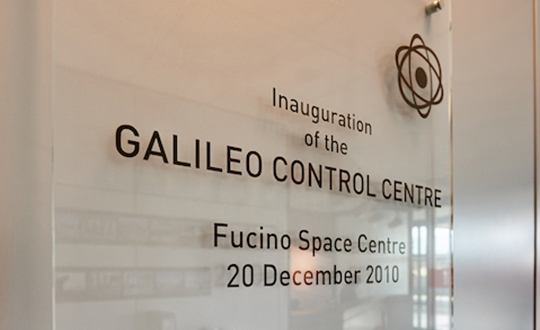
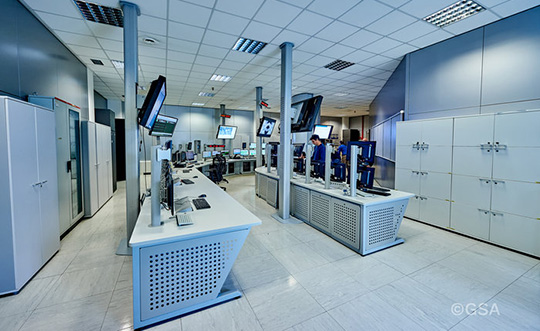
    Galileo's Control Centre in Fucino is used to oversee the satellites' navigation payloads and services.(Photo: ESA)
    Galileo’s Control Centre in Fucino is used to oversee the satellites’ navigation payloads and services. (Photo: ESA)

    Global markets learned something important from the brown-out of Galileo signals over a week’s time in July: Life goes on without a hiccup in the absence of the European GNSS.

    Very unfortunately for the backers and boosters of Galileo, this message will reverberate down through the years. If vital affairs proceed unaffected by Galileo’s travails, or triumphs for that matter, who needs it? The response, a shrug. I’m tempted to say a Gallic shrug, were it not that the Gauls, the French, are prime among the system’s boosters and backers.

    I’m among that number as well. Galileo and I have known each other all our lives, all our professional lives. When I started on this magazine 19 years ago, the first story I edited was on Galileo’s public-private partnership.

    Galileo then was just a collective gleam in several politicians’ and scientists’ eyes. Look how far it has come: 20 satellites flying in various operational or testing states.

    The European GNSS Agency was very careful to point out during the crisis that Galileo is in its initial services phase. Its signals are available for use in combination with other GNSS and are not intended to provide a complete solution by themselves. This status is expressly designed to allow for “the detection of technical issues before the system becomes fully operational.”

    So, it doesn’t count. Because, the game hasn’t really started yet. Right?

    Not quite.

    Because this episode occurred, it will be remembered. Because it lasted so long, it will be factored. Because the official announcements about it were so obscurantist, the system may find it more difficult to regain trust.

    Of course a full, careful, in-depth investigation must take place before officially announcing what caused the debacle. But more than was said could surely have been said, during the crisis. A full week now, as of this writing, after the week-long outage concluded, we still have no indication as to which piece of ground equipment or software failed and why there wasn’t a smooth transition from the Italian to the German control station.

    Redundancy was built into the system to preclude exactly such failures as this. Why didn’t redundancy work?

    Transparency is a rhyming word that goes well with redundancy.

    Trust — corporate confidence — is fundamental to installation in multi-GNSS chips, boards, modules, all manner of devices. Four systems compete for spots at a table that may comfortably fit only three. Even three could be a stretch.

    GLONASS suffered a much shorter (11-hour) timing glitch in 2014, and has yet to climb back into the public-confidence ring.

    Here’s a very public lesson in transparency: When the GPS satellite SVN49 failed rather spectacularly in 2009, the GPS Directorate was very forthcoming, almost embarrassingly so, about what happened and why. GPS never lost a step in the public’s and the industry’s eyes.
  • What happened when Galileo experienced a week-long service outage

    What happened when Galileo experienced a week-long service outage

    Analysis of the Signal Outage

    By Fabio Dovis, A. Minetto, A. Nardin, Politecnico di Torino Department of Electronics and Telecommunications,
    E. Falletti, D. Margaria, M. Nicola, M. Vannucchi, LINKS foundation

    Following the issue by the Galileo Service Center of the Notice Advisory to Galileo Users (NAGU) reporting Service Outage for all the Galileo satellites, as curious Galileo users our team of researchers of the NavSAS group started an independent investigation of the received signals in space (SISs).

    In fact, we observed that a commercial ublox EVK-M8T receiver, forced to use Galileo-only satellites, provided a “no-fix” indication. Three Galileo-enabled smartphones, the Xiaomi MI 8, Huawei P 10 and Samsung Galaxy S8, which use assistance from the cellular network, were also not providing a Galileo-based position solution, considering the Galileo satellites as “not usable.”

    However, the investigation started exploiting our in-house developed software receiver NGene, that was used in the past for similar monitoring of the GNSS signals, for example at the time of the transmission of the first IOV Galileo satellites in 2012, and the transmission of anomalous GPS signals from SVN49 in 2009. Monitoring the Galileo SISs, which were usable until the day before, we found that they were still correctly trackable, with normal power levels and Doppler profiles within feasible limits.

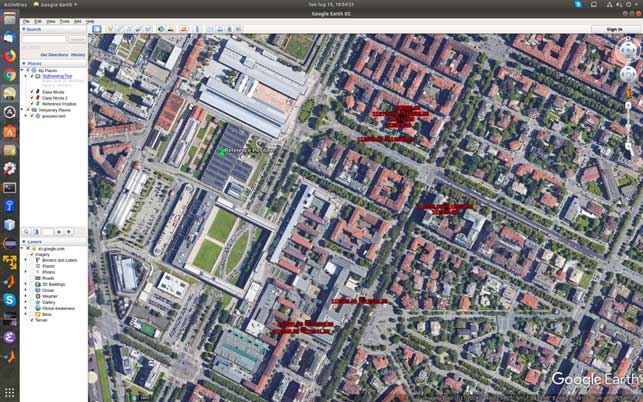
    At the time of the first analysis, seven satellites were visible in the sky over Torino, Italy. Figure 1 reports a screenshot of the positions computed by means of NGene between 07:14:54 and 07:24:54 UTC on July 15, plotted on Google Earth. The position estimated using the Galileo-only satellite or hybrid GPS-Galileo solutions (red dots) showed errors on the order of 500 meters or even more. The georeferenced antenna position is depicted by the green pin.

    Figure 1. Misplaced Galileo and GPS+Galileo solutions. (Screenshot: Politecnico di Torino and LINKS Foundation)
    Figure 1. Misplaced Galileo and GPS+Galileo solutions.
    (Screenshot: Politecnico di Torino and LINKS Foundation)

    The monitoring of the status flags taken from the Galileo E1B I/NAV message showed that the SIS was marked as “healthy” for all the visible PRNs apart the number 14, which is known to be “not usable” for a long time. The Signal in Space Accuracy Index (SISA) was set to 109, which is an acceptable prediction of the minimum standard deviation of an overbound of the SIS error.

    According to the Galileo Open Service, Service Definition Document (OS SDD, issued 1.1, May 2019), a SIS “Healthy” means that the SIS is expected to meet the Minimum Performance Level and “a navigation solution obtained with Galileo SIS is expected to meet the Minimum Performance Levels reported in the Galileo OS SDD only if receivers comply with the assumptions reported in Section 2.4, including the use of navigation parameters within their broadcast period.”

    In fact, the document specifies that “The navigation solution is expected to meet the Minimum Performance Levels only if receivers do not use navigation parameters beyond their broadcast period. The maximum nominal broadcast period of a healthy navigation message data set is currently 4 hours.”

    The check of the nominal broadcast period was bypassed in our software receiver, which is indented as a research tool and not a commercial product as the one mentioned above, so that we were still able to obtain a GPS + Galileo PVT solution, since this check looked to be the only discrimination factor to validate and thus exclude the computed solution.

    On July 17, the SISA flag was changed to 255: according to the OS SDD, the accuracy status was “No Accuracy Prediction Available (NAPA).” This means that the status of the broadcast SIS must be intended as “Marginal.” In this condition the EVK-M8T restarted to provide Galileo-based fixes, while the Xiaomi Mi8 Pro smartphone still excluded the Galileo satellites from its PVT fix.

    The analysis of the decoded Galileo navigation message led to the conclusion that ephemerides and clock correction data were last updated around 19:00 UTC of 1July 16. For example, PRN 3 and 15 changed Issue Of Data (IOD) from 958 to 17 at Galileo Signal Time TOW 241855, which corresponds to 19:01:25.

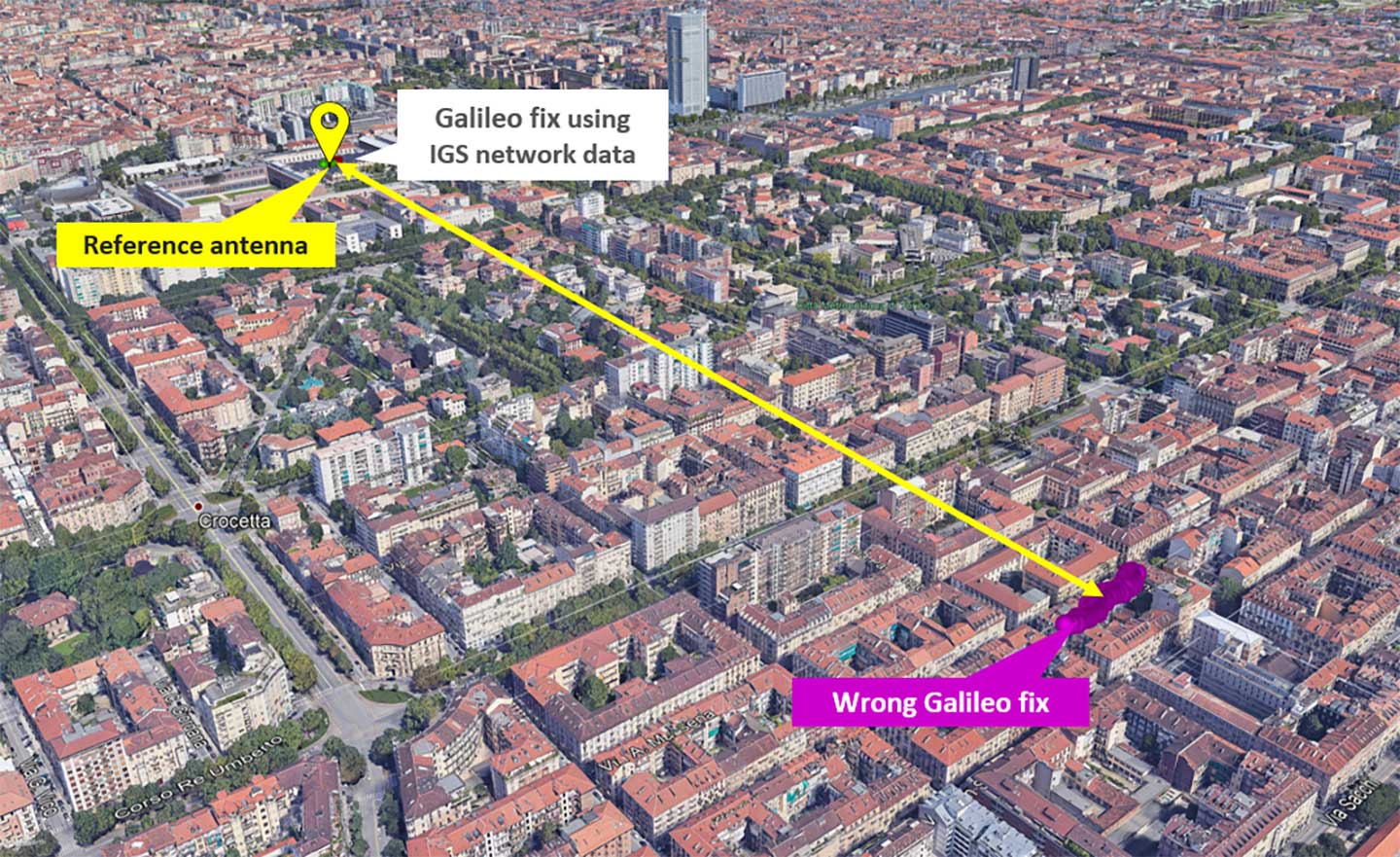
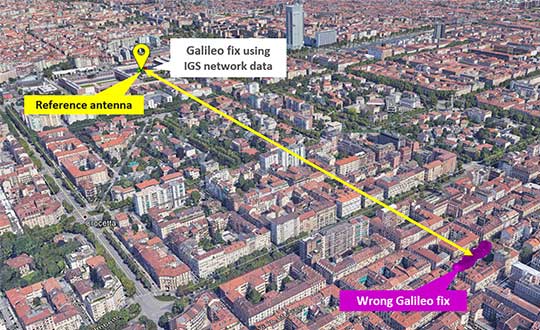
    As a final check, we used external ephemerides to process the Galileo signals during the “system outage.” Figure 2 and Figure 3 show different navigation solutions obtained by processing a data collection taken on July 12 at 10.00 UTC (12.00 Local time). The purple dots indicate few fixes obtained by demodulating the navigation message transmitted by the Galileo satellites and show a remarkable bias with regard to the reference antenna location.

    Figure 2. Comparison of Galileo-only solutions using Navigation message ephemeris data and IGS ephemeris. (Image: Politecnico di Torino and LINKS Foundation)
    Figure 2. Comparison of Galileo-only solutions using Navigation message ephemeris data and IGS ephemeris. (Image: Politecnico di Torino and LINKS Foundation)
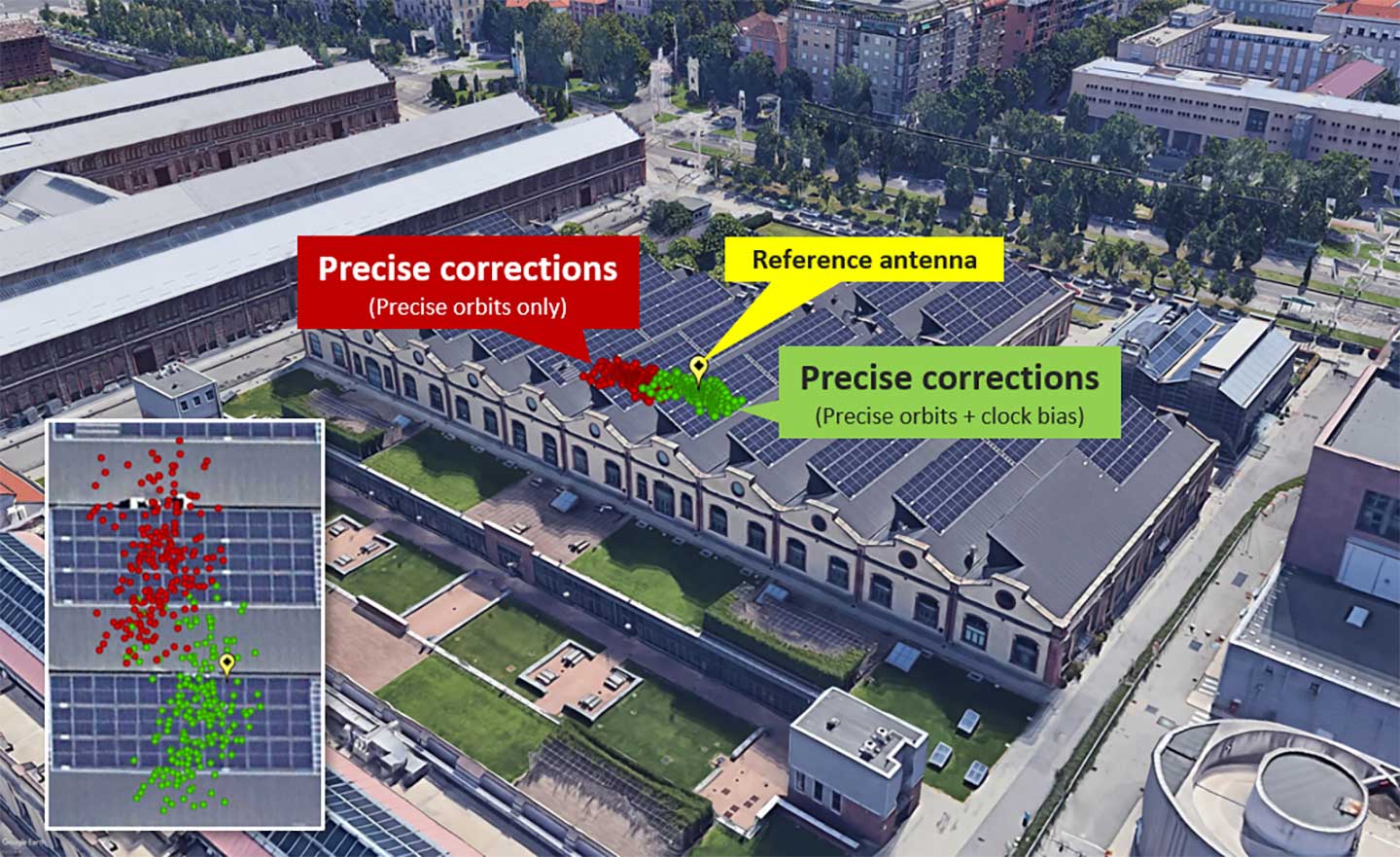
    Figure 3. Zoom on the Galileo-only positions obtained by using IGS data.(Image: Politecnico di Torino and LINKS Foundation)
    Figure 3. Zoom on the Galileo-only positions obtained by using IGS data.(Image: Politecnico di Torino and LINKS Foundation)

    In Figure 3, the green dots are the navigation solution obtained correcting the satellites positions according to precise orbits data and clock drift provided by the IGS network. The fix is a simple code based Least Mean Square solution without smoothing of the pseudoranges.

    The two results were obtained by processing the same satellites signals, thus proving that their quality was still sufficient to get an acceptable positioning solution during the Galileo service outage period. This brought us to the conclusion that, during the outage, only the ephemerides updates were affected by problems, while the other SIS components appeared sound and usable.

    The NavSAS group is a joint team of researchers of Politecnico di Torino and LINKS Foundation. The full analysis of the outage can be found at www.navsas.eu.

  • Galileo picks itself up and moves on

    Galileo picks itself up and moves on

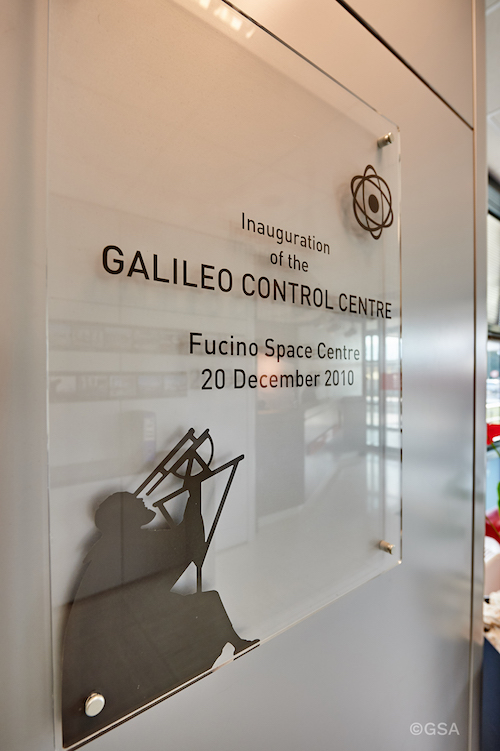
    Galileo Ground Control Center, Fucino. Photo: GSA
    Galileo Ground Control Center, Fucino. Photo: GSA

    Galileo Initial Services have been restored after a week-long signal outage, according to a statement released on July 18 by the European GNSS Agency (GSA).

    “Commercial users can already see signs of recovery of the Galileo navigation and timing services…although some fluctuations may be experienced until further notice.”

    After a signal outage that began on July 11, efforts to restore services reportedly found a malfunction in the calculation of time and orbit predictions (ephemeris).

    Why the error affected both Precise Timing Facilities (PTFs) within the Galileo ground control system, at Fucino in Italy and Oberpfaffenhoffen in Germany, has not been explained. System redundancy in the form of such doubled facilities was meant to prevent such breakdowns.

    The GSA statement continues:

    “Galileo Initial Services have now been restored. Commercial users can already see signs of recovery of the Galileo navigation and timing services, although some fluctuations may be experienced until further notice.

    “The technical incident originated by an equipment malfunction in the Galileo ground infrastructure, affecting the calculation of time and orbit predictions, and which are used to compute the navigation message. The malfunction affected different elements on the ground facilities.

    “A team composed of GSA experts, industry, ESA and Commission, worked together 24/7 to address the incident. The team is monitoring the quality of Galileo services to restore Galileo timing and navigation services at their nominal levels.

    “We will set an Independent Inquiry Board to identify the root causes of the major incident. This will allow the Commission, as the programme manager, together with the EU Agency GSA to draw lessons for the management of an operational system with several millions of users worldwide.”

    The full statement, including links to previously issued Notice Advisories to Galileo Users (NAGUs) is available here on the GSA website.

  • Galileo down over weekend

    Galileo down over weekend

    The entire Galileo system suffered an unexpected and hitherto unexplained signal outage, beginning on Thursday, July 11, at 1 p.m. Central European Time. At about that time, users noticed that all ephemeris stopped broadcasting, and then a Notice Advice to Galileo Users (NAGU) appeared:

    NAGU Subject: Service Degradation
    Satellite Affected: ALL

    Event Description: Until further notices, users may experience service degradation on all Galileo satellites.s this means that the signals may not be available nor meet the minimum performance levels defined in the service definition documents and should be employed at users’ own risk. The nominal service will be resumed as soon as possible.”

    The signal outage has persisted for more than two days (as of Saturday) and as yet no word has emerged as to the cause or duration of the signal outage.

    On the evening of July 13, a second NAGU appeared, saying simply that “Until further notice, users experience a service outage. the signals are not to be used.”
    On the European GNSS Service Centre’s constellation status page, 22 Galileo satellites are listed as “Not Usable” with cause being “Service Outage.”
    [Photo: Galileo Control Center, Oberpfaffenhofen. Photo: GSA]
  • Elliptically orbiting Galileo satellites to start broadcasting navigation messages

    News courtesy of CANSPACE Listserv.

    According to two Notice Advisories to Galileo Users (NAGUs), the two Galileo satellites launched into elliptical orbits in August 2014, GSAT0201 using PRN code E18 and GSAT0202 using PRN code E14, will start transmitting navigation messages for test purposes this Friday, Aug. 5.

    The Signal Health Status (SHS) flags will be set to “Test” and the Data Validity Status (DVS) flags will be set to WWG (working without guarantee).

    The satellites will not be included in the broadcast almanacs.

    Users are requested to provide feedback on usage of GSAT0201 and GSAT0202 by contacting the help desk on the European GNSS Service Centre web portal.

  • Galileo NAGU Announces Completion of Ground Upgrade

    News courtesy of CANSPACE Listserv.

    The European GNSS Service Centre has issued Notice Advisories to Galileo Users announcing the completion of a ground segment upgrade and system testing as of 1 April 2015. The three fully operational Galileo satellites (GSAT0101, GSAT0102, and GSAT0103) have been declared available from 1 April 2015 at 00:00 UTC.

    • GSAT0101 (ID:11) payload on PHM clock
    • GSAT0102 (ID:12) payload on RAFS clock
    • GSAT0103 (ID:19) payload on PHM clock
    • GSAT0104 (ID:20) is still considered unavailable as it only transmits an E1 signal.
    • GSAT0201 (ID:18) and GSAT0202 (ID:14), although now in improved orbits, have not been declared available.

    Meanwhile, the two recently launched satellites (GSAT0203 and GSAT0204) are slowly drifting to their assigned orbits. They are not yet transmitting standard L-band signals.

    Read more about the upgrade here.