Tag: National Academies of Sciences Engineering and Medicine

  • National Academies to reveal FCC-Ligado study results Friday

    National Academies to reveal FCC-Ligado study results Friday

    The latest chapter of the decades-long Lightsquared/Ligado saga will be revealed this week

    NAS logoThe National Academies of Science, Engineering and Medicine (NASEM) will hold a public online briefing at 11 a.m. ET on Sept. 9 to present the results of its Ligado interference study. The committee’s report will be available at National Academies Press at that same time.

    The decision by the Federal Communications Commission (FCC) to grant Ligado Networks permission to operate a terrestrial service in a frequency band adjacent to that used by GPS has been controversial since it was announced in April 2020.

    The Executive Branch has formally objected to the decision because of its potential to interfere with various kinds of GPS receivers and requested its reversal. So have numerous industry groups.

    The satellite communications company Iridium and some weather organizations also formally objected.

    Seven different “Petitions for Reconsideration” were filed with the FCC in May 2020 reflecting a variety of engineering- and process-based objections. None have been acted upon and all are still open issues for the commission.

    As a result of the long dispute over the potential for interference, the National Defense Authorization Act for 2021 required the Department of Defense (DOD) to contract with NASEM to examine the issue. The study effort began almost exactly a year ago with the announcement of a proposed study team.

    According to the NAESM website:

    This study will review Federal Communications Commission order FCC 20-48, which authorized Ligado Networks LLC to operate a low-power terrestrial radio network adjacent to the Global Positioning System (GPS) frequency band. It will consider how best to evaluate harmful interference to civilian and defense users of GPS, the potential for harmful interference to GPS users and DOD activities, and the effectiveness and feasibility of the mitigation measures proposed in the FCC order.

    Specific results were intended to include:

    • which of the two prevailing proposed approaches to evaluating harmful interference concerns — one based on a signal-to-noise interference protection criterion and the other based on a device-by-device measurement of the GPS position error — most effectively mitigates risks of harmful interference with GPS services and DOD operations and activities
    • the potential for harmful interference from the proposed Ligado network to mobile satellite services — including GPS and other commercial or DOD services, and including the potential to affect DOD operations and activities
    • the feasibility, practicality and effectiveness of the mitigation measures proposed in the FCC order with respect to DOD devices, operations and activities.

    Other relevant issues the study committee found are also expected to be discussed.

    The NASEM committee has been meeting regularly since the end of September 2021 and has heard from numerous industry and interest groups on both sides of the issue. Materials presented as well as videos of the public portions of all the meetings are available at the group’s website.

    Both a classified and an unclassified version of the report are supposed to be produced. No information has been released about whether the classified report has been completed and provided to the Department of Defense.

    Based on previous NASEM reports, some observers predict the results of the study will not strongly support either side of the dispute. “Most of these kind of reports say, ‘On the one hand this, but on the other hand that.’ Usually they are not really conclusive. I expect both sides will find something in it to support their assertions and the dispute will continue as it has to date,” said one stakeholder.

    Members of the public interested in viewing the on-line release and briefing can register at https://www.eventbrite.com/e/the-national-academies-review-of-fcc-order-20-48-report-release-webinar-tickets-398176525707


    Dana A. Goward is president of the Resilient Navigation and Timing Foundation.
  • National Academies proposes team to study FCC Ligado decision

    National Academies proposes team to study FCC Ligado decision

    NAS logoThe National Academies has announced its proposed team to examine the analysis and decision-making process by the Federal Communications Commission (FCC) in the matter of Ligado Networks.

    Individuals and organizations wishing to comment on the appropriateness of any of the members of that team or on any other aspect of this study have until Sept. 19.

    The April 2020 decision by the FCC has generated significant controversy and opposition within the public and Congress. This resulted in, among other things, seven separate petitions for reconsideration being filed, all of which are still pending, and several provisions in the National Defense Authorization Act for 2021. One of those provisions requires the Department of Defense to sponsor a study of the technical assumptions and analyses that went into the FCC’s decision to allow Ligado Networks to operate.

    According to the post on the National Academies website, the study will consider:

    1. Which of the two prevailing proposed approaches to evaluating harmful interference concerns — one based on a signal-to-noise interference protection criterion and the other based on a device-by-device measurement of the GPS position error — most effectively mitigates risks of harmful interference with GPS services and DOD operations and activities.
    2. The potential for harmful interference from the proposed Ligado network to mobile satellite services including GPS and other commercial or DOD services including the potential to affect Department of Defense (DOD) operations, and activities.
    3. The feasibility, practicality, and effectiveness of the mitigation measures proposed in the FCC order with respect to DOD devices, operations, and activities.”

    This announcement is the first significant public step for the effort which is expected to take approximately 12 to 18 months. Sources say that there will likely be public and classified versions of the report. The classified version is likely to take significantly longer to compile.

    Proposed study team members

    Chair: J. Michael McQuade

    Members:

    • Jennifer Lacroix Alvarez
    • Kristine M. Larson
    • John L. Manferdelli
    • Preston F. Marshall
    • Y. Jade Morton
    • Richard Reaser, Jr.
    • Jeffrey H. Reed
    • Nambirajan Seshadri
    • Stephen J. Stafford
    • Staff Officer: Jon Eisenberg

    Individuals and organizations wishing to comment on these proposed team members may do so through the project web page.


    Dana A. Goward is the President of the non-profit Resilient Navigation and Timing Foundation.

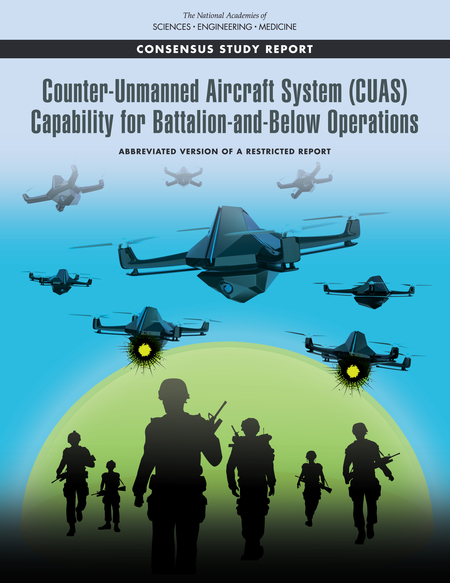
  • New report predicts small drone threats to infantry units

    The emergence of inexpensive small unmanned aircraft systems (sUASs) has led to adversarial groups threatening deployed U.S. forces, especially infantry units, according to a new report.

    Although the U.S. Army and the U.S. Department of Defense (DOD) are developing tactics and systems to counter single sUASs, the report by the National Academies of Sciences, Engineering and Medicine emphasizes the need for developing countermeasures against multiple sUASs — organized in coordinated groups, swarms, and collaborative groups — that could be used much sooner than the Army anticipates.

    The committee that conducted the study developed a classified report that details its findings and recommendations, along with an unclassified public version that discusses key background issues.

    “Hobby drones are easy to buy, their performance is improving dramatically, and their cost has dropped significantly; now with millions of them around the world, they pose a growing threat to the U.S. warfighting forces if used for nefarious intents,” said Albert Sciarretta, president of CNS Technologies and chair of the committee. “The threats could be consumer items like hobby drones, modified consumer items such as could be assembled with online components, and customized ones, like built-from-scratch aircraft.”

    The committee that authored the report was asked by the U.S. Army to assess the threat from sUASs, especially when massed and operating collaboratively, examine the current capabilities of military units to counter them, assess related human performance issues, and identify technologies appropriate for short- and long-term science and technology investments by the Army.

    Readily available, high-performance, sUASs can be easily modified to carry lethal weapons, identify targets at long ranges, and conduct electronic warfare attacks. As the capabilities of hobby drones improve at a rapid pace, the added threat from coordinated groups, swarms and collaborative groups of sUASs will pose a substantial challenge to U.S. armed forces, the report says.

    “Modified hobby drones can be used to support conventional and unconventional attacks. For example, they can be fitted with external or embedded explosives designed to explode on contact,” added Sciarretta. “In addition, they can be used by adversaries to jam our radio frequency signals and to support their information operations. When these sUASs are combined in groups or swarms, their threat is significantly enhanced.”

    Countering sUASs first requires detection and identification, which is difficult because they are small, fly at low altitudes, can have highly irregular flight paths, and travel at a range of speeds, the report says. Moreover, a sUAS can also take advantage of the surrounding environment, for example, by concealing itself among trees or blending in with a flock of birds.

    Even after threats are identified, countering sUASs can be challenging, the report says. The Army and DOD have invested significantly in technologies in response to these threats, often focusing on detecting radio frequency transmissions of the sUASs or their operators.

    However, the report highlights that today’s consumer and customized sUASs increasingly can operate without radio frequency command-and-control links by using automated target recognition and tracking, obstacle avoidance, and other capabilities enabled by software.

    The study was sponsored by the U.S. Army.

    Copies of Counter-Unmanned Aircraft System (CUAS) Capability for Battalion-and-Below Operations are available from the National Academies Press or by calling 202-334-3313 or 1-800-624-6242.