Tag: National Geospatial-Intelligence Agency

  • Advancing geomatics tradecraft and education in the public interest

    Advancing geomatics tradecraft and education in the public interest

    Image: stock_colors/E+/Getty Images
    Image: stock_colors/E+/Getty Images

    Anyone keeping up with my columns may know that I have been highlighting the geodesy crisis and programs that advance the science of geodesy (July 2020, November 2022, December 2022, and March 2023). On June 13-15, I had the privilege of participating in a working group event convened by the Geomatics Emerging Scientist Consortium for Education, Research and Capabilities Enhancement (GEO-ESCON). The GEO-ESCON, established in the summer of 2022, is a multi-university consortium serving the need of the Office of Geomatics of the National Geospatial-Intelligence Agency (NGA) for personnel with advanced geomatics expertise, a sustainable pipeline of critical geomatics skillsets, and capabilities enhancement in geomatics and other applied sciences. The 15-member consortium is led by The Ohio State University (OSU), which serves as GEO-ESCON’s managing higher education partner.

    GEO-ESCON is part of OSU’s Battelle Center for Science, Engineering and Public Policy in the John Glenn College of Public Affairs. As stated in an OSU press release, OSU was selected for its role with GEO-ESCON because of its longstanding commitment to geodetic education — its collegiate geodetic program is the oldest in the United States and offers undergraduate and graduate degrees in both geodetic engineering and geodetic science.

    OSU is home to more than 80 researchers across six colleges who focus on core research and development aspects of geospatial science and technology, including geodesy, remote sensing, photogrammetry, GIS, positioning, navigation, and timing (PNT), computer vision, mobility, smart cities, data analytics, autonomous systems (UAS, UUS and UGV), medical imaging, and precision agriculture.

    The GEO-ESCON consortium is designed to create a geographically distributed, multi-disciplinary network of universities to educate the federal geomatics workforce at advanced levels and provide opportunities for applied research and technology development. Higher education institutions are invited to participate in GEO-ESCON based on their capabilities in geomatics. As of July 18, the consortium has 15 members and two additional universities are in the process of becoming members. Click here for all GEO-ESCON member institutions.

    GEO-ESCON convened the June Geomatics Challenge Working Group to discuss pressing geomatics challenges and discuss potential solutions. The event facilitated dialogue between representatives from NGA’s Office of Geomatics and academic attendees on geomatics challenges of national priority that could result in actionable proposals to address the challenges. The working group enables representatives of GEO-ESCON member institutions to gain a deeper understanding of NGA’s geomatics priorities, build relationships with NGA leaders, collaborate with colleagues at other institutions, and provide recommendations to GEO-ESCON and the NGA. There were 47 academic participants representing 14 universities.

    NGA aims to encourage institutions with varied expertise to propose solutions that achieve greater outcomes through collaborative work. The agency provided six broad categories of geomatics challenges for discussion. See the image below for the categories of interest.

    Proposals submitted in response to the June Geomatics Challenges Request for Proposals (RFP) will be eligible for funding consideration and selected activities are expected to be awarded before the fall semester.
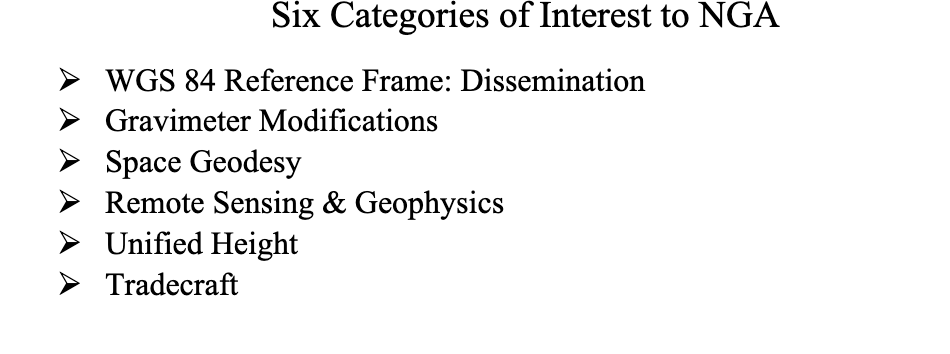
    The word “tradecraft” in the categories of interest was intriguing. In general, tradecraft refers to the skills, techniques, and practices used by professionals in various fields to carry out their work effectively and discreetly. During World War II, however, the term became associated with spy work and now is mostly used to refer to the techniques and procedures of espionage. NGA is concerned with the dramatic drop in the number of individuals pursuing careers in geodesy — that is, the geodesy crisis in the United States.

    Event attendees were asked to prioritize the topic(s) that most interested them, so that they could join a small group on the topic to identify issues, and discuss approaches, solutions, and potential actions for the challenge. Several universities had multiple representatives, so they selected different topics aligned with their individual interest.

    The meeting had professional workshop facilitators, technical advisors, NGA subject matter experts (SME), and student recorders. Facilitators encouraged the full participation of all attendees to elicit a range of viewpoints and generate previously unconsidered solutions that could bridge differences in approach — resulting in solutions that were supported by many.

    The small groups aligned with a specific challenge utilized the expertise of technical advisors — experts in geomatics or related fields with considerable industry, government, and/or research experience — who supported the development and maturation of proposed Geomatics Challenge solutions. The role of technical advisors was to work with the other leaders in their small group to encourage the full participation of all attendees and mentor the groups toward the generation of novel solutions. I was a technical advisor for the “unified height” topic.

    NGA’s SME participated in the working group activities and provided additional context for the individual topics, and other unclassified details related to the Geomatics Challenges.

    To capture the discussions at the group meetings, student recorders took detailed notes during the small group discussions. The recorders were graduate students — primarily in geodesy or other STEM fields — and they did an excellent job of capturing the discussion, action items, and potential proposals.

    As previously stated, individuals self-selected the topic that interested them but over the course of the three-day meeting individuals were asked to participate in other Geomatics Challenge small groups to provide constructive critiques to produce the best research projects. This was an excellent concept that, in my opinion, helped to improve draft proposals and identify new collaborative projects.

    As an example, the need for a unified height system that defines, assesses and correlates all height measurement processes became very evident when individuals participating in the “remote sensing and geophysics” topic engaged with the “unified height” topic members. This joint-topic group meeting helped form new partnerships and formulate new proposals.

    The GEO-ESCON and the participating institutions have an ambitious schedule of submitting and awarding the grant proposals before the end of the government’s fiscal year. That said, the participants appeared to be up to the challenge and prepared to make it happen. For obvious reasons, I cannot describe any of the projects discussed, but I will highlight them when they become available for public distribution.

    For now, I would like to state that GEO-ESCON is a great program, and it supports the advancement of the science of geodesy and geomatics. I believe that integrated and collaborative organizations are necessary for the successful development of geospatial products and services, and GEO-ESCON is the epitome of this concept. If you believe your institution would benefit from joining this consortium, I encourage you to visit their website to learn more or reach out directly to GEO-ESCON’s team ([email protected]). Click here to subscribe and stay up to date on GEO-ESCON news.

    In conclusion, as in my previous column, I would like to remind everyone that geodesy is the foundation for all geospatial products and services.

  • NGA seeks feedback on how to improve Earth modeling

    NGA seeks feedback on how to improve Earth modeling

    NGA logoThe National Geospatial-Intelligence Agency (NGA) is seeking information from the GNSS community on upgrades to its Stardust program.

    Stardust develops models of the Earth used in geomatics. The upgrades will result in modernization of geomatics information technology systems and infrastructure. The update includes migration of models to the cloud.

    The NGA posted a request for information (RFI), with responses due by 5 p.m. Eastern Time on Dec. 21.

    Stardust is run by the NGA Foundation GEOINT Integrated Program Office, partnered with the Foundation GEOINT Group (NGA/SF) within the Source Operations and Management Directorate.

  • NGA awards HawkEye 360 contract for RF mapping

    NGA awards HawkEye 360 contract for RF mapping

    Up to five-year contract follows a successful pilot program that demonstrated the value of commercial RF geospatial intelligence

    HawkEye360 logoHawkEye 360 has been awarded a contract by the National Geospatial-Intelligence Agency (NGA) to help the agency discover, characterize and map activities that emit energy in the radio frequency (RF) bands of the electromagnetic spectrum.

    HawkEye 360 specializes in RF data and analytics from space-based satellites.

    HawkEye 360 will provide NGA the means to develop global datasets, enabling users to discover and monitor a broad range of RF activity across large geographic areas.

    The $10 million one-year contract includes an option for four more years. It will support users throughout the NGA enterprise, including the combatant commands and other mission partners.

    HawkEye 360’s data will support a variety of analytics missions for NGA, including military activity and the trafficking of military, nefarious, non-state and transnational criminal (or illicit) activity. The company’s growing constellation of satellites will provide insight into developing events in a timely manner, and the company will work collaboratively with NGA on an ongoing basis to effectively meet the agency’s mission needs.

    “We’re pleased to be moving from the pilot into an NGA long-term operational contract, which showcases the value of unclassified, shareable commercial RF insights,” said HawkEye 360 CEO John Serafini.

    “This program is an excellent example of agile acquisition rapidly delivering high-impact GEOINT to the warfighter,” said Alex Fox, the company’s executive vice president for business development, sales and marketing.

    NGA leveraged a National Reconnaissance Office commercial integration study contract with HawkEye 360 in September 2020 to execute a test and evaluation contract with the company.

    NGA then issued a competitive RFP in March 2021 and awarded the contract in July 2021. “We are excited to continue working with NGA to address current mission requirements and expand the RF GEOINT tradecraft to address an even larger set of mission requirements, much like NGA has done with their pioneering use of commercial imagery,” Fox said.

    HawkEye 360 operates a constellation of nine RF-monitoring satellites. Twenty-one additional satellites are fully funded and scheduled for launch in 2021 and 2022. Once complete, this baseline constellation of 30 satellites will provide collection revisits as frequently as every 20 minutes.

    Following the establishment of the baseline constellation, HawkEye 360 plans to launch a second-generation constellation of 30 additional satellites by 2025 to satisfy projected capacity and operational requirements.

    The company’s RF data and analytics produce actionable insights for national, tactical and homeland security operations, maritime domain awareness, environmental protection and a growing number of new defense and commercial applications.

  • NGA launches new phase of Earth magnetic field project

    NGA launches new phase of Earth magnetic field project

    Image: Credit: Petrovich9/iStock/Getty Images Plus/Getty Images
    Image: Credit: Petrovich9/iStock/Getty Images Plus/Getty Images

    The National Geospatial-Intelligence Agency launches Phase 4a of MagQuest Challenge to advance NASA’s ability to measure Earth’s magnetic field

    The National Geospatial-Intelligence Agency (NGA) has launched the Demonstration Phase (Phase 4a) of its MagQuest Challenge to develop novel data-collection approaches for the World Magnetic Model.

    The WMM ultimately ensures the accuracy of navigation, because it corrects for differences in magnetic forces at a user’s location. The model is used by thousands of systems for mobile navigation apps and is critical for military and commercial uses around the world.

    Produced since 1905, the WMM originated with data collection from two ships surveying 500,000 miles of ocean. Today, the data is collected by satellites operated by the European Space Agency that will eventually reach the end of their useful life.

    NGA’s MagQuest Challenge is promoting the development of miniaturized solutions to determine whether they can produce data useful to support WMM production. NGA has an extensive network of government partners collaborating on the WMM production, including the National Oceanic and Atmospheric Administration (NOAA), the British Geological Survey, the Federal Aviation Administration (FAA), the Department of Defense (DOD), the United States Geological Survey (USGS), and the United States Naval Observatory (USNO) among others.

    As part of its core mission, NGA provides geospatial intelligence products and services to decision makers, military service members, and first responders.

    The MagQuest Demonstration Phase 4a will take place on HeroX, a social network platform for crowdsourced solutions.

    Three winning teams from Phase 3 of MagQuest each proposed a magnetometer design to measure the Earth’s magnetic field. In this new phase, the teams will receive several million dollars in awards, including a $1.55 million incentive prize purse, to develop their proposed magnetometers. NASA Goddard Space Flight Center will conduct independent testing on each team’s prototype.

    Following Phase 4a, successful teams will integrate their magnetometers into their satellites and launch their systems, acquire data and share their results with NGA.

    “Our ultimate goal is for all three teams to successfully develop a magnetometer, each of which can be sent into orbit to determine viability for WMM production,” said Mike Paniccia, NGA program manager for the World Magnetic Model. “We want to test as many innovative and groundbreaking magnetometers as possible to ensure that NGA has a robust set of data suppliers to support the future of the WMM. We intend to have a competitive procurement for a data-buy contract following MagQuest and hope that these three teams, in addition to others from industry, will be able to supply comprehensive data sets to support the future of the WMM.”

    Three of the teams that participated in Phase 3 were selected to participate in Phase 4:

    • Iota Technology, the first-place Phase 3 winner, works alongside experienced teams from Oxford Space Systems and AAC Clyde Space. Their combined expertise in sensor technology, deployable structures and mission design informed the design of their SIGMA solution — a 3U CubeSat featuring a novel deployable boom and a 3D magnetometer array.
    • University of Colorado Boulder is one second-place Phase 3 winner, and their solution, COSMO, leverages recent innovations in CubeSat technology and novel magnetometer technology. The University of Colorado Boulder team includes experts and faculty from the Department of Aerospace Engineering Sciences, the Department of Mechanical Engineering, and the Laboratory for Atmospheric and Space Physics, and they operate their missions entirely at the university, including using their own ground stations.
    • Spire Global and SBQuantum formed a partnership with a promising approach to become the other second-place Phase 3 winner. SBQuantum’s novel diamond-based quantum magnetometer technology is coupled with Spire’s expertise and existing infrastructure in satellites, ground stations and data processing to produce a unique solution.

    “This MagQuest Challenge is a testament to the power of the crowd,” said Kal K. Sahota, CEO, HeroX. “We are pleased to be part of securing the future of geomagnetic data collection and consequently contributing to the resilience and continued crucial work of the WMM.”

  • NGA seeks enhancements in predicting overhead geopose

    $50K prize purse for solutions to advance computer vision for time-sensitive mapping

    The National Geospatial-Intelligence Agency (NGA), Johns Hopkins University Applied Physics Laboratory and NASA have launched a crowdsourcing competition, the “Overhead Geopose Challenge,” which is being implemented by DrivenData and HeroX.

    The challenge seeks solutions that make overhead images more useful for time-sensitive applications like security and disaster response. Participants are competing for a prize purse of $50,000. To accept the challenge, visit this website.

    The challenge seeks to build computer-vision algorithms that can effectively model the height and pose of ground objects for monocular satellite images taken from oblique angles.

    Overhead satellite imagery provides critical time-sensitive information for disaster response, navigation, and security. Most current methods for using aerial images assume that the images are taken from directly overhead.

    However, the first images available are often oblique. These camera orientations complicate useful tasks like image alignment and change detection that are needed to ensure that maps are accurate in dynamic environments.

    Solvers will transform RGB images taken from a satellite to accurately determine each object’s real-world 3D structure or “geocentric pose.” Geocentric pose is an object’s height above the ground and its orientation with respect to gravity. Calculating geocentric pose helps with detecting and classifying objects and determining accurate object boundaries.

    NGA is continuously seeking novel concepts for assured positioning, navigation, and timing, said NGA Research Chief Scientist John Main. “We think the broader innovation community can help us support disaster response operations more effectively by exploring novel ways to understand where things are happening — or even better where things will be happening — during an emergency event. This is NGA Research’s goal and the reason we tap scientific and technical talent and ideas from national labs, universities, and businesses.”

    “This is a hard computer vision problem that will benefit from the diverse approaches that a machine learning challenge can bring to bear,” said Greg Lipstein, co-founder and principal of DrivenData. “This is a great opportunity to bring together a fascinating dataset with a passionate community of experts to generate innovative solutions for disaster response and other time-sensitive needs”

    “Our global network of problem-solvers is perfectly suited to support the advancement of state-of-the-art methods for using and understanding satellite imagery,” said Christian Cotichini, CEO, HeroX. “Having great minds come together for an initiative like this will help us more quickly and more effectively support people in times of need.”

    Eligibility to Compete and Win Prizes

    The challenge is open to anyone aged 18 or older not affiliated with DrivenData or the challenge sponsor and permitted to compete under the laws of the U.S. and their local jurisdictions.

    Finalists will be determined by performance on a private test set of historical measurements, and bonus prizes will also be awarded for qualifying scores that reflect innovative approaches. All prize-winning approaches will be shared under an open-source license for learning and use by the community.

  • Enview unveils 3D AI as a web application, Enview Explore

    Enview unveils 3D AI as a web application, Enview Explore

    Screenshot: Enview
    Screenshot: Enview

    Application empowers users with expert visualization and analysis of lidar

    Enview, a pioneer in the scalable processing of 3D geospatial data, has launched Enview Explore, a powerful web application that leverages artificial intelligence (AI) and cloud computing to automatically process 3D data at a high speed and scale.

    Also, Robert Cardillo, former director of the National Geospatial-Intelligence Agency (NGA), has joined the company’s board of directors. Following an oversubscribed round of funding in May, the company continues to experience growth and momentum in the market.

    Enview’s technology has been deployed on thousands of square miles worldwide to protect vital infrastructure and support mission-critical operations. Its unique method for classifying 3D data using neural networks and deep learning techniques reduces time to action by focusing on finding meaningful insights in 3D data.

    Previously offered as custom services for organizations such as Pacific Gas & Electric and the United States Air Force, this groundbreaking technology is now available for the first time as an easy-to-use, self-service web application.

    Screenshot: Enview
    Screenshot: Enview

    “Enview has built the world’s most scalable AI platform for transforming 3D point clouds into insight and action,” said San Gunawardana, Ph.D., co-founder and CEO of Enview. “We are solving one of the hardest problems in machine perception, and applying it to some of the most grounded and impactful challenges facing society. It is our goal to empower people with the confidence to perceive and navigate a rapidly changing world; Enview Explore is the natural next step in this journey and our team is excited to place this groundbreaking capability directly into the hands of operational end-users.”

    Key benefits of Enview Explore include:

    The power of 3D data. Three-dimensional unstructured data, such as lidar, contains incredible detail but is painfully slow to analyze manually. Enview solves this problem by combining its novel AI with the power of cloud computing to automate 3D classification and segmentation, giving users scalability that can support even nation-sized datasets.

    High speed. While current methods can take weeks or more to process data, Enview provides actionable insights in minutes. Enview Explore utilizes a new and innovative approach that applies AI to 3D data, yielding significantly faster results than traditional lidar software.

    Total data control. Enview Explore removes the need for outsourcing lidar to a third party by giving users the ability to perform classification, segmentation, terrain modeling, change detection, feature extraction, and intuitive visualization directly inside the application.

    Screenshot: Enview
    Screenshot: Enview

    “With this release, we wanted to show the world that you don’t need to be a professional to get expert analysis from lidar,” said Anthony Calamito, VP of Products for Enview. “Lidar and other 3D data hold tremendous value and provide unparalleled insight over 2D data sources. While unlocking that value traditionally has required an in-depth understanding of specialty software, Enview Explore lets anyone create meaningful insight from 3D data with just a few clicks.“

    The company also announced that Robert Cardillo has joined its Board of Directors. Cardillo served as the sixth director of the NGA from 2014 through 2019. In that position, he led the NGA under the authorities of the secretary of defense and director of National Intelligence to transform the agency’s future value proposition through innovative partnerships with the growing commercial geospatial industry.

    “Mapping the world in 3D opens new possibilities for national security and mission-critical infrastructure, including some of the most important challenges facing our nation today,” said Cardillo. “Enview has completely changed the game when it comes to what’s possible with lidar visualization and analysis, making unstructured data accessible and easy to use: in other words, creating coherence out of chaos. With a shared purpose and commitment, I look forward to working with the Enview team toward the future the world demands and our customers deserve.”

  • Team to collect Arctic surveillance data for NGA

    Photo: NASA
    Photo: NASA

    The National Geospatial-Intelligence Agency (NGA) has awarded GeoNorth Information Systems (GNIS) a five-year, $15 million contract for persistent surveillance services of the Arctic region. Lockheed Martin will provide a scalable geospatial processing platform to enable the surveillance project.

    GNIS will leverage Lockheed Martin’s Rosetta technology, which includes a versatile and highly automated set of commercial and civil image processing tools that scale and adapt to deliver precision geospatial intelligence products to the NGA.

    GNIS, a wholly owned subsidiary of the Tatitlek Corporation, an Alaska Native Village Corporation, will work with Lockheed Martin and the University of Alaska Fairbanks’ (UAF) Alaska Satellite Facility (ASF), under the banner of the Arctic GeoData Cooperative. GNIS and the partners will build, improve, monitor and maintain terrain elevation models of the Arctic region.

    “The Arctic region has significant global implications for environmental, economic and security factors,” said Gil Metzger, director of Applied Research at Lockheed Martin. “It is critical that we document and monitor this demanding environment with the best technologies available. Lockheed Martin is proud to be part of this innovative cooperative that establishes both an operational domain awareness capability and a foundation for advanced research.”

    The cooperative team will leverage each member’s unique expertise and capabilities to provide a one-of-a-kind solution to partners like the NGA.

    As the prime contractor, GNIS will perform overall project management, conduct day-to-day operations and provide access to commercial remote-sensing platforms through its existing direct receiving station located at ASF.

    UAF brings broad Arctic-related research and development, problem solving and the ability to refine existing scientific algorithms and methods to support specific project requirements.

    Lockheed Martin’s Rosetta toolset will transform the large volumes of sensed data into correlated geospatial intelligence products.

    “The Arctic domain poses many challenges,” said Jon Heinsius, general manager of GNIS. “Not only is it an area much larger than the whole United States and Canada combined, but its remoteness, intense weather conditions and unique characteristics are not found anywhere else in the world. The cooperative’s combined academic and commercial approach provides the NGA with tremendous flexibility to meet their current and future needs.”

    “The cooperative is going to be a supportive environment where participants can bring ideas, technologies, algorithms and research for development, testing and validation,” said Nettie La Belle-Hamer, director of the Alaska Satellite Facility. “The concept is to explore and nurture new ideas to take what we learn today to build for tomorrow.”

  • FAA restricts drone operations over NGA facilities

    FAA restricts drone operations over NGA facilities

    Photo: FAA
    Photo: iStock.com/NiseriN via the Federal Aviation Administration

    In cooperation with the U.S. Department of Defense (DoD), the Federal Aviation Administration (FAA) is establishing restrictions on drone flights up to 400 feet within the lateral boundaries of National Geospatial-Intelligence Agency (NGA) facilities.

    The temporary flight restrictions — specific to unmanned aircraft systems (UAS) — apply to three NGA facilities in or near St. Louis:

    • National Geospatial-Intelligence Agency (NGA) West
    • NGA Next West
    • NGA Arnold

    In June, the FAA responded to federal agency requests and restricted drone operations over penitentiaries and Coast Guard bases.

    The Federal Aviation Administration (FAA) is using its existing authority under Title 14 of the Code of Federal Regulations § 99.7 — “Special Security Instructions” — to address concerns about drone operations over national security-sensitive facilities.

    The changes, which are highlighted by FAA NOTAM FDC 8/7350, are pending until they become effective on Aug. 30.

    Only a few exceptions permit drone flights within these restrictions, and they must be coordinated with the individual facility and/or the FAA.

    Operators who violate the flight restrictions may be subject to enforcement action, including potential civil penalties and criminal charges.

    To ensure the public is aware of restricted locations, the FAA website also provides an interactive map, downloadable geospatial data and other important details. The restrictions also are depicted in the FAA’s B4UFLY mobile app. Broader information regarding flying drones in the National Airspace System, including frequently asked questions, is available on the FAA’s UAS website.

    The FAA continues to consider additional requests by eligible federal security agencies for UAS-specific flight restrictions using the agency’s § 99.7 authority as they are received. Additional changes to these restrictions will be announced by the FAA as appropriate.

  • Harris wins three 10-year NGA geospatial data contracts

    Harris wins three 10-year NGA geospatial data contracts

    Earth's western hemisphere, 2002. (Photo: NASA)
    Earth’s western hemisphere, 2002. (Photo: NASA)

    Harris Corporation has been awarded three multi-award indefinite delivery/indefinite quantity (IDIQ) contracts with ceilings totaling $1.5 billion to provide the National Geospatial-Intelligence Agency (NGA) with geospatial data services for up to 10 years.

    Harris will create, manage and disseminate high-quality geospatial-intelligence (GEOINT) information for use by the U.S. intelligence community and military worldwide under contracts that cover all three areas of NGA’s JANUS program — geography, imagery and elevation.

    The JANUS program will contribute to and maintain comprehensive, geospatially accurate databases of the world that can be accessed quickly as intelligence, operational and crisis needs arise.

    Harris will use its predictive analytics technology to continuously evaluate the health of NGA databases and to guide the acquisition, creation and integration of all forms of geospatial data. Harris’ cloud-based tools will validate and correct the data — pinpointing locations that require updates.

    “Winning JANUS continues our long-standing legacy of providing high-quality, responsive GEOINT and analytics to the intelligence and military communities,” said Bill Gattle, president, Harris Space and Intelligence Systems. “Our analytics technology provides NGA with fit-for-purpose data, reduced production costs and cloud-based access to geospatial products and content.”

    Harris is investing in new technologies that improve the speed and accuracy of providing GEOINT products. The company has partnered with the NGA for almost 20 years to provide automated geospatial data processing, data management, and geospatial systems design and development. Harris provides high resolution geospatial data content and products under NGA’s Foundation GEOINT Content Management program, and previously supported the Global Geospatial-Intelligence program.

    Hexagon US Federal Also Contracted

    The NGA also has selected Hexagon US Federal as a prime contractor on two multiple award, indefinite delivery/indefinite quantity contracts for amounts totaling $1.17 billion for the JANUS Geography and JANUS Elevation contracts.

    JANUS Geography. Hexagon’s tasks for the JANUS Geography program will support the creation, conflation, integration and enrichment of Foundation GEOINT data used to produce a comprehensive and seamless dataset for NGA partners and customers.

    The creation of this dataset will ensure more accurate and readily available geospatial data for military and intelligence operations as well as disaster relief missions saving time and lives.

    JANUS Elevation. As a prime contractor on the JANUS Elevation contract, Hexagon will support NGA’s Office of Geomatics with maintenance to an existing worldwide library of digital elevation models. The effort includes products generated, modified or assessed by the office that are a digital representation of the terrain surface of the Earth.

  • TerraGo launches reconnaissance app in NGA GEOINT store

    TerraGo launches reconnaissance app in NGA GEOINT store

    Image: TerraGo
    Image: TerraGo

    TerraGo, a provider of dissemination and collaboration software for defense and intelligence agencies, has announced the availability of R3 for immediate download in the National Geospatial-Intelligence Agency’s (NGA) GEOINT App Store.

    R3 is a mobile data collection and collaboration app customized for the missions of reconnaissance, response and recovery. Designed for the most challenging missions and environments, R3 lets users keep working offline and off the grid with customizable workflows for security, humanitarian and disaster relief programs, the company said.

    “R3 enhances situational awareness, search and rescue, damage assessments and recovery efforts,” said Scott Lee, director of federal programs at TerraGo. “It really gives users the best of both worlds with mobile technology that can go anywhere, and will also work even when the network doesn’t.”

    Image: TerraGo
    Image: TerraGo

    Designed with a simplified user interface, R3 provides a robust standalone capability for a variety of field-based collection activities. Users can access custom basemaps from numerous GIS, map and imagery sources including GeoPDF, ArcGIS, USGS and GXP, while collecting and exchanging location-tagged notes using smart forms, photos, videos and audio files.

    Pre-loaded forms are available for structured assessments, and users can connect to a secure server to create unique mission packages and enable synchronous collaboration. R3 supports important standards like OGC GeoPackage interoperability and sharing geospatial assets among mission partners.

    Registered GEOINT App Store users can download TerraGo R3 for iOS here. The Android version is complete and coming soon, the company added.

  • GeoQ: Robust homeland security tools for first responders

    Art Kalinski, GISP
    Art Kalinski, GISP

    When I was the GIS manager of the Atlanta Regional Commission, the most rewarding and important work we did was geospatial support for our first responders. The culmination of this effort was creation of a portable GIS that we could set up in the field on short notice anywhere in the region to provide situational awareness for first responders.

    The system consisted of two laptops, external hard drives, a HP “E”-size plotter, foam-board laminator and an LCD projector — all housed in a portable tent. We used ArcInfo and ArcView to build and overlay vector data on ortho/oblique aerial imagery to aid visualization.

    We found that police and firefighters especially liked our large laminated plots of imagery overlaid with street data, because the aerial images were easy to understand and the GIS data provided needed location references. The hard-copy plots required no computer and could be marked up with grease pencils.

    ARCUASI-W

    ARC_UASI-W

    Helping in our small way, we provided the same kind of large plots of New Orleans to the Louisiana National Guard days after Hurricane Katrina hit. We later learned that the plots were used by National Guard headquarters to keep track of search-and-rescue efforts by marking up neighborhood blocks with grease pencils and recording search results. They crossed off buildings that had been searched and recorded urban rescue information such as who did the search, and the date and number of live or deceased bodies found. The hard-copy plots were a low-tech embodiment of higher tech GIS data and imagery.

    Firefighter-W

    Nine years later, the National Geospatial-Intelligence Agency (NGA) developed a similar but higher tech and more robust system called GeoQ.

    GeoQ: Geographic Work Queueing and Tasking System

    GeoQ is an open-source geographic tasking and management system that facilitates collection and display of diverse geographic and geographically tagged data across large areas to provide situational awareness for all involved. As needed, the large areas can be broken down into small grid squares and assigned to teams or team members for detailed analysis or tasking.

    The system is designed to be very transparent so all involved can view the workflow and assist as needed, while avoiding duplication of effort. This NGA video is a well done and rapid overview of GeoQ.

    GeoQ software was developed by NGA and the MITRE Corporation to leverage NGA tools and data to the benefit of Homeland Security personnel. In 2013, the leadership at NGA made a gutsy decision to share some of their unclassified geospatial tools with the nation’s first responders through GitHub, an open-source software developers’ online collaboration environment. With more than 2 million participating programmers, GitHub hosts more software source code than any other single service in the world.

    GeoQ was the first NGA product shared through GitHub, and was in keeping with a change in philosophy at NGA to take advantage of feedback and improvements generated by the huge and diverse talent pool available through GitHub. NGA was the first intelligence agency to share some of its work in this open-source environment, and the results have been extremely beneficial to all involved.

    The Huntsville Connection

    With more than 70 geospatial firms and agencies, Huntsville, Ala., has always been an early adopter of geospatial technology. Several years ago it was again a Huntsville team that developed a first-ever Google Earth Enterprise-based emergency response system called Virtual Alabama. The system was so effective that eight other states adopted the model. Work was underway to build a national version when Google announced the phasing out of Google Earth Enterprise. We now know that Google was not motivated to build authoritative geospatial systems, but was focused on building products and services that attracted customers so it could accomplish its primary business of selling advertising.

    Fortunately, the work of the Virtual Alabama team was not wasted. Team members became experts regarding first-responder operations and their unique situational awareness requirements. They learned that first responders needed much more than just a GIS. The best analogy I can think of is that one could use PowerPoint as a word processor, but that wouldn’t be a very efficient system. Likewise, MS Word could be used for presentations, but not as elegantly as PowerPoint. The same holds true for rapid dissemination, communication and perception of a common operational picture. Geospatial tools and analysis are part of situational awareness, but the work flow and many components are different, not necessarily spatial and need to be assembled and processed at their own pace.

    The timing was almost perfect, since GeoQ was released as Google Earth Enterprise was being phased out. Huntsville again seized the opportunity to build on its experience, and GEOHuntsville became a prime GeoQ testbed. I recently met with Chris Johnson, one of the early Virtual Alabama leaders and president of A Visual Edge, Inc., a Huntsville geospatial firm. She demonstrated GeoQ and Huntsville’s role in advancing the technology.

    GitHub has a very thorough description of GeoHuntsville, a non-profit 501c6, and its role with NGA to test and share lessons learned through a “Blueprint for Safety” pilot project involving other cities to improve rapid disaster response. The sharing of lessons learned, code sets and documentation through the multi-city collaboration is called “Exemplar City.”

    Another aspect of the Blueprint for Safety is support of rapid sensor deployment in support of first responders through common standards. Sort of a “plug-and-play” for complex devices. (See the GeoQ projects page and the OpenSensorHub.)

    There is quite an extensive collection of material on GitHub regarding GeoQ and other NGA, projects including support of FEMA and GeoQ technical specifications. NGA doesn’t directly support these efforts, with legal language such as “NGA assumes no responsibility for the use of the software by any parties, and makes no guarantees, expressed or implied, about the software quality, reliability, or any other characteristic.” Still, NGA is behind the creation of the software and is working on other tools and support that will expand the capabilities. Participation of both GeoHuntsville and the Federal Emergency Management Agency (FEMA) bodes well for future use, since I don’t envision the same situation we ran into with Google and Virtual Alabama/USA.

    Update on What3Words

    In February, I wrote about what3words. The simple what3words system is now available as a locator, accessible via the Esri ArcGIS platform.

  • Lockheed, Esri Cloud Deployment Enables Government GIS Sharing

    Lockheed-NGA-Map-world-
    Lockheed Martin and Esri have deployed commercial software to the Amazon Web Services Commercial Cloud Services (C2S) environment for the first time with an intelligence community customer, the National Geospatial-Intelligence Agency (NGA). The move enables government agencies to better share geospatial intelligence.

    The deployment of the portal for Esri’s ArcGIS geographic information system (GIS) provides a single environment for analysts to securely organize and share data throughout the intelligence community and Department of Defense. It’s also the foundational step in consolidating multiple geospatial intelligence portals into the single NGA-provided portal, resulting in technology and license cost savings.

    This is NGA’s second pioneering step in the cloud, after the agency moved its Map of the World application to the C2S environment late last year.

    “Deploying Esri’s Portal for ArcGIS to a commercial cloud environment securely organizes existing data and facilitates collaboration across intelligence agencies,” said Jason O’Connor, vice president of Analysis and Mission Solutions for Lockheed Martin. “This cloud implementation also further shapes the government’s processes for architecting and implementing enterprise class services within a cloud environment.”

    ArcGIS connects users to maps and geographic information. Users can create and view maps, compile geographic data, analyze mapped information and share geographic information in a range of applications.

    “Working with Lockheed Martin and the NGA on this strategic implementation for national security is particularly meaningful,” said Jack Dangermond, Esri president. “It recognizes the importance of consolidating geospatial intelligence information into a single portal to facilitate rapid situational awareness and response by our intelligence community.”

    Lockheed Martin and Esri have partnered for eight years on the Geospatial-Intelligence Visualization Services (GVS) program, which helped NGA and the Intelligence Community achieve this cloud migration milestone. The Total Application Services for Enterprise Requirements (TASER) GVS contract vehicle, which was originally awarded in 2012, conveys geospatial visualization context and analytic capabilities to warfighters, intelligence officers and policy-makers through classified and unclassified computer networks.