Tag: National Guard

  • Defending America and saving lives with NITRO

    Defending America and saving lives with NITRO

    Image: Just_Super/iStock/Getty Images Plus/Getty Images
    Image: Just_Super/iStock/Getty Images Plus/Getty Images

    In May the President’s PNT Advisory Board heard a presentation about a National Guard project called NITRO. RNT Foundation President, Dana Goward, recently spoke with the project’s leader, Maj. Gen. Richard R. Neely, Adjutant General, Illinois National Guard, to find out more.

    Mr. Goward: Thanks for speaking with us, General. Could you start by telling us what NITRO is and why it’s important?

    Maj. Gen. Neely: Of course. NITRO is a project to ensure that the National Guard and our state’s first-responder partners can maintain communications and other critical functions even if we lose GPS timing signals.

    NITRO is an acronym for Nationwide Integration of Timing Resiliency for Operations. ]You know how we in the military love our acronyms.

    Telecoms and most of the rest of America’s critical infrastructure are dependent on timing from GPS. However, GPS signals are weak, highly vulnerable and under threat.

    In addition to bad actors who can and do jam and spoof signals, accidental interference happens all the time. Operations at the Dallas and Denver airports were each interrupted by accident for more than a day last year, for example. A couple of years ago, a passenger airliner almost hit a mountain because of interference with GPS.

    Q: It sounds like this is a safety of life issue.

    A: It is. Right now, if we lost GPS signals and had to respond to a domestic attack, natural disaster, or other contingency, I am confident there would be additional unnecessary casualties. We are building NITRO so that we can save those lives and keep America safe.

    Q: So how does NITRO work?

    A: In addition to GPS, it gets multiple sources of space-based and terrestrial time from government and commercial providers. NITRO can use any trusted source. It is not provider- or vendor-specific.

    Inputs are combined and compared, matched to the nation’s atomic clocks keeping Coordinated Universal Time, and users are sent the best accurate time multiple ways including over fiber, terrestrial broadcast, and resilient wireless networks.

    Another great way in which I think it will be useful: NITRO gives us a common operating picture that can help detect and terminate GPS disruptions and anomalies around the country.

    Q: Is the National Guard the only user?

    A: Absolutely not! This is a state/federal partnership. The states’ Adjutant Generals are working with their Homeland Security Advisors to make it available to state, local, and tribal first responders. In some instances, also to critical infrastructure.

    Even though we are in the early stages of implementation, NITRO is being used by seven states and 256 organizations and it is protecting more than 33 million people, including citizens here in Illinois.

    Q: Is NITRO a tasking from the President or Congress? Who told you to do this?

    A: NITRO helps execute long standing presidential policy and orders, as well as the recently released National Cybersecurity Implementation Plan. It also meets congressional mandates for backups and alternatives to GPS timing.

    However, we created NITRO because we identified a serious threat to the National Guard’s mission execution. It closes 11 operational gaps for us, all without changes to end-user equipment.

    Q: With what groups are the NITRO team working?

    A: All the states are involved through their adjutant generals, homeland security advisors, and emergency managers. The NITRO board I chair is made up of the adjutant generals from six states.

    We are also coordinating across the federal government, especially with the Departments of Homeland Security, Transportation, Commerce, and Energy.

    As part of this we are partnering with the Department of Transportation to establish a NITRO engineering and operational site at Joint Base Cape Cod. This will allow engineers from different organizations to see more easily what we are doing and contribute their expertise.

    Q: NITRO is going to provide timing signals in places and at times when GPS is not available. Won’t the National Guard also need navigation information?

    A: Positioning and navigation are very important, but not quite as critical as timing. So, we are addressing that problem first. And since wireless location and navigation are often based on timing signals, NITRO will provide a good foundation for services and systems that can augment GPS-based navigation.

    Q: So, how is the project going?

    A: From a technical and operational standpoint, it’s going great. We have very high satisfaction ratings from NITRO users, and states are eager to be connected as soon as possible.

    The technologies used are all mature, reasonably low cost, and most components are commercially available. So, engineering-wise it is low risk.

    And our team is doing a great job helping folks move from full dependency on GPS to resilient positioning, navigation and timing (PNT) operations.

    Q: Do you have any concerns going forward to full deployment?

    A: The only thing I worry about is continued funding. Over the next five years we need something less than the cost of one GPS satellite. You would think that would be easy to find for an important effort like this, but it is a state/federal partnership, not a Department of Defense project. So, it falls into a kind of bureaucratic and budgetary no man’s land.

    Q: What’s the solution for funding?

    A: That’s not our call. The folks at the White House are exploring several alternatives, and I know several members of Congress are also concerned. We see a possibility of this fitting nicely with the recent infrastructure funding bill.

    Q: It sounds like NITRO is something America really needs. Let’s hope they find a solution to the funding challenge, and quickly, to keep you on track. Thank you very much for your time!

    A: My pleasure!

  • National Guard timing backup for GPS in House FY-2023 NDAA

    National Guard timing backup for GPS in House FY-2023 NDAA

    On July 14, the U.S. House passed its version of the National Defense Authorization Act (NDAA) for fiscal year 2023, which begins Oct. 1, 2022.

    The report released with the legislation contains several provisions of interest for the GPS and positioning, navigation and timing (PNT) communities. Perhaps most intriguingly, it indicates the National Guard is considering a program to ensure it has one or more sources of time independent from GPS.

    Here are some of the more interesting PNT-related mentions in the report.

    GPS Disruption & RF-Based Alternatives

    A provision entitled “Briefing on Disruption of Global Positioning System” reiterates concerns Congress has expressed repeatedly over the last two decades.

    On the civil side, these concerns have resulted in prohibiting the U.S. Coast Guard from disposing of old Loran facilities until a backup for GPS is decided upon and requiring the Department of Transportation to establish a timing alternative to GPS.

    Most of Congress’ attention has been focused on the Department of Defense (DOD), though.  Over the years, it has tasked the department with a wide variety of briefings and actions including reporting on threats to GPS, how DOD will operate in GPS-denied environments, progress (or lack thereof) in OCX and M-code, and development of alternative PNT systems.

    The 2021 NDAA took a more activist approach and required DOD to “generate resilient and survivable alternative positioning, navigation and timing signals.” It also directed the department to work with the National Security Council, the departments of Transportation, Homeland Security, and others “to enable civilian and commercial adoption of technologies and capabilities for resilient and survivable alternative positioning, navigation, and timing capabilities to complement” GPS. The act mandated that this all be completed within two years.

    Photo: Andrea Izzotti/Shutterstock.com
    Photo: Andrea Izzotti/Shutterstock.com

    The 2023 NDAA reinforces Congress’ long standing concerns about “increasing threats of disruption” to GPS, stating “it is critical to invest in technologies that provide resilient and assured positioning, navigation and timing capabilities…”

    Language in that same provision, though, focuses just on alternate navigation capabilities as opposed to full PNT. The act requires a briefing before the end of this year about DOD’s plan across the Future Year Defense Program (FYDP) for “alternative navigation broadcast services.” The briefing is required to include information about “progress on radio frequency-based alternative navigation solutions,” what the department is doing now, and cost estimates for infrastructure and other expenses across the FYDP.

    Army MAPS Program

    The Army’s Mounted Assured PNT System (MAPS) is focused on ground vehicles. Information on the service’s website seems to indicate the upgrade in the first generation of MAPS is an anti-jam antenna. The overall program of record is more ambitious, according to the site, and includes M-code, other GNSS and inertial sensors.

    “Path to ALTNAV” and “Open Standards Interfaces” are also listed as features in the MAPS final version. This is likely incorporation of DOD’s mandate for modular open system architecture to ensure the ability to easily integrate future navigation and timing systems and signals.

    The Army is already producing and fielding the Gen 1 version of MAPS. In March 2022, the Aberdeen Proving Ground News announced that 1,000 units had been fielded.

    In its report accompanying the NDAA, Congress expressed concern with the pace of the MAPS program. It notes the Army has procured 2,000 units — a small fraction of the 225,000 ground vehicles the service operates.

    The text of the congressional report also seems to indicate the program is not much beyond the point described on its website two years ago. The website says a Program of Record technical solution was planned to have been finalized in September 2020.

    The House version of the bill would require the Army to provide a briefing on:

    • technical performance of candidate systems to incorporate into MAPS
    • the cost of these systems and integration
    • plans to deploy MAPS to the Army’s fleet of vehicles
    • plans to upgrade the Gen I MAPS units already fielded.

    Another indication of the delayed pace of the program is that this briefing is not due for more than a year, in December 2023.

    Autonomy Software for PNT-Denied Environments

    While much less specific, another interesting PNT-related provision is a requirement for DOD to “Report on autonomy software for Next Generation Air Dominance.”

    It describes a developing Air Force strategy for using piloted and unpiloted aircraft alongside each other. The software “could enable the continued operational capability of systems in positioning, navigation and timing-denied environments.” The Navy and Marine Corps are developing a similar concept.

    Photo: Brian Kinney/Shutterstock.com
    Photo: Brian Kinney/Shutterstock.com

    Little public information is available concerning any of the Next Generation Air Dominance programs or supporting systems. Experts have speculated, though, that operation in PNT-denied environments would likely involve some of the aircraft remaining outside the denied area and providing PNT information to the others via one or more links.

    National Guard and Nationwide Alternative Timing

    At the end of a section entitled “Collaboration on positioning, navigation, and timing research,” the House report reveals that the National Guard is concerned about relying entirely on GPS for timing and seems to have begun to address that shortfall.

    It requires a report no later than February 2023 on the Guard’s “Nationwide Integration of Time Resiliency for Operations (NITRO) effort.” The report should address, among other things, mission need, capability gaps, estimated costs and how the department is collaborating with other federal, state and local entities.

    The budget item for NITRO cites malicious cyberattacks that can impact command and control (C2) systems. It says the Guard’s ability to support civil authorities and critical infrastructure is at risk if not mitigated with resilient time.

    While attempts to reach the National Guard for comment have been unsuccessful, PNT expert Pat Diamond said the Guard’s concerns and efforts are well justified. “Precision timing is a seriously weak link for everyone in the United States, including critical infrastructure and organizations like the National Guard,” Diamond said. “If GPS timing was not available for some reason, land mobile radios, common operational pictures, the ability to navigate, plus command-and-control systems would suffer greatly, potentially being completely degraded. It’s outstanding that the Guard has realized this and seems to be moving out. All the power to them.”

    A Must-Pass Bill

    The House version of the 2023 NDAA has yet to be conferenced and reconciled with that of the Senate. While the Senate’s version of the NDAA has been filed, the accompanying report has not yet been released. Since the House provisions seem relatively non-controversial, they are almost certain to be included along with others from the Senate in the final bill and report.

    The resulting legislation is almost certain to pass into law.

    Congress often struggles to pass even routine legislation. For example, it has only funded the government on time in four of the last 40 years. The annual defense authorization is an exception. NDAA’s are considered “must-pass” bills. Congress has sent one to the president in each of the last 61 years.


    Dana A. Goward is President of the Resilient Navigation and Timing Foundation. He is also a member of the President’s National Space-based Positioning, Navigation, and Timing Advisory Board.

  • NASA program aids with disaster relief efforts

    NASA program aids with disaster relief efforts

    Satellite imagery and mapping have proven to be critical technologies when it comes to disaster relief efforts.

    The NASA Earth Science Disasters Program has harnessed these technologies to help communities and governments recover from natural disasters like earthquakes, hurricanes and more.

    “[The goal of the program is to] try to prevent natural disasters or limit their impact and also help people recover from them more quickly,” Jeremy Kirkendall, senior GIS administrator for the NASA Disasters Program, told GPS World in an exclusive interview at the 2019 Esri User Conference in San Diego. “We provide the products free to anyone to use, and data is only available if there is a good satellite pass.”

    When a natural disaster strikes, researchers at the NASA Disasters Program will take satellite imagery of the affected location and create a map to show what the area looks like from an aerial perspective. Authorities who request this information can then compare the disaster map with maps of what the area looked like before the disaster took place.

    “We do take requests from agencies or governments for disasters if they need help if data is available,” Kirkendall said. “We’ll create the products that show where the earthquake damage happened, where the fire burned or where the flooding is, and then users take that — combined with their local information — to determine what needs to be checked.”


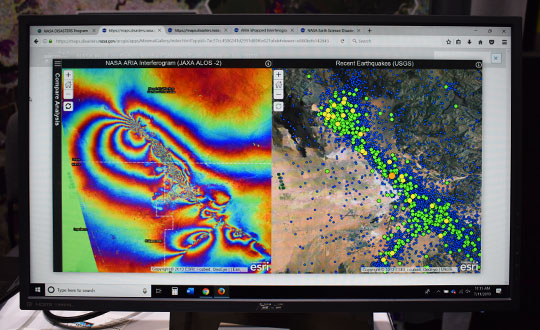
    For example, the NASA Disasters Program was able to map out the magnitude 6.4 July 4 Southern California earthquake.

    “The earthquake that happened on July 4 caused a lot of deformation to the ground, so we mapped out that surface deformation and shared that information with other emergency managers, the Federal Emergency Management Agency, National Guard and U.S. Navy,” Kirkendall said. “You can look at things like roads, utilities, underground pipes for natural gas or geothermal wells, or fiberoptic cables. Then when you provide the product to these end users, they can overlay it with utility and infrastructure information to identify what’s the most at risk and what needs to be investigated.”

    Sometimes, when a natural disaster occurs over a longer period of time, data is mapped throughout the duration of the occurrence, as well. This can help with search-and-rescue missions, infrastructure repairs and post-disaster analysis.

    “We will create products during responses that can last a long time, like for Hurricane Florence or the flooding that recently happened in the Midwest,” Kirkendall said. “We’ll keep turning out flood products day after day when there’s good satellite passes that show that information.”

    Kirkendall added that the National Guard has used the live data, along with 911 calls, to find individuals trapped in flooded houses. The data also serves as a tool for post-disaster analysis to understand where damage occurred, ways to fix it and how to prevent it from happening again.

    “The program itself is gearing toward a resiliency effort, where we can provide these products when communities says, ‘We get flooded here all the time, over and over,’” Kirkendall said. “That’s where we need to be prepared to fix something. We need to do something to prevent that.”

  • NGAUS 2015: National Guard Leaders Meet to Learn and Confer

    Art_NGAUS_still

    Three weeks ago I attended the National Guard Association of the United States Conference (NGAUS 2015) in Nashville, Tenn. Few people understand that — unlike the U.S. Army and Air Force, which are under direct federal control — each state has its own National Guard organization under the control of the individual state governors. They serve as the state’s local militia responding to disasters and civil unrest as directed by the governor.

    The National Guard is also part of the reserve components of the United States Armed Forces, and in that capacity many National Guard units have been called up to serve in overseas operations alongside their active duty counterparts such as in the Mideast. This dual control leads to countless discussions regarding Title 10 or Title 32 funding and jurisdiction.

    Additionally, the National Guard is administered by the National Guard Bureau (NGB), which is the communications channel between the states and the departments of the Army and the Air Force. NGB is headquartered in Washington, D.C., and is a joint activity of the Army and Air Force. NGB provides policies, training requirements and, most important, funds for the state units. This makes the NGAUS annual conference much more than a social gathering. It’s an opportunity for the leadership of each state to learn and coordinate, to view new technology and share best practices. It’s also an opportunity to provide official feedback to NGB regarding policies and all-important funding.

    Behind-the-Scenes History. A panel discussion I found especially fascinating was the Joint Domestic Operations session. One of the speakers was the former chief of the NGB, retired Lt. General H. Stephen Blum. General Blum was the NGB chief during Katrina, and shared some behind-the-scenes discussions he had with President Bush as Katrina unfolded. We now know that the New Orleans mayor delayed giving the order to evacuate the city, resulting in thousands stranded and hundreds dead. You may remember the photo of more than 100 school buses that went unused and ultimately flooded and unusable. The governor also delayed the order to evacuate, and the request for outside help from other National Guard units and the federal government.

    Anxious about the growing disaster, president Bush’s cabinet was pushing him to federalize the National Guard and take charge of the situation. However, General Blum was the single voice against federalization, telling the president that if you seize charge now you will “own the whole problem forever.” Fortunately, the call for help soon came from the Louisiana Governor, and military and National Guard action was almost immediate. General Blum was able to proudly draw the president’s attention to the TV news feed showing the military in action with the under caption “The Cavalry arrives!”

    Conference Exhibitors. The NGAUS conference is held in a different state each year. Last year it was in Chicago, and next year it will be in Baltimore. Although this is not a geospatial-centered event, a number of exhibitors and sessions involved geospatial topics, with the following being good examples. I was able to shoot video clips of some of the exhibitors, since seeing technology in action is always more informative than just writing about it.

    Esri. For years Esri ArcGIS has been the most common GIS platform used by most states. Several years ago, MajGen William Reddel, Adjutant General of New Hampshire, arranged to consolidate dozens of ArcGIS licenses to one enterprise license for all National Guard units. This greatly simplified GIS software procurement and saved taxpayers thousands.

    ForeFlight. For years you may have seen pilots dragging large document cases through the airport. These contained countless paper maps, charts and documents required for the safe navigation of aircraft. Finally, after years of work and the incorporation of digital content that many of you created, the FAA has approved electronic flight bags. See what they look like in this video.

    ForceX. ForceX and Z Microsystems have numerous tools to register and incorporate full-motion video and imagery into geospatial environments. See their technology in this video.

    Rapid Composites. Rapid Composites builds high-end UAVs for the military and first responders.

    As a UAV user myself (DJI Inspire 1), I’m especially interested in the proposed UAV impact tests that will be conducted by the FAA starting in October. Currently, the FAA authorizes the commercial use of drones up to 55 pounds in non-restricted airspace. However, there is a growing concern that a “Sully on the Hudson” incident could severely curtail drone use. The Mississippi State-led Alliance for System Safety of UAS through Research Excellence (ASSURE) will be doing such testing in conjunction with the FAA. ASSURE will test the effect of UAV impact on aircraft windshields, control surfaces and engines.

    Knowledge Center. The Knowledge Center has an overarching system that manages assets and personnel for first responders. See their system in operation.

    Other exhibitors included Soft Power Solutions LLC, which displayed a geospatial-based personnel and asset management system, and Ball Aerospace, which showed off its new compact real-time 3D collection system that I previously wrote about. The new system has been redesigned to be under 12 pounds and suitable as a payload for many military UAVs.

  • KEYW Unveils Aeroptic Aerial Mapping System at National Guard Conference

    Aeroptic-law-enforcement-bostonThe KEYW Holding Corporation’s subsidiary, KEYW Corporation, will formally unveil the Aeroptic Mapping System August 22-25 at the 2014 National Guard Association (NGAUS) Conference & Exhibition in Chicago. With a 10-year legacy of mapping around the globe, Aeroptic is a fully integrated airborne solution that provides high-resolution, wide-area map data for both civilian and military applications.

    “Aeroptic is a commercially available mapping system that supports every mission in which the National Guard engages, ranging from incident assessment and disaster response in Domestic Operations (DOMOPS) to reconnaissance and situational awareness on the OCONUS battlefield,” said Kevin Gunde, executive vice president, Surveillance and Exploration Systems. “Aeroptic can be deployed on a variety of fixed- and rotor-wing platforms, including the National Guard UH-60 Blackhawk.”

    KEYW developed the Aeroptic solution with image quality, positional accuracy and ease of use in mind. The system integrates a full-color electro-optical (EO) camera, GPS/IMU, and user-friendly geo-processing software based on non-proprietary open standards. The system is compact, light-weight and ruggedized for deployment in harsh environments.

    The rapid-refresh EO camera captures imagery of extraordinary quality by employing advanced noise reduction, image sharpening algorithms and high-end lenses with innovative configurations, the company said. The interchangeable lenses offer multiple focal length options that enable the Aeroptic camera to acquire high-resolution visible-band imagery with sub-meter geo-positional accuracy from varying flight altitudes without surveyed ground control points.

    Aeroptic offers the option of processing imagery in the air or on the ground, producing unclassified, wide-area ortho-mosaic maps in near real time. Generated imagery products are ready for immediate ingest into standard commercial viewing tools and GIS packages.

    “No expertise in GIS or cartography is needed to make full use of the Aeroptic system,” said Kevin Gunde, executive vice president, Surveillance and Exploration Systems. “With just eight hours of training, the typical user can produce content-rich image maps ready for distribution within minutes after acquisition.”

    KEYW will be discussing the Aeroptic Mapping System and its many mission applications in booth #512 at the NGAUS General Conference & Exhibition being held August 22-25, 2014, in Chicago’s McCormick Place.