Tag: National Instruments

  • M3, Averna join to test auto infotainment

    M3, Averna join to test auto infotainment

    Averna AST-1000.
    Averna AST-1000.

    Averna has entered a strategic partnership with M3 Systems to distribute M3’s StellaNGC GNSS Simulator on National Instruments’ VST platforms for the infotainment segment of the automotive market.

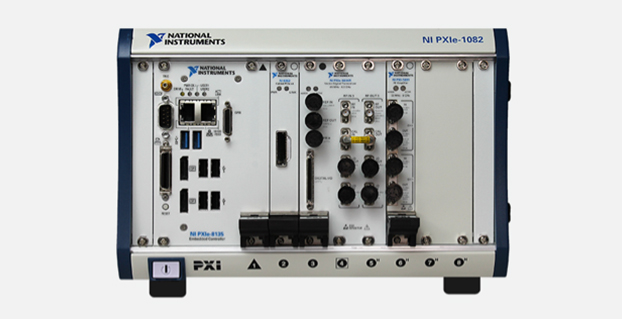
    M3 Systems’ GNSS simulator, based on National Instruments’ Vector Signal Transceiver (NI VST), will now be available as part of Averna’s AST-1000 platform, extending its capability to navigation and GNSS testing.

    Launched in July 2016, the AST-1000 is an RF solution designed for radio, navigation, video and connectivity testing. Also based on the NI VST, the software-defined AST-1000 supports all common infotainment RF signals, including AM/FM, DAB, RDS, HD Radio and Sirius/XMas, as well as GNSS navigation.

    The combination provides a comprehensive solution and enables unprecedented applications for the testing of infotainment systems.

    M3 Systems’ GNSS simulator is a good fit to extend the capability of the AST-1000 for navigation testing because both instruments are based on the NI VST, the companies said.

    Averna is aiming for an all-in-one platform for the complete validation of infotainment systems, including radio, navigation, audio/video and connectivity testing.

    The Averna AST-1000 is available to customers worldwide.
  • M3 Systems Announces Simulator Based on Vector Signal Transceiver

    M3 Systems Announces Simulator Based on Vector Signal Transceiver

    StellaNGC_Simulator-O

    M3 Systems is now offering the StellaNGC multi-constellation GNSS simulator based on the National Instruments (NI) vector signal transceiver.

    The simulator is designed for the testing of satellite navigation receivers for GPS, GLONASS, Galileo, and EGNOS/WAAS. It is designed to improve performance, scalability, and versatility, and reduce cost over existing navigation test solutions.

    GNSS is the predominant technology today for navigation and outdoor positioning. However, given the weakness of GNSS signals, receiver performance is often affected by interference from the local environment and propagation channel conditions. Understanding the effects of this interference is of particular importance not only for existing GNSS signals but also for future signals that will appear with the deployment of new constellations such as Galileo.

    To properly characterize receiver performance under varying conditions, the StellaGNC multi-constellation GNSS simulator provides signal generation, signal recording and replay, interference generation, signal and data processing, and complete analysis tools. The StellaNGC simulator is based on the NI vector signal transceiver in PXI for improved performance and full simulation capabilities. For record and playback only, a scaled-down version is also available based on the NI USRP (Universal Software Radio Peripheral). Both options were developed with NI LabVIEW and benefit from the performance and flexibility of the NI RF platform.

    The simulator provides a scalable solution that allows easy signal additions through software upgrades, multi-frequency, processing extensions with the addition of FPGAs with NI FlexRIO, and an HDD extension for storage increase. Because the simulator is based on the open PXI standard, the hardware investment can also be extended to other applications, such as simulation, record and playback, or payload simulation.


  • National Instruments Launches GPS Time-Stamping and Synchronization Module


    National Instruments has announced the NI 9467 GPS synchronization module, which accurately synchronizes a large-scale CompactRIO system with features such as data time-stamping and system clock setting.

    The NI 9467 is one of six new C Series modules designed for NI CompactRIO embedded control systems and NI CompactDAQ modular data acquisition systems. By expanding the C Series platform, NI provides engineers and scientists with new and improved options for a wide variety of embedded control, monitoring and data acquisition applications. Channel counts on the individual modules range from three to 32 channels to accommodate a wide range of system requirements, and the majority of C Series modules work in both the NI CompactDAQ and CompactRIO measurement platforms with no modification.

    “We rely on National Instruments hardware and software to provide the rugged, distributed control we need for our wind turbine system,” said Jonathan C. Berg, mechanical engineer at Sandia National Laboratories. “The site-wide architecture uses NI VeriStand and the NI 9467 GPS module to choreograph all of the data acquisition and control operations.”

    “This is the largest C Series module release in several years, reflecting our ongoing commitment to expanding the NI LabVIEW RIO architecture,” said Jamie Smith, director of industrial embedded marketing at National Instruments. “At NI, we constantly innovate and build upon our systems to help engineers simplify development.”

    Features of the NI 9467 include:

    • Pulse per second (PPS) accuracy of ±100 ns, >99 percent typical
    • SMA female antenna connector type (antenna sold separately)
    • +5 VDC (up to 30 mA) for active GPS antenna
    • Returns stationary global position after self-survey (module does not work for mobile applications)
    • NI CompactRIO support only
    • NI recommends using the NI 9467 with the NI FPGA Timekeeper.