Tag: navigation payload

  • L3Harris delivers eighth GPS III navigation payload

    L3Harris delivers eighth GPS III navigation payload

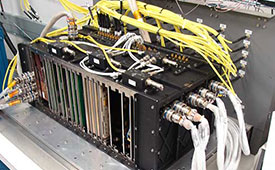
    The Harris-supplied navigation payload before integration into the second GPS III SV. (Photo: Harris)
    The Harris-supplied navigation payload before integration into the second GPS III SV. (Photo: L3Harris)

    As the U.S. Air Force prepares to launch its second next-generation GPS III satellite, L3Harris Technologies delivered its eighth navigation payload to GPS III satellite prime contractor Lockheed Martin.

    The first GPS III satellite launched in December 2018 and its navigation payload has performed beyond expectations on-orbit during pre-operational testing, L3Harris said in a press release.

    In May, the Air Force declared the third GPS III satellite Available for Launch, pending a launch date. L3Harris payloads are also already fully integrated in the GPS III 4-6 space vehicles currently in production and testing at Lockheed Martin.

    The GPS III navigation payload features a mission data unit (MDU) with a unique 70-percent digital design that links atomic clocks, radiation-hardened processors and powerful transmitters — enabling signals three times more accurate than those on current GPS satellites. The payload also boosts signal power, which increases jamming resistance by eight times and helps extend the satellite’s lifespan.

    In 2017, L3Harris announced that it completed development of an even more-powerful, fully digital MDU for the Air Force’s GPS III Follow On (GPS IIIF) program. The new GPS IIIF payload design will further enhance the satellite’s capabilities and performance.

    In September 2018, the U.S. Air Force selected Lockheed Martin for a fixed-price-type production contract for up to 22 GPS IIIF satellites. L3Harris is Lockheed Martin’s navigation signal partner for GPS IIIF satellites, and in January received a $243 million award to provide the navigation signals for the first two GPS IIIF satellites, space vehicles 11 and 12.

    L3Harris’ expertise in creating and sending GPS signals extends back to the mid-1970s — providing navigation technology for every U.S. GPS satellite ever launched. While the Air Force originally developed GPS for warfighters, millions of people around the world and billions of dollars of commerce now depend on the accurate, reliable signal created and sent by L3Harris navigation technology.
  • First of Batch 3 Galileo payloads delivered with evolved clocks

    First of Batch 3 Galileo payloads delivered with evolved clocks

    Galileo is on the march with a new generation of satellites bearing improved atomic clocks. The first of the Batch 3 navigation payloads was delivered in June by Surrey Satellite Technology (SSTL) in the UK to OHB System AG in Bremen, Germany.

    SSTL’s payload for Batch 3 is a recurrent build of the existing FOC payload, with an evolution of the atomic clocks to incorporate advances made under the European GNSS Evolution Programme. The earlier SSTL Galileo FOC payload comprised different units including European-sourced atomic clocks, navigation signal generators, high power traveling wave tube amplifiers and antennas.

    The new payload will be integrated aboard the satellite platform Galileo FOC FM23, named Patrick in honor of the winner of a drawing competition. Payload integration will be followed by a series of comprehensive test activities. Patrick and its next youngest sibling satellite of this series are scheduled to be ready for launch in autumn 2020.

    “We are looking forward to this first ‘marriage’ of a Batch-3-payload and platform and are ready to start Patrick’s test sequence soon,” said Lars Peters from OHB System AG, in charge of the Assembly Integration and Test for the satellites at eleven production islands where one satellite is completed every five weeks.

    “The ambitious schedule means that looking forward reserve satellites will be available both in orbit and on the ground,” added Dr. Wolfgang Paetsch, a member of the OHB System AG Management Board responsible for navigation, Earth observation and science.

    Paetsch received a PNT Leadership Award from GPS World magazine in 2017. At that time, Paul Verhoef of ESA, accepting on behalf of Paetsch, stated:

    “Of course we are waiting a bit to see what the real lifetime of the satellites is going to be. We don’t know that yet but we will find out in the next couple of years. Obviously there is a lot of pressure for further innovation, for further improvements. The user community over the last couple of years has become more outspoken about what they want and what they expect, which is nice. Obviously we need to take care of the legacy users, and we are having to see what new technology would allow us to do.”

    OHB System AG has contracted to deliver a further twelve satellites of this Batch 3 for Galileo. This will bring to 34 the number of Galileo satellites being supplied by the SSTL-OHB partnership. Of these, 14 are already in orbit.


    Feature photo: The satellite Patrick, first of Galileo’s Batch 3, will eventually travel from OHB to ESA’s ESTEC technical centre (shown here) in Noordwijk, the Netherlands for rigorous testing in simulated space conditions. (Photo: European Space Agency)

  • Harris Corporation delivers fifth GPS III satellite navigation payload

    Harris Corporation delivers fifth GPS III satellite navigation payload

    Harris Corporation has provided Lockheed Martin with its fifth of 10 advanced navigation payloads contracted for the U.S. Air Force GPS III satellite program.

    The GPS III navigation payload features a Mission Data Unit (MDU) with a 70-percent digital design that links atomic clocks, radiation-hardened computers and powerful transmitters — enabling signals three times more accurate than those on current GPS satellites, the company said.

    The payload also boosts satellite signal power, increases jamming resistance by eight times and helps extend the satellite’s lifespan.

    Lockheed Martin successfully integrated the navigation payload into the fifth GPS III space vehicle (GPS III SV05). Harris is committed to delivering three more payloads by the first quarter of calendar year 2019 for GPS III SVs 06-08.

    Four navigation payloads have already been fully integrated on GPS III SV01-SV04. In September 2017, the Air Force declared the first GPS III satellite Available for Launch (AFL) with launch expected later in 2018.

    In December 2017, GPS III SV02 completed rigorous thermal vacuum testing and is expected to be declared AFL this summer. GPS III SV03 and SV04 are expected to undergo environmental testing this year.

    In November 2017, Harris announced that it completed development of an even more-powerful, fully digital MDU for the Air Force’s GPS III Follow On (GPS IIIF) program. The new GPS IIIF payload design will further enhance the satellite’s capabilities and performance for the Air Force.

    Harris’ expertise in creating and sending GPS signals extends back to the mid-1970s — providing navigation technology for every U.S. GPS satellite ever launched. While the Air Force originally developed GPS for warfighters, millions of people around the world and billions of dollars of commerce now depend on the accurate, reliable signal created and sent by Harris navigation technology.

  • Harris delivers navigation payload for third GPS III satellite

    Harris delivers navigation payload for third GPS III satellite

    Harris Corporation has delivered the third of 10 advanced navigation payloads to Lockheed Martin, which will increase accuracy, signal power and jamming resistance for U.S. Air Force GPS III satellites.

    The navigation payload before integration into the second GPS III SV, which now is in environmental testing. (Photo: Harris)

    The advanced navigation payloads feature a Mission Data Unit (MDU) with a unique 70-percent digital design that links atomic clocks, radiation-hardened computers and powerful transmitters — enabling signals three times more accurate than those on current GPS satellites.

    The new payloads also boost satellite signal power, increase jamming resistance by eight times and help extend the satellite’s lifespan.

    The payload is expected to be integrated into GPS III Space Vehicle 3 (GPS III SV03) this summer. In May, Harris’ second GPS III navigation payload was integrated into GPS III SV02.

    The first navigation payload is integrated aboard GPS III SV01, which has now completed rigorous testing and is in storage awaiting its expected 2018 launch.

    The MDU performs the primary mission of the GPS satellite, which is generation of the navigation signals and data that provide precise time information to users on a continuous basis. (Photo: Harris)

    “We are now in full production and on target to deliver the fourth GPS III navigation payload to Lockheed Martin this fall,” said Bill Gattle, president, Harris Space and Intelligence Systems. “Our payloads help U.S. and allied soldiers complete their missions, enable billions of dollars in commerce and benefit the everyday lives of millions of people around the world.”

    Harris has a long legacy of expertise in creating and sending GPS signals, extending back to the mid-’70s — providing navigation technology for every U.S. GPS satellite ever launched.

    Harris is also developing a fully digital MDU for the U.S. Air Force’s GPS III Space Vehicles 11+ acquisition. This new MDU will be demonstrated in fall 2017 and provides even greater flexibility, affordability and accuracy versus existing GPS satellites.

    Harris navigation payloads are already integrated in the second GPS III space vehicle, now in environmental testing, and the first GPS III satellite (pictured here), expected to launch in 2018. (Photo courtesy Lockheed Martin)
  • SSTL delivers 22nd — and final — Galileo FOC payload

    SSTL delivers 22nd — and final — Galileo FOC payload

    Surrey Satellite Technology Ltd (SSTL) has delivered the 22nd Galileo navigation payload to prime contractor OHB System in Bremen, Germany. This is SSTL’s final payload under Galileo Full Operational Capability (FOC) Works Orders 1 and 2.

    SSTL’s FOC payload is based on European-sourced atomic clocks, navigation signal generators, and high-power traveling wave-tube amplifiers and antennas. It will provide Galileo’s navigation, positioning and timing services.

    As payload prime contractor, SSTL is responsible for the development, assembly, integration and test of 22 navigation payloads. The first Galileo FOC payload was delivered to OHB in 2012, and since then payloads have continued to roll off the production line at SSTL, with a delivery schedule of approximately one every six weeks.

    On May 12, SSTL held an event to mark the occasion, and to celebrate the achievement with the contributors and supporters of the FOC payloads work. Katherine Courtney, chief executive of the UK Space Agency, attended the event and remarked ,“Satellite navigation is an important part of the UK space industry success story and we are at the forefront of innovation in technology and services. Every FOC payload for the Galileo constellation — the beating heart of each satellite — has been built here in Guildford and the completion of this 22nd payload is a significant milestone which should be celebrated. We remain fully committed to the success of the Galileo programme, and look forward to the start of initial services later this year.”

    SSTL’s FOC payload comprises different units that have been manufactured by a European supply chain. The modular design of the satellite enables SSTL to assemble the payload units onto three panels for delivery, fully tested, to OHB in Bremen.

    The last of the payloads in these two batches has now completed its journey through production and test at SSTL and has been delivered to Germany, where a team of SSTL engineers will assist OHB engineers with integration to the spacecraft platform.

    SSTL's Galileo FOC payload under production. (Photo: SSTL)
    SSTL’s Galileo FOC payload under production. (Photo: SSTL)

    “The completion and delivery of the 22nd payload for FOC marks another milestone for SSTL, and I must pay tribute to the talented and dedicated FOC team here who have worked tirelessly to keep the production line rolling for the past four years,” said John Paffett, director of Telecommunications and Navigation at SSTL. “We are extremely proud of our contribution to Europe’s new navigation system, and we are all looking forward to the day that the new service comes on stream, and we can start using it in our daily lives.”

    “SSTL has been a reliable partner of the Galileo venture since GIOVE-A,” said aul Verhoef, director of Galileo Programme and Navigation at the European Space Agency. “I wish to thank all SSTL staff for their extremely valuable contribution.”

    The subcontractors for SSTL’s Galileo FOC navigation payload are Airbus Defence and Space, Finmeccanica, Spectratime, Kongsberg Norspace, Rymsa, TAS-I, Tesat, Ruag, Mier, ComDev (Honeywell), and Siemens. Testing facilities were provided at Airbus Defence and Space and RAL Space.

    The next launch of a pair of Galileo FOC spacecraft is scheduled for May 24 on board a Soyuz launcher from Kourou in French Guiana. Twelve Galileo satellites are already in orbit, and a second launch of four spacecraft is planned for later this year, bringing the total of 18 Galileo satellites in orbit by the end of this year.

  • GPS III navigation payload to be all digital

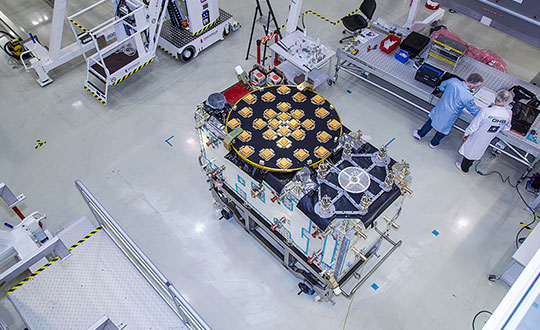
    The first GPS III satellite in accoustic testing. (Photo: Lockheed Martin)
    The first GPS III satellite in accoustic testing. (Photo: Lockheed Martin)

    Harris Corporation will offer an all-digital navigation payload for GPS III Space Vehicles (SV) 11 and beyond.

    According to Harris, the fully digital navigation payload will provide enhanced performance and enable on-orbit reprogramming. The all-digital payload expands on the advanced features of the current 70-percent digital payload that Harris provides for Lockheed Martin’s GPS III SV 1-8 satellites.

    The features provide greater flexibility, affordability and accuracy compared to existing satellites and include an advanced modular design, atomic clock timing systems, radiation-hardened computers and powerful transmitters.

    The new payload combines innovative digital capabilities developed by Harris and Exelis, now a part of Harris. In 2013, Exelis successfully demonstrated digital navigation signal capability in a formal preliminary design review conducted by the Air Force.

    The payload also leverages the mature Technology Readiness Level 9 legacy Harris reconfigurable payload that is flying on the International Space Station and is incorporated on hosted payloads for the Iridium NEXT satellite.

    Harris has more than 500 digital processors on-orbit and another 150 awaiting launch. Harris navigation payloads have been on all of the 80-plus U.S. GPS satellites launched since the 1970s, with more than 750 years of on-orbit life without a payload-related failure. Harris has delivered more than 100 digital payloads, which have performed flawlessly on-orbit, the company said.

    Harris will provide a fully digital payload for GPS III satellites beginning with SV11. Shown is SV1 in testing. (Photo: Lockheed Martin)
    Harris will provide a fully digital payload for GPS III satellites beginning with SV11. Shown is SV1 in testing. (Photo: Lockheed Martin)