Tag: Navteq

  • German automakers complete HERE acquisition

    Kevin Dennehy
    Kevin Dennehy

    In what was 2015’s largest location-industry deal, three German luxury auto manufacturers completed the purchase of HERE. But that wasn’t the only recent acquisition as location-based services provider TeleCommunication Systems, or TCS, was bought by Comtech Telecommunication Corp. Both deals indicate the growing, and continued growth, of location services going forward into 2016.

    Three German automakers are now in the location business following the finalization of a $2.8 billion deal to buy Nokia’s HERE digital mapping company last week. Audi, BMW and Daimler are now equal owners of HERE following quick regulatory approval.

    While some say there was much Nokia-driven hype about who was bidding on HERE, including Uber and Baidu, ultimately others breathed a sigh of relief that automotive companies, not Google, bought the digital mapping pioneer.

    The deal, which was originally announced in early August, shows the continued value of accurate maps to the automotive industry as it transitions for connected to autonomous vehicles. In addition, the number of big suitors interested in HERE shows the rise in the potential and real market for location-based services in both smartphones and connected vehicles.

    Many of the early suitors balked at HERE’s early price tag, estimated to be more than $4 billion. Uber, which some felt would be a good match for HERE because of their autonomous vehicle intentions, decided to go in another direction, buying mapping company deCarta.

    While it’s too early to analyze the consequences of the deal, some analysts say it will be interesting to see if the new owners keep the mapping giant neutral to not alienate future clients.

    It remains to be seen whether its competitor, TomTom, which also has been talked about as an acquisition target, should stay as an independent company or form its own consortium.

    Nokia purchased HERE, the former Navteq, for $8 billion in 2007. The sale of HERE is part of Nokia’s transformation as it completes its $16.6 billion acquisition of Alcatel-Lucent, which is expected to close early next year.

    In another big deal since our last column, Annapolis, Md.-based TeleCommunication Systems was acquired by Comtech Telecommunication Corp. for $430.8 million deal. The deal is expected to close in March 2016.

    TCS was one of the first companies to do it all in the consumer location space, buying entities in automotive navigation and also making inroads in the fleet management and indoor positioning/9-1-1 space. The company most recently was developing location technology for mobile, or m-health markets.

    Cyber Security Big Connected Vehicle Concern in 2015

    As we review the past year, one of the biggest connected vehicle trends in 2015 was when cyber security became real for the automakers, said Jon Allen, Booz Allen Commercial Solutions principal.

    “Just as automakers are increasingly demonstrating the power of automation, their momentum is challenged by researchers showing they really can hack into vehicles. While there are engineering challenges ahead to realize the full potential of autonomy, the priority in automotive is to protect the trust of customers and regulators as autonomous capabilities are further developed,” he said. “That puts cyber at the top of the agenda.”

    2016, OEMs will need to further embrace a security mindset, Allen said. “These [cyber risk] issues are solved by designing, engineering and testing your vehicle to meet defined standards. But cyber risk has an outside variable you can’t control: cyber threat actors. This means you’re not just engineering a solution — you’re fighting an adversary,” he said.

    Allen said that automakers need to identify a single leader to champion vehicle cyber security, supporting them up with an integrated, cross-functional team. “That includes experts from safety, privacy, IT, legal, engineering, manufacturing, customer service and supply chain,” he said.

    Autonomous vehicles tout a safety record that far surpasses today’s cars, but a cyber incident has potential to reverse that claim, Allen said. The “doomsday” scenario is attacking multiple vehicles over the air to “brick” multiple platforms, but this may be an unlikely near-term scenario, he said.

    “The near-term attacks will be motivated by money. That’s why many of the largest hacks were designed to exploit personal and financial information,” Allen said.

    At a Colorado Space Roundup meeting in Denver last week, Thad Allen, former Coast Guard commandant and now executive vice president at Booz Allen Hamilton, said that there won’t be a “cyber Pearl Harbor” as the government and civilian entities should have had plenty of warning it was coming. Allen, who was in Denver working on the GPS Operational Control System, or OCX, also said that it would be catastrophic if the GPS infrastructure was compromised.

    “If someone does something to disrupt GPS, it will affect everyone,” said Allen, who oversaw the Hurricane Katrina and Deepwater Horizon oil spill operations.

    Indoor Positioning’s Big Story in 2015: Consumer Appliances?

    While there were several significant tests and infrastructure rollouts, at least one analyst says the rise of indoor positioning in consumer appliances was huge. Bruce Krulwich, Grizzly Analytics founder, said that such companies as Move ‘n See are putting location chips into electronic devices.

    Move ‘n See also has a camera robot, called Pixio, which follows a person moving around a sports field or other indoor site. “What’s huge about this is not the product itself — it’s hard to tell whether it will appeal to the masses or only a niche market–but I believe that it’s the first in a new trend of electronic products that enhance their capabilities by incorporating indoor location technology,” he said.

    In other location news:

    • CalAmp Corp. said it made a $113 million offer for LoJack Corp., which is a pioneer in car theft-recovery using location technology. According to published reports, CalAmp has made three cash offers for Lojack in the past 14 months. LoJack’s car recovery systems use location technology, which seems to be a great fit for CalAmp, which offers fleet tracking software.

    It’s been a good run. After eight-and-a-half years, this is my last Wireless LBS Insider column. Many thanks to Alan Cameron and Tracy Cozzens, both seasoned journalists, who steered me on the right course over the years. I will be at CES in a freelance role next month and will continue to operate my autonomous vehicle conference, Driverless.


  • A Milestone in Digital Mapping

    Janice Partyka
    Janice Partyka

    Editor’s Note: Janice Partyka is principal of JGP Services, a consulting practice. She is GPS World’s editor for wireless, writing a monthly column for the Wireless LBS Insider newsletter. The views expressed are her own.

    Hard to believe, we have only now reached the 10th anniversary of Google Maps. As important as digital maps have become, their purpose is much the same as the printed and drawn maps that preceded them. Digital maps emerged in the 1960s with the Census Bureau’s DIME maps. These first digital maps were used for analysis of place-specific data, such as populations within census tracts or cities. Digital maps in turn led to geographic information systems (GIS) for spatial analysis. Though GIS had uses in fields like city planning, the main stimulus for digital maps came in the 1990s with the convergence of the completion of GPS infrastructure, and affordable and portable computers.

    Naturally, just knowing where you are doesn’t have huge value, but if that information can be fused with a digital map, which could generate a route to the destination of your choice, or access information on the places that surround you, then you have something. This is why companies like Etak, Tele Atlas and Navteq began the painstaking process of converting satellite images, printed topographic maps and data that could only be observed with one’s eyes (such as street signs, addresses, speed limits, and turn restrictions) into digital form.

    One of my projects during the 1990s was to compare the accuracy of competing digital maps. It was a tedious process, entailing two-person driving crews traveling each street. The passenger recorded all relevant information and made periodic readings with a large, costly GPS receiver. At the time, digital maps could only be accessed by complicated GIS programs which restricted their usefulness.

    Since then, digital maps have grown in significance due to the advent of smartphones, a growing suite of digital-map-enabled applications, and of course Google Maps. Google has made maps friendlier to developers through its application program interfaces (APIs), which also improved the user experience for scrolling across locations from a map view.

    Google has mastered the process of data capture from roadways. Rather than rely on the eyes of people in the field, sensors and cameras collect mapping data. Image-processing software extracts and geo-codes textual data, automating and enhancing map creation. And Google has incorporated overhead and street-level photographic images into maps, adding substantial value.

    We will never arrive at having a perfect digital map. The work to keep mapping accurate and give it more context will be ongoing. The next challenge in digital mapping is making it work offline and creating accurate maps of the indoors. These next innovations will not be led by GPS, but by sensors, including beacons. GPS has already done the heavy lifting.

  • Nokia’s Mapping Business Has Options, Issues

    Kevin Dennehy
    Kevin Dennehy

    In the wake of Microsoft’s recent purchase of Nokia’s mobile phone business, the Nokia unit formerly known as Navteq, and now know as HERE, has opportunities, but also a hard-to-guess future. At least one industry analyst believes that Navteq/HERE was not included in the Microsoft deal because it was too expensive.

    “While much ado has been made of the Nokia/Microsoft deal in the press, I was interested in why Mr. Softy did not acquire Navteq/HERE with the other assets of interest. There are several possibilities to explain this omission,” said Mike Dobson, TeleMapics president.  “First, it could be the case that Nokia did not want to sell Navteq/HERE. Second, it is possible that Microsoft had no interest in acquiring its current map database supplier. Third, maybe the price for Navteq/HERE was too high. My vote is for number three.”

    Dobson said that Nokia clearly would like to sell HERE, as it does not fit with the company’s profile, growth strategies, or competencies, on a going-forward basis.  “Just as Navteq was not a good fit for Nokia in 2007, it is now a less comfortable fit for the reconstituted company, which is being focused on network infrastructure services,” he said.  “Conversely, I suspect Microsoft was ambivalent about a deal that included [Navteq/HERE].”                           Under the proposed Nokia/Microsoft deal, Nokia’s mapping assets are to be licensed for a four-year term by Microsoft, which gives them time to firm up their future strategy for spatial data.  Note that the price of the license for the mapping products was not part of the $7.1 billion transaction, Dobson said.

    “Why was Mr. Softy gun shy? First, I suspect that Microsoft concluded that owning a mapping company was not core to any of Microsoft’s current initiatives, including its bumbling approach to location and connected car services,” Dobson said.  “Next, Microsoft has enough problems competing with companies in its distribution chain, without adding another business that would serve to complicate its relationship with manufacturers and resellers. Of course, all of these objections could have been overcome if the price was right, it wasn’t, but that does not mean it won’t be in the future.”

    Where Does Navteq Go from HERE?

    Dobson says Navteq, Nokia and HERE are in a world of pain. “While the ‘new’ Nokia will have the ability to fund all of the development to enhance the Navteq database that it has deferred over the past five years, I think it is unlikely to do so. Nokia does not appear to understand the fundamentals of the location market, the automotive navigation market, or the connected car market,” Dobson said.  “Perhaps most importantly, they have lagged Google in evolving their map compilation process into a modern, synergistic, information sourcing engine. The Navteq approach to crowdsourcing hinders their potential speed to market with updated map information and has allowed Google to reach parity with Navteq in some areas, while exceeding it in quality in other markets.”

    The future battleground in the location markets will devolve into a scarp for ownership of the last mile, Dobson said.  “The type of thinking that believes that the ‘last mile’ is all about road geometry, simply does not understand the problem. People want to know that the map will support their journey to a destination, but they are focused on the destination and the various opportunities that it presents,” he said.  “For example, the mobile phone has promoted an egocentric view of the world focused on ‘what’s around me?’  Providing the spatial detail of the total environment that surrounds the user is key to winning the last mile battle and I do not see Nokia having the assets to participate in this market.”

    Nokia announced that HERE, at the recent Frankfurt Motor Show, partnered with Mercedes Benz, Continental Corporation and Magneti Marelli to offer connected products and services beyond navigation.  Nokia believes that connecting the car to the cloud is one of the biggest opportunities for the automotive industry.

    “Whether the concept of the connected car offers Nokia a lifeline is unclear. Connectivity may suck the spatial data out of the car and into phone based systems,” Dobson said.  “Others would argue that smart cars will require a detailed, highly accurate database of spatial information to manage the safety systems in the automobile of the future.  I’m not wise enough to predict the future, but I think the Nokia is going to have a rocky road with Navteq/HERE.”

    Dobson said that it is interesting that Microsoft has loaned Nokia 1.5 billion Euros in three tranches of convertible bonds.  “The bonds will be redeemed and netted against the deal proceeds, although the loan is not conditional on the deal closing, nor is Nokia obligated to exercise its option,” he said.  “However, it would appear that Mr. Softy and Nokia are not quite through with each other:  if Nokia exercises these options, Microsoft will become a shareholder in Nokia.”

  • Expert Advice: Cooperative Updates with Maps 2.0

    Oliver Kuhn, Skobbler
    Oliver Kuhn, Skobbler

    By Oliver Kühn, Skobbler

    Not so long ago, paper maps were a necessity in many walks of life. Today, they are increasingly a nostalgic novelty, to coin a term.

    It’s not difficult to understand why digital maps replaced their paper brethren. Digital maps are more accurate, more adaptable, and most importantly, in an increasingly real-time environment, much faster at making the appropriate updates and amends.

    Now, however, digital mapping finds itself at a crossroads. Crowdsourced navigation platforms like OpenStreetMap — affectionately referred to as the “Wikipedia of maps” — are forcing digital maps and the map-building process to evolve significantly. As a result, the future of mapping is now in the hands of location enthusiasts and everyday map users. These people are redefining what a map is, how data is sourced and utilized, and how much it can cost to harness that information both efficiently and effectively. Those of us who have been in this space for years can see the writing on the wall.

    Some, however, are eager to write off crowdsourced mapping. Corporate digital map providers, for instance, often refer dismissively to these mapping platforms as “hobby maps.” Nevertheless, they recognize the potential for change such innovation brings and are vulnerable to it.

    What potential? Consider the benefits attainable through a crowdsourced approach, in the following sections.

    Scalability

    As with any process, cost is critical. It is particularly core to building a digital map. Truth be told, the fewer dollars ultimately spent on a map’s construction, the more its long-term operational preservation and, through that, scalability can be ensured. Despite massive innovation in our field, collecting data and creating a usable international digital map is far from cost-effective or efficient today. Candidly, it is one of the clunkier processes in technology, perhaps because it appears compulsory.

    Look no further than Google, which spends billions of dollars a year to maintain its platform, yet we marvel at the huge scope of its operation. In truth, it is an effort in dire need of real streamlining. Google, via its recent acquisition of Waze, along with Navteq, TeleAtlas, and the like, leverage laser-enabled cars and high-tech backpacks that are astoundingly inefficient from a pricing standpoint, costing hundreds of thousands of dollars. Nokia’s Map Mobiles, for example, are each outfitted with more than $25,000 of computing equipment.

    To think this is sustainable in the long term, on an international level, is wrong. It will inevitably cripple a map’s quality and viability, with corporate providers choosing to limit global detail and upkeep to balance costs.

    For crowdsourced map platforms, this problem does not exist. They can and are scaling rapidly, without the exorbitant costs corporate players are used to — and tired of. These costs secondarily manifest in mapping service usage fees for third parties, as well as subscription costs for consumer navigaton products. For either use case (business-to-business or business-to-consumer) crowdsourcing delivers cost benefits traditional players cannot match. Again, this leads directly to scalability, with crowdsourcing the most enduring maps option.

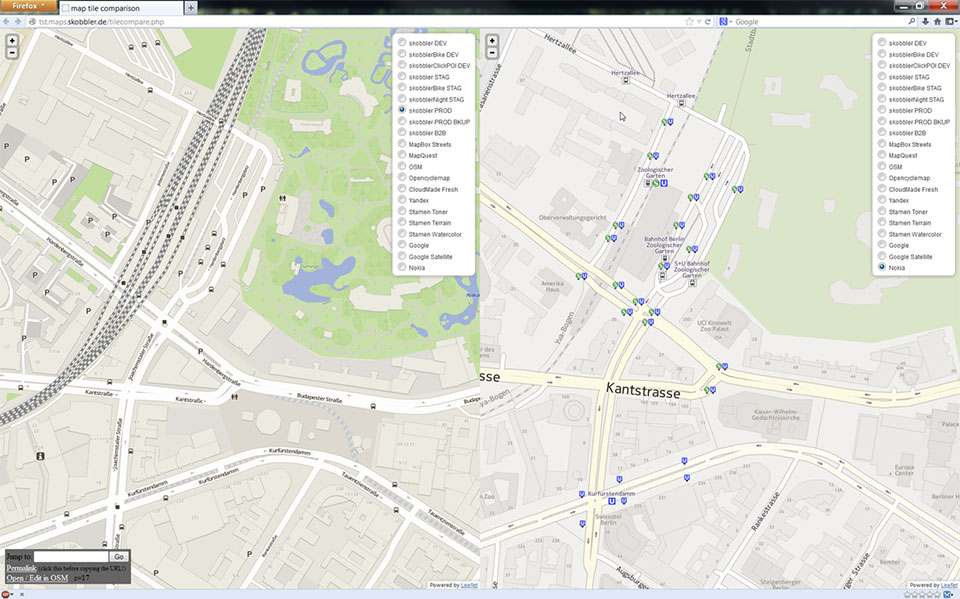
     Same time, same place — different look. Crowdsourced OpenStreetMap (left) and Nokia map (right) of central Berlin, Germany. Photo: Oliver Kühn
    Same time, same place — different look. Crowdsourced OpenStreetMap (left) and Nokia map (right) of central Berlin, Germany. Photo: Oliver Kühn

    Detail

    Crowdsourced mapping services and platforms like OpenStreetMap are more than just cost-efficienct tools to coax scale. As a crowdsourced dataset built using more than a million dedicated mappers, OpenStreetMap inherently delivers benefits above and beyond those obtained from corporate map providers like TeleAtlas and Navteq.

    The most visible benefit is the unrivaled map quality. With an army of contributors, the data dynamically and constantly evolves — just as places do. Locations are rarely fixed or stable. They change and progress over time. No other service or platform can immediately provide developers with the real-time, on-the-ground granularity of a crowdsourced map. Google and the others are trying, but the costs they incur will ultimately be too taxing to maintain detail.

    Firsthand influence carries equal weight. Mappers who edit an open-source map have often had personal interactions with a place or locale. They know places intimately, and this makes their contributions detailed, rich, and hyperlocal. More companies and developers are looking to OpenStreetMap for this reason: they want to future-proof their services and products, making sure that they always have the best and most up-to-date data. Only a platform like OpenStreetMap can do this. Corporate map providers are painfully aware of it, too.

    Flexibility

    Google owns Google Maps, and TeleAtlas owns its TomTom platform. Not surprisingly, this affects what a third party, whether an automotive company or a travel brand, can and cannot do with the service. It is essentially a copyrighted product like an MP3, an audio digital file. So, Google can limit the way you visually render and showcase its platform. Needless to say, this can be suffocating for those interested in building their own unique services. This is what makes crowdsourced mapping such a significant development for those interested in integrating additional data with a digital map. Do with OpenStreetMap what you will, visually or design-wise; there are absolutely no limitations. Every map can be made unique and rendered differently. This also speaks to the flexibility of crowdsourcing more generally.

    Beyond design, crowdsourced maps can harness the data to build completely new maps that cater to a specific concept, creating thematic maps for different uses, such as walking, hiking, bicycling, routes for those with disabilities, and more. More traditional digital maps lack this flexibility; it affords possibilities to source non-traditional location data to build even more accurate maps.

    The Future — Through Cars

    Despite the fact that crowdsourced maps are forcing digital mapping to adopt a more scalable, cost-efficient, detailed, flexible andaltogether long-term approach, digital mapping definitely has room to grow.

    One of the most exciting opportunities for crowdsourced maps specifically, and digital maps generally, lies in car user data, which is just coming into its own. Cars are obviously one of the largest travel tools utilized by individuals on a daily basis, and, with the advent of the connected car, the data that they collect via internal/external sensors has grown more nuanced, granular, and specific over the years.

    Cars are simply getting smarter, with sensors capable of providing everything from weather conditions to speed-zone information.

    Making this information available in the cloud and combining it with data available via crowdsourced mapping platforms produces remarkable possibilities for innovation.

    Imagine adding road-condition data, as just one example, to crowdsourced mapping services. By marrying a crowdsourced map with crowdsourced car-sensor data, the map’s overall utility multiplies immeasurably.

    To avoid missteps that have positioned companies like Google to spend billions on building a digital mapping service — unsustainable long-term figures — we must always look to embrace that which is cutting-edge. We find that today in crowdsourced mapping platforms, as they enable us to maintain, update, and enrich maps as never before. We must also consider the limitations of the cutting edge and understand how to improve the latest innovation (car-sensor data, and more) before the once cutting edge becomes the next paper map, so to speak. This is key to evolving maps for the better and for the future.


    Oliver Kühn has an MBA from the University of Cologne, Germany. He has 10 years of location-based service experience and was Head of Product Management Special Projects at navigation systems specialist Navigon AG (acquired by Garmin). In late 2008, he co-founded skobbler GmbH, being responsible for business development and legal matters. He is also a board member of the OpenStreetMap Foundation.

  • Google’s $1.1 Billion Purchase of Waze Under FTC Scrutiny

    Google’s $1.1 Billion Purchase of Waze Under FTC Scrutiny

    Kevin Dennehy
    Kevin Dennehy

    In a year of ho-hum location deals, or the lack of any, the recent Google purchase of Waze for more than $1 billion is a big one. In fact, readers of GPS World magazine’s LBS Insider would have to go back to the summer of 2007, when TomTom purchased Tele Atlas and Nokia bought Navteq, to find an industry acquisition as big as this one.

    The Federal Trade Commission is reviewing Google’s $1.1 billion acquisition of Israel-based mapping startup Waze, according to published reports.  The big issue is that while Waze’s revenue was too low to trigger automatic review by the FTC, it may have hundreds of millions of users worldwide.

    The fact that Google’s acquisition of Waze has caught the FTC’s attention is not unusual, said Mike Dobson, TeleMapics president, who authors a location industry blog at www.telemapics.com. “Google, in an attempt to speed the acquisition, declared that the assets of Waze based in the United States are worth less than the $70.9 million that requires an antitrust review. Google maintains, and I agree, that the majority of the [intellectual property] for which they were willing to pay $1 billion was created in Israel, where it is currently located, and in that location it continues to be revised and enhanced,” he said.

    One of the supposed reasons, which were publicized in media reports, is that the deal with Facebook fell through because the social media giant wanted to relocate the Waze development activities to the U.S. and the Israel-based company declined.

    Google’s purchase of Waze ends months of rumors and stops other suitors, including Facebook, Apple and Microsoft, from moving in on the mapping startup. Google has said that its mapping technology will be incorporated into Waze.

    The Waze deal may strengthen Google, but won’t be the deciding factor on whether it has an unfair advantage in the [location] market, said Marc Prioleau, president of Prioleau Advisors. “They will have that regardless of Waze. I am not sure the criteria for the FTC, but I think Waze is just a spark to trigger a look at Google’s mapping position overall,” he said. “The FTC will have a hard time making the case that Google dominates the industry when Google can point to market share for Apple Maps, Nokia/Here [through its own sites as well as Bing, Amazon, Facebook and others] and even MapQuest, which stubbornly hangs on to a high market share with the over-50 demographic.”

    When it comes down to it, it is all about money. “It appears that the FTC’s preliminary interest in the Google acquisition of Waze is in determining if the U.S.-based assets are worth more than $70.9 million, and whether or not Google’s position regarding the Waze IP being located in Israel is justified,” Dobson said. “Many would argue that a considerable portion of the value of the Waze IP affects consumers in the United States, resides on cell phones of users in the United States, and has a functional impact in the United States beyond the $70.9 million that Google is claiming. Functional impact is a difficult issue, but since Waze generates little income, Google is probably in a good position here.”

    Dobson said that other pundits are commenting that the problem here is that Noam Bardin, Waze CEO, described Google as its only competition during a recent press conference. “Oh, how unusual, someone selling their company trying to increase the value of the company,” he said. “Has everyone forgotten about Nokia and TomTom? Does anyone really think they are incapable of competing with Google, Waze or the combination of both companies?”

    Google Made Strategic Decision Not to Buy Tele Atlas and Navteq                          

    Dobson said that, more troubling for the FTC and other antitrust interests, is this:  If Google wanted to monopolize the mapping world, why did it not choose to bid (or counterbid) when Navteq and Tele Atlas were sold in 2007?

    “I think the answer to this question is quite plain. Google did not participate in either acquisition because it had tried both companies’ data and found that the content quality and spatial coverage was not quite what Google had set as goals when developing its strategy for mapping. Instead, Google built its own ‘map machine’ and has managed to out-innovate either of these companies over the last several years,” Dobson said. “In addition, both Nokia and TomTom have fallen on hard times, not because of Google’s success, but because both companies overpaid for the assets they acquired, just before a worldwide economic downturn. Reduced budgets (for research and compilation) at TomTom and Nokia have had a lot to do with Google’s success in the mapping world.”

    The big deal in Google’s interest in Waze lies in the success that the mapping startup has had in capturing traffic information, as well as how it has attracted a large user community willing to contribute traffic data, Dobson said.

    “I doubt that Google will find that the map coverage provided by Waze has data they have not already mapped and mapped more exhaustively than Waze. However, it is somewhat camp to be an ‘anybody but Google’ fan boy and I suspect conspiracy theories about the acquisition will abound,” Dobson said. “I doubt that the FTC will find anything actionable. If Google were to announce next week that it was acquiring Inrix, I suspect that the FTC might have a real case with real antitrust issues.”

    While Waze hasn’t generated much revenue, its real-time maps and traffic information are valuable. This value was magnified last year when Apple tried to replace Google Maps on the iPhone with a not-so-good alternative.

    Analysts are looking around at what other companies are out there as potential acquisition targets — particularly as the smartphone industry becomes even more competitive. The apps on the smartphones will need to be distinguishable, particularly the mapping systems and capability, say several analysts.

    One company that stands out as a potential acquisition target is TomTom, which is the last independent provider of digital maps, now that Navteq was gobbled up by Nokia.

    Send all of your LBS stories to [email protected].

  • Will Fragmentation Hurt Location Business?

    Get out of the way, GPS. Wi-Fi is elbowing in on the location game. Wi-Fi operators are tracking people and offering retailers and marketers access to customers’ behavior and location. Traffic patterns emitted by smartphone Wi-Fi signals let network operators keep tabs on what shoppers are doing. Heat maps are being created with data from Wi-Fi points to map out aggregated customer behavior. Nearbuy Systems offers stores software that will let them track the website that a shopper is viewing, overlaid by where the shopper is within the store. However, beware of companies’ hyped up claims on indoor location. Another worry is the deployment of proprietary location systems which reduce overall usefulness. And some offerings are simply PowerPoint aspirations. In other news, Apple and Google are kings of the hill; in-vehicle mapping belongs to Nokia; and location privacy of a different sort.

    Fragmented Indoor Location. If proprietary indoor location systems are developed, the market will be hampered. Ben Rodilitz of Level8 noted that, while attending GPS Wireless last March, he was bemused by the excitement regarding indoor location as manifested in a number of one-off, proprietary systems. If Home Depot used its own system, an airport used another, and a shopping mall implemented a third, ubiquitous indoor location would be problematic. “I know companies like Qualcomm, Broadcom, and SiRF/CSR were building competing platforms; one would hope this is a vehicle for best-of-breed choices for service providers,” says Rodilitz. I am glad to see the formation of the In-Location Alliance and the players who are supporting it.”

    Other Complications. The nuts and bolts of indoor location aren’t easy peasy. “For detailed location pinpointing in places like malls, a high density of Wi-Fi radios need to be deployed and it isn’t super cheap to do so,” says Joseph DeStasio of Boingo Wireless. Stores may want to deploy a denser Wi-Fi system than in the outer mall. But it can be a clunky transition between two different Wi-Fi systems. DeStasio estimates that true mobile retail location-based advertising/couponing at malls is still 18 months away.

    Mapping in Vehicles. Nokia may be battered, but the mapping it acquired years ago from its acquisition of Navteq is shining bright. Companies have long fought over “ownership” of the in-dash navigation market, and Navteq lords over the market, powering four out of five systems. Nokia has deals with many car makers, including BMW, Hyundai, Mercedes, and Volkswagen, as well as with Pioneer and Garmin.

    Wireless Data Privacy and Mooching. There is always an interesting mobile location privacy case. In Pennsylvania, police obtained a warrant to search the house where child pornography was being downloaded. Police determined that the offender was a neighbor who had been free-loading on the house’s wireless Internet. The suspect was found with Moocherhunter, an app to identify wireless moochers. The suspect argued that police needed a warrant to use the app to locate him. The court ruled that he “could have no reasonable expectation of privacy in the signal he was sending to or receiving” from the wireless router.

    More on Wi-Fi. Towerstream is building wholesale Wi-Fi access points across some urban regions, including Manhattan, with 1,000 access spots arranged in a giant dense honeycomb across the Big Apple. Before you equate this with previous municipal wireless disasters, know that these networks are several times fasters and don’t involve local government.

    Towerstream is granting users four hours use with no charge if the user will interact with a location specific advertisement. These deals may be targeted to within dozens of feet of the user. Since service over Wi-Fi doesn’t count against U.S. mobile data limits, usage is particularly appealing to 18-34 year olds, who may be wallet constrained and open to viewing location-based ads in exchange for streaming video at high speeds.

    Oligopoly! Google’s Android and Apple’s iOS continue to wipe the floor with their competition. Together they controlled 87.9 percent of the U.S. smartphone market in October, according to comScore. Android ended October with 53.6 percent nationwide smartphone share, increasing 1.4 percentage points over July. iOS grew its U.S. market share from 33.4 percent in July to 34.3 percent in October, a 0.9 percent improvement.

    Tweet This. Use of social media and social networking is growing rapidly. Consumers continue to spend more time on social networks than on any other category of site—roughly 30 percent of total time online via mobile, reports Nielsen and NM Incite. Facebook remains the top social network, followed by Twitter and Blogger, but new social media sites continue to emerge.

    Foursquare Wants Money. The tepid, if not poor, performances of social media IPOs has made investors skittish. The fates of Facebook, Zynga and GroupOn stocks have weighed heavily on this category. Foursquare, which pioneered location check-ins and is now succeeding with target location couponing, is having difficulty attracting added investment, reports the Wall Street Journal. Foursquare counts more than 25 million registered users, with only about 8 million accessing the app monthly. Some investors believe the company is moving too slowly to monetize.

  • Europe Takes Closer Look at Navteq/Nokia Merger

    While European regulatory authorities are closely scrutinizing the proposed TomTom/Tele Atlas merger, they have also turned their eyes to the proposed Navteq/Nokia deal.

    Navteq Corp. said today that the European Commission has initiated a second-phase review of Nokia’s pending acquisition of Navteq. The company stressed in its announcement that this is part of the commission’s review process and does not signal the ultimate outcome. Nevertheless, it is a rare, if not extraordinary step for the commission; in the past 10 years it has only initiated a second-phase review in about 3 percent of European mergers of publicly held companies.

    The Commission now has 90 working days to make a final decision on the transaction. However, the review period may be extended to 125 working days. Such has been the case with the TomTom/Tele Atlas deal, also under a second-phase review. Those two companies are anticipating a commission decision on their merger by May 21.

    Both Navteq and Nokia said they remain committed to their merger plans, noting that the deal has received all the other necessary regulatory approvals, including anti-trust approval in the United States.

    Meanwhile, TomTom said March 27 that it was extending the period of its offer for Tele Atlas. It was clear the European Commission wouldn’t reach a decision by the end of the previous time frame attached to the offer to acquire Tele Atlas for €30 per share, or about €2.9 billion, which would have ended March 31, TomTom said. As result, it has extended its offer to May 30. The Commission originally announced that it was initiating a second-phase review of the merger in November of last year.

  • Navteq Shareholders Approve Nokia Merger Plan

    Navteq Corp. said Wednesday that its stockholders have approved the company’s pending merger deal with Finnish mobile phone giant Nokia.

    Shareholders representing more than 75 percent of the issued and outstanding shares of common stock eligible to vote and nearly 100 percent of the total votes cast at the special meeting Wednesday, voted in favor of the merger agreement. That move follows the company’s announcement late last week that it had received early termination of the mandatory waiting period under the U.S. Hart-Scott-Rodino Antitrust Improvements Act.

    Nokia plans to acquire Navteq for about $8.1 billion (€5.7 billion).

    Upon satisfaction of the remaining closing conditions, under the terms of the merger deal each outstanding share of the common stock of Navteq will be converted into the right to receive $78 in cash, without interest, and Navteq will survive the merger as a wholly-owned subsidiary of Nokia Inc., according to the company. All unvested options to purchase common stock will accelerate and vest in full immediately prior to the consummation of the merger. Option holders will receive a cash payment for each option held equal to the excess of $78 over the applicable option exercise price, less taxes.

  • Navteq Schedules Stockholder Vote on Nokia Merger

    Navteq Corp. said Monday that it has scheduled a special meeting of stockholders next month to consider approval of the previously announced merger agreement between the company and Nokia.

    Finnish mobile phone maker Nokia and digital map supplier Navteq first announced on October 1 that they had reached a definitive merger agreement to the tune of $8.1 billion (€5.7 billion). In the meantime, PND rivals Garmin and TomTom became involved in a bidding war over Tele Atlas, a Navteq competitor.

    Navteq stockholders of record at the close of business on November 13, 2007, are entitled to notice of the special meeting and to vote on the adoption of the merger agreement, according to the company. The special meeting will be held on December 12 in Chicago. Proxy statements and the accompanying proxy card were mailed to Navteq stockholders earlier this month, the company said.

    Completion of the merger is subject to the adoption of the merger agreement by Navteq stockholders at the special meeting and the satisfaction of the other closing conditions set forth in the merger agreement. Navteq currently expects to complete the proposed merger in Q1 of next year.