Tag: Nuro

  • Navigating Urban Roads

    Navigating Urban Roads

    From its very first issues, 31 years ago, this magazine has covered the role of GPS, now GNSS, in guiding ships, trains and automobiles. What were then some of the most aspirational visions of future applications are now routine. For all forms of transportation, navigation is a safety-critical issue. This is particularly true in the case of cars on public roads, which is also where the technical challenges are the greatest. Ships mostly travel in deep waters, far away from other traffic and fixed obstructions, and nearly always enjoy an unobstructed line-of-sight to GNSS satellites. So do trains, which have the additional advantages of being kept, literally, on track and of operating in controlled environments, with hardly any concerns for unexpected intrusions on their path. Cars, trucks, and busses, on the other hand, must contend with many other vehicles, including those with distracted, drowsy, drunk, or drugged drivers, as well as cyclists, pedestrians, accidents, construction and a bedeviling myriad of sudden and often unpredictable circumstances. Additionally, their view of the sky is often limited by overpasses, tunnels and tall buildings, which challenge GNSS-based navigation with signal occultation and multipath, and their view of their surroundings is often blurred by weather conditions.

    Currently, prototype autonomous vehicles carry cameras, lidar scanners, radars and ultrasonic sensors to provide positioning relative to mapped features, as well as for collision avoidance. However, some use cases require absolute positioning sensors, consisting of GNSS receivers coupled with inertial sensors. For example, autonomy levels 3 and 4 require dynamic error bounds of no more than a few meters most of the time under challenging highway conditions and levels 4 and 5 will require this level of accuracy even in deep urban canyons.

    This month’s cover story highlights progress in several transportation-related GNSS/PNT applications

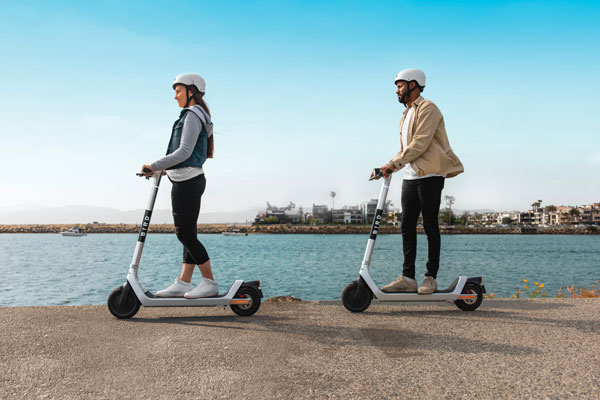
    u-blox partners with Bird e-scooters

    Domino’s delivers with Nuro

    u-blox shares autonomous insights

    Hexagon guides Indy Autonomous Challenge

    Swift Navigation provides precise corrections

    Skytraq Technology modules meet market needs

    SBG Systems drives GNSS+inertial in Paris

    Featured Photo: Bird
  • Domino’s delivers with Nuro and GNSS

    Domino’s delivers with Nuro and GNSS

    Photo: Domino's
    Photo: Domino’s

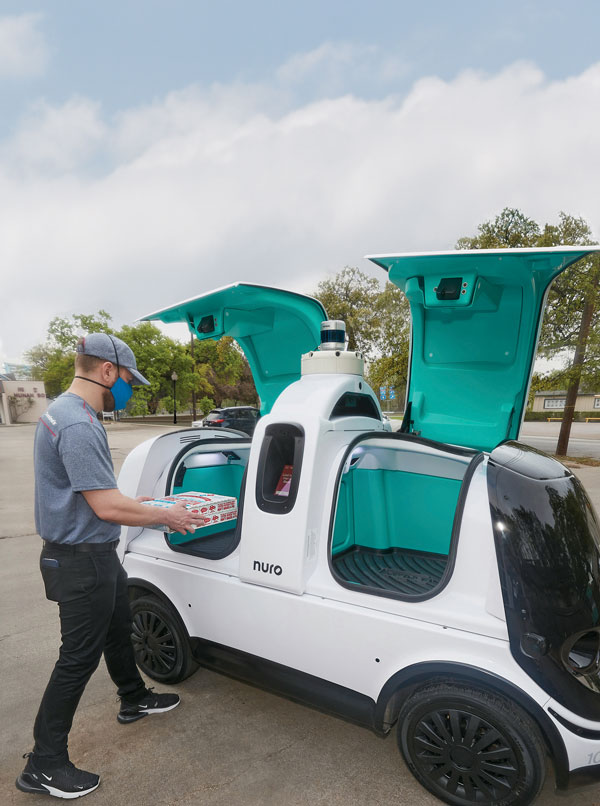
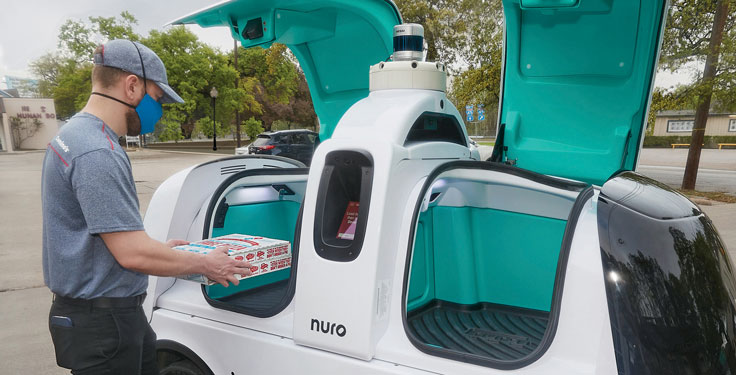
    In April, the pizza company Domino’s and self-driving delivery company Nuro launched autonomous pizza delivery in Houston, Texas. Select customers who place a prepaid online order on certain days and times from Domino’s in Woodland Heights can choose to have their pizza delivered by Nuro’s R2 autonomous, occupantless on-road delivery vehicle.

    Customers selected for the service receive text alerts, which update them on R2’s location and provide them with a unique PIN to retrieve their order. Once R2 arrives, customers are prompted to enter their PIN on a touchscreen, opening its doors.

    In February 2020, Nuro became the first autonomous vehicle developer to be given exemptions by the U.S. National Highway Traffic Safety Administration for testing on public roads without the need to have controls for human operators. Unlike many other autonomous vehicle companies, Nuro engineered its self-driving road vehicles to transport goods instead of people.

    There’s no set timetable for how quickly Domino’s and Nuro will evaluate their testing or expand the service.

    Nuro is also carrying out trials and pilot deliveries with several other companies, including restaurant chain Chipotle, Kroger grocery stores, CVS pharmacies, Walmart and FedEx.

  • Seen & Heard: Robot pizza delivery, NavIC rising

    Seen & Heard: Robot pizza delivery, NavIC rising

    “Seen & Heard” is a monthly feature of GPS World magazine, traveling the world to capture interesting and unusual news stories involving the GNSS/PNT industry.

    Photo: Nuro
    Photo: Nuro

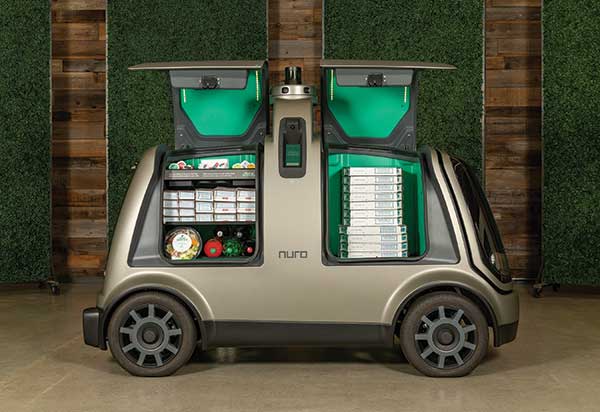
    Hey, R2, Where’s my pizza?

    Domino’s pizza will start using Nuro’s R2 unmanned vehicles for delivery in Houston, Texas, later this year. Once customers have opted in, they can track the R2 vehicle via the Domino’s app and will be provided with a unique PIN code to unlock a compartment to get their pizza. Nuro is already at work in Houston delivering goods from dinner to dry cleaning.

    Screenshot: BBC
    Screenshot: BBC

    Drone Attack

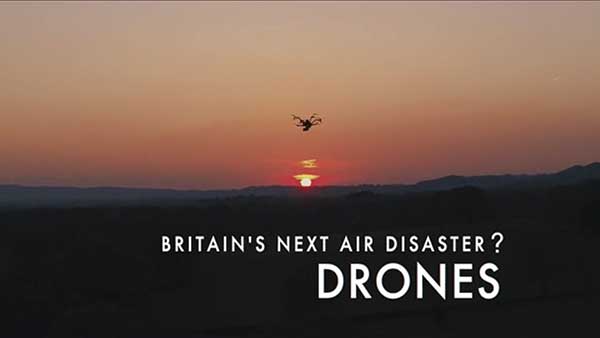
    A BBC documentary has sent the drone industry into a tizzy. “Britain’s Next Air Disaster? Drones” begins with the December 2018 Gatwick Airport incident when two drones entering airport airspace led to a disruption of operations for three days. Dronemakers dislike the documentary’s thrust that drones are a threat to public safety and a tool for terrorists, while barely mentioning their positive contributions in fields such as search and rescue, plant inspections and agriculture.

    Photo: Rawpixel.com/Shutterstock.com
    Photo: Rawpixel.com/Shutterstock.com

    NavIC Rising

    The Indian Space Research Organisation is in talks with chipmakers Qualcomm and Broadcom to substitute GPS in Indian mobile phones with its own satellite system (NavIC). The Times of India noted that cellphones hold the biggest commercial potential for NavIC, with more than 650 million mobile users in India. ISRO and the Indian Air Force are also working to equip fighter jets with the navigation system, and commercial vehicles registered after April 1 are mandated to have NavIC trackers.

    Photo: Monitum Pty Ltd.
    Photo: Monitum Pty Ltd.

    Infrastructure sensors are Mthing

    Internet of things (IoT) project Mthing is researching GNSS monitoring sensors to record near-real-time measurements of infrastructure construction. The 18-month project in Brisbane, Australia, aims to develop GNSS IoT sensors that will provide cost-efficient, constant and high-precision monitoring that will connect to cloud services and provide instant alerts. Mthing aims to produce low-cost sensors with broad market potential. The research team includes Queensland University of Technology, survey company Monitum, and the Innovative Manufacturing Cooperative Research Centre.