Tag: OEM GNSS board

  • New Septentrio receivers support Japan’s CLAS

    New Septentrio receivers support Japan’s CLAS

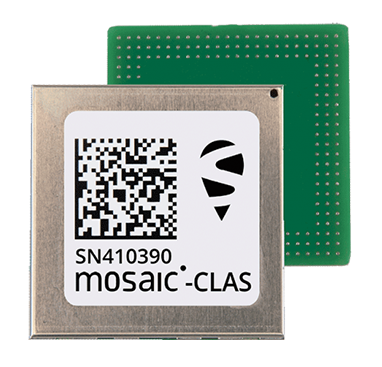
    The mosaic-CLAS GNSS module. (Photo: Septentrio)
    The mosaic-CLAS GNSS module. (Photo: Septentrio)

    Septentrio, a leader in high-precision GNSS positioning solutions, has launched three new products that support Japan’s high-accuracy Centimeter Level Augmentation Service (CLAS).

    The three multi-frequency GNSS receivers support CLAS on a single device, thanks to the latest GNSS technology which receives the L6 signal, which transmits high-accuracy corrections from Japan’s QZSS constellation. This technology was developed in close cooperation with CORE, a leading integrator of high-accuracy positioning technology and services in Japan.

    • The mosaic-CLAS receiver is a GNSS module with a very small form-factor suitable for high-volume industrial applications.
    • The AsteRx-m3 CLAS is Septentrio’s best-in-class OEM board combining PPP-RTK CLAS with dual-antenna heading functionality.
    • The AsteRx SB3 CLAS features a ruggedized IP68 enclosure to protect it in harsh environments.

    Septentrio is simultaneously offering various receiver types to the Japanese market ensuring an optimal match between products and customer needs in various applications including robotics, precision agriculture, construction, machine control and UAV.

    “We are very pleased to jointly develop CLAS software on a new GNSS module, mosaic-CLAS,” emphasized Takahiro Yamamoto, director, GNSS Solution Business Center at CORE Corp. “This receiver puts CLAS GNSS technology on par with regular RTK receivers in terms of size as well as price. We believe that the realization of CLAS on the Septentrio mosaic platform will significantly promote the use of new QZSS services for industrial applications.”

    “The launch of our new module and OEM board with CLAS support opens up new markets and use cases, which will benefit from centimeter-level positioning with fast acquisition time,” commented François Freulon, head of Product Management at Septentrio. “This launch demonstrates the technological leadership of Septentrio and our ability to provide dedicated solutions embedding L6 bands for the Japanese market.”

    The CLAS PPP-RTK is the latest generation of GNSS correction services, combining near-RTK accuracy and quick initialization times with the broadcast nature of PPP. Receivers with built-in CLAS functionality offer sub-decimeter positioning accuracy right out of the box. Corrections for high-accuracy positioning are received directly from satellites, reducing the need for additional base stations or service subscriptions.

    Find out more about PPP-RTK and other positioning correction methods in the insight article GNSS Correction Demystified.
  • Spoofing detection available on Javad GNSS OEM boards

    Two methods of spoofer detection, the identification and sourcing of false GNSS signals, have been released by Javad GNSS, using features available for all of its OEM GNSS boards.

    • Spoofer detection and alarm. This feature then identifies and isolates the spoofer signal, ignores it, and provides a position solution using only valid satellite signals.
    • Determination of the direction from which the spoofing signals emanate. This can aid in tracking down the actual spoofing source.

    Spoofer Detection

    With 864 channels and roughly 130,000 quick-acquisition correlators, the Javad GNSS Triumph chip can assign more than one channel to each GNSS satellite, in order to find all the signals that are transmitted with that satellite’s PRN code. If the chip detects more than one reasonable and consistent correlation peak for any PRN code, it concludes that spoofing is present and can the proceed to identify the spoofed signals.

    In this case, it uses the position solution provided by all other clean signals (L1, L2, L5, and so on, from all GNSS constellations — GPS, GLONASS, Galileo, Beidou, and mroe) to identify the spoofer signal and use the real satellite measurement. If all GNSS signals are spoofed or jammed, then the system issues an alarm, directing the user to ignore GNSS and use other sensors in an integrated system.

    Satellite and Spoofer Peaks

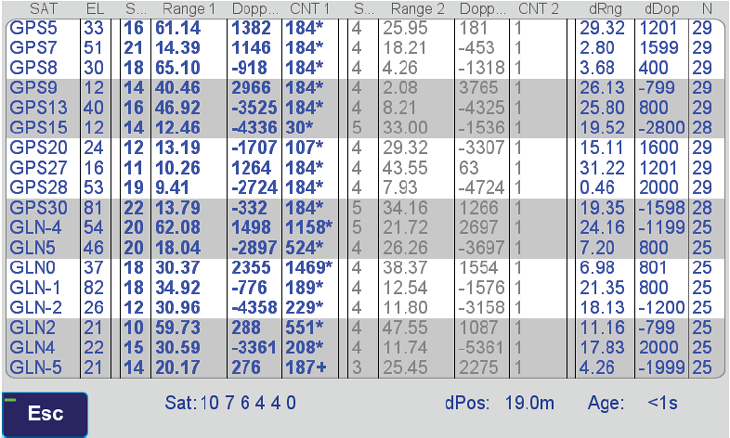
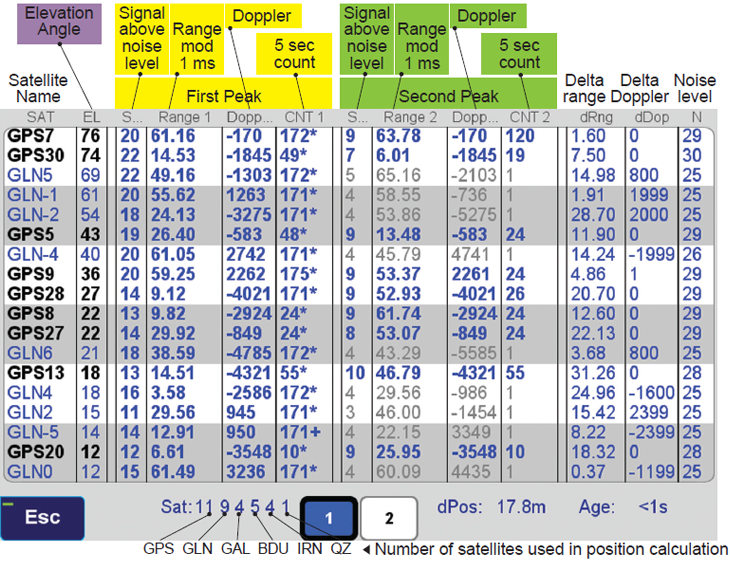
    The figure below shows an example of a spoofer signal and a real satellite signal received at a GNSS receiver. These  screenshots  are from a real spoofer in a large city. The bold numbers are for the detected peaks. The gray numbers represent highest noise, not a consistent peak. A “*” symbol next to the CNT numbers indicate that signal is used in position calculation. Each CNT count represent about 5 seconds of continuous peak tracking.

    The first screenshot shows no spoofing is present. The second shows that all GPS satellites are being spoofed.

    No spoofer. Only one reasonable peak for each satellite. (Table: Javad GNSS)
    No spoofer. Only one reasonable peak for each satellite. (Table: Javad GNSS)
    Table: Javad GNSS
    Table: Javad GNSS

    In the above screenshot all GPS satellites have two peaks and all are spoofed. We were able to distinguish the spoofer signal and use the real satellite signals in correct position calculation as indicated by the ”*” next to the CNT numbers.

    GNSS Overall View

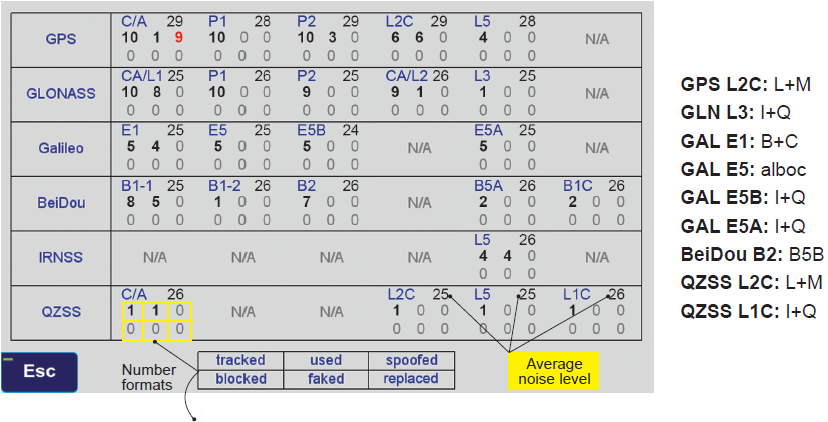
    The following screenshot  shows the status of all GNSS signals. The format and the signal definitions are explained below.

    Table: Javad GNSS
    Table: Javad GNSS

    Tracked: Tracked by the tracking channels and has one valid peak only.
    Used: Used in position calculation.
    Spoofed: Has two peaks. Good peak is isolated, if existed.
    Blocked: Blocked by buildings or by jamming. If jammed, shows higher noise level.
    Faked: Satellite should not be visible, or such PRN does not exist.
    Replaced: Real signal is jammed and a spoofed signal put on top of it. Because of jammer, it shows higher noise level.

    For determination of the direction from which the spoofing signals emanate, see Where is that spoofed signal coming from?