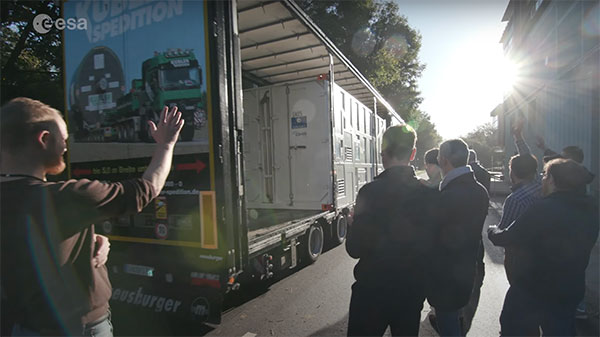
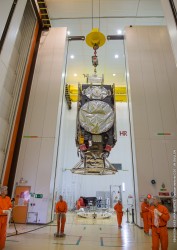
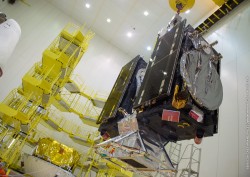
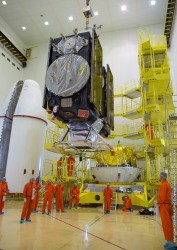
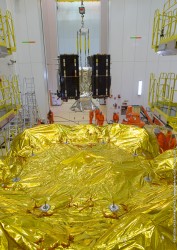
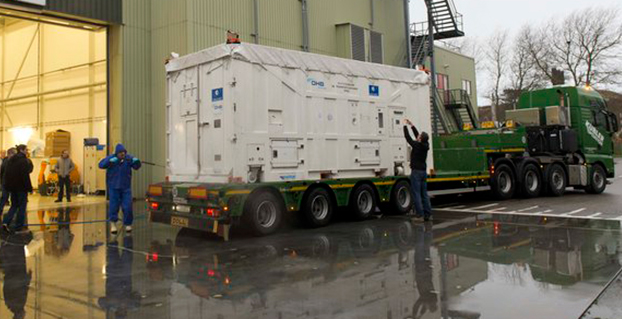
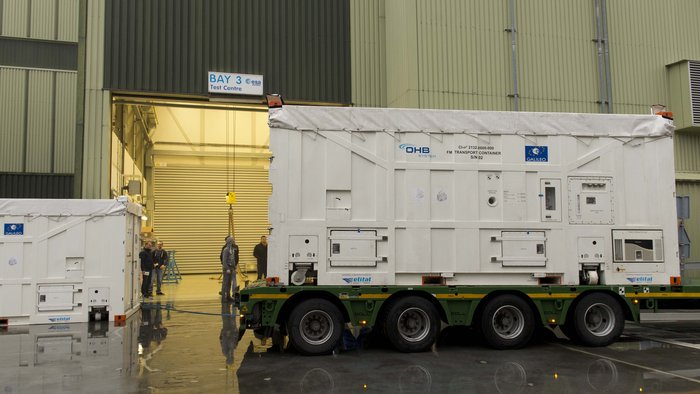
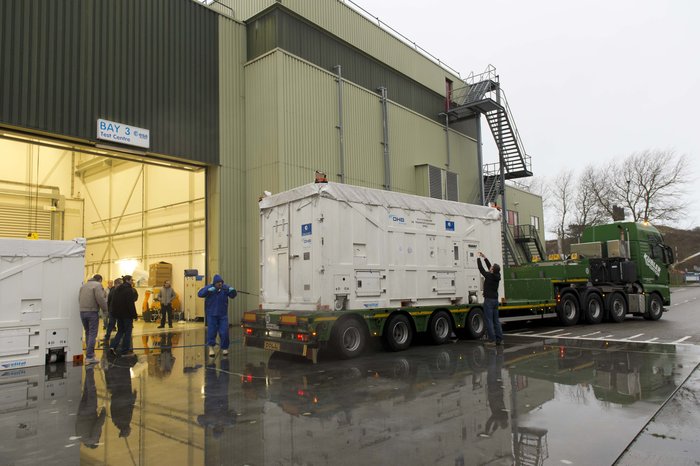
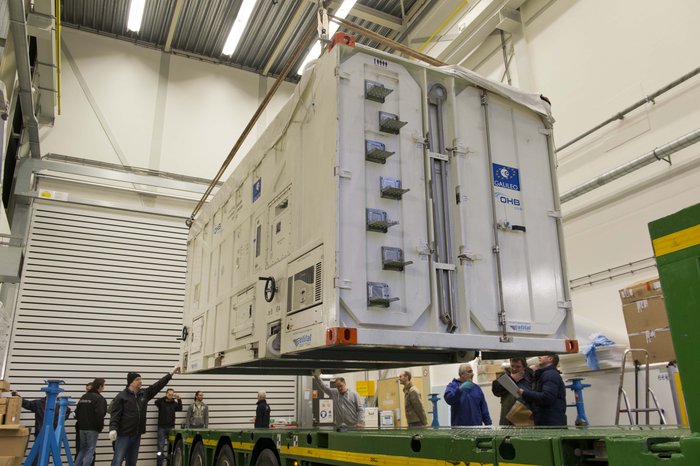
ESTEC Test Centre, Europe’s largest satellite testing facility, said goodbye on Nov. 14 to the final satellite in the Galileo First Generation series, as it departed to OHB in Germany. There, it will rest in storage until ready to be sent for launch.
In a new European Space Agency (ESA) video, the people responsible for readying the satellites for space have gathered to reflect on the end of an era.
The work on Galileo began two decades ago with two test Galileo In-Orbit Validation (GIOVE) satellites, followed by a series of operational launches. The two GIOVE satellites and all 34 Galileo Full Operational Capability satellites were tested at ESTEC.
Next will come the Galileo Second Generation satellites, already in development.
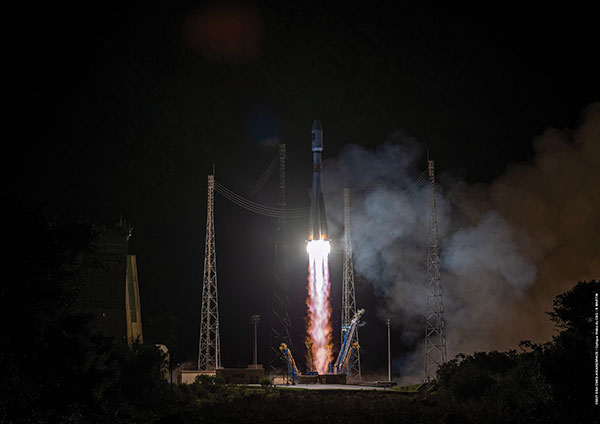
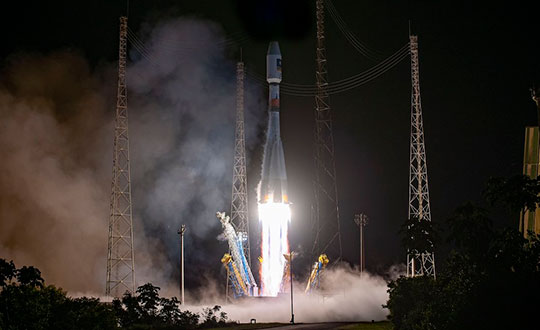
Galileo launch 11 from Europe’s spaceport in French Guyana sent satellites 27 and 28 into orbit. (Photo: ESA/CNES/Arianespace)
News from the European Space Agency (ESA)
Europe’s latest Galileo satellites in space have joined the operational constellation, transmitting navigation signals to three billion users across Earth as well as relaying distress calls to rescuers.
Their entry into service follows a summer test campaign and will result in a measurable increase in positioning accuracy and improved data delivery performance of the overall Galileo system.
Galileo satellites 27-28 were launched at the end of 2021 and underwent in-orbit test review at the end of April. The review was conducted by ESA, satellite manufacturer OHB, and navigation payload maker Surrey Satellite Technology Ltd (SSTL).
Key findings showed both satellites’ payloads are performing extremely well — among the best in the entire constellation — and the satellites entering into service increase the position accuracy and robustness of the overall Galileo system.
A successful system and in-orbit operations review followed, co-chaired by ESA and the EU Agency for the Space Programme (EUSPA), which is in overall charge of commissioning.
Improved navigation message
The two satellites are the first to broadcast an improved navigation message, resulting in three key improvements for Galileo’s public Open Service users:
faster navigation data acquisition, allowing users to establish a first position fix more rapidly
better robustness in challenging environments, such as urban centers
easier access to timing information in the navigation message for users possessing only a rough estimate of timing of the order of 1-2 seconds.
For the testing and broadcasting of this new navigation message, new software for the Navigation Signal Generation Unit was developed by Thales Alenia Space in Italy, SSTL, OHB and ESA, and was uploaded to the two satellites.
During the summer, an extensive test campaign was conducted by ESA to ensure the compatibility of the entire Galileo system at unit, payload, satellite, ground and system levels with the enhanced message. As part of this effort, EUSPA oversaw receiver testing to ensure this compatibility extended to Galileo receivers and chipsets in the market.
These latest launched satellites made ideal test cases for the software and the improved navigation message. Transmission of the upgraded signals from Galileo satellites 27-28 allowed the team to confirm its correct implementation and characterize its long-term performance.
Following a successful Test Review Board, the satellites were brought back into service on Aug. 29
Space Tech Expo Europe has opened its call for speakers for the free-to-attend conference to be held Nov. 15-17 in Bremen, Germany.
The conference will focus on the latest advancements in the European and global space industry, including space exploration, in-space manufacturing, launch, system development, market trends and more.
The conference will take place alongside the leading supplier trade show with hundreds of exhibitors showcasing the latest space technological advancements. The conference provides attendees with the knowledge on the latest developments in European space. Previous speaking companies include: OHB, NASA, ArianeGroup, Airbus Defence and Space, UK Space Agency, ESA and many more.
Proposals for speakers will be accepted through April 11, 2022. To submit a proposal or learn more about the event, please visit the Space Tech Expo Europe website.
It is a beautiful, crisp afternoon, the last of the summer, as I write and as we prepare for next week’s ION GNSS+ conference, where GPS World and sponsors Harris Corporation, Rockwell Collins and Spirent Federal Systems will host the 2017 Leadership Dinner and confer this year’s Leadership Awards in Satellites, Signals, Services and Products.
The engraved glass awards nestle snug in their boxes beside me, the names upon them known only by a few.
However, as you read this, it is early October — and hopefully another beautiful crisp afternoon among autumn’s best — and those glass awards are safe at home with their new owners. Their names are known by all 125 Leadership Dinner attendees, and now by you as well. We will publish their spoken remarks in the December issue. Here now are the basic details.
The voting ballot for the awards was assembled by polling a group of roughly 25 industry VIPs for their nominations, and that same group plus another 40 voted for the final recipients.
The 2017 Leadership Award for Satellites went to Wolfgang Paetsch, director of Navigation for OHB, primarily responsible for the space projects that the company executes for the European Space Agency (ESA) and the European Union. He was nominated for his leadership in setting up the routine production of the Galileo satellites leading to Galileo constellation deployment, including the quadruple Ariane 5 launch in November 2016. As one voter remarked as he cast his ballot, “The quadruple launch capability is a key enabler for the future.”
The Leadership Award for Signals was conferred upon Christopher Hegarty, director for Communications, Navigation and Surveillance Engineering and Spectrum at The MITRE Corporation, for contributions to the Department of Transportation’s GPS Adjacent Band Compatibility Assessment. Said Compatibility Assessment has been a long and winding road, and has required several sure hands, Chris’ among them, to guide it. We hope to publish something on its outcomes soon.
The Leadership Award for Services was given to Patricia Doherty, director and senior scientist at the Institute for Scientific Research at Boston College, for initiating and leading the Africa GNSS Outreach program since 2009. The program’s mission is to help developing countries derive social and economic benefits from satellite-based positioning, navigation and timing. Each year, around 50 graduate students and faculty from African and other countries attend these GNSS workshops. The faculty reads like a Who’s Who of satnav scientists and teachers, testifying to both Doherty’s formidable recruiting talents and the dedication of this community to knowledge-sharing around the world.
2017 GPS World Leadership Awards.
The Leadership Award for Products was a tri-partite affair, going to colleagues Charles Abraham and Andreas Warloe, vice president of Engineering and senior director of GPS Engineering, respectively, at Broadcom. As the chief designer and the architect of the first dual-frequency L1/L5 E1/E5 GNSS chip for smartphones, they are helping to usher in a new era of high-precision GNSS in mass-market products. See this article for more details on the just-launched product.
The two shared the award with Javier de Salas, director of Software Engineering at Broadcom, for leadership in establishing Galileo-ready receiver products.
A good time was had by all at the Leadership Dinner, which also included the PNT Powerplay Puzzle and Pig-in-a-Poke Live Auction. Details in December!
UK’s SSTL to build third batch of Galileo navigation payloads
News from the European Space Agency
Europe’s Galileo navigation constellation will gain an additional eight satellites, bringing it to completion, thanks to a contract signed at the Paris Air and Space Show.
The contract to build and test another eight Galileo satellites was awarded to a consortium led by prime contractor OHB, with Surrey Satellite Technology Ltd overseeing their navigation platforms.
This is the third such satellite signing: the first four In Orbit Validation satellites were built by a consortium led by Airbus Defence and Space, while production of the next 22 Full Operational Capability (FOC) satellites was led by OHB.
These new batch satellites are based on the already qualified design of the previous Galileo FOC satellites, except for changes on the unit level – such as improvements based on lessons learned and reacting to obsolescence of parts.
ESA’s Director of the Galileo Programme and Navigation-related Activities, Paul Verhoef, signed the contract with the CEO of OHB, Marco Fuchs and OHB Navigation Director Wolfgang Paetsch, in the presence of ESA Director General Jan Woerner and the EC’s Deputy Director-General for Internal Market, Industry, Entrepreneurship and SMEs, Pierre Delsaux.
“This procurement from OHB will enable the completion of the Galileo constellation and have reserves both in-orbit and on-ground,” said Director Verhoef. “This signing delivers the necessary infrastructure robustness that is essential for the provision of Galileo services worldwide.”
ESA signed the contract on behalf of the EU represented by the European Commission – Galileo’s owner. The Commission and ESA have a delegation agreement by which ESA acts as design and procurement agent on behalf of the Commission.
Signing Ceremony
Galileo is Europe’s own satellite navigation system, providing an array of positioning, navigation and timing services to Europe and the world.
With 18 satellites now in orbit, Galileo began Initial Services on Dec. 15, 2016, the first step towards full operational capability.
Further launches will continue to build the satellite constellation, which will gradually improve the system performance and availability worldwide. The launch by Ariane 5 of another four satellites is due to take place later this year.
The full Galileo constellation will consist of 24 operational satellites in three orbital planes plus orbital spares, intended to prevent any interruption in service.
These new eight satellites will provide the constellation with in-orbit and on-ground spares. ESA and the Commission are also in the process of developing an improved Galileo Second Generation for the next decade.
Galileo is now providing three service types, the availability of which will continue to be improved.
ESA’s Director of the Galileo Programme and Navigation-related Activities, Paul Verhoef (right), signing the contract of behalf of the European Commission, shakes hands with the CEO of OHB, Marco Fuchs beside OHB Navigation Director Wolfgang Paetsch, in the presence of ESA Director General Jan Woerner (in background) and the EC’s Deputy Director-General for Internal Market, Industry, Entrepreneurship and SMEs, Pierre Delsaux.
Galileo coverage
The Open Service is a free mass-market service for users with enabled chipsets in, for instance, smartphones and car navigation systems. Fully interoperable with GPS, combined coverage will deliver more accurate and reliable positioning for users.
Galileo’s Public Regulated Service is an encrypted, robust service for government-authorized users such as civil protection, fire brigades and the police.
The Search and Rescue Service is Europe’s contribution to the long-running Cospas–Sarsat international emergency beacon location. The time between someone locating a distress beacon when lost at sea or in the wilderness will be reduced from up to three hours to just 10 minutes, with its location determined to within 5 km, rather than the previous 10 km.
The public will begin benefiting as Galileo-capable devices enter the marketplace: 17 companies, representing more than 95% of global supply, now produce Galileo-ready chips.
SSTL continues Galileo work
“SSTL is delighted to have been selected to build the third batch of navigation payloads needed to complete the initial Galileo Constellation,” said Gary Lay, SSTL’s director of navigation. “I am confident that the OHB-SSTL solution offered the lowest risk and best value for money, and I believe that our selection as payload providers for the third time in succession demonstrates a high regard for our work.”
SSTL’s state-of-the-art Galileo FOC payload comprises different units including European sourced atomic clocks, navigation signal generators, high power traveling wave tube amplifiers and antennas. SSTL’s payload proposal for Batch 3 is for a recurrent build of the existing payload, with an evolution of the atomic clocks to incorporate advances made under the European GNSS Evolution Programme.
Fourteen of SSTL’s Galileo FOC navigation payloads are currently operational in orbit, with a further eight payloads already delivered to OHB for integration and test.
SSTL has been involved in the Galileo program since 2003 with the design and build of GIOVE-A, Galileo’s pathfinder mission. GIOVE-A was launched in 2005 and is still operational today, providing valuable data about the radiation environment in Medium Earth Orbit. An experimental GPS receiver on board GIOVE-A is also used to map out the antenna patterns of GPS satellites for use in planning navigation systems for future high altitude missions in Geostationary orbit, and beyond into deep space.
Surrey Satellite Technology Ltd (SSTL) has delivered the 22nd Galileo navigation payload to prime contractor OHB System in Bremen, Germany. This is SSTL’s final payload under Galileo Full Operational Capability (FOC) Works Orders 1 and 2.
SSTL’s FOC payload is based on European-sourced atomic clocks, navigation signal generators, and high-power traveling wave-tube amplifiers and antennas. It will provide Galileo’s navigation, positioning and timing services.
As payload prime contractor, SSTL is responsible for the development, assembly, integration and test of 22 navigation payloads. The first Galileo FOC payload was delivered to OHB in 2012, and since then payloads have continued to roll off the production line at SSTL, with a delivery schedule of approximately one every six weeks.
On May 12, SSTL held an event to mark the occasion, and to celebrate the achievement with the contributors and supporters of the FOC payloads work. Katherine Courtney, chief executive of the UK Space Agency, attended the event and remarked ,“Satellite navigation is an important part of the UK space industry success story and we are at the forefront of innovation in technology and services. Every FOC payload for the Galileo constellation — the beating heart of each satellite — has been built here in Guildford and the completion of this 22nd payload is a significant milestone which should be celebrated. We remain fully committed to the success of the Galileo programme, and look forward to the start of initial services later this year.”
SSTL’s FOC payload comprises different units that have been manufactured by a European supply chain. The modular design of the satellite enables SSTL to assemble the payload units onto three panels for delivery, fully tested, to OHB in Bremen.
The last of the payloads in these two batches has now completed its journey through production and test at SSTL and has been delivered to Germany, where a team of SSTL engineers will assist OHB engineers with integration to the spacecraft platform.
SSTL’s Galileo FOC payload under production. (Photo: SSTL)
“The completion and delivery of the 22nd payload for FOC marks another milestone for SSTL, and I must pay tribute to the talented and dedicated FOC team here who have worked tirelessly to keep the production line rolling for the past four years,” said John Paffett, director of Telecommunications and Navigation at SSTL. “We are extremely proud of our contribution to Europe’s new navigation system, and we are all looking forward to the day that the new service comes on stream, and we can start using it in our daily lives.”
“SSTL has been a reliable partner of the Galileo venture since GIOVE-A,” said aul Verhoef, director of Galileo Programme and Navigation at the European Space Agency. “I wish to thank all SSTL staff for their extremely valuable contribution.”
The subcontractors for SSTL’s Galileo FOC navigation payload are Airbus Defence and Space, Finmeccanica, Spectratime, Kongsberg Norspace, Rymsa, TAS-I, Tesat, Ruag, Mier, ComDev (Honeywell), and Siemens. Testing facilities were provided at Airbus Defence and Space and RAL Space.
The next launch of a pair of Galileo FOC spacecraft is scheduled for May 24 on board a Soyuz launcher from Kourou in French Guiana. Twelve Galileo satellites are already in orbit, and a second launch of four spacecraft is planned for later this year, bringing the total of 18 Galileo satellites in orbit by the end of this year.
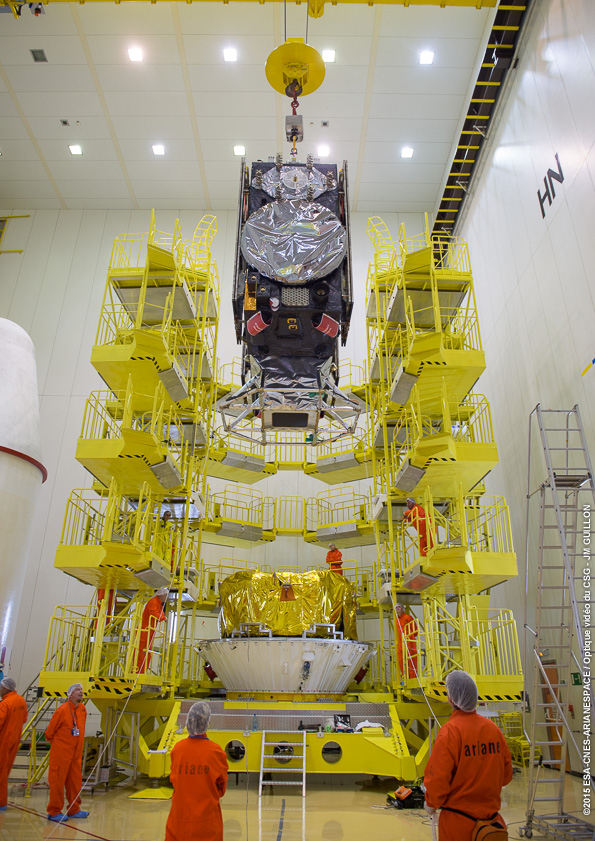
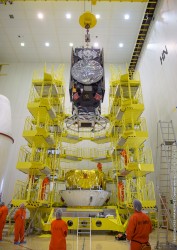
Galileos 9 and 10 are lowered onto the Fregat upper stage.
Galileo 9 and 10 are ready for launch atop a Soyuz rocket at 23:08 local time on Sept. 10 (02:08 GMT and 04:08 CEST on Sept. 11) from Europe’s Spaceport in French Guiana.
After being attached to their carrier last week, the pair of fully fueled satellites was carefully lowered onto the Fregat upper stage on Wednesday, Sept. 2, in the 3SB preparation building of the Guiana Space Centre. The following day was devoted to functional checks and inspections, preparing the Galileos plus Fregat to be encapsulated within the halves of their Soyuz rocket fairing, which took place on Sept. 4. This complete “upper composite” was then transported to the launch site and attached vertically to the first three stages of the Soyuz ST-B, the 12th Soyuz to be operated from the spaceport.
As much a spacecraft as a launcher stage, the re-ignitable Fregat will take the Galileos the bulk of the way to their designated medium-altitude orbit once the first three stages achieve low orbit, 9 minutes and 24 seconds after launch. A pair of Fregat firings will be separated by a 3-hour, 13-minute coast up to their target 23,222 km orbital altitude and 57.394° inclination.
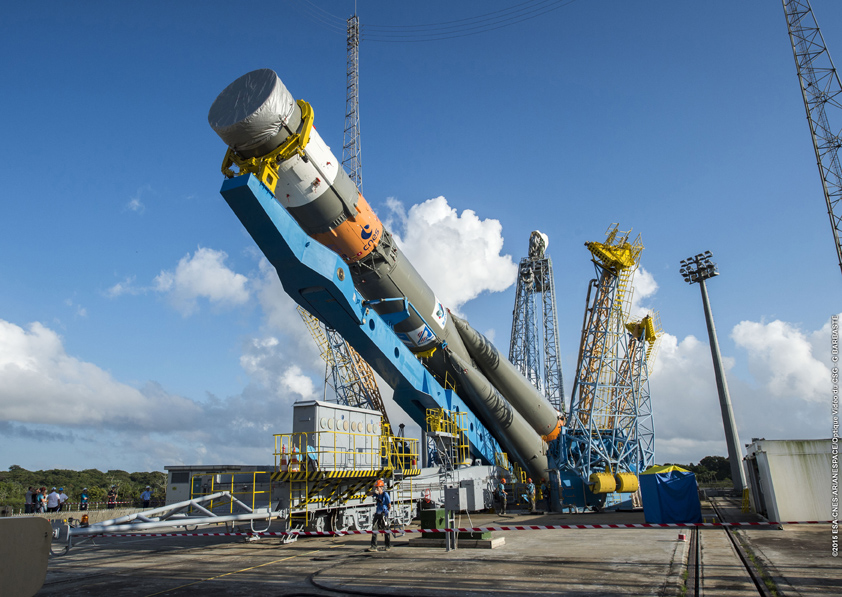
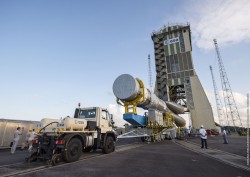
Soyuz in Launch Zone. The basic three-stage vehicle for Arianespace’s Sept. 10 Flight VS12 rolled out from its MiK integration building in the Spaceport’s northwestern sector this morning, and was transferred horizontally to the ELS launch zone by a transporter/erector rail car.
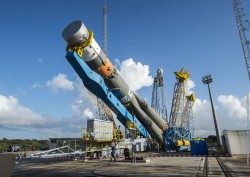
The Soyuz rocket is moved to the launch pad and lifted into a vertical position.
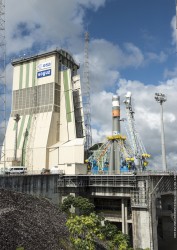
The Soyuz was then erected in a vertical position and suspended over the launch pad, held in place by four large support arms. This was followed by the 53-meter-tall mobile gantry’s move-in to protect the launcher, providing a safe environment for installation of the “upper composite” containing the Galileo satellites.
Galileo 9 and 10 are the fifth and sixth Galileo FOC (full operational capability) spacecraft, and have been designated “Alba” and “Oriana” — continuing the naming process after children who won a painting competition organized by the European Commission in 2011. The satellites were built by OHB System, with Surrey Satellite Technology Ltd. supplying their navigation payloads.
The European Commission is managing and funding Galileo’s FOC phase — during which the network’s complete operational and ground infrastructure is being deployed. The European Space Agency has been delegated as the design and procurement agent on the Commission’s behalf.
Two More this Year. Two further satellites are scheduled for launch by the end of this year. One is under test at ESA’s ESTEC technical centre in Noordwijk, the Netherlands, while the other has already completed its checks and is awaiting transportation to Kourou in the second half of October. In addition, the first satellite of the following batch (Galileo 13) has arrived at ESTEC and is undergoing its thermal-vacuum test. The next will arrive by mid-September.
Follow Arianespace’s launch activity on its website.
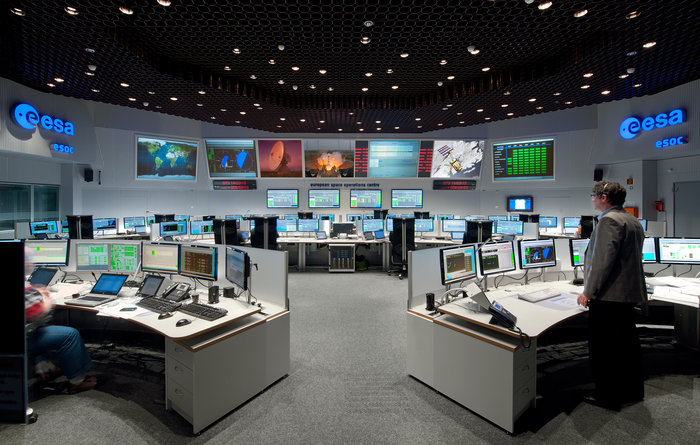
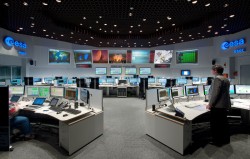
ESOC serves as the Operations Control Centre for ESA missions and hosts ESA’s Main Control Room (shown here), combined Dedicated Control Rooms for specific missions and the ESTRACK Control Centre, which manages ESA’s worldwide ground tracking stations.
Mission Control’s Mission. When the next pair of Galileo satellites is boosted into orbit on Friday, a team of mission control experts in Darmstadt, Germany, will spring into action, working around the clock to bring the duo through their critical first days in space. The fiery ascent to space will last just over nine minutes, after which the Fregat upper stage will fire twice to place the satellites into their release orbit.
Separation from Fregat, about 3 hours and 48 minutes into flight, marks the start of the critical early orbits for the team at ESA’s European Space Operation Centre in Darmstadt. Within the combined flight control team from ESA and France’s CNES space agency, each position is paired with its counterpart from the other agency and mixed “CNESOC” shifts will rotate to conduct operations around the clock. The same team conducts all the Galileo early operations alternately from ESOC and from the CNES control centre in Toulouse, France.
“Upon separation, the team will be very focused, and we’ll be watching for a number of critical events on the satellites to happen automatically at the right time and in the right order,” said ESA’s Liviu Stefanov, lead flight director for this phase. “The satellite must switch on, go into a basic flight configuration, deploy its solar wings for power, orient them towards the Sun and acquire Sun-pointing attitude. “As soon as we get communications, we’ll check its health and start sending commands to configure the satellite after completion of the automatic sequence and prepare it for the next major activity: pointing Galileo towards Earth.”
The intense activity will begin the 10-day early operations phase, during which the joint team will work 24 hours/day to oversee steps to prepare the satellites for handover to the Galileo Control Centre in Oberpfaffenhofen, for routine operations, and ESA’s Redu Centre in Belgium, for detailed payload testing.
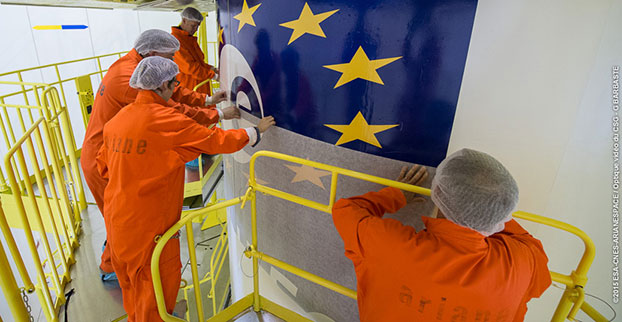
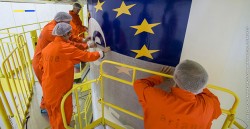
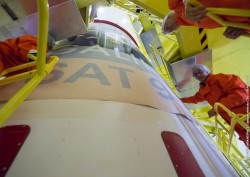
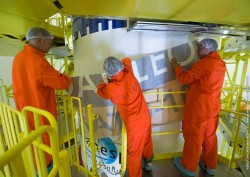
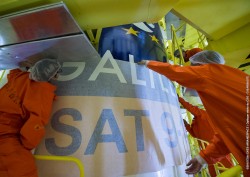
The logos of the two new satellites in the Galileo constellation are placed on the launcher fairing.
Photo Gallery
Galileos 9 and 10 are lowered onto the Fregat upper stage. (Credit: CNES/ESA)
Galileos 9 and 10 are lowered onto the Fregat upper stage.(Credit: CNES/ESA)
Galileo 9 and 10 on their dispenser being lifted towards the gold-insulation-covered Fregat upper stage. (Credit: CNES/ESA)
Galileos 9 and 10 are lowered onto the Fregat upper stage.(Credit: CNES/ESA)
Galileos 9 and 10 are lowered onto the Fregat upper stage. (Credit: CNES/ESA)
Galileos 9 and 10 are lowered onto the Fregat upper stage. (Credit: CNES/ESA)
The Soyuz launcher is transferred to the launch pad. (Credit: Arianespace)
The Soyuz rocket is moved to the launch pad and lifted into a vertical position. (Credit: Arianespace)
The Soyuz launcher is transferred to the launch pad. (Credit: Arianespace)
The logos of the two new satellites in the Galileo constellation are placed on the launcher fairing. (Credit: CNES)
The logos of the two new satellites in the Galileo constellation are placed on the launcher fairing. (Credit: CNES)
The logos of the two new satellites in the Galileo constellation are placed on the launcher fairing. (Credit: CNES)
The logos of the two new satellites in the Galileo constellation are placed on the launcher fairing. (Credit: CNES)
ESOC serves as the Operations Control Centre for ESA missions and hosts ESA’sMain Control Room (shown here), combined Dedicated Control Rooms for specificmissions and the ESTRACK Control Centre, which manages ESA’s worldwide groundtracking stations. (Credit: ESA)
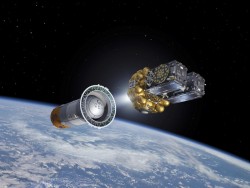
Artist’s view of Galileo satellites attached to their dispenser atop their Fregat upper stage separating from the Soyuz upper stage. The Fregat then flies them the rest of the way up to medium-Earth orbit. (Credit: ESA)
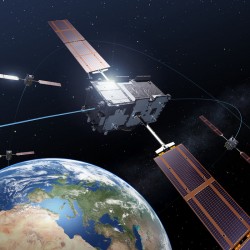
The Galileo GNSS. (artist’s rendering, courtesy ESA)
The latest Galileo satellite, formally known as FOC FM06, arrived at the ESTEC Test Centre in its protective container on Dec. 18, after traveling from OHB in Bremen, Germany. Photo: European Space Agency
The latest Galileo satellite has arrived at ESTEC, in the Netherlands, and is undergoing a full checkout to prove its readiness for space.
The satellite was carried by lorry from its manufacturer in Germany, cocooned within an environmentally controlled container. It arrived inside ESTEC’s cleanroom environment on Dec. 18. The container was then opened up to begin preparations for testing.
The first six Galileo satellites are already in orbit, launched in pairs in 2011, 2012 and August this year.
The last pair was delivered into the wrong orbit by a faulty upper stage, but the fifth satellite’s orbit has since been changed to allow checking of its navigation payload, which began at the end of November.
The sides and top of the Galileo satellite container were sprayed clean before it was taken inside the bay of the ESTEC Test Centre to keep any contamination from entering the pristine cleanroom. Photo: European Space Agency
Meanwhile, down on the ground, production of further satellites continues steadily, taking the Galileo series into double figures overall.
Following on from the first four In-Orbit Validation satellites, 22 of these Full Operational Capability satellites are being built by OHB in Bremen, Germany, with navigation payloads from SSTL in Guildford, UK.
Numbered Flight Model 6, or FM06 for short, this latest of the newer satellites is now reunited under the test centre’s roof with three others. FM03 and FM04 have completed their acceptance testing, culminating in the weeks-long thermal-vacuum test. Each satellite was subjected to the same vacuum and extreme temperature conditions experienced in orbit, as well as radio-frequency testing of their navigation payloads and antennas inside an anechoic chamber isolated from the external universe. This pair is now in storage in the centre pending the results of their concluding acceptance review.
The other satellite, FM05, recently ended its own thermal-vacuum trial. It is now being reconfigured for radio-frequency testing, planned to take place after the Christmas break. The latest unboxed Galileo satellite will undergo its own thermal–vacuum test in January.
ESTEC is an essential stop on the way to space for Galileo. It is equipped with all the facilities needed to simulate space conditions under a single roof, including an acoustic chamber, earthquake-strength shaker tables, and anechoic and vacuum chambers, along with a range of specialised measuring equipment.
Once ESTEC gives the satellites its stamp of quality then they are in principle ready to be flown to Europe’s Spaceport in Kourou, French Guiana. ESA and the European Commission are currently deciding on the launch schedule for these next Galileos.
The container containing the latest Galileo satellite, FOC FM06, was carefully hoisted off the lorry that carried it from OHB in Bremen, Germany. Its underside was then carefully cleaned before it was taken out of the bay into the cleanroom environment. Photo: European Space Agency
The cause of two Galileo satellites being released into the wrong orbit August 22 can be traced to improper installation of a hydrazine fuel line, according to Space News and the GalileoGNSS blog.
The hydrazine fuel line was installed too close to a supercold helium line on the Fregat upper stage, which caused the hydrazine to freeze long enough to upset the Fregat stage’s orientation and cause the two satellites’ release into an orbit that is both too low and in the wrong inclination, officials said as reported on the websites.
No official report has been issued; the board of inquiry is expected to release its findings this week.
The Euro-Russian inquiry board looking into the cause of the failure has discovered that one in four Fregat upper stages at prime contractor NPO Lavochkin in Moscow had the same fuel-line installation, according to the reports. “We have to assume that this was a practice that had gone on in perhaps a quarter of the Fregat stages produced in the past decade, but that it had not affected our launches up to now because of mission-specific aspects like coast time between burns, the number of burns and so on, which can influence the effect of the helium on the hydrazine,” one official is quoted as saying. “In any case, we’d like Arianespace, which currently has almost no inspection rights on the Soyuz, to be given more say in quality assurance.”
In the stages without the installation issue, the hydrazine and helium lines were separated so that the supercold helium could not freeze the hydrazine. The design did not foresee any problem in putting the lines together, but in fact that is a problem for some missions.
European Union government and officials are debating how to proceed, the reports said. The options are to continue, as scheduled, with the December launch of two more Galileo satellites aboard a Soyuz Fregat rocket, or to wait until next spring or summer and launch four Galileo satellites on a heavy-lift Ariane 5 vehicle.
As for the two wayward satellites, in a presentation to the 65th International Astronautical Congress in Toronto September 30, OHB’s Galileo deputy program manager, Kristian Pauly, said he was optimistic that once the satellites’ perigee is raised and their orbit made less eccentric, they can be fitted at least partially into the Galileo program and perform a navigation function, Space News reported. OHB System is the prime contractor for the full operational capability (FOC) satellites.
The first priority, Pauly said, is to take the two satellites out of regular contact with the Van Allen belts and adjust their Earth sensors to their new, unplanned view of Earth — which is much closer given the lower altitude.
Pauly did not speculate on what the Galileo launch schedule would be. He said that OHB’s delivery schedule will not change much. “We have a delivery schedule that is extremely challenging and we will keep to it,” he said.
Surrey Satellite Technology Ltd (SSTL) Director of Telecommunications & Navigation, John Paffett, has today signed a contract with Ingo Engeln, member of the Executive Board of OHB System AG at the Farnborough International Airshow, for the construction of a further eight navigation payloads for the European Galileo programme.
Under the contract, worth approximately €80 million, SSTL will construct the navigation payloads for the second batch of Full Operational Capability satellites (Work Order No. 2), continuing a successful cooperation between the two companies to build the first 14 satellites (Work Order No. 1) under the supervision of the European Space Agency (ESA).
Matt Perkins, CEO of SSTL, commented, “We value our role in the Galileo programme greatly. SSTL is committed to the FOC programme and together with OHB we are making great strides towards the completion of the first satellites — a momentum which we will carry forward with these next eight payloads.”
"It is a pleasure to witness this signature, it shows OHB and SSTL are preparing at full speed the building of the additional eight satellites ordered at the beginning of 2012 for the GALILEO constellation. These will complement the order of 14 satellites initiated in 2010," said Giuliano Gatti, head of the ESA Galileo Space Segment Procurement Office.
Today’s contract formalizes arrangements between the two companies following the award of Work Order No. 2 to the OHB-SSTL team by Antonio Tajani, European Commission vice president in February of this year. Work has already begun on the new batch of payloads and the first is due for delivery in early 2014.
SSTL is responsible for the navigation payloads that will provide all of Galileo’s services. Assembled and tested at SSTL’s Kepler Technical Facility in the UK, the sophisticated payloads are based on European-sourced equipment, including highly accurate atomic clocks, navigation signal generator, high-power traveling wave tube amplifiers, and antennas.
The SSTL-OHB team is currently integrating the first of the FOC Work Order No. 1 satellites in at OHB’s facilities in Bremen, Germany, which are scheduled for launch next year.
The Full Operational Capability phase of the Galileo program is managed and fully funded by the European Union. The Commission and ESA have signed a delegation agreement by which ESA acts as design and procurement agent on behalf of the commission.
European Commission Vice President Antonio Tajani announced in London that the consortium led by OHB System AG and Surrey Satellite Technology Ltd. (SSTL) will build a further eight satellites for the European Union’s Galileo satellite navigation program under the supervision of the European Space Agency.
The new contract will see SSTL continuing its role as payload prime, assembling, integrating and testing the navigation payloads in the UK, whilst OHB System, as the prime contractor, builds the eight satellite platforms and executes the final integration of all the satellites in Germany. The SSTL-OHB partnership is already building fourteen satellites for the Galileo program and will draw on its heritage and experience to produce the additional satellites to demanding schedules.
Matt Perkins, SSTL Group CEO commented “SSTL has played a key role in the development of the Galileo program for nine years and we have the commitment, experience and track record to deliver this substantial contract. We are delighted to have been selected with our partner, OHB, to continue to play our part in building Europe’s operational navigation system.”
SSTL is assembling the Galileo program payloads at its recently opened purpose-built Kepler technical facility in Guildford, UK. Under the contract, SSTL is fully responsible for the construction and test of the navigation payloads. SSTL will manufacture the electrical harnesses and the electronics to interface the navigation payload with the satellite platform. The remaining payload equipment will be externally procured by SSTL from European and other suppliers. SSTL's payload solution is based on European-sourced atomic clocks, navigation signal generators, high power travelling wave tube amplifiers and antennas and will provide all of Galileo’s services.
Galileo is Europe’s own Global Navigation Satellite System (GNSS), providing real-time positioning, navigation and timing services with unrivalled accuracy and integrity. It will be interoperable with the American GPS system and Russia’s GLONASS system.
The Full Operational Capability phase of the Galileo program is managed and fully funded by the European Union. The Commission and ESA have signed a delegation agreement by which ESA acts as design and procurement agent on behalf of the Commission. The views expressed in this Press Release can in no way be taken to reflect the official opinion of the European Union and/or ESA. “Galileo” is a trademark subject to OHIM application number 002742237 by EU and ESA.
European Commission Vice President Antonio Tajani announced in London that the consortium led by OHB System AG and Surrey Satellite Technology Ltd. (SSTL) will build a further eight satellites for the European Union’s Galileo satellite navigation program under the supervision of the European Space Agency.
The new contract will see SSTL continuing its role as payload prime, assembling, integrating and testing the navigation payloads in the UK, whilst OHB System, as the prime contractor, builds the eight satellite platforms and executes the final integration of all the satellites in Germany. The SSTL-OHB partnership is already building fourteen satellites for the Galileo program and will draw on its heritage and experience to produce the additional satellites to demanding schedules.
Matt Perkins, SSTL Group CEO commented “SSTL has played a key role in the development of the Galileo program for nine years and we have the commitment, experience and track record to deliver this substantial contract. We are delighted to have been selected with our partner, OHB, to continue to play our part in building Europe’s operational navigation system.”
SSTL is assembling the Galileo program payloads at its recently opened purpose-built Kepler technical facility in Guildford, UK. Under the contract, SSTL is fully responsible for the construction and test of the navigation payloads. SSTL will manufacture the electrical harnesses and the electronics to interface the navigation payload with the satellite platform. The remaining payload equipment will be externally procured by SSTL from European and other suppliers. SSTL’s payload solution is based on European-sourced atomic clocks, navigation signal generators, high power travelling wave tube amplifiers and antennas and will provide all of Galileo’s services.
Galileo is Europe’s own Global Navigation Satellite System (GNSS), providing real-time positioning, navigation and timing services with unrivalled accuracy and integrity. It will be interoperable with the American GPS system and Russia’s GLONASS system.
The Full Operational Capability phase of the Galileo program is managed and fully funded by the European Union. The Commission and ESA have signed a delegation agreement by which ESA acts as design and procurement agent on behalf of the Commission. The views expressed in this Press Release can in no way be taken to reflect the official opinion of the European Union and/or ESA. “Galileo” is a trademark subject to OHIM application number 002742237 by EU and ESA.