Tag: Ohio

  • Federal agencies addressing the geodesy crisis

    Federal agencies addressing the geodesy crisis

    In my last column, I highlighted the announcement made by the National Geodetic Survey (NGS) of the recipients of the NOAA FY 23 Geospatial Modeling Competition Awards. As shown in the image below, NGS awarded approximately $4 million in grant funding to four institutions for projects that will research emerging problems in the field of geodesy, develop tools and models to advance the modernization of the National Spatial Reference System (NSRS), and help address a nationwide deficiency of geodesists.
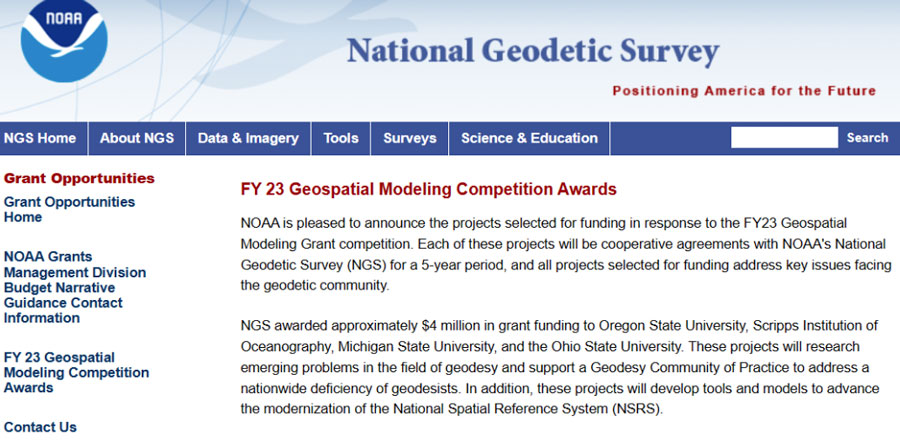
    Image: NGS
    Image: NGS

    I had the opportunity to speak with Juliana Blackwell, director of the NGS, about the geospatial awards. I asked her how the grants will help NGS in its development of products and services as well as the implementation of the modernized NSRS.

    “The geospatial modeling grant is an opportunity to expand our abilities within NGS to address research challenges, diversify the tools we provide, and multiply our future workforce,” Blackwell said. “I’m excited about the competitive and collaborative nature of the grant and the chance for NGS to work with a variety of academic institutions.”

    NGS awarded the grant funding to four institutions including Oregon State University, Scripps Institute of Oceanography, Michigan State University, and the Ohio State University. Looking at the summary of the awards, there appears to be some overlapping interest between grantees that could lead to a diverse set of solutions to a problem or task. I will report on specific tasks and outcomes as more details become available.

    I was pleased to see that grant proposals included developing new geodetic tools and operating procedures for working with the new, modernized NSRS. Hopefully, these universities will engage the geospatial user community when developing new tools so the tools will be useful during the implementation of the new NSRS.
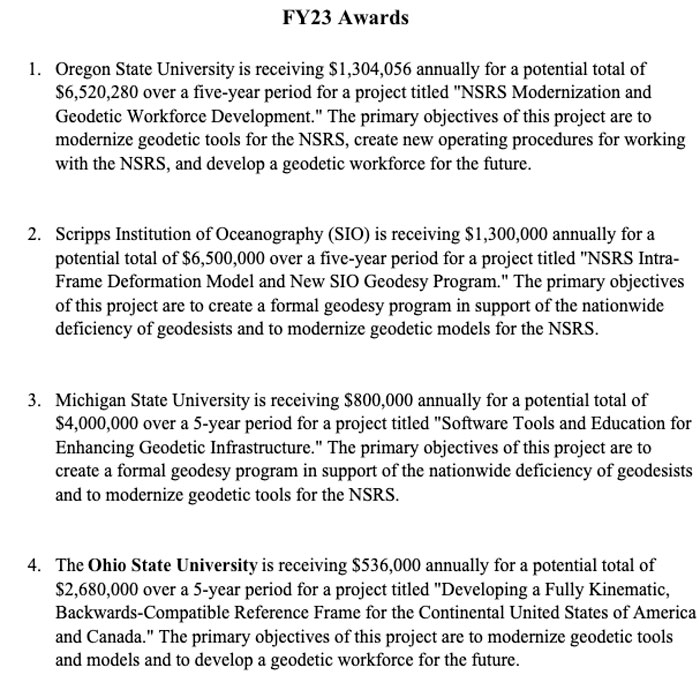
    Summary of the Geospatial Awards (Image: NGS)
    Summary of the Geospatial Awards (Image: NGS)

    Besides providing funds for the geospatial grants, NGS is collaborating with other federal agencies to address the geodesy crisis. This collaboration, denoted as the “Geodesy Community of Practice (COP),” includes four agencies — NGS, National Geospatial-Intelligence Agency (NGA), National Aeronautics and Space Administration (NASA), and United States Geological Survey (USGS). The co-chairs of the group discussed the group’s actions and goals at the Hydrographic Services Review Panel (HSRP) fall committee meeting held in Silver Spring, Maryland, on Sept. 27-29.
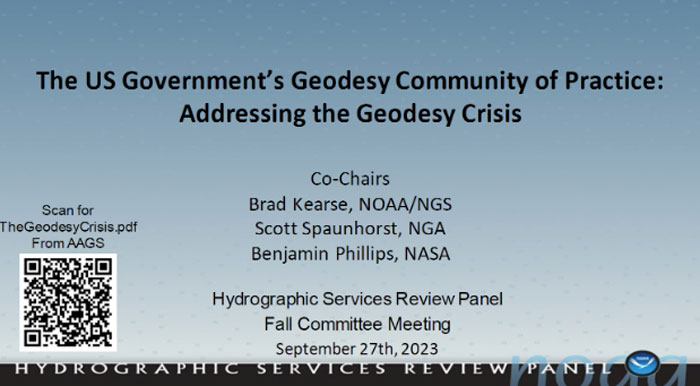
    Geodesy Community of Practice. (Image: NOAA's Hydrographic Services Review Panel)
    Geodesy Community of Practice. (Image: NOAA’s Hydrographic Services Review Panel)

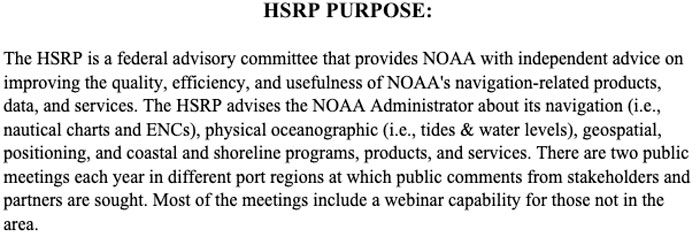
    The HSRP involves four NOAA offices: three National Ocean Service (NOS) program offices -NGS, the Center for Operational Oceanographic Products and Services (CO-OPS), the Office of Coast Survey (CS), and the University of New Hampshire’s Joint Hydrographic Center and Center for Coastal and Ocean Mapping. More information and the presentations from the HSRP meeting can be obtained here. The purpose of the committee is to review and provide NOAA with independent advice on their products and services.
    (Image: NOAA's Hydrographic Services Review Panel)
    (Image: NOAA’s Hydrographic Services Review Panel)

    I attended the three-day HRSP meeting as a virtual participant. As previously noted, NGS is one of the NOS offices that’s part of the HSRP. As the Director of NGS, Blackwell participated in the 2023 fall HSRP meeting. A majority of the meeting discussed the geodesy crisis. In my opinion, this is due to Blackwell’s efforts to highlight the importance of geodesy to NOAA products and services.   

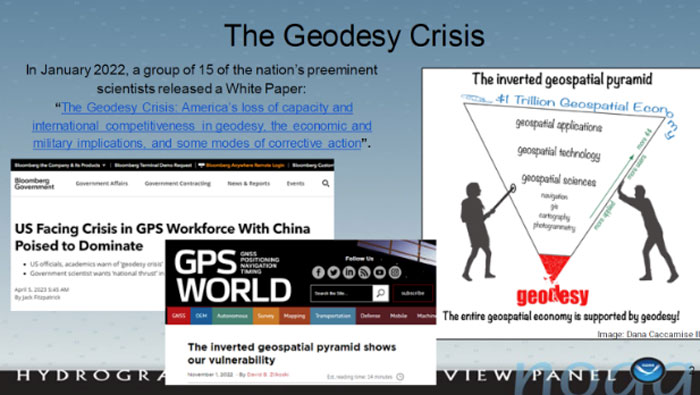
    The presentation by the co-chairs of the Geodesy Community of Practice highlighted a few articles that have brought the geodesy crisis to the attention of the geospatial user community. Anyone keeping up with my columns knows that I have been highlighting the geodesy crisis and programs that advance the science of geodesy (July 2020, November 2022, December 2022, and April 2023). The geodesy crisis white paper is posted on the American Association for Geodetic Surveying (AAGS) website. 
    (Image: NOAA's Hydrographic Services Review Panel)
    Image: NOAA’s Hydrographic Services Review Panel)

    The Geodesy COP established working groups to address topics that are important to all geospatial users. All the agencies are supporting the working groups which should help create more effective and efficient solutions to technical geodetic issues.
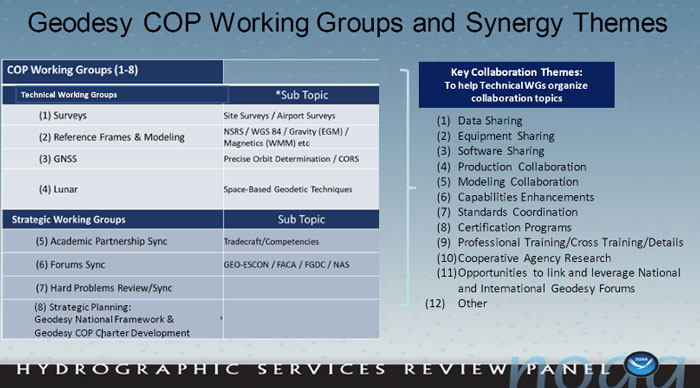
    Image: NOAA's Hydrographic Services Review Panel
    Image: NOAA’s Hydrographic Services Review Panel

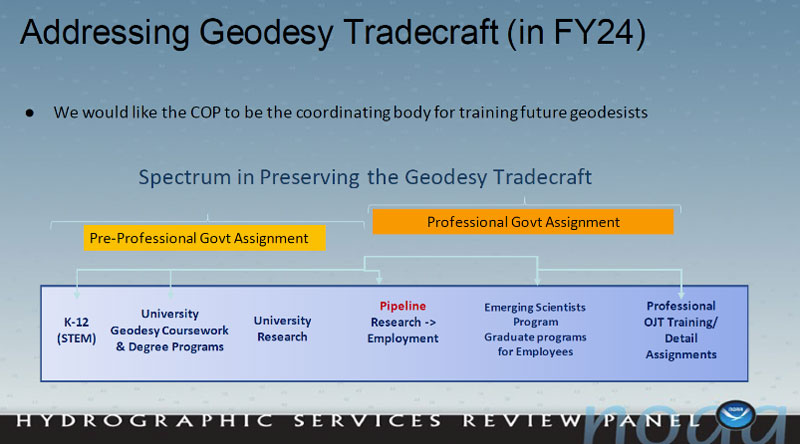
    A goal of the Geodetic Community of Practice is to train future geodesists. The advancements in satellites and computers have enabled geodesy to expand into many different disciplines Geodetic science and technology now underpin many sciences, large areas of engineering (such as driverless vehicles and UAVs), navigation, precision agriculture, smart cities, and location-based services. Major U.S. companies, such as Google and FedEx, as well as the automobile industry, precision farming companies and mining companies also need more accurate geodetic models, tools, and algorithms. Therefore, these companies also need trained geodesists to perform important research on topics that address their specific geodetic requirements. I highlighted this in my July 20, 2020, GPS World First Fix article. To address the geodesy tradecraft, the COP includes providing professional government assignments. That said, many industries that rely on accurate and consistent geodetic information should also provide professional geodetic assignments.   
    Training future geodesists. (Image: NOAA's Hydrographic Services Review Panel)
    Training future geodesists. (Image: NOAA’s Hydrographic Services Review Panel)

    I asked Blackwell how she thought the U.S. government’s Geodesy Community of Practice will help NGS and the geodesy crisis.

    “The Geodesy Community of Practice is in the beginning phase right now with the collaboration among federal agencies with geodetic missions, NOAA/NGS, NGA, NASA, and USGS,” Blackwell said. “There is already a benefit in sharing research, workforce, and operational needs and leveraging our resources. I envision expanded engagement with academia, private industry, and other government agencies as the community of practice matures.”

    In my opinion, the Geodesy Community of Practice’s integrated working groups consisting of individuals with different backgrounds and skills addressing geospatial problems will help to advance the field of geodesy. I believe that integrated and collaborative organizations create the best geospatial solutions; the Geodesy COP is an embodiment of this concept.

    Of course, as I have stated in many of my columns, I like to remind everyone that “geodesy is the foundation for all geospatial products and services.”
  • Satellite imagery shows aftermath from Ohio train disaster

    Satellite imagery shows aftermath from Ohio train disaster

    Image: Maxar Technologies
    Image: Maxar Technologies

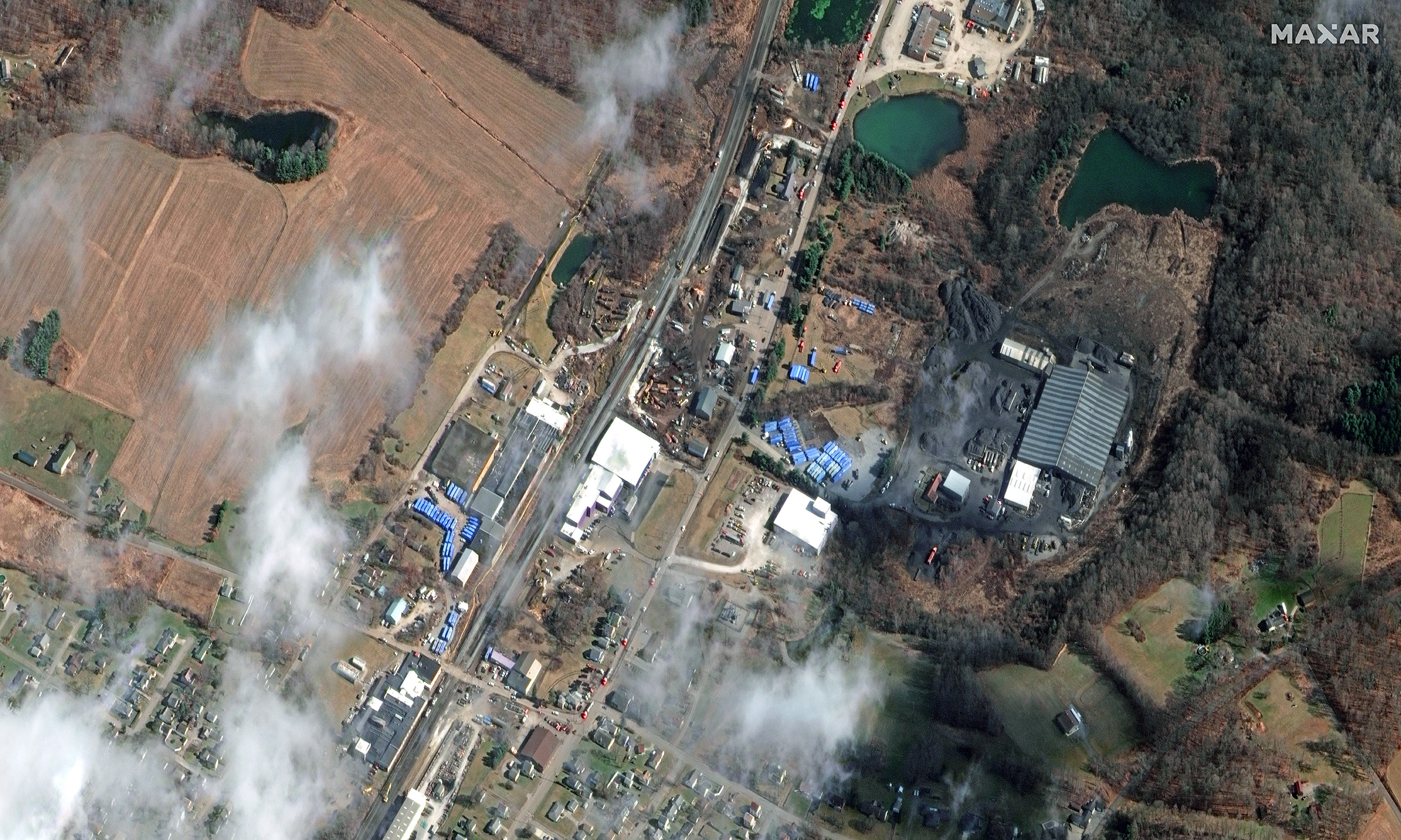
    Maxar Technologies shared via Twitter satellite imagery from the aftermath of the train derailment and explosion in East Palestine, Ohio. The train derailed on Feb. 3 and was carrying toxic materials.

    The satellite images show the ongoing cleanup efforts following the derailment. The wrecked train can be clearly seen as well as blue storage containers being used to collect hazardous materials.

    Hundreds of East Palestine residents had to evacuate their homes after a Norfolk Southern Railroad train carrying vinyl chloride derailed and exploded, emitting deadly fumes into the air and toxic material into the Ohio River.

    A Feb. 8 press release from Ohio Governor Mike Dewine stated that it was safe for residents to safely return to their homes. “There will be ongoing air monitoring in the area, but for those who would like air quality readings to be conducted within their homes, Norfolk Southern Railroad has hired an independent contractor to work with local law enforcement, the U.S. EPA, and state officials to take air quality samples and provide results at no charge to residents,” it said.

  • NXP partners with Columbus Smart City Challenge

    NXP Semiconductors N.V. has announced the next phase in its Smart City collaboration with Columbus, Ohio, the winner of the 2016 U.S. Department of Transportation’s $40 million Smart City Challenge.

    NXP will contribute key technologies for smart and safe mobility to the Smart Columbus Experience Center.

    Smart Center. On June 30, the City of Columbus celebrated the opening of its Smart Columbus Experience Center. The center allows visitors to see how new mobility options, such as connected, autonomous, shared and electric vehicles, will help make Columbus a more connected community.

    Hands-on educational experiences and technology demonstrations aim to show visitors how technology and innovation in transportation can grow the local economy and create ladders of opportunity for central Ohio residents.

    Visitors to the Smart Columbus Experience Center will learn how Vehicle to Everything (V2X) Technology allows cars to communicate with each other as well as with intelligent traffic infrastructure to keep mobility safe and efficient. (Image: NXP USA)
    Visitors to the Smart Columbus Experience Center will learn how Vehicle to Everything (V2X) Technology allows cars to communicate with each other as well as with intelligent traffic infrastructure to keep mobility safe and efficient. (Image: NXP USA)

    Cohda Wireless. As part of the Smart Columbus Experience Center initiative, NXP and Cohda Wireless will deploy a connected vehicle environment through the center’s electric vehicle test drive area so drivers can experience this future technology in person.

    NXP has also donated an electric motorcycle with an accompanying drone that alerts the driver to dangers or delays ahead.

    Key smart city technologies

    As part of its commitment to Columbus, NXP will continue to contribute key mobility technologies to the Smart Columbus Experience Center, including:

    • NXP’s RoadLINK V2X technology allows cars to communicate with each other as well as with intelligent traffic infrastructures. The IEEE802.11p Dedicated Short Range Communications (DSRC) standard allows cars to securely connect to each other as well as to infrastructure. DSRC technology is the only ADAS sensor that can look around the corner and offers lowest latency in the communication.
    • Smart Card IC technology that enhances transportation for all citizens by supporting secure and convenient public transportation ticketing and payment systems, including contactless transit fare solutions.
    • Highly secure NXP Radio Frequency Identification (RFID) solutions designed to promote public safety and convenience. Smart City applications for this NXP technology include vehicle window stickers that enhance driver convenience and reduce municipal costs by eliminating the need for stop-and-pay stations in public parking spaces.
    NXP eBike and Drone demo at the new Smart Columbus Experience Center shows how drones could send real-time video of a traffic incident to a city emergency vehicle. (Image: NXP USA)
    NXP eBike and Drone demo at the new Smart Columbus Experience Center shows how drones could send real-time video of a traffic incident to a city emergency vehicle. (Image: NXP USA)

    Concept of Operations released

    Smart Columbus, the smart city initiative from the City of Columbus, in July released the Concept of Operations for its Connected Vehicle Environment (CVE) pilot.

    The Concept of Operations outlines in detail how the CVE pilot will be implemented over the next two years. The pilot will involve:

    • 113 road side units (RSUs) that will be installed at intersections with stoplights
    • up to 1,800 on-board units (OBUs) that will be installed on participating private, emergency transit and freight vehicles, and
    • 12 vehicle-to-vehicle or vehicle-to-infrastructure applications that will be deployed, according to the document.

    Goals of the CVE pilot include improvements of:

    • vehicle operator safety
    • intersection safety
    • school zone safety
    • reliability of transit vehicle schedule adherence
    • emergency vehicle response times
    • traffic management capabilities.

    Smart city demonstrations. Visitors to the Smart Columbus Experience Center can try out electric automobiles. A fleet of six electric vehicles will be on display and is available for test drives through a connected vehicle environment provided by NXP and Cohda Wireless.

    Vehicles on display or available for test drives include:

    • a BMW i3 provided by BMW
    • a Chevrolet Bolt provided by Dave Gill Chevrolet
    • a Honda Clarity provided by Honda
    • a Mercedes-Benz GLE 55e provided by Daimler
    • a Nissan LEAF provided by Nissan North America
    • a Toyota Prius Prime provided by Toyota.

    An electric motorcycle provided by NXP and a Ford Ojo electric scooter are also on display.

  • PNT Roundup: Columbus discovers — and implements — smart city solutions

    Visitors to the Smart Columbus Experience Center will learn how Vehicle to Everything (V2X) Technology allows cars to communicate with each other as well as with intelligent traffic infrastructure to keep mobility safe and efficient. (Image: NXP USA)
    Image: NXP USA

    Columbus, Ohio, has positioned itself smartly for an autonomous future, taking a lead role in pilot projects on infrastructure and autonomous air and road transport.

    The city will draw on up to $40 million in grants from the U.S. Department of Transportation, $10 million from Vulcan, Inc,. and $500 million in local private pledges.

    Carla Bailo, assistant vice president for mobility research and business development at Ohio State University (OSU), presented the city’s ambitious program at ION GNSS+.

    In “Position, Navigation and Timing — An Enabling Technology for Mobility and Smart Cities,” she focused on a triple-zero target: zero accidents and fatalities, zero carbon footprint and zero stress.

    Smart Columbus will put six autonomous shuttle buses in the commercial district, coordinate truck platooning, time deliveries and manage parking to reduce congestion, and undertake drone delivery of medical supplies and other critical needs. Multimodal transit apps, mobility assistance for those with disabilities and pedestrian collision avoidance will be based on real-time data on transit options and availability, as well as traffic information, road and weather conditions.

    Position, navigation and timing (PNT) technologies play a central role in smart cities: vehicle-to-vehicle and vehicle-to-infrastructure communication, autonomous navigation and collision avoidance, location-based services and smart, resilient infrastructure.

    Smart Columbus envisions the city as a center for high-tech transportation research and innovation. OSU’s partnerships with mobility companies and vehicle manufacturers, industry groups and government agencies contribute to the city’s comprehensive approach to the smart city project. Through its expertise in sensors, communication, PNT, transportation, autonomous and connected vehicles, and geospatial science and engineering, OSU will serve as the lead researcher on Smart Columbus.

    Dorota Grejner-Brzezinska, OSU professor and frequent contributor to GPS World, in her new role as associate dean for research at OSU’s College of Engineering will be a key participant in research projects on ways to integrate self-driving cars, deliver high-definition 3D maps and metadata, use sensors to better connect vehicles for safety and efficiency, and find better ways to move people around the city when they don’t have access to a car.

  • Ohio/Indiana UAS Center Receives Another FAA Approval

    The Unmanned Aircraft Systems (UAS) Center has teamed up with the University of Cincinnati to conduct research and development on systems necessary to execute precision flight control algorithms for small UAS. Outcomes from this research are targeted to help emergency responders but may also be leveraged for other industrial purposes. The small UAS leased by the UAS Center is a rotocopter that weighs 15 pounds and has a payload capacity of 10 pounds.

    The FAA granted a two-year Certificate of Waiver or Authorization to the Ohio/Indiana UAS Center and Test Complex. Testing of the aircraft will take place at Wilmington Air Park in Wilmington, Ohio.

    “We will continue to support safe and cost effective research and development efforts across the state in partnership with the FAA, providing the foundation for this rapidly emerging industry,” said Ryan Smith, UAS director for the State of Ohio.

    Once this technology is developed, the University of Cincinnati plans on transitioning it to industry. “The type of research being conducted right here in Ohio is what will help the UAS industry grow. Interested Ohio businesses can leverage this technology for commercial purposes,” Smith said.

    The Association of Unmanned Vehicles Systems International (AUVSI) estimates the UAS market in Ohio is projected to be a 2 billion dollar industry with a potential to create 2,500 jobs over the next 10 years.

  • Drone Drops Drugs into Prison Yard, Incites Fighting

    Mansfield Correctional Institute (photo by U.S. Corrections-Special Operations Group)
    Mansfield Correctional Institute (photo by U.S. Corrections-Special Operations Group)

    A drone flew over an Ohio prison and dropped a payload containing heroin, marijuana and tobacco last week, causing a fight to break out. Prison officers rushed into the north yard of Mansfield Correctional Institution in Mansfield after noticing 75 inmates gathering and fighting, according to an incident report from the Ohio Department of Rehabilitation and Correction as reported by CNN.

    Authorities later viewed a survelliance video that showed a drone delivery had caused the fighting. Inmates were able to get their hands on the delivery containing 144.5 grams of tobacco, 65.4 grams of marijuana and 6.6 grams of heroin before the fight ensued and the package was thrown into the prison’s south yard, the incident report said.

    Two corrections officers called for assistance and ordered the inmates to stop fighting, according to the department. They used pepper spray to control the fight, reports U.S. News and World Report. About 75 inmates in the north recreation yard and 130 on the south recreation yard were taken to the gyms, where they were strip-searched, run through a cell sensor and checked by a clinic. The nine people involved in the fight were placed in solitary confinement. No staff members or inmates were injured, the department said.

    This is not the first time an Ohio prison has had an incident with unmanned aerial vehicles, according to Ohio Department of Rehabilitation and Corrections spokeswoman JoEllen Smith. She declined to elaborate further because of a potential security risk.

    Ohio authorities are now on the lookout for more attempts to use drones to smuggle drugs over prison walls and into inmates hands, and the owner of the drone is being sought. “It’s something we’re certainly aware of,” Smith told CNN. “We’re taking a broad approach to increasing staff awareness and detection.”