Tag: Parsec

  • Parsec Introduces PTA1.5M-9 Active GPS/GNSS Antenna

    Parsec Technologies, Inc., global provider of wireless positioning antennas and amplifier integrated circuits for the consumer, automotive and defense markets, introduced its GPS/GNSS L1 high-radiated efficiency active antenna at CTIA Super Mobility Week September 10.

    The PTA1.5M-9, sized 9 x 9.175 x 1.3 mm, integrates easily with GNSS/GPS 3D-SIPs and system-on-chip (SoC) receivers with only a single direct connection typically required, and is compatible with any GNSS receiver operating from 1560 to 1610 MHz.

    The Parsec PTA 1.5M-9 is a wideband antenna ideal for embedded LBS receivers requiring good user experience to operate within 5 to 7 mm of the human body, indoors in the presence of multi-path, and in applications with obstructed views of orbiting satellites.

    Key benefits include:

    • Micro miniature size: 9mm x 9.175mm x 1.3mm (L x W x H)
    • 50 MHz bandwidth: covers GNSS systems from 1560 – 1610 MHz
    • Highest rated efficiency in class: 50% at 1575.42 MHz
    • Antenna gain: Ga=0.8 dBi @ Fc = 1575.42 MHz, linear polarization
    • Ideal for M2M GPS/GNSS requirements

    Plano, Texas-based Parsec is displaying their products for M2M devices, showcasing their GPS and GNSS product line of active and passive antennas as well as introducing their new ultra-thin dual band cellular antenna at CTIA 2014 in Las Vegas, Nevada – Booth #6221 in the M2M Zone.
  • Parsec Antennas Designed for Telit Mini GPS Receiver

    Parsec Antennas Designed for Telit Mini GPS Receiver

    Telit Wireless Solutions and Parsec Technologies today announced that a combination of the companies’ technologies results in a low profile  companion solution for GPS receiver and antenna. For host devices able to accommodate higher volumetric symmetry, assembly of the components can be made to fit a 6 x 16 x 8 millimeter volume. A flat component arrangement can yield an ultra-low-profile volume of 6 x 16  x 2.4 millimeters.

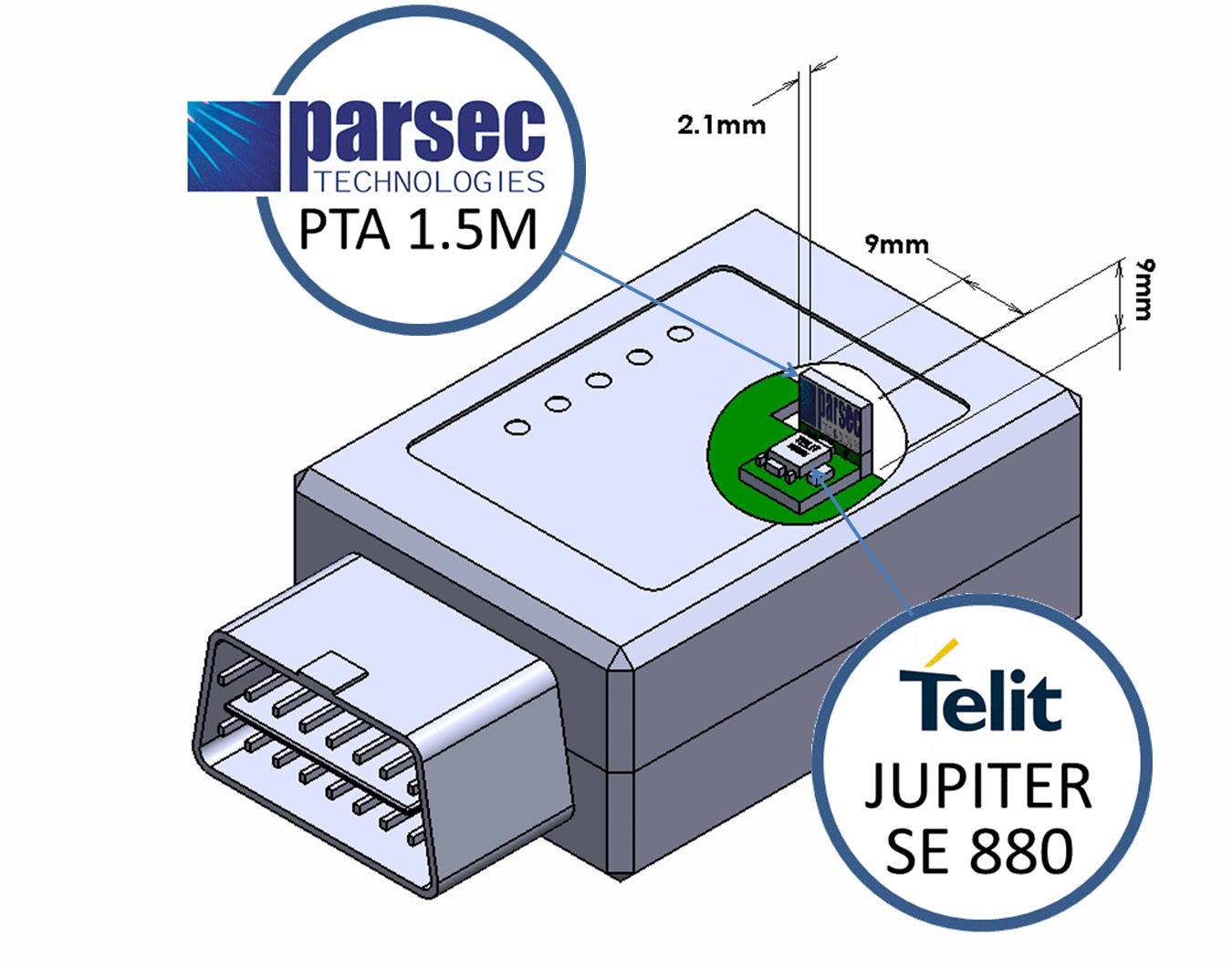
    ParsecTelitFig1 OBD“Receivers combining the Parsec PTA/PT Family and Telit’s Jupiter SE880 modules deliver good user experience in finished LBS (location-based services) critical products without sacrificing design flexibility, ease of implementation or cost,” said Michael A. Neenan, CEO and founder of Parsec Technologies, Inc. “The combination is ‘bullet-proof’ in providing a rewarding design experience making RF work reliably, passing end-product regulatory compliance testing without re-test.”

    “Miniaturization is a major enabler of new application areas for positioning and M2M,” said Taneli Tuurnala, Vice President and Head of GNSS Division of Telit Wireless Solutions. “With the Parsec antennas, the complete receiver features the industry’s ‘smallest landed footprint,’ making it suitable for use in wearable electronics, UBI devices or adapters for the mobile computing industry.”

    Along with miniaturization, the receiver outperforms top traditional designs, handling a loss of 10 dB or greater in GPS signal reaching, for example, the typical OBD port under a vehicle’s dashboard where many usage-based insurance (UBI) dataloggers are installed. The PTA1.5M active antenna delivers the ultra-sensitive Jupiter SE880 micro receiver over 15 dB of additional gain in the operating frequency range. Both companies are making available complete application notes to simplify the engineering effort for system integrators.

    The miniature 4.7 x 4.7 millimeter LGA (Land Grid Array), SiRFstarIV-based Jupiter SE880 receiver module employs heterogeneous 3D integrated technology to achieve best-in-class performance in all dimensions critical for regular or size-constrained GPS applications. Its RF front-end employs spatially calibrated waveguide-quality radio paths inside the three-dimensional space of its architecture, reducing parasitic impedances characteristic of traditional 2-D RF designs. Inside, a multi-filter system includes not only the traditional SAW filters typical in GPS receiver designs but also a 2.4-GHz notch-filter capable of nullifying the jamming effects of high-energy radio devices such as Wi-Fi hot-spots, Bluetooth systems, cordless phones, and others, which greatly affect a GPS receiver’s ability to resolve timid satellite signals in the hostile radio environment where they need to operate.

    The PTA1.5M, with a gain of 15dB, and PTA1.5x2M, with a gain of 30dB, are tiny GNSS active antenna modules capable of receiving signals down to -192 dBm with frequency centered at 1575.42 (±1.023) MHz. Either model delivers a radiated efficiency greater than 60% when mated to the Jupiter SE880 receiver. Parsec’s PT1233D LNA also has the highest available IP3 at low voltage, helping eliminate interference. Both PTA1.5M and PTA1.5x2M can incorporate the antenna element, an optional SAW filter, the cascadable PT1233D LNA, matching and passives components, on a low cost, easy to integrate 10×16 mm single sided PCBA with “back side” copper clad ground plane. The height of the PTA1.5M and PTA1.5x2M modules vary according to application, allowing their use in even the smallest form factors including Intel’s M.2 Next Generation Form Factor (NGFF) module (23x30x2.4 mm, LxWxH).

  • Parsec Combines Telit Technology with Micro-Mini Modules to Deliver Tiny GPS Receivers

    Parsec Technologies, Inc., today announced that the company’s Micro-Mini PTA/PT family of GNSS/GPS receiver modules seamlessly integrates with the Telit Wireless Solutions Jupiter SE880 three-dimensional system-in-a-package (3D-SIP) to enable what it calls the world’s smallest- to-date, commercial-class, low-cost GPS L1 receiver.

    By combining a PTA/PT family module with the Jupiter SE880 3D-SIP, OEMs and integrators are able to deliver a location-based service product with a GPS L1 receiver in a landed form factor of 20 x 20 x 6 millimenters, or 20 x 10 x 6 millimeters, depending upon component orientation. This contrasts with landed GPS receiver sizes integrating a passive ceramic patch antenna that measure 25 x 25 millimeters, and which Parsec says don’t match the GNSS/GPS frequencies in performance despite being four times the surface area.

    With the Parsec/Jupiter combination, integrators can design LBS-critical products with exceptional user experience in applications with severe use, such as obstructed satellite view and high path loss, including indoors, urban canyons, wearables, smart watches, vehicle under-dash on board diagnostics (OBD) devices, metal containers and aircraft fuselage asset tracking, and M.2/next-generation form factor (NGFF) products.

    Receivers combining Parsec PTA/PT Family and Telit Jupiter SE880 modules deliver good user experience in finished LBS critical products without sacrificing design flexibility, ease of implementation, or cost, Parsec said. The combination is fully vetted and “bulletproof” in providing a rewarding design experience making RF work reliably, passing end-product regulatory compliance testing without re-test.

    According to Michael A. Neenan, CEO and founder of Parsec, customers are future-proofing their LBS critical products when they select a Parsec PTA/PT family for integration with the Telit Jupiter SE880 3D-SIP. PTA/PT family modules receive and amplify any GNSS system signal from 1560 to 1610 MHz, including GPS L1/L1C, with high radiated efficiency in any end product orientation.

    Telit Jupiter SE880 reference design kits will soon be equipped with the Parsec PTA/PT family module. OEMs and integrators can order GPS L1 receiver solutions today.

    The PTA/PT family of GNSS/GPS receiver Micro-Mini modules extends Parsec’s decade-long tradition of stretching the state-of-the-art in small size, ultra-linearity, miniscule energy usage, high gain, low noise, Any Voltage operation, Field-and-Forget reliability, low cost, and ease of integration/use.