Lidar USA has become the Titanium sponsor for the first UAS Rodeo, hosted by GEOHuntsville out of Hunstville, Alabama.
Operating since 1999, Lidar USA offers unmanned aerial vehicle (UAV) and mobile mapping systems for scanning, imaging and navigation.
Its products will be on display at the UAS Rodeo, which is designed to give Part 107 UAS pilots involved in public safety activities a full-scale training, skill-building and competitive environment to share knowledge in UAS operations.
The company said that integrating its mobile mapping solutions with the rapidly growing UAV industry has been pivotal to its success to adapt to a customer’s needs. UAS Rodeo will provide Lidar USA an avenue to show the UAS community its cutting-edge technology.
The UAS Rodeo takes place Oct. 9-10 in Huntsville at the Public Safety Training Academy, 6001 Cecil Fain Drive NW.
Skyfront’s Perimeter 4 long-range hybrid gas-electric drone this summer successfully performed the first civilian beyond-visual-line-of-sight (BVLOS) flight without visual observers under the FAA’s Part 107 rules.
The flight serves as a significant step toward the safe integration of unmanned aerial vehicles into the national airspace, according to the company.
During the round-trip flight, the Perimeter UAV flew over mountainous, rugged terrain along a four-mile stretch of the Trans-Alaska pipeline. The UAV maintained a constant above-ground altitude of 400 feet with multiple ascents and descents of 1,000 feet on 45-degree slopes. Radio-based telemetry, command and control of the vehicle was uninterrupted during the flight.
FAA representatives observed all aspects of the mission, including planning, system setup and ground-station operation. The Perimeter “did [the flight] safely, effectively and efficiently. It accomplished a beyond-visual-line-of-sight mission, and it was approved by the FAA,” said Robert Huber, program manager for the Integration Pilot Program (IPP) of the FAA.
“Today’s flight was a milestone in the unmanned community,” said Troy Mestler, CEO of Skyfront. “We at Skyfront are excited to be pushing the limits of unmanned aerial vehicles here in the United States.”
The Perimeter UAV was integrated with Iris Automation’s Casia collision avoidance system and was observed by Echodyne’s ground-based detect and avoid systems.
The University of Alaska Fairbanks and the Alaska Center for Unmanned Aircraft Systems Integration purchased the UAV and organized the flight over the pipeline, with the approval of the Alyeska Pipeline Service Company.
More than 100 control towers and airports have been added to the hundreds of Federal Aviation Administration (FAA) air traffic facilities and airports that currently use the Low Altitude Authorization and Capability (LAANC) system.
LAANC is a collaboration between the FAA and industry that directly supports the safe integration of unmanned aircraft systems (UAS) into the nation’s airspace.
LAANC expedites the time it takes for a drone pilot to receive authorization to fly under 400 feet in controlled airspace. By adding contract towers to the number of LAANC-enabled facilities, drone pilots will have access to more than 400 towers covering nearly 600 airports.
In less than two years, LAANC has provided fast access to controlled airspace for more than 100,000 flights, according to Matt Fanelli, director of strategy at Skyward.
Image: Skyward
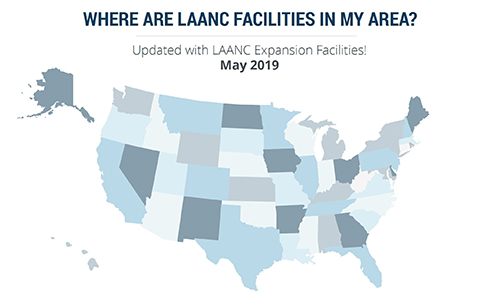
“People have been asking the FAA to add more airports and today, 109 contract towers have now been added to LAANC.” Skyward has updated its 2019 LAANC Facilities Guide so that UAV pilots can easily reference airports near them that will be adding this service.
Contract towers are air traffic control towers that are staffed by employees of private companies rather than by FAA employees. LAANC provides air traffic professionals with visibility into where and when authorized drones are flying near airports and helps ensure that everyone can safely operate within the airspace.
The expansion to more than 100 contract towers means the FAA has further increased drone pilots’ access to controlled airspace safely and efficiently.
LAANC is used by commercial pilots who operate under the FAA’s small drone rule (PDF) (Part 107). The FAA is upgrading LAANC to allow recreational flyers to use the system and in the future, recreational flyers will be able to obtain authorization from the FAA to fly in controlled airspace.
For now, recreational flyers who want to operate in controlled airspace may only do so at fixed sites.
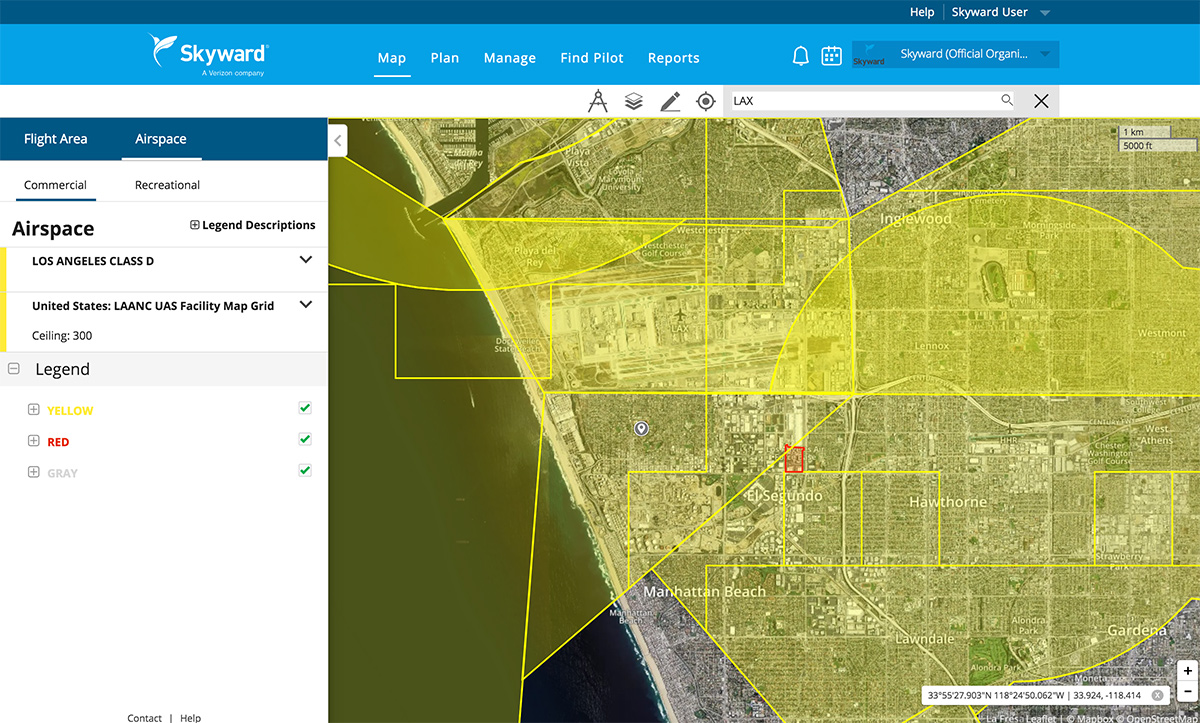
Commercial drone operators in California and Hawaii — as well as a few areas in Nevada, Utah and Arizona — now can get quickly authorized to fly in controlled airspace, Skyward announced.
Screenshot: Skyward
Skyward is an FAA-approved airspace vendor. With Skyward, pilots can access the FAA’s LAANC (Low Altitude Airspace Notification Capability) across the five states.
This means that pilots with a Part 107 license can get permission to fly in regulated airspace in seconds compared to manual authorizations that can take months, making it significantly easier for businesses of all sizes, particularly in the construction and warehousing industries, to manage a fleet of drones to access valuable, cost-saving data.
The LAANC platform lets UAV operators take advantage of this digital timesaver. Skyward was the first provider approved by the FAA to offer LAANC, and Skyward saw quick adoption by its customers as soon as the prototype was released on Oct. 23, 2017.
This phase of Skyward’s LAANC expansion includes airspace in some of the country’s busiest metro areas, including Los Angeles, the Bay Area, San Diego, Las Vegas and more than 50 smaller air markets. It will help the full diversity of businesses in the west find new ways to use drones in their operations through LAANC capability.
The first operational rules for routine commercial use of small unmanned aircraft systems, announced June 21, officially take effect today.
“People are captivated by the limitless possibilities unmanned aircraft offer, and they are already creating business opportunities in this exciting new field,” said U.S. Transportation Secretary Anthony Foxx. “These new rules are our latest step toward transforming aviation and society with this technology in very profound ways.”
“The FAA’s role is to set a flexible framework of safety without impeding innovation,” said Administrator Huerta, Federal Aviation Administration (FAA). “With these rules, we have created an environment in which emerging technology can be rapidly introduced while protecting the safety of the world’s busiest, most complex airspace.”
The provisions of the new rule — formally known as Part 107 — are designed to minimize risks to other aircraft and people and property on the ground. A summary is available.
Effective today, the FAA has several processes in place to help users take advantage of the rule:
Waivers. The agency is offering a process to waive some of the rule’s restrictions if an operator demonstrates the proposed flight will be conducted safely under a waiver. Users must apply for these waivers at the online portal.
The FAA is issuing more than 70 waivers today, based on petitions for Section 333 exemptions. These waivers will be posted on September1. The majority of the approved waivers were for night operations under Part 107.
Airspace Authorization. Users can operate their unmanned aircraft in Class G (uncontrolled) airspace without air traffic control permission. Operations in Class B, C, D and E airspace need air traffic approval. Users must request access to controlled airspace via the electronic portal at www.faa.gov/UAS.
The FAA will evaluate airspace authorization requests using a phased approach. Operators can submit their requests starting today, but air traffic facilities will receive approved authorizations, if granted, according to the following tentative schedule:
Class D & E Surface Area: Oct. 3, 2016
Class C: Oct. 31, 2016
Class B: Dec. 5, 2016
The FAA will make every effort to approve requests as soon as possible, according to the agency, but the actual processing time will vary, depending on the complexity of an individual request and the volume of applications the FAA receives. The agency is urging users to submit requests at least 90 days before they intend to fly in controlled airspace.
The FAA will use safety data from each phase to ensure appropriate mitigations are in place as small UAS operations are integrated into controlled airspace.
Aeronautical Knowledge Test. Testing centers nationwide can now administer the Aeronautical Knowledge Test required under Part 107. After an operator passes the test, he or she must complete an FAA Airman Certificate and/or Rating Application to receive a remote pilot certificate.
It may take up to 48 hours for the website to record that the applicant has passed the knowledge test. The FAA expects to validate applications within 10 days. Applicants will then receive instructions for printing a temporary airman certificate, which is good for 120 days. The FAA will mail a permanent Remote Pilot Certificate within 120 days.
In the future, the FAA also will address operations not covered by Part 107 without a waiver, including operations over people, beyond line of sight operations, extended operations, flight in urban areas, and flight at night.
Part 107 does not apply to model aircraft. Model aircraft operators must continue to satisfy all the criteria specified in Section 336 of Public Law 112-95 (which is now codified in part 101), including the stipulation they be operated only for hobby or recreational purposes. Click here for more information on hobby or recreation uses.
The Federal Aviation Administration’s (FAA) new small drone rule — formally known as Part 107 — is effective on Monday, Aug. 29. The FAA has released information to help drone users understand the new requirements.
Below is information on Part 107’s effect on Section 333 waivers, along with how to obtain a Part 107 waiver.
Section 333 vs. Part 107: What works for you?
The biggest question is whether you are better off flying under the provisions of Part 107, or should continue using your existing exemption? The video below explains what happens to your Section 333 exemption grant or petition for exemption.
Your exemption is valid until it expires — usually two years after it was issued. Even after Part 107 becomes effective, you may choose to fly following the conditions and limitations in your exemption.
However, if you want to operate under the new Part 107 regulations, you’ll have to obtain a remote pilot certificate and follow all of the rule’s operating provisions. You must apply for a waiver if some parts of your operation don’t meet the rule’s requirements.
If you already have a Certificate of Waiver or Authorization (COA) under your Section 333 exemption, you can continue to fly under the COA limitations until it expires. If you don’t already have a COA, you probably won’t need one when the new drone rules go into effect.
However, if you want to fly in controlled airspace, you will need permission from FAA air traffic control. Details about obtaining that permission will be online at www.faa.gov/uas when the small drone rule is effective on Aug. 29.
If you applied for a Section 333 exemption but haven’t received it yet, you should have received a letter from the FAA with specific information about the status of your petition. Generally, if your petition is pending and falls within the provisions of the rule, you should follow the steps outlined in the rule.
Whether you choose to fly under your exemption or under the new small drone rule is your choice, depending on how you want to operate your aircraft. You’ll have to compare the conditions and limitations in your exemption to the operating requirements in the rule to determine which one best addresses your needs.
Applying for a waiver under the new drone rules
Part 107 allows for some expanded operations based on technology mitigations if you can make the safety case for a waiver of some provisions. Operators can apply for waivers to operate at night, beyond line of sight, above 400 feet and other specific types of operation.
Here’s what you need to know about the waiver process:
Under Part 107, you may request a waiver of certain provisions starting Aug. 29 if your operations don’t quite fit under the rule’s provisions. On Aug. 29, the FAA will have an online portal you can use to request waivers of applicable Part 107 regulations at www.faa.gov/uas.
The FAA won’t grant waivers automatically, and processing your waiver request may take time. The exact length of time will depend on the volume of requests the agency receives and the complexity of the waiver application. You should submit your waiver requests to the FAA as early as possible, at least 90 days before you plan to fly.
If you have a Section 333 exemption grant, and we previously said you could operate under Part 107 with a waiver, you will receive a letter notifying you that we have granted you a 0waiver or that we need additional information for you to make your safety case. (See above section.)
Information on the regulations potentially eligible for a waiver is here. Below is a short video on the waiver process.