Tag: planetary science

  • ION GNSS+ Plenary Navigates to Space, and Beyond

    ION GNSS+ Plenary Navigates to Space, and Beyond

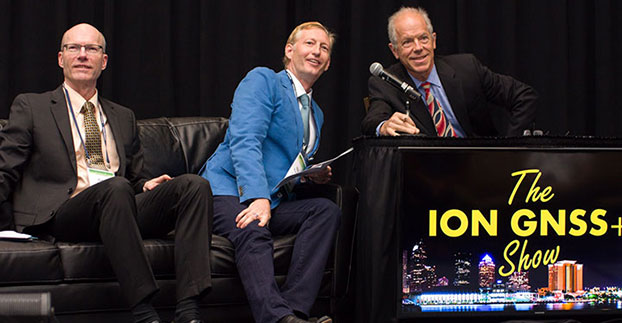
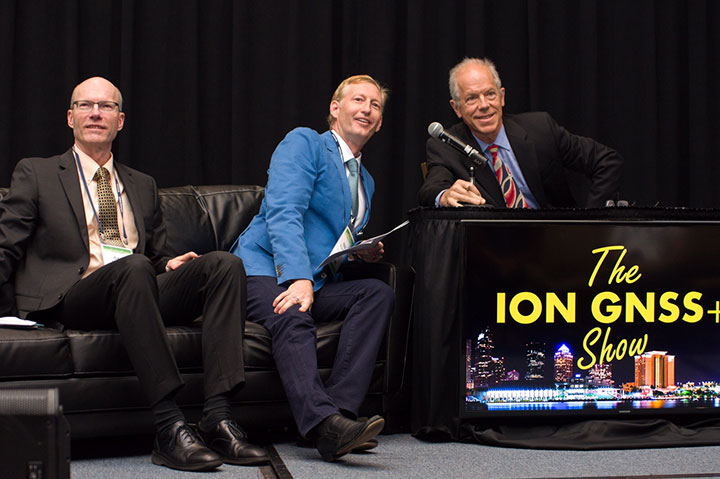
    Alan Cameron, GPS World editor and publisher, interviews Technical Chair Paul McBurney following his lightning presentation. At left is Program Chair Gary McGraw.
    Alan Cameron, GPS World editor and publisher, interviews Technical Chair Paul McBurney; at left is Program Chair Gary McGraw. Each presenter was interviewed for “The ION GNSS+ Show” following a five-minute lightning presentation. (Courtesy of ION)

    Tuesday night’s Plenary Session at ION GNSS+ took attendees to space with a high-flying presentation on NASA’s planetary exploration endeavors by keynote speaker James L. Green, director of Planetary Science for NASA. He touched on most of the planets, with the July fly-by of Pluto by the New Horizons probe the climax of his talk.

    Following the keynote, the ION GNSS+ program chairs shared insights on the topics to be covered at the conference in a lighthearted — and very fast-moving — format. Each presenter had only five minutes to describe their program track. Afterward, they were invited to the set of “The ION GNSS+ Show,” where moderator (and GPS World editor and publisher) Alan Cameron asked them a few questions.

    This year’s conference feature panels of industry experts, policy updates, the world’s largest GNSS commercial exhibit and more than 300 technical presentations presented through both Systems and Application Tracks and Peer-Reviewed Tracks.

    Program chairs who gave lightning talks before joining Alan on the couch, and their topics, were: Paul McBurney, GopherHush Corp., Mass-Market Applications; Sandra Kennedy, NovAtel, High Performance & Safety-Critical Applications; Andre Hauschild, German Aerospace Center, System Updates, Plans and Policies; Zainab Syed InvenSense, Multisensor Navigation and Applications; Olivier Julien, ENAC, Algorithms and Methods; and Grace Gao, University of Illinois at Urbana-Champaign, Advanced GNSS Technologies.


    Planetary Navigation. During his keynote address, Green took the audience on a journey navigating through the solar system. He explained that NASA’s goals are to advance our knowledge of the origin and history of the solar system, discover the potential for life elsewhere, and assess what hazards humans may face in exploring space. First stop was our nearest neighbor, the Moon, which was explored in 2012 by NASA’s Gravity Recovery and Interior Laboratory (GRAIL) spacecraft. GRAIL uncovered the origin of massive invisible regions that make the moon’s gravity uneven, a phenomenon that affects the operations of lunar-orbiting spacecraft. Because of GRAIL’s findings, spacecraft on missions to other celestial bodies can navigate with greater precision in the future.


    Moving on to Mars, Green shared the background and successes of the Curiosity rover, which is still on Mars researching the Red Planet. Curiosity also took a selfie.
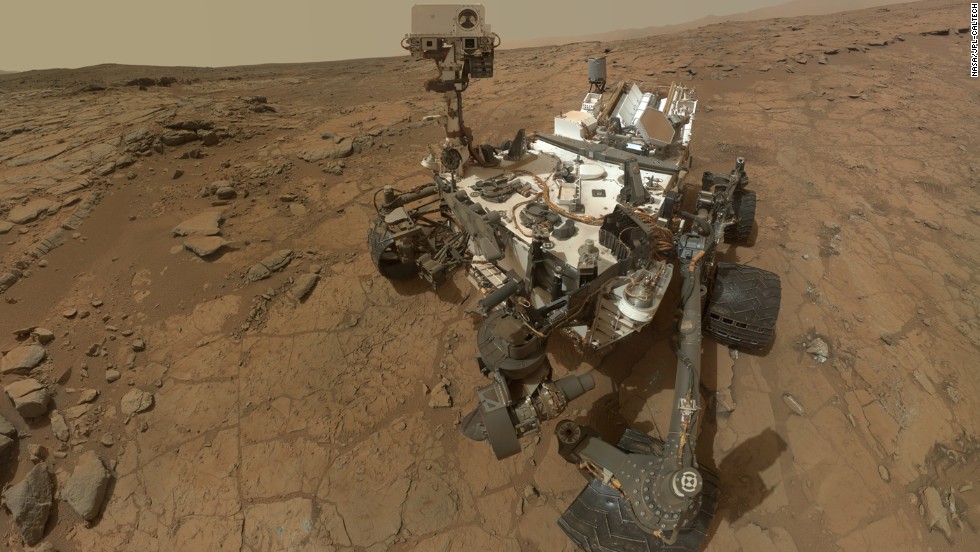
    Curiosity landed on Mars in August 2012 and took this selfie, which is an aggregate of more than a dozen separate images.
    Curiosity landed on Mars in August 2012 and took this selfie, which is an aggregate of more than a dozen separate images.

    Green said Andy Weir’s novel The Martian, which has been made into a movie that will be out in October, is a realistic depiction of what exploring the hostile red planet would be like for humans.

    The New Horizons flyby of Pluto drew several audience questions following Green’s presentation. With an orbit of 248 years, it was a challenge to determine the precise navigation route to the Solar System’s outermost planet, especially when travel at 16 kilometers a second could spell disaster if the probe encountered any space debris — even a particle the size of a grain of sand could end the mission. Mission control constantly reassessed the spacecraft’s trajectory using imagery from the Hubble space telescope and then New Horizons itself.
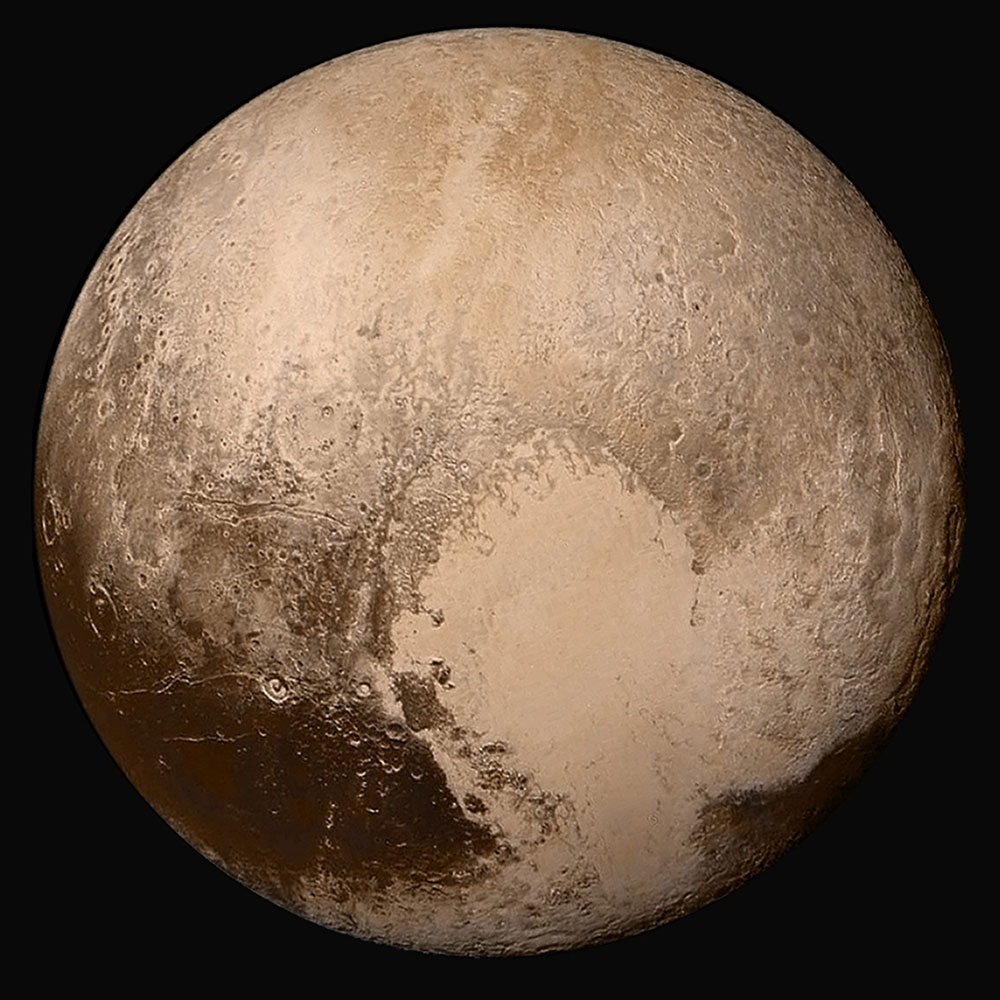

    NASA was surprised to find that Pluto's surface has relatively few craters.
    NASA was surprised to find that Pluto’s surface has relatively few craters.


  • NASA’s James L. Green to Headline ION GNSS+ 2015

    NASA’s James L. Green to Headline ION GNSS+ 2015

    James L. Green, director of Planetary Science for NASA.
    James L. Green, director of Planetary Science for NASA.

    James L. Green, director of Planetary Science for NASA, will take the audience on a journey navigating through the solar system at The Institute of Navigation’s ION GNSS+ 2015 Conference.

    Green’s keynote address will show new worlds and new discoveries through the eyes of NASA’s planetary spacecraft. The conference takes place Sept. 14-18 at the Tampa Convention Center in Tampa, Florida.

    At NASA, Green is responsible for solar system exploration including astrobiology research. Under his leadership, a number of recent planetary science mission events have been successfully completed, including the New Horizons space probe which is scheduled to reach Pluto on July 14, Messenger orbit insertion at Mercury, the launch of Juno to Jupiter, the launch of Grail A and B to the Moon and subsequent orbit insertion, Dawn’s encounter with Vesta, and the landing of the Mars Science Laboratory and Curiosity rover on Mars. He has published more than 100 scientific papers on the magnetosphere of Earth and Jupiter. He has also contributed more than 50 technical articles on various aspects of data systems and networks.

    Green received his Ph.D. in physics from the University of Iowa in 1979 and has worked at NASA’s Marshall Space Flight Center and Goddard Space Flight Center before becoming the director of the Planetary Science Division at NASA Headquarters in 2006. In 1988 he received the Arthur S. Flemming award given for outstanding individual performance in the federal government and was awarded Japan’s Kotani Prize in 1996 in recognition of his international science data management activities

    Sponsored by the ION’s Satellite Division, ION GNSS+ is the world’s largest international technical meeting and showcase of GNSS technology, products and services and brings together international leaders in GNSS and related positioning, navigation and timing fields to present advances, introduce new technologies, update current policy, demonstrate products and exchange ideas.